SteveJ
Community Member
-
Joined
-
Last visited
Everything posted by SteveJ
-
Have some cake to celebrate!

-
Right back at you, Philip.


-
It is best to have all the grounds in place for testing electrical circuits.
-
I'll be on the lookout for this one, too.
-
On my bookshelf. I found it last week.
-
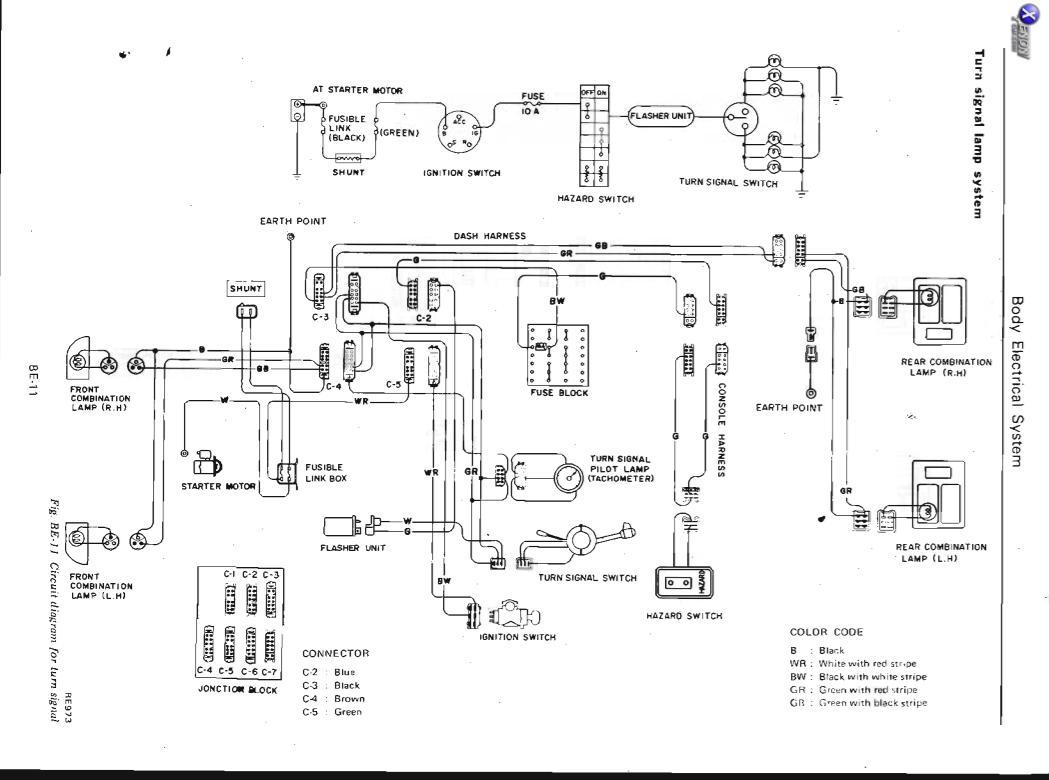
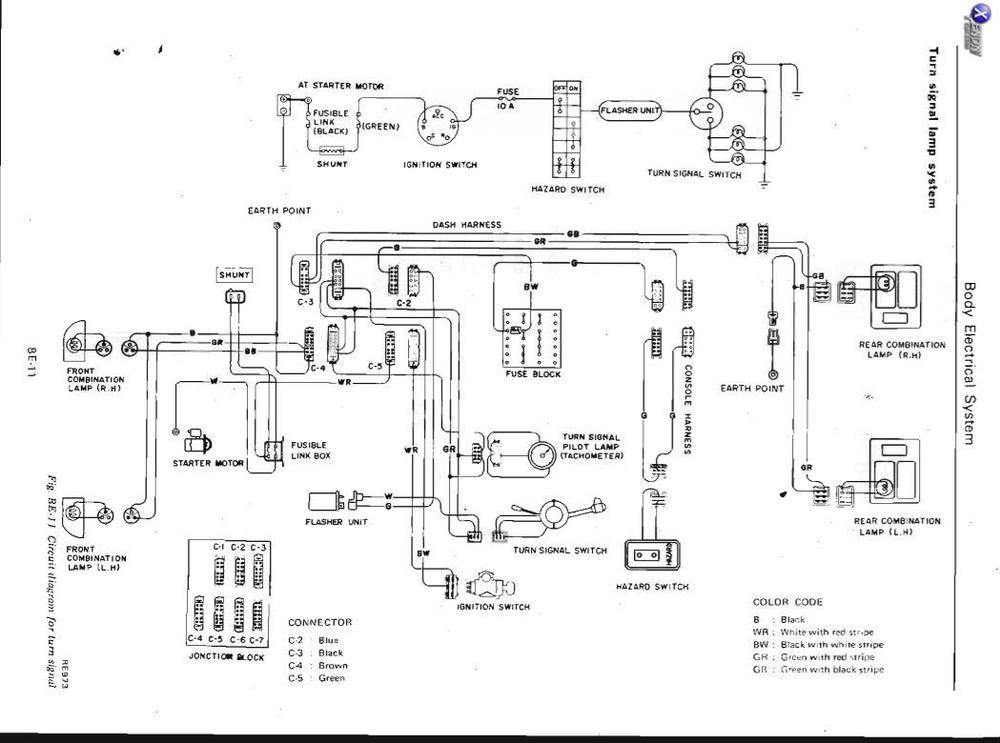
First, the FSM clearly identifies two ground points for this circuit. One is in the engine bay, and the other is by the taillights. They are identified at Earth Point. Let's talk about theory of operation as designed. When the turn signal switch is moved up or down, it completes the circuit for the right or left side respectively. Using a positive to negative flow, we can trace voltage from the battery, to the starter, through the black fusible link, through the shunt, through the green fusible link, through the ignition switch, through the fuse box, through the hazard switch, through the flasher relay, and to the turn signal switch. After the switch, you just have the bulbs, ground, and back to the battery. As current flows through the circuit, the bimetal strip in the flasher relay heats up (power= current x voltage). Due to the nature of the bimetal strip, the heat causes the strip to move away from the contact, and that opens the circuit. The strip quickly cools down, and it makes contact again, heating it with the current flow. So, since you said the blinking speed did not vary with the engine speed, let's break this down into the elementary factors of resistance, current, voltage, and power. The resistance is primary from the bulbs. It can be considered constant. The current that causes the bimetal strip to heat up is voltage divided by resistance. This gives us two things to check in this circuit: The voltage in the circuit: Measure voltage to ground while the turn signals are operating and see if there are voltage fluctuations. Higher voltage would, in theory, give a faster blink rate. The condition of the flasher relay: See if the hazard lights exhibit the same behavior as the turn signals. If they don't, swap the two flasher relays and see if the problem follows the flasher relay.
-
Is the car running? Does the rate of blinking correlate to engine speed? How old are the flasher relays? What modifications have been made to the car? Does it still have incandescent bulbs, or have they been swapped over to LEDs? This has NOTHING to do with the turn signal switch. There is no ground for the circuit at the switch. You should download the service manual from this site. The BE section has some excellent breakouts of many of the circuits, including the turn signal circuit. It helps a lot in troubleshooting.
-
Post photos of the inside of the sockets and the bulbs you pulled out of them. Do this for all the sockets in each taillight housing. Otherwise, all you will get here is speculation.
-
The electric fuel pump was a field modification designed by Nissan and installed by dealers. I don't know if Nissan ever shipped any 73s with the fuel pump already installed.
-
That's why I'm about to turn my SUs into throttle bodies.
-
I registered and commented. The comment was trapped in moderation and never saw the light of day. It was not critical, the slightest bit obscene, or anything that would go against community standards. I thought it was odd that it never left moderation, but I didn't try to pursue why they left it in purgatory.
-
I don't know the secret code to get a comment out of moderation there, either. On the other hand, I only tried once and figured that the moderators don't try or don't care about allowing posts outside of a select group.
-
That means that it is likely that the switch is not being actuated.
-
Put the switch back in, without wires, put the car in reverse and check for continuity across the switch contacts.
-
@jwtaylor I emailed Rick. This was his reply:
-
https://zcardepot.com/products/valve-spring-compressor-tool-l-l24-l28-l16-l18
-
Ignore this. It got to the wrong thread
-
Ignore this post.
-
This will easily fit in the garage, and this is the best price I've seen online. If I didn't already have a lift, I would buy this: https://www.costco.com/QuickJack-5%2c000-LB-Capacity-Portable-Car-Lift.product.100460313.html
-
I found this a few years ago. I think the price has gone up a fair amount since I first found it. https://nostalgicac.com/datsun-240z-260z-280z-compressor-upgrade-kit.html
-
Tom, As I said before, for the EARLY MC, the front reservoir is for the front brakes (disc brakes), and the rear reservoir is for the rear brakes (drum brakes). The only risk about adding DOT 3 fluid is if a previous owner used DOT 4 or DOT 5 fluid, and that is unlikely if the car was not set up for track use. There is one other possible explanation for the loss of brake fluid from the rear reservoir. It could be leaking into the brake booster. Finally, do not just go by the size of the reservoir. They can be swapped. Look on the driver's side of the MC. You should see F and R cast in the body of the MC.
-
Which Master Cylinder do you have? Early Later If you have the early master cylinder, the front reservoir is for the disc brakes (front), and the rear reservoir is for the drum brakes (rear). If you have the later master cylinder, the front reservoir is for the rear brakes, and the rear reservoir is for the front brakes. Note: Some early cars have been modified to use the later master cylinder due to the lack of availability of rebuild master cylinders. You'll need to look at the path of the brake lines to verify. If the reservoir is low for the rear brakes, I would inspect the wheel cylinders and brake lines for signs of leakage.


-
You'll have to change the connector on the 1977 voltage regulator. You will have to compare the wiring diagrams to set the pin-outs for the new connector. The proper connector can be found at http://www.vintageconnections.com
-
This is one of the more important things: When did it last run right, and what did you touch between then and now?
-
Philip, there isn't a seatbelt interlock relay in the 73 like the 74. Is the car going through an automatic to manual swap?