
Zed Head
Community Member
-
Joined
-
Last visited
Everything posted by Zed Head
-
Earlier I was going to suggest that he could probably make the car pass just by tweaking what he has. And he might still be able to do that, As he figures out what he has and how it's supposed to work he'll probably also figure out how to make the oddball parts work. Eve if he finds all of the original parts he'll still have to understand how they work. There's really not much to the EFI systems. Fuel pressure, air flow, and timing (cam and ignition), are the biggies.
-
I was guessing on the switchover, either 77 or 78. But I know that 78 had the webbed. Also, there's no serial number on the engine bay plate in 1978 so that won't help him ID his engine. I thought he might have a 79 ZX, since the emissions guy wrote ZX on the test paper, but I see the 280Z access door on the side in his pictures. ZX's didn't have those did they? He has a blend of parts, some not even Nissan, like the FPR and the header. We can all guess away but really, he's going to have to dig in to each part to see what he has. Look at what CO ended up with and his engine looked factory stock.
-
No offense Dave, but I think he needs to consider the whole system before doing too much else. Here's another possibility for the low pressures - the FPR diaphragm is blown. He could spend a lot of time getting the pressure back up just find that the other parts are wrong. He is far away from the delicate tuning, he has major things going on. Different methodologies. I would ID and catalog all of the critical parts first.
-
Check the injectors. Take a closeup and post it. It might have turbo injectors. Also, check the kick panel by the left of the driver's leg. Make sure the stock ECU is there. Who knows, it might have Megasquirt or one of the other aftermarket systems. Know what you are working with before you get carried away. The engine has had a lot of modifications done but that doesn't mean it's hopeless. The key is to be systematic and persistent. You don't have a one-shot fix ahead of you. On the plus side though, it's a great opportunity to learn about how EFI and engines work. It's a classroom in an engine bay. Good reason to buy and learn new tools. The fundamentals you need to work on these engines work everywhere in life.
-
Filling and draining might be a waste of fluid and money. If it works well from the beginning then it's probably fine. I had one that had sat for quite a while, there must have been rust on the cones because it was very grabby when shifting, the synchros weren't working right. It took a while to wear back in after I finally tried a funky Swepco/ATF blend to use in it. But it was great once it got a few hundred miles on it. Maybe start with a cheap throwaway fluid to purge any rust particles then fill it with Redline. Don't abuse it just run it through the gears until it stabilizes then switch to the spendy fluid.
-
Hey Mike, that is a ZX distributor, probably 79-about 81, with the E12-80 module. It's a nice and effective way to get high energy ignition, if you can find a distributor. They're getting harder to find since they are are all remans now. The ZX distributors weak point is the bushing for the center shaft. It wears then the teeth of the rotor and starter contact and things break. Check the play and you might be able to replace it before it goes.
-
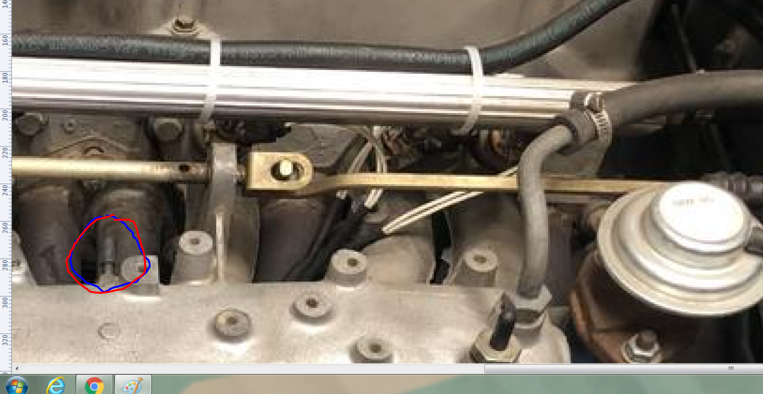
Pretty sure it's this one, circled in red and blue.
-
I notice a few other things now in the picture. It has the non-webbed intake manifold which came on 75-76. So that's a clue. You should probably check the cam shaft to see if it's stock. Check valve lash while you're there. Give it a good tuneup, back to stock specs if you can get there. Get a piece of hose and connect that FPR vacuum port while you're watching the gauge. Don't try to do a tuneup without the vacuum hose attached and the FPR adjusting normally, the EFI system is designed around it. It is a critical component of the system.
-
Just noticed that you're kind of mixing timing with dwell with point gap. Your distributor definitely seemed to be off, which would affect ability to set timing. But dwell is a function of points gap. Not really sure what "eccentric screw" means either. Not a biggy, just makes you wonder.
-
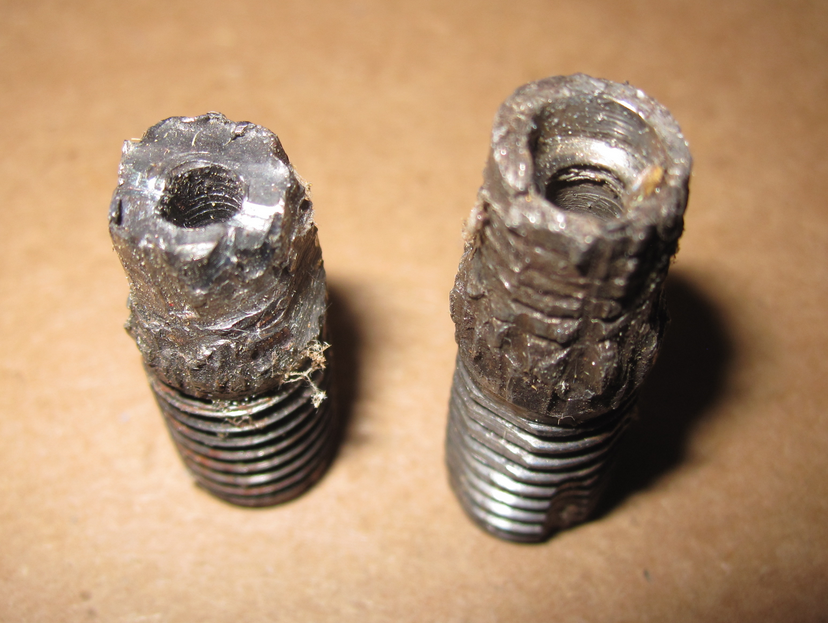
Run the bolts in to their holes without the head and measure the distance from the bolt head to the block. If it's less than head thickness it's as good as it needs to be. In manufacturing, precision and accuracy cost money. There's no purpose to having all of the bolt holes the same depth so that spec would not be set that way.
-
The numbers aren't really that bad. It only takes a few misfires to blow them up, you're actually within simple tuning range, i think. Are you sure it's not a 79 280ZX? The emissions guys might have used the build date as the model year. The AFM to manifold hose looks more ZXey than Z. Not sure. There should be a sticker on the door jamb or under the hood that says "CATALYST" if it had a converter. Look for that. Did the visual inspection include the EGR parts? How do you know the gas cap failed, do they test that? Lucky for you guys though, new caps are available for the unleaded style filler necks. Find them on the internet. The PCV system has been disconnected also, which tends to dirty up the oil with gasoline vapors and combustion byproducts. You can reconnect it. It has a lot of the "get rid of emissions junk" mods done that cause problems for people.
-
Check the front cover carefully. It has coolant on one side and oil on the other. A crack or hole could cause your problem. Also, check the thermostat housing and its bolts. One of the bolt holes is a through-hole in to the cover, behind the chain guide. Many timing chain guides have scars on the back side from using a too-long bolt in the T-stat housing.
-
Have you tried the crude but effective "fuel pressure gauge hanging out of the hood" method. Real-time pressure readings will tell you if the filter is clogged.
-
Compensator would be a better word for it.
-
You're not justifying your statement. Explain why. You're asking questions because you don't know then correcting people like you're an expert. Explain how your finger moving the throttle blade is different from the spring moving the throttle blade. You shut the blade with your finger, a stronger spring could do the same. Sorry, but you shouldn't comment on people's attitudes. Calling someone cranky just leads to more crankiness.
-
No offense. But there's no target to shoot at... Your posts are full of distracting information, then you say "I already checked that" when people make suggestions. "Please understand"? You came here asking... Seems like you're trying to make sure that only you find the solution. Good luck.
-
-
-
-
So, actually two of them are sticking. One thing that happens when the throttle blade is partially open is that any ported vacuum holes will open up. They are typically right under the edge of the blade, Blocked when the blade is closed, pulling vacuum when the blade is open. Usually they are meant to actuate some other valve, and not have any actual flow through them. Just supply vacuum, no flow. It might be that you have the ported vacuum ports open to atmosphere and the blade balance gets screwed up because of it when the blade is partially open. Short - check your ported vacuum ports and see if they're open when they should be sealed to a separate device. I don't even know if those carbs have ported vacuum ports but most do, since that is how ignition vacuum advance is often controlled. It might be labeled as "ignition vacuum advance port" on a diagram. Edit - also, if they are connected to the distributor vacuum device the advance diaphragm might be blown, allowing a leak.
-
I confess, I didn't watch the videos and didn't really absorb everything you wrote. Certain types of videos don't play well at all on my old computer and I didn't want to download it. A youtube link is better, youtube videos play well for whatever reason. Plus the videos are too close focused they should show all three carbs at the same time, and the angled view is not pleasant. No offense, they're just not good movies. 25% Rotten Tomatoes.. But, like jonbill said, it seems like a simple extra or stronger spring, maybe on just the sticking center carb, would do the job. Why make it more complex? I think that CO has pondered how the vacuum effects the backside of the blades, top versus bottom halves, if I remember right. A sticking EFI throttle blade. Same concept. He might have some thoughts. @Captain Obvious
-
Put the block number and type of block in your title. And post a picture of one, as example, so people know where to look. Many people aren't aware that the engine's have a serial number. Edit - I meant post a picture of the serial number on the block.
-
No offense intended to the guys with the problem but buying a new manifold to fix a linkage problem makes little sense. There are three throttle blades and linkage to make them work together. If the blades aren't sticking it's the linkage. If a new manifold works it's because it came with new linkage.
-
And...if you really want to go an extra step for reliability, get an aluminum fuel rail. These engines typically have heat soak/hot start problems and that is one thing that seems to really help the problem. Very little worse than getting in to your car after 20 minutes in the store, with people watching and wondering about the cool little sports car, just to sit there for 30 seconds that seem like 30 minutes while the engine coughs and pukes until things cool down.
-
Most of the adjustable regulators lost pressure rapidly after shutdown. It's very annoying, people spend hours diagnosing hard start problems and end up replacing their regulators to one that doesn't leak down. If you find that you need more fuel to the injectors it's better to add resistance to the coolant temperature sensor circuit. Short - a good OEM style regulator will probably work best. While you're on it though, replace all of the rubber fuel hose, especially the high pressure side. Even back at the fuel pump. They dry up and crack and split longitudinally and will probably leak. Plus they're not designed for ethanol fuel.