
Zed Head
Community Member
-
Joined
-
Last visited
Everything posted by Zed Head
-
Sorry, I got distracted by the California comments, thought you were in CA. Looks like you're in PA. CO would know the laws there. I don't see the EGR valve on your engine either. Just looks like a dirty old 75 280Z, very nice and clean. Good luck.
-
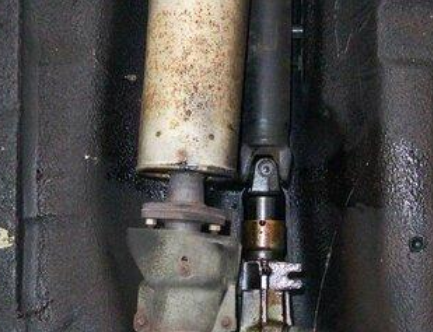
This looks like the Nissan (anti-) resonator. Doesn't look like it ever had a converter, so it's federally legal, and are you sure that you have to get one? Looks like you don't even need to get tested. 1975. Wrong below...wrong state. https://www.dmv.ca.gov/portal/vehicle-registration/smog-inspections/

-
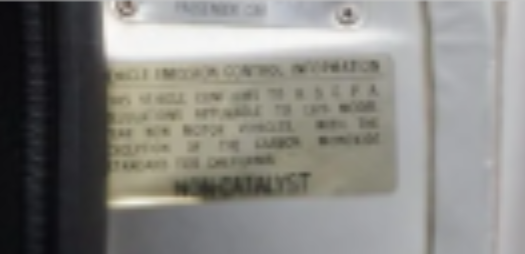
Here's the best picture I could find on BAT, from a 76. "Non Catalyst". https://bringatrailer.com/listing/1976-datsun-280z-59/
-
Cars that came with a converter have a sticker on the door jamb that says "Catalyst" or "No Catalyst". Not quite the right word, but it's what they used. I had to point it out to the guy doing my emissions testing in Oregon, while he was looking underneath for a converter with his mirror.
-
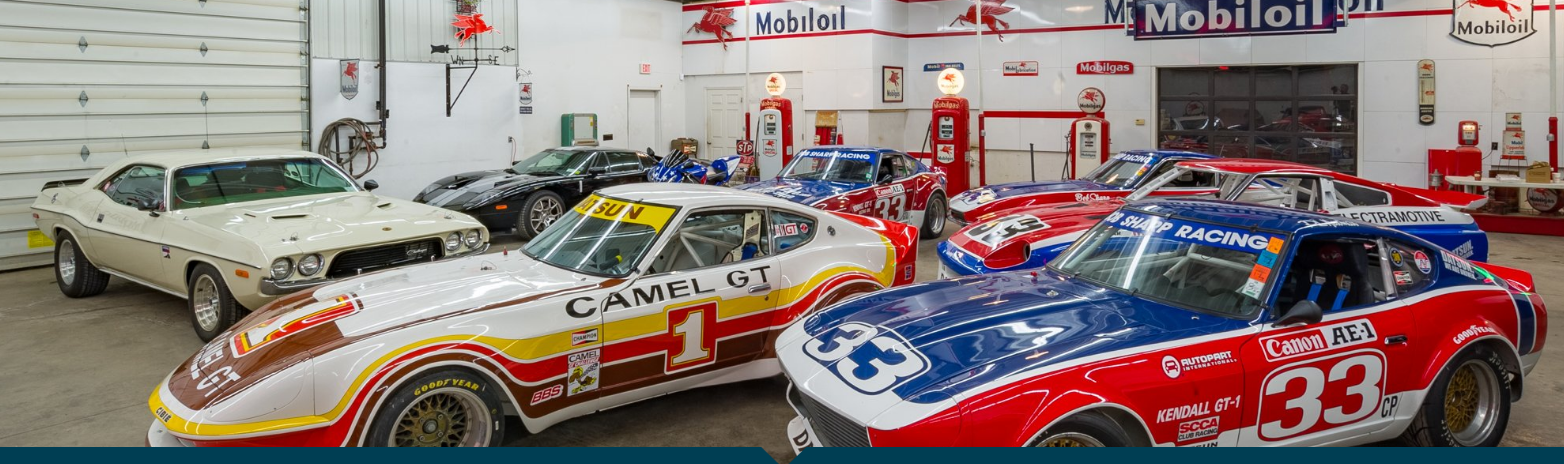
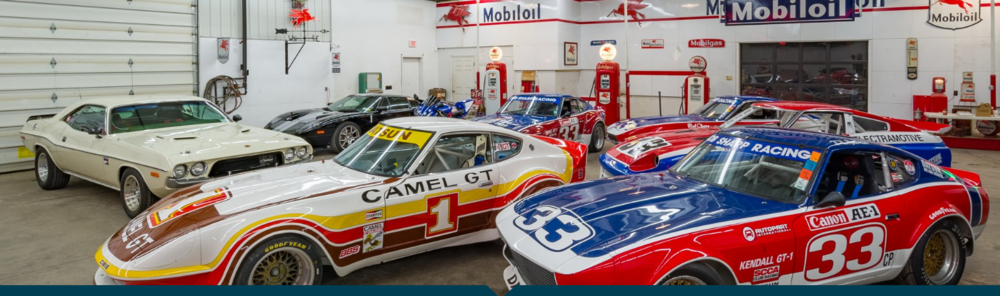
There are two 33's in the picture. Some other interesting Z's and a ZX too. The eBay ad is just free promotion. https://datsunracecars.com/
-
Here's more from Alan Robbins. http://www.zhome.com/History/sharp.htm
-
It has past damage...
-
Contact cleaner is made for it. Looks like a 74 260Z so it has the voltage driven tach. Yes, 2.2 kohm is right. You should still have the resistor on line, it's black and has two bullet terminals. Edit - just remembered that the 260Z resistor looks different. Very primitive looking. Probably wrapped up in tape. CRC looks to have a nice one. Cleaner and protectant. Hardware stores usually have some, maybe an auto parts store.

-
There are only two wires. One ring is bigger than the other. Some pumps are set up so that they only fit the right way. They usually put a + and a - on the terminals. If you have a meter test the wires first. Pretty sure green with white stripe is positive. The black one should be continuous to ground. Meter.
-
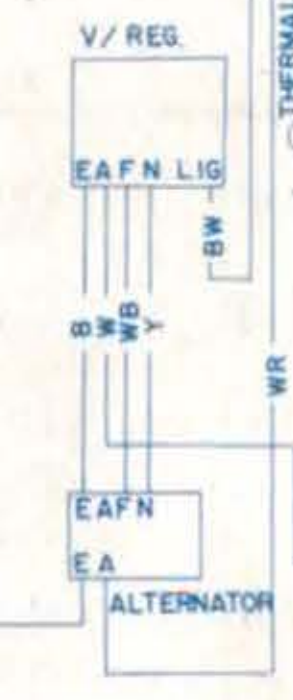
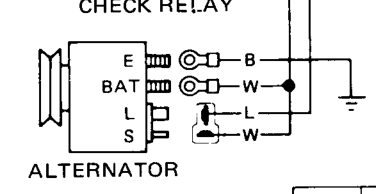
Top of the T which would be the (S)ense wire which would be the N wire which would be the yellow wire from the car harness. Bottom of the T would be the (L)amp wire which would be the (F)ield wire which is the B(L)ue wire which should go to W/B on your car. Top of the T goes to yellow. (Probably green in your picture). Vertical of the T goes to W/B. (Probably yellow in your picture). You took the picture in such a way that I can't be certain which is the top and which is the vertical. Your initial thought seems backwards. Also, where is the special conversion plug to allow an internally regulated alternator?
-
There's quite a bit on the site about lightened flywheels and the Fidanza flywheel. The Fidanza is a light flywheel and it is drilled for either 225 or 240 mm clutches. Can't remember all of the people that have posted about the topic but @siteunseen and @EuroDat come to mind. Your cam is probably not as radical as you think it might be. No offense.
-
Looks like just another way to get the word out. Somebody is selling a collection. https://datsunracecars.com/

-
Weird that your mechanic's gear tooth counts don't seem to correspond to anything. Oh well. Going back to your original questions. A Fidanza flywheel would let you use a 240mm clutch, which should handle your power (it's the turbo and 2+2 clutch size). The Subaru diff is an R180 which might handle the power just fine but the MFactory helical diff will fit an R200 and give the same effective results in a stronger package. But, if you want to get rid of that 3rd gear bog, maybe a ZX 5 (not 4) speed is the way to go, with a 3.9 R200. Find an old ZX to buy and scavenge from. At least you know what have now for the most part. Good luck, carry on.
-
It can't be direct drive and overdrive. Just saying. You can check pretty easily with the rear wheels in the air. The direct drive gear will cause the propeller shaft to move exactly in unison with the crankshaft. Put a wrench on the crankshaft and a marker on the propeller shaft and see what happens when you turn the crankshaft.
-
The math still comes out different than your list. There's a good thread on Hybridz where a guy spent a lot of time building the perfect transmission. Synchros, ratios, everything. He found that many of the gears can be swapped to build your own custom transmission ratios. Or maybe your mechanic just missed a tooth when he was counting. That is a pretty high, like high speed, 1st gear. Not a lot pull from a stop. "Zero gear" - 31 / 19 = 1.632 First gear set 33 / 19= 1.737 Result - 1.737*1.632 = 2.83
-
But wait (of course) you seem to be right in that there is a 5th gear direct drive. Changes everything. https://www.zcar.com/threads/nissan-competition-5-speed-direct-drive.304300/
-
Found another video that's pretty good. Your first gear would be 2.45 by the tooth counts you showed. I'm calling the gear set the zero gear set but I'm sure that there's another name for it. Can't remember. It's confusing because it is the "4th" in the transmission but has nothing to do with 4th at the shift lever. "Zero gear" - 31 / 22 = 1.409 First gear set 33 / 19= 1.737 Result - 1.737*1.409 = 2.45
-
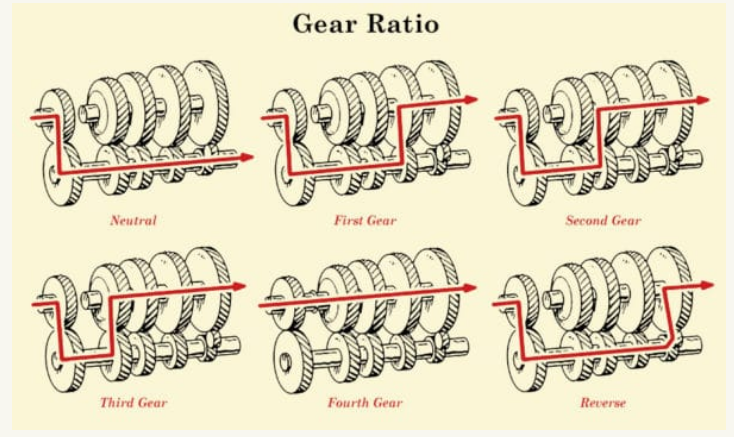
I fumbled around with some ratio calculations and your gear teeth numbers come up more like a very close ratio competition transmission. Not a 3.321 first gear. Fourth is always 1:1 on the Nissan transmissions I believe. Tried to find a calculator to make it easy but had to go back to basic math. One hard part of understanding the calculations is realizing that "4th gear" is not really a gear ratio. It's direct drive through the shaft. And, the gears that are called fourth gear are really just the gears that start the power flow through the gear set. They're not really 4th, more like zero. They are part of the ratio calculation for every "gear" that transmits power through the countershaft. Found some illustrations. https://www.artofmanliness.com/skills/manly-know-how/gearhead-101-understanding-manual-transmission/
-
I don't think that you really know what your ratios are. No offense. Unless you have tiny wheels. The black gear is the 3.54 gear so should give the correct speedo reading. I don't know that the "Nissan comp steel synchros" has standard 280Z ratios either. The ratios you wrote look 280Z but I don't know that there is a "Nissan comp" 5 speed like that. What would be the point? No offense, the numbers just don't fit together. You said you'd like a bit less RPM at highway speed but then said a 3.9 diff might be good. That's going the other way if you really do have a 3.54 now. Also, general warning, beware of California Datsun purchases. His track record is poor.
-
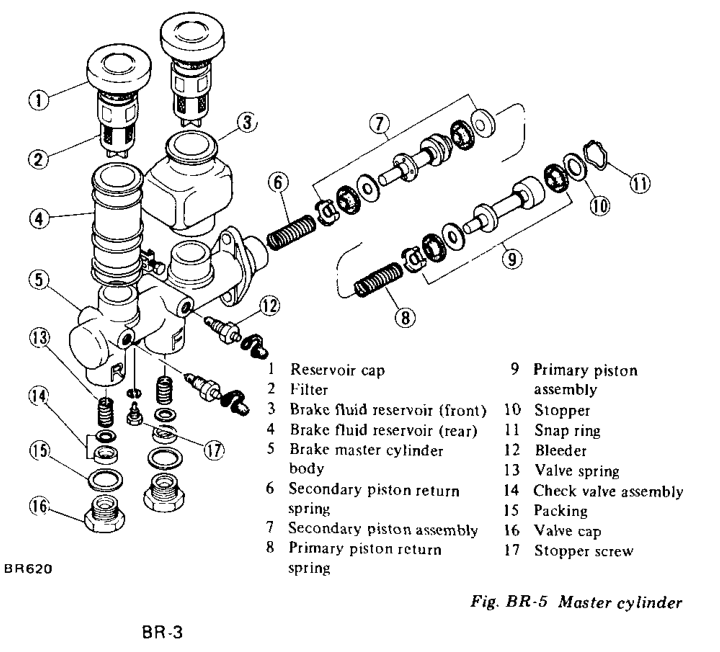
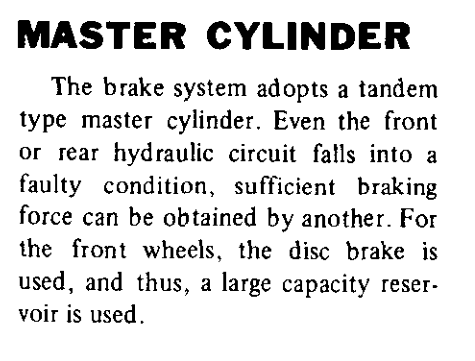
p.s. And, just because others, apparently, use a residual pressure valve on mixed drum and disc systems it doens't mean that Nissan did. Despite the extensive descriptions that Nissan put in to the brake chapters, the only mention of a difference at the MC between front and back is about the reservoir. The closest thing to an RPV is the check valve that they show. But there is one on each side and they look the same.
-
Thanks for posting the jalopyjournal page, that was a good read. I didn't actually absorb the whole of the page two of the Wilwood pdf. It was kind of contradictory, with saying only use it for drums, remove it for discs, then put it back in for discs if the MC is lower than the discs. ??? The jalopyjournal discussion is a lot like this one, with many different views, not all of which seem based in actual knowledge. It does seem to show though that there is a reason for an R and an F, and they do differ due to pressure reasons. So hydraulics do come in to play. Seems like it would only be for pedal feel though. Maybe balancing the contact times between shoes and pads, and/or reducing the pedal travel. So F and R do matter, for reasons not clear, therefore, also, importance is not clear. But, since it is a hydraulic matter, if releasing the pressure at the cylinder of the sticking wheel doesn't unstick the shoes in the single drum, then F and R is not the cause of the sticking. I learned something new. It would be neat to put a pressure gauge at the ends of the lines just to see how much residual pressure is maintained. And how long.
-
At 28 seconds
-
Probably right, for when you're climbing those really steep hills. Good luck. " If the master cylinder is mounted lower than the disc brake calipers, some fluid flowback to the master cylinder reservoir may occur, thus creating a vacuum effect that retracts the caliper pistons into the housing. This will cause the pedal to go to the floor on the first stroke until it has “pumped up” and has moved all the pistons out against the pad again. A Wilwood in-line two pound residual pressure valve, installed near the master cylinder will stop the fluid flowback and keep the pedal firm and responsive."
-
I have. The AFM worked fine though. Notice that the ratio is still 1.8, just like if you had 180 and 100. I don't really know how the AFM works so can't say if that means anything.
-
So that means the MC "issue" is just the fact there's an R where an F is expected. One reasonable explanation for the F and the R is that it makes it easier for the people assembling the cars to put the big reservoir on the right spot. The real discussion might be why they decided to switch the reservoirs. Maybe a decision was made to switch the reservoirs and the switching of the lines followed, logically, but had nothing at all to do with how the stacked hydraulic pistons operated. Anyway, if you're restoring it or you're going to be at car shows, then making it look right is probably worthwhile. Otherwise you'll spend hours talking about F and R instead of the other cool things. I only chimed in here because you implied that the previous owner did not know what they were doing, when they might have actually known exactly how things worked and decided it wasn't worth messing with.