
Captain Obvious
Community Member
-
Joined
-
Last visited
Everything posted by Captain Obvious
-
You and me too, my friend!! I wish we could spend way more time together. Maybe next time, it'll be at your place.
-
Yes, you want to bend the arm you have labeled #2. Leave #1 alone. So by moving the actuation spot, you were able to get it out to about 3/4 full pedal? That's significantly farther then stock. Good luck with the numbers run. Hoping they look great across the board!
-
That is exactly what happens if the key slips out of place when you install the damper. The key rocks the wrong way in the slot, gets jammed in there, and if you keep pressing and force the pulley on anyway, it cracks the brittle cast iron pulley. Since some dampers are really hard to get onto the crank snout anyway, you might not even notice the force required to get the pulley "home". If you use the large bolt through the middle to jack the pulley into place, you'd never know. And (as it sounds like you found out) it won't necessarily affect the running of the engine like that. If the pulley slips, it will screw with the timing marks, but if it's timed correctly, you may never know. So if your PO did that and timed the engine when he put it together, it may have been like that (seemingly just fine) since then.
-
Cool. I switched over to a cable actuation a couple years ago and I've been considering doing the same thing Nice to see pics that prove it works! I like it! I should do that!
-
Numbers look good. Let's just hope that when the WOT contacts are back in the picture, it doesn't mess things up. Hopefully you'll be able to bend the WOT out of the way far enough so it doesn't interfere with your cruise numbers. I was thinking about it just a little more, and another relatively simple idea would be to mount a new WOT switch somewhere else on the system if you needed to. That way you could adjust where the WOT actuated independent of the idle switch. (or vice versa... install a separate idle switch, etc.)
-
I don't know what the original bolts looked like on the earlier cars, but I can confirm from tearing down a couple later cars, the bolts pictured above were used on the ZX motors. Don't know when they started, but I can confirm that's what they ended with. Flange heads and no separate washers.
-
Not a chance. We already talked about this.... I'm not getting pulled into a carbon fiber layup project.
-
Well, another idea... I have not looked into any of the details about the actual circuit that performs the WOT or idle enrichment. The rest of the ECU is a black box of analog voodoo magic, and there's no reason to believe the enrichment circuits are anything other than more of the same. And because of that, there exists the possibility the amount of enrichment may actually be able to be adjusted by controlling the amount of resistance between the contacts. In other words... The system normally works using two different resistance values - zero and infinite. Zero when the switch contacts are closed, and infinite at all other times. But what happens if you use a different value for when the switch is closed. Say 1K Ohms and infinite instead of zero and infinite? If you put a resistor in series with the WOT contacts maybe it will still actuate the WOT enrichment, but not by as much as when it sees 0 Ohms? You could try that at idle to see what happens. Compare what the A/F numbers do with 1) the WOT switch open, 2) switch closed, and 3) switch closed with some resistance in series. Just a thought if you wanted to give it a try.
-
Great input. Your findings with the WOT contacts are exactly what I meant with my #3 theory: 3) I think the WOT contacts close too early and the car runs too rich when they do. It's clear from studying the system that the WOT contacts close long before you are actually at WOT. And that's why I was theorizing they closed too soon. But when gas is cheap, emissions standards are loose, and you want to sell sporty cars, you would err on the side of burning some extra fuel instead of the opposite. So going up a hill on the highway closes the WOT contacts. So what? It's just a little more gas. Butterfly valves (like the throttle plate) are way way non-linear, so even though the plate isn't completely horizontal when the WOT contacts close, I was thinking that maybe you were pretty much there as far as max flow goes. But your A/F readings show that may not be the case. So what are the alternatives? First alternative I got is the simple one... "Do you really need it at all?" By that, I mean... Can you tune the rest of the system such that the idle looks good, cruise looks good, and WOT is rich enough even without ever closing the WOT contacts? If not, then the next alternative is what you already mentioned... Bend the WOT contacts as much as you can to delay the closing of the contacts. But as Blue mentioned, you can only do so much with that. Once the cam ramp is over, it's over. And bending beyond that will make it so the switch never closes at all. If there's still not enough adjustment there, you may want to play around with different cams. That part should be a breeze for someone with a 3-D printer to whip out. Small and not particularly accurate. You could make a custom cam with more rotation between idle and WOT.
-
I suspect the reason for the change in your numbers are simply from different engine temperatures. If you tuned it all nice and warm and then shut it off and now you notice that the numbers are way different on a cold start, I bet that's what's going on. I talked about it a little in the TPS thread, but to bring some of that here as well... I don't think you can apply any meaningful info to the WOT setting of the switch unless the engine is under load. I haven't connected an A/F gauge to my car, but my seat of the pants "feelings" about the Bosch L-Jet system after messing with it some: 1) The slope of the enrichment from cold to warm is too steep. In other words, it's too rich when cold. You could set it "correct" when cold, but then it'll be lean when warm. 2) The impact of the air temp sensor in the AFM is too high. Sort of the same thing as above. When the incoming air is cold, it runs rich. 3) I think the WOT contacts close too early and the car runs too rich when they do. The bottom line is it's an analog system designed in the early seventies when gas was cheap and performance was higher priority. No computer, no feedback, and no tuning features. I think the numbers you were getting earlier in this thread are fantastic and I think you might be trying just a little too hard with the RCH adjustments of the throttle switch? Set the TPS using the 1400 RPM method, and get idle and cruise working again. Then lets see what the WOT numbers look like. Maybe we can entertain some modifications to the TPS to close the WOT contacts deeper into the pedal?
-
Why isn't the TPS set that way? My guess is that it's not objective enough. All the other methods have something you can measure. "Adjust the TPS so it makes contact at idle, but as soon as you touch the pedal, it opens" isn't something I would trust thousands of tech across the country to get the same. And to add some detail and to what Patcon alluded to (I think)... There's a big difference between 1400 RPM sitting still with no load and 1400 RPM while driving. Sitting still with no load, it really doesn't take a lot of pedal push to get the RPMs up to 1400. The idle enrichment from the ECU not only boosts the idle fuel, but also provides an additional short bump in the fuel delivery just like an accelerator pump would do when transitioning from idle to cruise. Not sure how effective it is, but the documentation says Dr. Bosch put that in there. For a data point, I've messed around with the setting of my TPS a bunch (surprised?) and honestly, I didn't notice any difference. I've had it set where there is some pedal travel before the idle contacts open, and I've also had it set where it's a "hair trigger" just barely making contact with your foot off the pedal and would open if you so much as breathed on the linkage. Didn't really notice any difference in how the car performed. I didn't have an A/F gauge on it though. Might have seen some results if I had that level of diagnostic tool.
-
I just published my book report in that other TPS thread.
-
I took a quick look through some of the docs and there appears to be three methods for setting the switch. First method is the "measure the angle of the throttle valve at which the switch opens" method. Page EF-56 (of the 75 FSM) says the switch should open when the throttle valve reaches about 7 degrees. (Note that page EF-57 of the 77 FSM says 4 degrees). Second method is the "measure the gap between the throttle linkage and the throttle stop" on the throttle body method. This method is described on page EF-62 (75 FSM) and EF-63 (77 FSM). They say this is how you adjust the switch if you have the throttle body loose on a bench and are replacing the switch. I don't know why they didn't employ this method all the time? Maybe because it's difficult to do with the throttle body on the car? Third method is the "raise the RPM to a certain level and set it so that's where the switch opens" method. This method does not seem to appear in any of the FSM's, nor does it appear in the 76 version of the FI manual (the "FI Bible"), but it DOES appear in the later (1980) version of the FI manual. Pages 126-127 of the 1980 FI Bible say to raise the idle to 1400 RPM and set the switch there. Most notable is that the 1980 FI manual ALSO mentions the "measure the gap" method, but says you should only do that when you can't use the 1400 RPM method. They say the 1400 RPM method is the "preferred" method. Looks to me like the 1400 RPM method superseded the previous methods? I guess I would use that if I had to? That's the results from my book report. Then I went downtown. To look for a job.
-
Hmmm... Nothing like a well thought out follow-up question to get you to fill leaky holes in a previous opinion. Haha! If I were selling a 240Z, I guess it would come down to the condition of the rest of the car and if I considered it "collectible" or not. If I thought the car had solid standing as "original", then I could value the original factory equipped transmission higher (regardless if it were a 4 or a 5-speed). By that, I mean if someone could unquestionably prove that transmission was bolted to that motor left the factory in that car on day one, then I would probably consider that trans as having collector "originality" value. But only if the rest of the car supported that situation. If the exterior had already been irreversibly changed (fender chopped out and flares added, spook instead of original front, etc) and the engine had been changed (someone swapped in an L28 but kept the original trans) and the interior had been irreversibly changed (roll bar), then having the original transmission would mean little to me. In that situation, I would NOT mention the trans being original in a for-sale ad. Unfortunately, I'm not in a position to purchase a collectible 240Z. Now that the prices are rising so quickly, I guess I missed my opportunity. And since I won't be buying one, I guess I won't be selling one. "Driver quality" only for me, and the transmission thing is low on the list.
-
No, thankfully I have never done a roof replacement to get rid of a sunroof. I've seen a couple people here on the forum get involved in that, and their (unpleasant) experience is what has driven me to put that so high up on my list. I'm with you... I'd much rather do a trans swap than deal with that!! Hmmm... Maybe I should move sunroof up even higher.
-
So I changed up my order just a little bit. I moved the chopped-up rice rocket to the top of the list. Why? Because at that point, it doesn't matter to me if it's clean or rusty, I'm not interested. If it's been chopped, tubbed, flared, whatever, beyond being able to be put back stock-ish, then I don't care how clean it is. I just can't. Oh, and I put in a line for sunroof and auto trans. Four-speed vs. five-speed is still #374
-
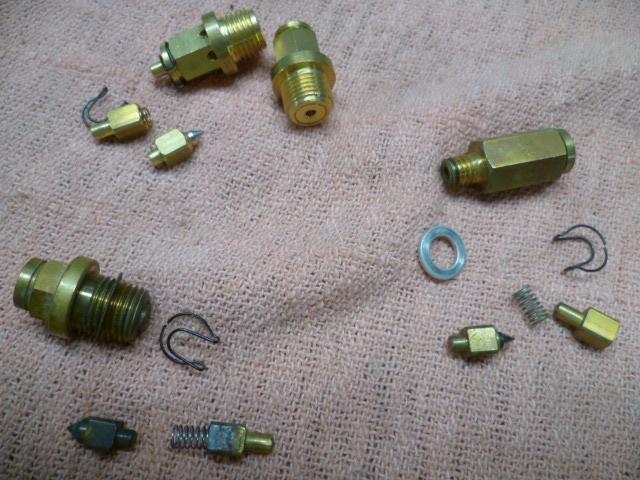
Gotcha. Here's a pic of some float valves where you can see the guts. There are a bunch of different styles floating around out there made by different manufacturers, but most of them are the same concept. It's been many moons since I took that pic, but I think the ones at the top are aftermarket flat-top, the one on the bottom left is OEM flat-top, and the one on the bottom right is OEM round-top: Not claiming that it's an all inclusive list, but I've seen sticky valves from: 1) rubber tip turned to gooey gum from incompatibilities with today's fuel 2) corrosion on the brass bits (note some of that starting on the one in the lower left of the pic) 3) broken spring 4) Crud built up inside the valve interfering with the movement of the guts 5) insufficient fuel line pressure to overcome the cracking pressure of the valve In any event, happy hunting and I'm glad you found the smoking gun!
-
Yeah, that's not a new issue. The two choices are trim the bushings down, or jam it the heck together by compressing the urethane. Putty knife comes to mind... I don't consider either of those a fantastic solution, but given those two, I would trim just enough off the bushings so that jamming them together doesn't make you wince.
-
Cool! Glad you found the root cause. So this sort of thing SHOULD have shown up on a bowl level check, but I'm guessing you never had the bowl sight glasses attached at the exact time the problem occurred? Also, do you know WHY the float valve was sticky? Is it something inside the valve itself, or is it friction between the float tang and the valve stem? That could be valuable info.
-
I'm certainly no expert on the collector value thing, so keep that in mind, but here's my thought on the matter. Here's my quick list of what I would look for when buying any Z, including a 240Z: 1) Has it been molested into a rice rocket JC Whitney abomination with fender flares, lowered, RB motor, fender mirrors, roll cage, fuel cell, go-faster stickers all over it 2) Rust 3) Rust 4) Rust 5) Does it have a sunroof, or is it an automatic 6) Rust 7) Rust 8) Is it a half finished torn apart molested project mishmash of different cars and years 9) Rust 10) Does it run and drive. At all 11) Rust 12) Does it have an interior. At all . . . 374) Does it have a 4-speed or a 5-speed. Like I said, I'm no expert, but that's my list.
-
I've found problems with the on-line compression ratio calculators, so I'm not confident in the numbers you mentioned. I've done a little work on my own calculator and I come up with 8.3 for an N42 with dished pistons and 10.25 when used with flat tops. If you're really wanting accurate numbers, let me know and we can get into it here in the thread.
-
Jeff, Please don't tell us any more details about what went in the dumpster. I (and probably lots of others here) really just don't want to even think about it.
-
How many joints in a lid?
-
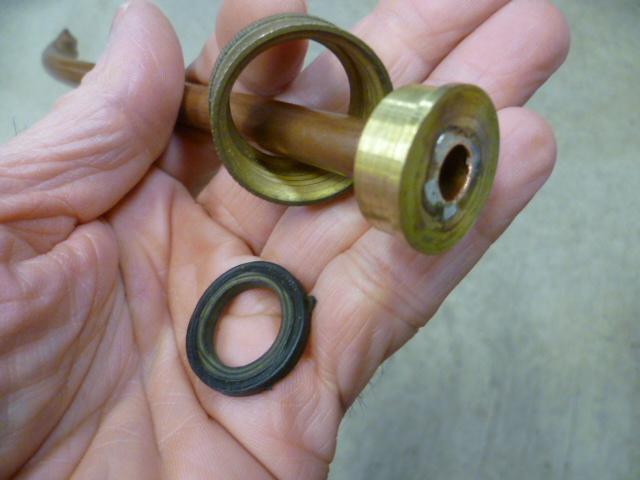
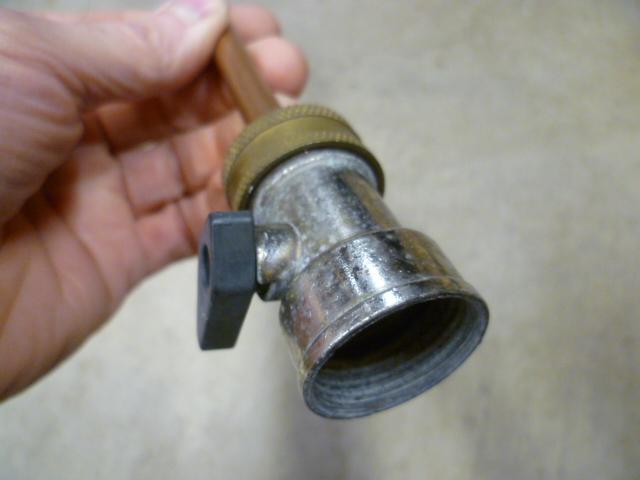
That stove top stuffing is probably remnants of someone using one of those products that is supposed to stop leaks. I didn't have a pressure washer, so I made a little garden hose blaster instead. Of course, a real pressure washer would have been more powerful and presumably more effective, but it's what I had access to at the time. With "standard" household garden hose pressure, my contraption will shoot about thirty feet, so it's not bad. Cobbled together from stuff I had laying around. Looks like this: Here's the business end. I just crimped down the sides in a bench vice. Very scientific like: Soldered a piece on the end to adapt to a hose: And put on an in-line hose valve: It's small enough that (with the freeze plugs removed) I could reach up inside the block and around the piston jackets into the dark recesses.


-
That starting time on the Z is perfect. One final thought on the matter. I once used an ebay purchased cheap-O in-line check valve and it didn't last. Worked great for a month or so, but then the internal seal started to curl and wouldn't seal anymore. Presumably from incompatibility with ethanol in the fuel? In any event, the point is... If you used a el-cheapo valve, it should get you through this current transport move situation, but don't assume it'll last for years. And good luck with all of the new venture!!