Captain Obvious
Community Member
-
Joined
-
Last visited
Everything posted by Captain Obvious
-
-
-
Got it. Yeah, I'd pull the distributor unit off and spin the shaft and watch how it looks when you spin it. Take a look both with and without a rotor installed, and as Zed Head mentioned, also put the rotor and cap on and see if you can hear it making contact inside as you spin it.
-
Is the location (cylinder) that gets chewed up always in the same spot? I'm wondering if maybe the distributor shaft is bent. If you pull it, it would be easy to spin it by hand and watch to see if the air gap changes as you spin it. The air gap should be the same for all positions of the shaft, but if it's not, the shaft might be tweaked.
-
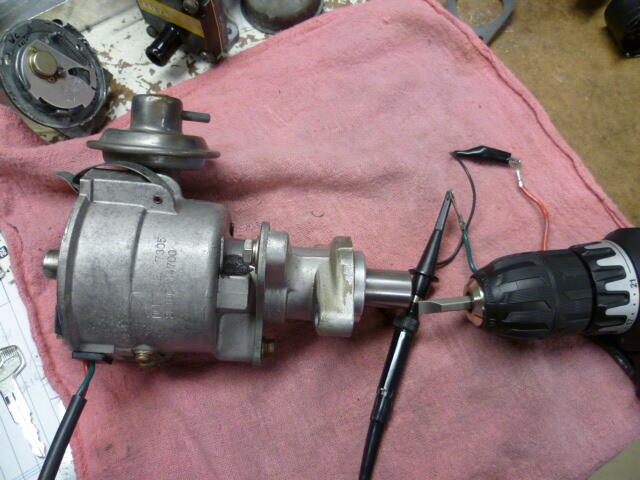
If you take the whole distributor off as a unit, it doesn't change the timing (except for the small amount of play in the mounting bolt holes). By "as a unit", I mean like this. The engagement shaft is asymmetric and only fits one way. You can pull the whole thing and put it back and not change the timing:
-
I'm not convinced that you have an ignition problem. First, you said that the spark at the points is weak and intermittent. My reaction that it "Good. Your condenser is working." In other words, you don't WANT a spark at the points because any spark there will eat up your points. The whole reason for the condenser is to suppress the spark on the low voltage (the points side) of the coil in order to extend points longevity. Don't consider a weak spark there a problem. Consider it a benefit. Second, you say you're getting 8.5 Ohms between the open points and ground. I do not necessarily believe that is a problem either. What you could be measuring is the load to ground of all the other things that are tied to that same B/W wire elsewhere in the car. Such as..... Your fuel gauge, your water temp and oil gauge, the tach, your choke light, etc. I could easily be convinced that all that stuff in parallel works out to your 8.5 Ohms. So... Have you looked for spark at a spark plug? A nice hot spark there would be desirable!! If you have good spark at the plugs, then have you put a timing light on it
-
It's been a while since I've messed with one of those idle mixture screws and don't remember how many turns it takes in order to take it all the way out, but I believe there is an O-ring seal around the head. (Either there's an O-ring on it, or maybe I made one and put an O-ring on it? Don't remember.) But, in any event... I wouldn't want that screw to be run out more than maybe five or six turns. If it takes more than that, I think you might want to look into possibilities in other areas for running rich. Without and AFR gauge I think your plan is sound assuming you aren't having to run that screw out more than five or six.
-
Sounds like someone did a bunch of hacking on that car. So you mentioned a "distributor module"... Not exactly sure what you're talking about, but if you are talking about an ignition module on the outside of the distributor, then that car is not supposed to have such a thing. Can you take a couple pics of the distributor and the coil area?
-
Yeah, the first bubble link I looked at converted a "17" to a "7", so the pdf recognition wasn't foolproof. No surprise, and as always, the last 10% of any project like this will take the most time. I applaud the effort. So two additional comments... First is it would be nice to have prominent navigation buttons at the top of each screen to allow you to move right, left, up, down so you could move around just like the original films. Second is that many of the pages are redundant. This is caused by the architecture and layout of the original films and the limited space they had on each slide for the item numbers parts breakdown info at the bottom. So they repeated the same picture with the next group of item numbers at the bottom. Since you have ALL the item numbers on ALL the pictures, they end up redundant. IMHO, I find this a little confusing. The two possible solutions that come quickly to mind are either 1) duplicate the scheme that they used on the original slides, or 2) delete the redundant slides. Note that the second solution (deleting the redundant slides) is what the current existing on-line resource does.
-
I like the quality of the digitization. The item number bubbles and links to that item in the list aren't correct for me though. Most of the items don't have links at all, and many of the ones that do have hot links are incorrect. I assume that feature is still in progress?
-
Sure, no problem. We're here to help. @Mike
-
Or you could use a zip-tie instead of wire. Like what this guy did: 😀
-
Well played. 😀
-
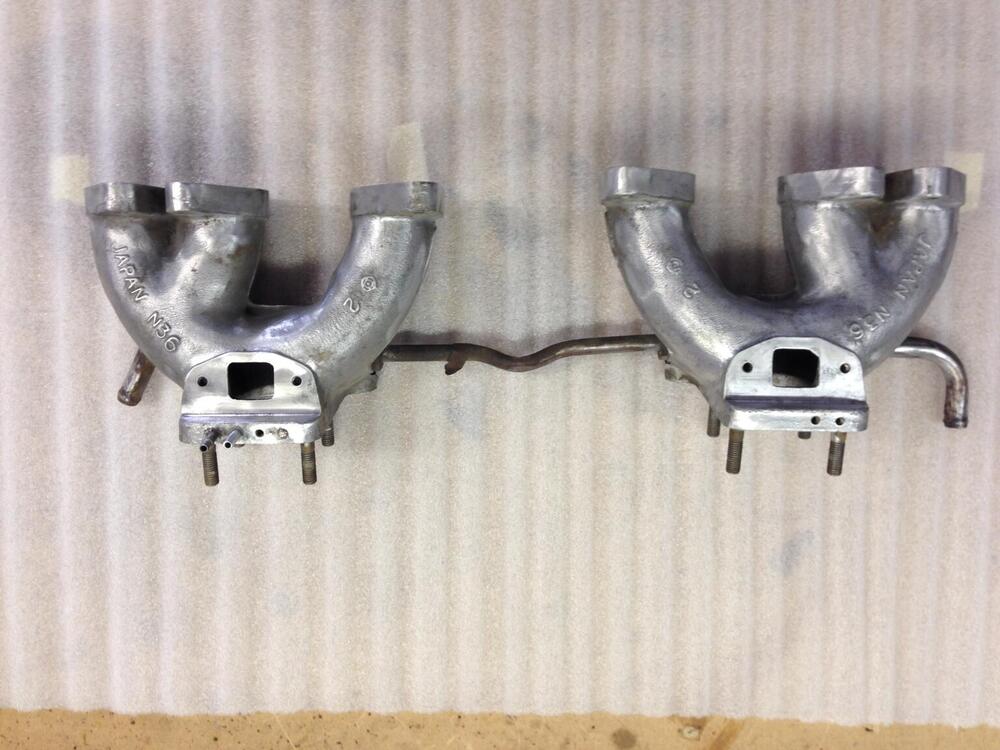
Well I've heard the same internet legend that you've heard, but I've never seen any flow data to support the claim. Would be interesting to see some data, so if you do turn something up, please post I've got some N36's here but I don't think I have N33's to compare them against each other. I've held N33s, but never measured anything on them. Don't remember much difference though. What displacement engine are you putting these on? And just remember that bigger isn't always better when it comes to this kind of stuff. What you really want is the sweet spot between momentum and flow (at the RPM range you care about). Hoovered some time ago just because pics are nice:
-
Are you thinking that the flow characteristics between the N33 and the N36 are different? I've heard (on the web) that the N36 is "the best flowing intake manifolds for carbs", but I've never seen data to support that. Have you flow benched the two and compared them?
-
Ferg!!! 🙂
-
That's really a broad description of a problem and could probably use a little scope narrowing... So when you say it cuts out under load, does that mean: A) You're cruising around no problem at light throttle, but when you punch it it backfires and cuts out for a brief instant and then maybe pulls OK? B) You're cruising around no problem at light throttle, but when you go WOT, it pulls great for a little bit and then it starts to backfire after maybe five seconds or so? C) You're cruising around no problem at light throttle, but when you go WOT, it pulls but not well, blowing black smoke out the exhaust the whole time? Just trying to narrow scope some.
-
The fit of the pivot pin through the float hinge is typically a little sloppy. Doesn't really cause a problem since it's always loaded in the same direction. The level setting of the floats can however, be finicky. I've found that I've had to add weight to the floats to get them to work properly. (Nicknamed "bloats" here on the forum if you want to search for that.) I don't know if the new aftermarket floats have the same problem, but I've found the old original floats seem to be too "floaty"
-
To simply a little on what SteveJ said... The ground is fine. There is only one ground that connects to the rear light assemblies. If your hazards and parking lights work, that ground is making connection. You need to focus on the 12V side, not the ground side.
-
Jut for future correctness, that is the hazard flasher, not the turn signal flasher. But getting to the point... As mentioned above, the orientation of those two wires does not matter. Either way will work. Here's what you're working with.

-
And forgot... I'm not sure if all the aftermarket switches behave that way, but I checked out two original used switches here and they both had that anomaly.
-
@jonbill , @Patcon , I was poking around with an ignition switch and a meter and found the following anomaly. This is probably related to the "running in the LOCK position" issue you have seen. I cannot identify the smoking gun on the wiring diagram that would exactly cause the run-on issue, but I wanted to throw this out there so others could be aware and maybe come up with some theories. Due to the internal construction of the ignition switch, there are (undocumented) two pins on the switch that get connected together in the LOCK position. Wire colors are B/W and L/R. This is not shown on the wiring diagrams. In theory, it doesn't cause any problem on a stock electrical system, but in reality on a non-stock system, who knows. Here's what I'm talking about:


-
No way I'm qualified for that. But it has been suggested. Of course, beer was involved.
-
So interesting to note that the original bolts in that location are supposed to be 45mm long. Been a long time since I was messing with T/C rods, but I do remember there was some pushing and shoving required to get the bolts started. Maybe the extra length helps getting the nut started while you fight the bushings at the other end of the rods? And the two different part numbers that zedhead pointed out? Maybe that's the change from the full diameter shank to the reduced diameter. I have some fuel injection intake manifold mounting bolts, which the fische says are supposed to be the 08134-04510 bolts. And they are the reduced shank, which is not ideal in my application. And thanks much for the offer to send bolts. I hope I don't have to take you up on that. I've got a box of bolts on it's way from a hardware supplier. They're not exactly what I was looking for, but hopefully they will be good enough. There's a problem with you sending me bolts... I need ten of them. So if my box of bolts doesn't work out, I'll let you know. I need two and-a-half early cars worth of T/C bolts. 😄
-
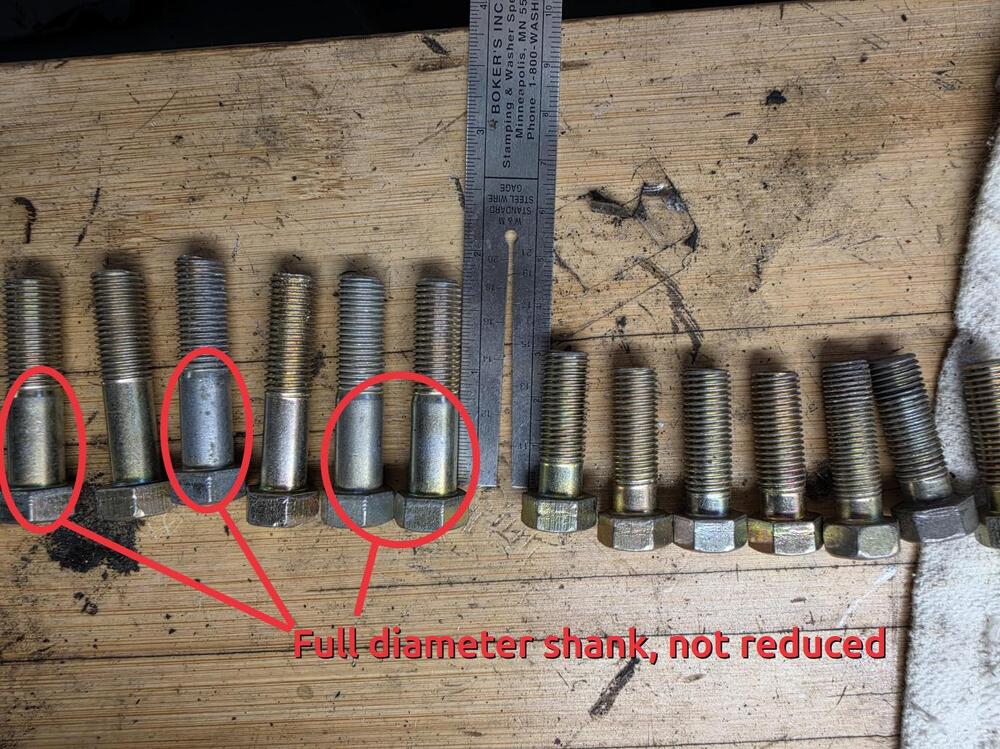
Glad your pedal stop wasn't snapped off after all. It must have a trick of the camera with the yellow paint showing through the hole that made it look like it was. In any event, happy to hear it was not. Mine was a real pain to fix. Took heat and contortions. One of those simple five minute jobs that turned into a couple hours to completion. So for your bolts for the T/C rods... Assuming the length of the un-threaded portion of the 45mm bolts is not too long for the application, you could cut those down. Just cut them a little longer next time! 🙂 One thing I wanted to point out, however, is that you actually have two different bolt styles in your pic... Undercut shank, and full diameter shank. The difference is the diameter of the un-threaded portion. On the undercut shank, they made the un-threaded portion a smaller diameter than the minor diameter of the threads. That makes manufacturing easier and cheaper to roll the threads and usually doesn't have any impact on how the bolt functions in application. However, in some applications where the bolt shank is used to help locate something, or is in full shear under load, it's often better to use a full diameter shank bolt where the un-threaded portion is dimensioned to the MAJOR diameter of the threads instead of the minor diameter. I think for the T/C rods, you might want to use full diameter shank bolts. Here's a pic showing what I'm talking about. You have four full diameter shanks (circled) and everything else is reduced shanks: So, I'm actually looking for some similar bolts... M10 x 1.25 partially threaded with a full diameter shank. I'm looking for 35 mm minimum, but I can cut them down if necessary. Do you know where off the car(s) did you find those 45mm long full shank bolts?