
SteveJ
Community Member
-
Joined
-
Last visited
Everything posted by SteveJ
-
Some background is needed here. Why did you replace the alternator and regulator? Where did you get the parts from? Did you get a 50 Amp alternator, or did you go with a higher rating? Nissan changed from an externally regulated to an internally regulated alternator for the 1978 model year. Having an internally regulated alternatore with an external regulator is bad mojo. You can get overvoltage conditions that can damage equipment. Was the click inside the car (accessory relay) or in the engine bay (starter solenoid)? This part screams "Accessory fuse". I bet you don't have a working rear defroster, either. Anyway, start by checking the fuse in the lower right of the fusebox. Also check the upper 2 on the left. Take the fuses out of the fuse box and test them with an ohmmeter. Before you take the car out again, I suggest you check the output of the alternator with a voltmeter. Measure at the battery. If it's about 14.5 at idle, shut down the car immediately and research alternator swaps. If you're in the northern suburbs of Atlanta, send me a PM. I might be able to come over and help you if need be.
-
The link is in my signature.
-
You can download the FSM. You may also want to get How to Rebuild Your Nissan & Datsun OHC Engine. It never hurts to have the proper references.
-
Have you downloaded a copy of the FSM and looked at it? How about a copy of How to Rebuild Your Nissan & Datsun OHC Engine?
-
Yes, the coil of the defroster relay is on the same fuse as the radio. As for the relay failing, yes, the coil can fail. If you hear the relay clicking, that would support a coil getting weak before failing. Don't forget to check the connectors for failure, too.
-
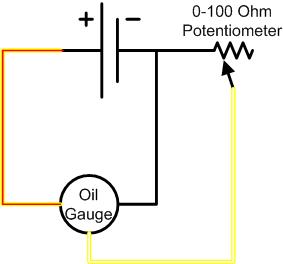
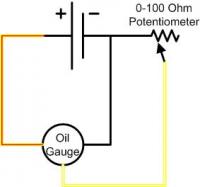
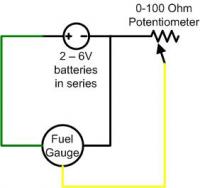
If you are up to removing the gauge from the dash, it's not to difficult to test. I have only opened up the fuel gauge/ammeter, so I can't say for sure about all of the wiring, but if you open up the meter, you can confirm the following. If the oil pressure gauge works like the fuel gauge, you have the Yellow/Red wire providing 12 VDC+. The gauge probably works on a voltage divider with one part of the gauge wired to black and the signal wire for the gauge wired to Yellow/White. (It says Yellow/White in the FSM, but it may be Yellow/Black in reality.) Get a 0-100 Ohm potentiometer and 2 6 VDC lantern batteries and wire them up to the gauge as shown in the picture. Vary the resistance on the pot and look for movement in the gauge. By the way, you didn't use teflon tape or some other sealant like that on the threads, did you? You should only use a sealant that has enough metal in it to be conductive. Also, it's a good idea to have an ohmmeter or multimeter rather than a test light. A meter will give you a better quantitative answer.
-
Thanks, those images are definitely worth saving.
-
I believe you refer to the length of the shoulder. Look at McMaster-Carr for descriptions. However, they don't carry M10 bolts with a shoulder and 1.25 pitch.
-
The electrical systems in 40 year old cars is not that complicated. Most ever potential in the car is 12 VDC. A notable exception is the primary side of the coil when the car is running & has a ballast resistor. The chassis is negative in most cars, including our Z cars. Stock black wires are paths to ground/chassis. Wires are color coded in the wiring diagrams in the FSM. You can buy a reasonably good multimeter for not too much money. Learn how to measure voltage and resistance, and you can trace most any circuit in the car and know how it's doing. You can also post questions here to get you on the right path.
-
As you take things apart and measure them, you start to notice trends. You can also buy gauges at home improvement/hardware stores or online.
-
I suspect that is the same car that someone had a thread on here about a year or more ago. I think the story line was that the car had been hit & repaired and sat undriven for a long time. Edit: Here's the thread I was talking about. If it is the same car, someone sure had a lot of fun with it over the last year. Upon further review, it can't be the same car. I just noticed the C pillar badges.
-
Did you try what Sarah said to do? It would be good to check your fuel pressure with a gauge, too.
-
Now that I remember, I believe I bought some last year from a Nissan dealer.
-
I didn't see them on his website, yet. Go look at it. There are plenty of drool-worthy items there.
-
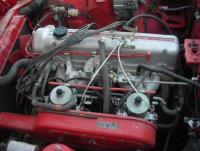
I found this picture on a 260Z for sale in France
-
If I were to hazard a guess, I would say those are the flat tops that the markets outside of the US received. By the way, the US flat tops don't seem to be that problematic to me, and the ones outside the US were even better.
-
Hot to the touch? Maybe 4 runs of 6 would reduce the current through each line. Thanks for the detailed write-up.
-
Jamie, talk to Eddie and see who he might use. Also, you might see if someone at Garage Zero knows a glass shop that will work on older cars.
-
Gee, so someone hacked into the wiring?
-
The coil has no moving parts. It's a simple step-up transformer. If you look on page EE-40 of the FSM, it gives you the resistance ranges for the primary and secondary coils. If the resistance is out of tolerance, it could mean a short in the coil (low resistance) or a broken wire (high resistance). Note: The resistance ranges are for a stock type coil. If you or a previous owner changed to a 3 Ohm coil and removed the ballast resistor, the resistance range will be different at least for the primary side of the coil. You would have to find the range from the manufacturer of the coil in that case.
-
As long as you can still remove the panel with the vents & map light, you should be able to remove the gauges that way...unless you have AC.
-
Okay, you might try Google. I did a quick search and found lots of vendors for different brands. Since the 280Z fuel injection was based on a Bosch design, I would think someone probably sells a compatible one.
-
Aren't they shown here?
-
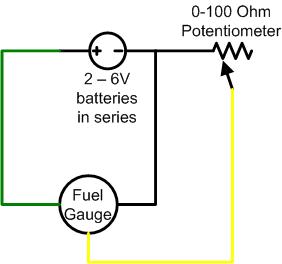
It sounds like you're doing good diagnostics so far. I suggest testing the fuel gauge out of the car. Hook up the Green, Yellow, and Black wires from the gauge to 2 lantern batteries and a 100 Ohm potentiometer as shown in the drawing. Vary the resistance on the potentiometer, and you should see the needle move.
-
If it is a stock ignition module, it is in the passenger footwell by the fusebox. If the car has been converted to a ZX ignition, the module is attached to the distributor. A bad ignition module could make the car difficult to start if it is not triggering the spark properly. However, sometimes the coil or module can start the car and get overheated and not function until cooled down. There are many threads on that issue.