


.JPG.cfcada9cf1c1b502df3f5f2f2ca3ff36.JPG)
SteveJ
Community Member
-
Joined
-
Last visited
Everything posted by SteveJ
-
No When starting the car, the same wire from the ignition switch that powers the solenoid energizes the coil for the fuel pump. When the engine catches, the alternator will be turning fast enough for it to generate enough voltage to coil. The actual source from the fuel pump doesn't change. Only the switch that completes the circuit changes. There is a chance you already have the fuel pump wiring fully in place for a 73. I'll try to dig around and locate the wires you should be looking for.
-
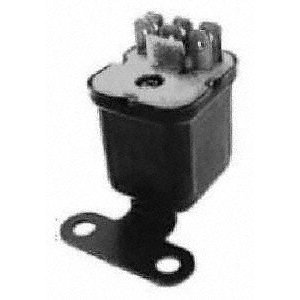
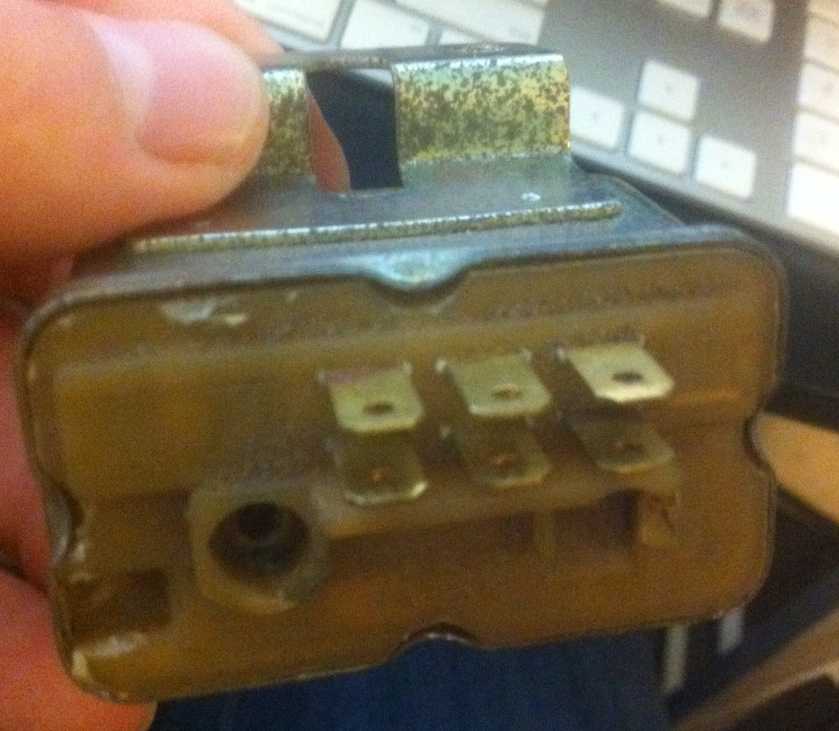
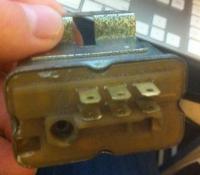
This relay, RY-199, from Standard Motor Products looks like it might work for the ignition relay. I've added an image of a Z ignition relay for reference.

-
Yes, I've seen that one, too. Since I didn't have a 280Z to tear into, I didn't mention it, though. I was trying to help someone on facebook with replacing the ignition relay. Some day I'll have to post how to use a DPDT relay to use as a substitute. On the other hand, I think SMP has a replacement ignition relay...I'll see if I can find the part number.
-
Look for loose or missing bolts on the driveshaft.
-
I was at The Classic Motorsports Magazine Mitty at Road Atlanta in 2010 when Pete Brock was there. I had two posters all ready for him to sign. One was for me, and the other was for my nephew. My copy hangs at my desk at work. I didn't get to see John Morton up close, though. At the 2011 ZCCA convention, I had a nice drawing of a BSR 240Z that Bob Sharp graciously autographed for me, and I promptly put it back in the frame.
-
If you're still using the 280Z ignition module, you could change to a GM HEI ignition module.
-
Rockauto does carry replacement ignition modules.
-
The US 260Z used flattops. It was not fuel injected from the factory.
-
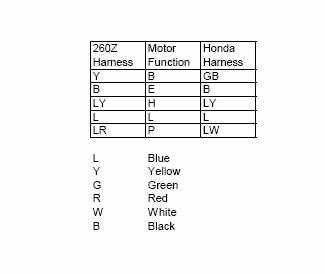
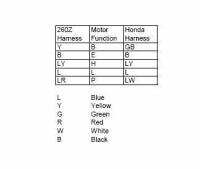
There's nothing like getting empirical data to figure out what's going on. I took current, voltage & resistance measurements to figure out what I didn't have right. Blue/red should go to green/black. That is the 12VDC for the motor. The blue & blue/yellow from the Z should be connected as I suggested. Try the blue/white from the Z to the blue/white on the motor for the parking function. If that doesn't work, try the yellow on the Z to the blue/white on the motor. (The last is a guess. I traced the yellow wire to the heater subharness. I wasn't expecting it to go there.)
-
Actually, you could blow a fuse by grounding any but the black. Since my diagram accounted for all but the blue/white, I wasn't as worried about your grounding the others. I'll see if I have time to measure the voltages at the 260Z harness side for the functions soon.
-
If it doesn't park, I'll draw up something for you to try for that. The 74 FSM was pretty clear on what wire coming off the amplifier was for parking the blades.
-
From the combo switch the red/white wire is split into the left and right headlight circuits. Those wires are the fused wires.
-
I don't have a Honda wiper motor to test with. However, if I am right, you won't need to unhook the intermittent wiper relay (amplifier in the FSM). As long as the 6th wire (blue/white) in the Z harness isn't allowed to touch ground, you should not get any smoke. The park function is listed as coming off of the wiper relay, so that's why I think it should work for the Honda wiper motor as I listed it.
-
Please keep in mind that this is completely untested, but I think this will work for a 260Z. You will lose intermittent function, though.
-
The Honda wiper motor swap works for 70-72 Z cars because they did not have intermittent wipers. Your 260Z has intermittent wipers. It's not plug and play that I'm aware of. I will look at the circuits, though, and see if I can find a work-around.
-
Do me a favor. Disconnect both sides of both ballast resistors and find out the actual resistance of each. Also, did the Mallory ignition module come with any technical specs? I'm curious about its impedance.
-
-
Is RockAuto out of stock, too?
-
You should really put the year of your car in your posts or signature. A 76 280Z would maintain pressure in the lines. Unless the original poster (or previous owner) changed the fuel system, the car does not have carburetors. The problem could be a fuel pressure regulator. Download a copy of the FSM and look in the EF section for troubleshooting tips. Also consider getting an inline gauge and installing that to see what the fuel pressure is while the engine is running and after you turn in off.
-
If Reddat is selling them, that means Nissan still carries them cheaper. However, note that for some of the hardware, Nissan doesn't necessarily care what was original for color. Who knows? Maybe I might be able to remember to look at my 73 this evening and tell you what it has.
-
Wasn't this car from East Tennessee? If so, I think I saw it on Craigslist. I hope you enjoy the ride.
-
Okay, you guys goaded me into doing some research. I found this link interesting: http://autoclub.atilim.edu.tr/dokuman/Automotive%20Electrical%20and%20Electronic%20Systems/Chapter13.pdf I took apart a faulty fuel gauge I had. I thought there was a voltage divider at play, and I figured it out...I think. (Correction as I type...It's a current limiter. The bimetallic strips are in parallel, so they both have 12 volts when connected.) The gauge has two bimetallic strips that can be heated up. One moves the needle and the other limits the current. The one that limits the current does so in the manner Enrique suggests. It heats up and breaks contact, allowing the full current to go to the sender side. This lets the other bimetallic strip heat up as it moves the needle. The bimetallic strip on the current limiter cools down, and the contacts make, letting it heat up again. This takes current away from the gauge bimetallic strip. If the contacts carbon up on the current limiter, that could cause too much current to flow through the gauge bimetallic strip for too long. Maybe I'll set up my test bench and multimeters on Saturday and let it be an electrical engineering play day. Thanks for getting me to think, guys. It's about time I spent some quality time on car stuff.
-
How would you swap in a 280Z ammeter? The 280Z has a voltmeter. Changing the alternator won't affect the ammeter.
-
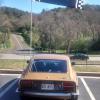
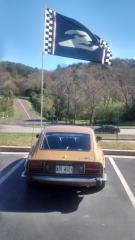
I drove my Z to the local Ace Hardware store to pick up a couple of things today. While I was in line to pay, an older gentleman asked if anybody drove the 260Z in the parking lot. I mentioned it was mine, and he said that someone was saying he was a previous owner of the car. I walked out to the parking lot and met Randall. He said he bought the car in California and brought it with him when he moved to Georgia. That matched the verbal history given to me by the seller. We chatted about the car for a while, and I let him look it over. He bought the car in 1985 with over 150K miles on the clock and sold it in 1994. He was the third owner of the car, buying it and selling it for $2000. He recognized many of the modifications I made to the car, as well. And to think that it was a last minute decision to take the Z instead of my daily driver.
-
That's what I get for working from memory. Yes, screws to remove the headlights. I did about a year and a half ago. The penetrating oil did the trick for getting those screws out intact, too.