
Jeff Berk
Community Member
-
Joined
-
Last visited
Everything posted by Jeff Berk
-
I'm currently on my $25 four speed. I have a five speed in my shed but I'm not emotionally ready to tackle that right now.
-
I'm going to try and meet up with the area Datsun expert tomorrow and see what he says.
-
The new disk is in and the car is working fine except for one annoyance. With the clutch disengaged, there is a slight grinding sound in 1st and 2nd gear. The sound goes away as soon as I let the clutch out or when in neutral, 3rd and 4th gear. Could the clutch slave not disengaging far enough? On a side note, anyone go to the vintage car race in Pittsburgh last weekend? There were not too many Z's racing but quite a few parked in the car show area.
-
Kully... I ended up cutting my vapor line at the right rear fender. While at it tried pulling a suction on the line. The line to the top of the reservoir tank drew air when a suction was applied. When applied to the line from the right rear wheel to the engine compartment, it held a vacuum. There was some water accumulated in the line I cut which was a low point. The car seems to be running fine at this time and the pressure issue (and I think the fuel overflow at the carb) seem to be resolved. I don't think the reservoir tank has a valve at the top but I cannot tell for sure since I cant open the top. The connection on the gas filler neck I think just drains into the reservoir.
-
Kully, The carbon can was removed by a PO and the car seemed to run correctly except for a vapor lock issue. Unfortunately, a PO also deleted the fuel return and made this a dead head system. That likely contributed to vapor lock under certain conditions (e.g. between autocross runs). I recently reestablished a return fuel flow by connecting to the abandoned return line. My car had a fuel pressure regulator installed before the carburetors but it seemed more straight forward to have the regulator after the carb's if I was adding the return line back in. It appears that my vapor line to the canister is plugged as I cannot suck air out of either end and cannot blow air into the canister end. I am going to cut the vapor line at the right rear fender to allow the vapor to escape. Hopefully that will take care of the pressure buildup in the tank and fuel line.
-
“O Captain, My Captain!” I see that orifice thing in the FSM but if it was located adjacent to the carbon canister, it is likely missing as well.
-
It seems that if all this tube does is route fumes from the overflow tank to the engine compartment and dumps it there (the carbon canister is missing), could I just cut the hose off beneath the car next to the gas tank and let it vent there?
-
I found what I think is the charcoal vent line. It terminates at the front right fender, engine compartment. I blew air at about 30 psi into the tube while my son listened for air at the filler port. Nothing. I'm assuming that the charcoal vent tube originates at the overflow tank inside the right rear fender so I'm going to start stripping panels. Update: I used a hand vacuum pump on both the tube that terminates in the engine compartment and the hose that connects to the top of the overflow tank in the trunk. Both ends hold a vacuum.
-
I'll check for the vent line tomorrow morning. The fuel return line was capped off until I reestablished a return flow fuel system a few months back. Is there some way of adding a signature line or information in the block to the left of messages that includes vehicle information? I think that image is sideways to permit fuel to drain back into the tank:)
-
Is the vent line the one on the top of the reservoir tank in the right rear fender? As long as I'm pulling interior panels out, are there any suggestions on how to get them to stop creaking? Silicone on the plastic to plastic contact seams perhaps?
-
I noticed that my gas tank seems to build up pressure, is this normal? Also, and possibly related, I had fuel leaking out of my rear SU carb after a few miles last week and the fuel pressure gage recently was showing 7.5 psi after a drive. The carbon canister was deleted by a PO. The return line to the fuel tank was reconnected after ? years so it has not been tested other than to confirm it was not leaking. My fuel system is currently as follows: 1) Fuel is pumped from the fuel tank, through a fuel filter using an after-market electric fuel pump to the engine compartment. 2) Fuel is pumped through the mechanical fuel pump and into a DIY fuel rail with three outlets. Two of the outlets flow into a pair of round top S.U. type carburetors. The third port is connected to a low-pressure fuel-pressure regulator. 3) The fuel-pressure regulator has two active ports and a pressure gage. One port is connected to the fuel rail and the second port is connected to the return fuel line.
-
Yes, they were a little off but not enough to prevent them from working. I should of used a drill press and not a hand-held drill but my drill press did not have the reach to clear the steering wheel and I didn't want to wait a few days to get access to one of the ones at the maker space. At least they were both off in the same direction so the separation was correct. And for the first time in 9 months, my horn is working!
-
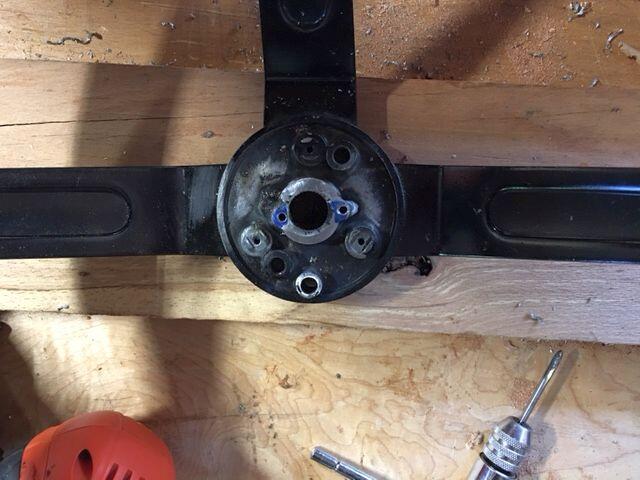
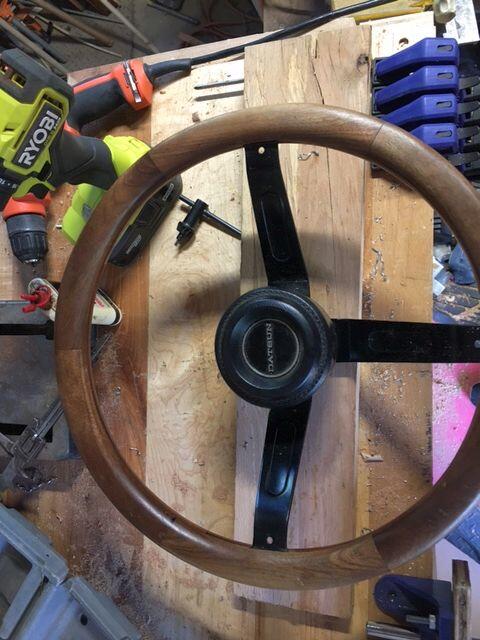
The wheel is a strange construction of cast aluminum hub and steel spokes. I had the welding instructor at a local makerspace do the welding for me. It did pop a little due to the casting having bubbles, but he had no problem welding it. I personally would of not attempted as aluminum is very tricky to weld. At home, I drilled and tapped the holes to 4mm and was able to mount the hub. There's a little gap between the hub and the horn button but I can fill that in with a ABS printed part (once I can get one of my two printers working again).
-
GOT IT OPEN Thanks for the help and support.
-
Should I keep trying the pry bar then, or go with a can opener?
-
So far, no luck with tripping the hood release, too much engine and transmission in the way. If I just undo the bolts on the front of the hood, wouldn't the latch at the rear of the hood keep me from removing it?
-
I think I just found something in an old posting: https://forums.hybridz.org/topic/107117-howto-release-a-240z-hood-when-cable-broken/ Note that the link shows a slightly modified latch using a nut and bolt to attach the cable end. I just ordered a new cable (from Thailand) and am heading out tomorrow to get a long, narrow pry bar/screwdriver.
-
My carbonator linkage disconnected during a drive so I pulled the hood release lever to fix it only to have it pull out with a broken cable. I had it towed home and it's up on my lift. If I want to try and release the latch with a long screw driver, what does the latching mechanism's cable attachment point look like from underneath? Oh... BTW: Happy 4th of July
-
I think we are drifting off topic but good reading in any event.
-
I'm tracking down sources of rear end noise in my early '74 260Z. So far I identified a loose stabilization bar link. I also noticed while the car is in motion that the threaded rod protruding out of the top of the right rear strut has some minor movement associated with it while the driver's side one does not move. The three bolts securing the top of the strut are properly tightened. As far as I can tell, the strut's upper end is held in place under spring tension. Is there anything I can (or should) do to keep it from moving around? Note that the struts and springs were replaced not too long ago but by the same monkey that was riding around in the trunk.

-
Dutchzcarguy I'm still working on it. I'm either going to weld some metal on the new wheel's center to give something to drill into or I'm going to make a an adaptor. I'm waiting for the welder at my local maker space to get back in town next week. Jeff
-
I guess maybe I need to start at getting an alignment. The tie rod ends and ball joints don't seem to have any play in them. How does one find a "good" wheel alignment shop? Do I trust a shop like Goodyear or Firestone? There are not many independents around now. I tried to adjust the toe in using two aluminum 2 x 4 plates with slot cut in them for a tape measure. Doesn't sound as precise as laser-based alignment methods.
-
My steering seems to wander in the center position. Where should I start looking to resolve this? I replaced the struts and springs and toed the wheels in a little but the problem persists. With the car standing still, moving the steering wheel doesn't seem to show any slack in the under-hood couplings Should I take it to a shop with an alignment rack and if so, would they even know what to set it at since it has a non-standard wheel size and lowering springs?
-
-
I did my tank a couple of years back and my early '74 260z did not have that intake screen. The cleaning and coating went off without an issue. I used a pound or two of steel nuts and sloshed them around inside the tank to help remove the rust. I'd say the toughest job is definitely the pins holding the rear suspension in place.