



Captain Obvious
Community Member
-
Joined
-
Last visited
Everything posted by Captain Obvious
-
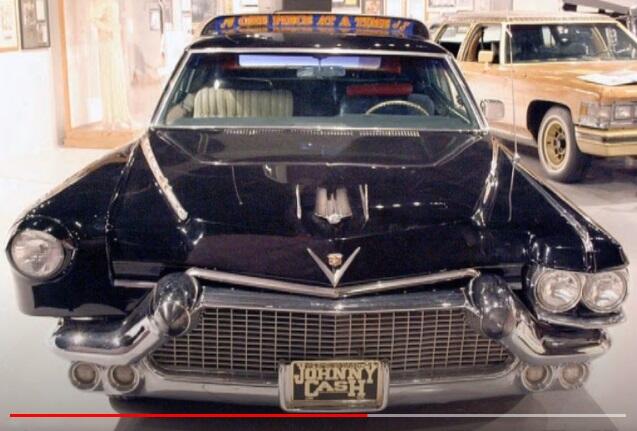
The first year, they had me putting wheels on a Cadillac:
-
Thanks for the links Gav240Z.
-
I don't think it was for more charging time. I think it was for a sharper steeper less scattery firing time. Based on the shape of the ZX reluctor, it looks to me like they were trying to reduce the amplitude of the negative pulse before a super-er steeper rising edge. Better for noise rejection and repeatability? And I'm sorry for the sporadic updates. I'm working on this little bit at a time as I get the chance. But here's a preview... The E12-80 is essentially the same as the previous versions, but in a different form factor. Electrically very similar, but different shape. But the E12-92 is not. It's different.
-
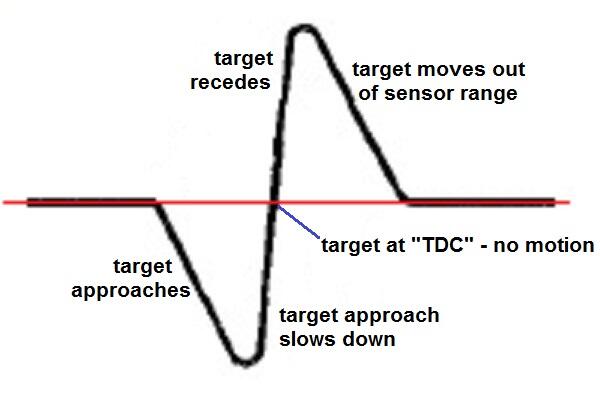
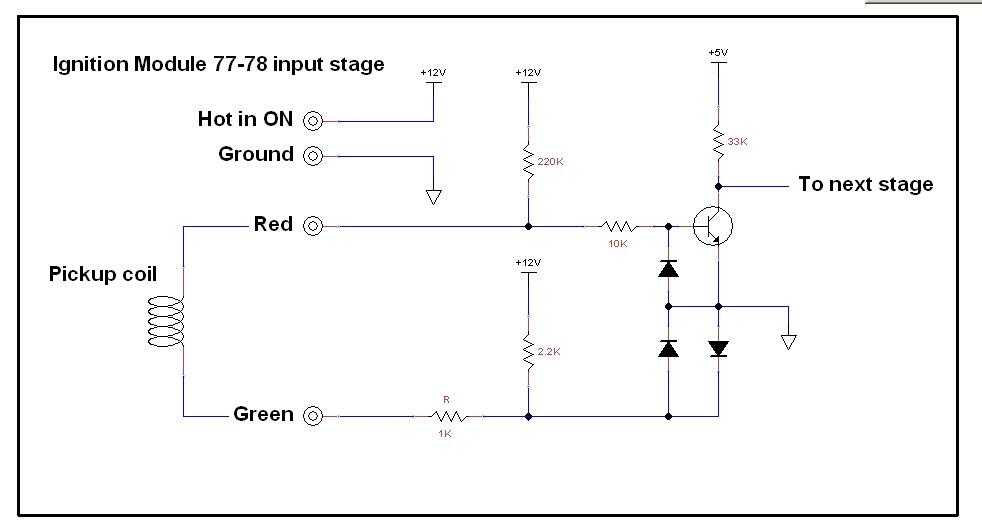
Here's a sketch I whipped up showing a simplified input section of the 77-78 ignition module*. The topic and concept of "polarity" keeps coming up, and I'm going to explore that some more: So take a look at the input pickup coil connections... The red and green. If you know what you're looking at, it's clear that the red is the "controlling" connection while the green connection is pretty much tied to ground. If you connect up a voltage source between the red input and ground and wiggle that voltage around, the output of the module will switch. However, if you connect up the same voltage source between the green wire and ground, the output will never change regardless of what voltage you apply to the green input connection. In fact, if you connect up a voltage source between the green input connection and ground, you will forward bias one of the diodes and pass a bunch of current through the 1K resistor. The green input is tied to ground through diodes and will pass significant current if you connect up a source to it. The red input does the switching and the green input is the "ground" side. And I know from looking at the rest of the module that when the red input is negative, the output charges the coil. And when the red input goes positive, the module releases the coil and causes a spark. So for the early modules, the spark occurs at pretty much the zero crossing on the rising edge of the switching input. On this pic, the spark would occur on the steep rising edge when the red wire goes from negative to positive: *I assume that 74-76 is pretty much the same as 77 and 78
-
Thanks again for the help guys. I'll hold tight and hope others can chime in. And I'm certainly in agreement with the flat tops being good carbs. Swimming upstream against strong current, but moving my arms anyway. And thanks Dutch for that document page. I'll add that to my files.
-
Thanks all for the help so far. Hoping that someone can turn something up. The documentation I have mentions nine different revisions of the flat tops (HMB46W-1 through -9) used in the US. But who knows how, or even if, those revisions correspond to your 1A through 1C. And beyond that, the doc I'm referring to is dated at the end of 1975, so who knows what happened after that through 1978? Does your UK market docs indicate any time line as to WHEN those 1A, B, C variants were used?
-
So here in the US, they used P/N 16354-N3310 needles in the flat top carbs in 73 and 74. The parts manuals says they used the same needle for both years. Then in America they changed out the carbs completely in favor of fuel injection in 75, but I know that's not the case in other parts of the world. So I'm wondering if they used the same needles in flat top carbs in other parts of the world from 73 to 78. Did they use the 16354-N3310 globally, or did they use something else? So do any of you non-US enthusiasts have any experience with this? Off the top of my head, just tagging people (not in the US) I can think of? @kats @EuroDat @dutchzcarguy @Gav240z @RIP260Z @jonbill @Jason240z And just because everyone likes pics, here's a pic of 78 flat tops that I hoovered up some time ago:
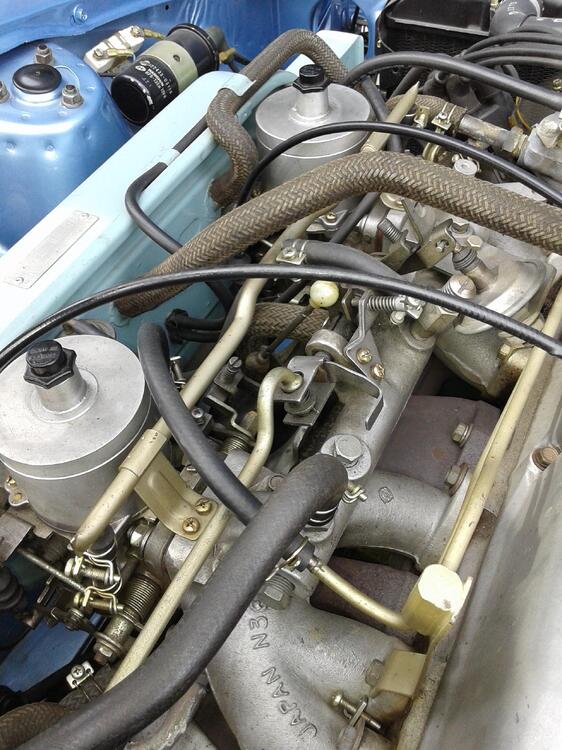
-
Ignore the bright links. They only properly line up every eleven revolutions of the cam (every 22 rotations of the crank).
-
-
-
Woot!!
-
Sorry. I thought you were saying that Dutch adage was the direct translation of what I wrote. Thanks, I get it now! So for the OP... De onderste steen boven halen.
-
Yup! So what's the old adage in Dutch that implies you need to dig deep to the root cause of a problem when looking for the solution? I'm sure there has to be one!
-
Yes, sorry. It's a translation issue AND a cultural issue. Goes like this... When investigating a mystery, it's important to hunt for clues and look into all possibilities in order to truly solve the mystery. And here in the US there is an old saying along those lines that goes: "Leave no stone un-turned." The meaning of which is "turn over every stone looking for clues as to what's really going on." or in other words, "When looking for the true root cause answer to a question, do a thorough investigation and make sure you look into everything." Then also some time ago, some silly person manipulated that old saying juxtaposing letters and turned "leave no stone un-turned" into "leave no tern un-stoned" which is just a silly concept of a flock of seabirds stoned on drugs. Back to the topic at hand, I was implying (in a silly stoned bird way) that it was unclear how the OP of this thread claims that his back-up lights worked a bunch of times before failing, but the current theory (wrong bell housing) should have made that completely impossible. It's a mystery that has not been solved. I'm sure there is a similar saying in Dutch that would make no sense to me.
-
Kinda doesn't matter much since (it seems) you guys have presumably hit on the root issue, but is there any explanation for this? Terns unstoned and all that.
-
Put me into the "I want a dimmer" crowd too. I run my dash lights just bright enough that I can see them when I drive. I want the gauges to be visible if I need them, but not the main area of focus. LOL... In other words, I need my 50 year old headlights to be brighter than my new LED dash bulbs.
-
Yeah, it's cool. Of course they were only using it as a simple light pipe, but still. First time I saw they did that, it was a surprise!
-
I believe that is the "light box" for the cigarette lighter illumination lamp. The bulb is in there, and they use a fiber optic cable (the black cable on the left side in your pic) to transfer that light over to the cigarette lighter.
-
Couple tags off the top of my head: @Dave WM @Derek @Serban @tunesnxs @26th-Z
-
I think the ZX distributor I've been messing with has an unbroken magnet. I think I have one here with a magnet in pieces too, but it may be in too many pieces. I'll look to see what I have.
-
For me, it is. Everything I have is stock parts. Spectrum of different years, but all stock. I'd be happy to look into other systems, but I don't have anything here. It all started for me wondering what they did in 78 to allow the removal of the ballast resistor. And the answer is they started including current limiting inside the module in 78. Then av8ferg wanted to be able to mount two different style modules (ZX matchbox and GM HEI) on his car and be able to swap between the two if one of them failed. But when he tried it, he noticed a timing difference between the two. So I thought it might be interesting to investigate that. That's how I got here. I've been poking around inside the stock modules for some time now but figured nobody (other than me) really cared, so I didn't post about it.
-
Agreed on that. Hearing about the popping followed #1 connected or not seems like a distraction from the bigger picture at this point. But it also seemed like something simple to look into.
-
Take a look at the connectors from the injector dropping resistors? That's something that could electrically affect cylinder #1 only. And next time it's screwing up, try swapping #1 and #2 injector connectors. If the bucking now comes and goes with #2 (instead of #1), that could be useful info. The ECU fires all six injectors at the same time, so other than a bad connection to the box or a broken circuit trace inside the box, I cannot come up with anything else the ECU could do that could affect #1 only.
-
Nice work.
-
The "energy starts to fall off" mention is kinda interesting. At low RPM there is plenty of time for dwelll and plenty of time for spark. At high RPM however this is not so true. But the issue is it doesn't matter which ignition system you are running, you are still bound by the same cycle times. By that, I mean... On a six cylinder engine spinning at 6000 RPM, there are 3.33 ms between firing events. In that 3.3 ms you have to charge the coil and then spark that coil. If you want enough spark time, you have to be able to charge the coil fast. And that's where a no-ballast system that uses a current limit in the module would have an advantage. You can charge it faster so you have enough time for adequate spark time. I bet all the systems "fall off at higher RPM's". Unless they are using the same dwell across the entire RPM range, then they would all fall off as dwell decreased at higher RPMS. I haven't measured any of the aftermarket stuff with built in dwell control to see if they use the same dwell time at idle and 6000 RPM. I suspect not. I had all those measurements done for the 77 and 78 modules, but I was just using a signal generator as a simulated input. But after seeing how the modules can react different using the real VR pickup, I'm rethinking the validity of those measurements. I'm not sure using a sig-gen is valid.