



Zed Head
Community Member
-
Joined
-
Last visited
Everything posted by Zed Head
-
Yes, the transverse link is the A shaped piece. Also called a control arm by many. If I remember correctly,the guy who had the worn bushings found them because he had a noise from the rear end. If yours are as bad as you describe, they could also be a part of your "thud thud" sound. If your mechanic is not familiar with the these suspensions he might even be mistaking bushing movement for wheel bearing wear. Each rear wheel assembly is held on to the car by three contact points with the body. The top of the strut and the two inner bushings. They take up all of the turning, braking and accelerating loads. You really need good bushings to have a good solid car.
-
Getting closer! I was going to say bearing. Seriously. Anyway... Your transverse link bushings determine the alignment of the rear wheels (assuming that their mounting points to the body are not misaligned). Are they worn? There are two inner, where the wide part of the link attaches to the frame, and two outer, where it attaches to the strut/bearing housing (the cast iron piece) via the spindle pin. If the inner ones are worn, I've heard (read) that you can get quite a bit of movement of the whole assembly. I think that it would give toe-out under braking, toe-in under acceleration. There is an account out there from someone about being able to move the whole wheel assembly by hand because the bushings were shot. There is also talk of poorly drilled bearing housings, from the factory. I still have my stock bushings though, and my rear alignment seems pretty good, so can't offer much more.
-
It might help you if you try to separate the drivetrain issues, from the suspension, brakes and wheels, as far as you can. Even if it's just down to fine details of the noise. You said decelerate originally and then later you said decelerate and brake. It's not clear if you're using engine braking, brakes or a combination of both. If you decelerate just using the transmission and engine braking, is the noise different than using just the brakes with the clutch in or transmission in neutral? With just brakes you're only loading the wheels and suspension. With engine braking only, you're loading the half-shafts and driveshaft, along with the wheels and suspension. You might even try stopping hard using just the parking brake, to put more load on the rear wheels. It might give a few more clues.
-
KDMatt might be on target. I have a spare engine that had a bad AAR and I could not get the idle down to where I wanted it until I plugged it off (it's a spare engine so I didn't replace it). The FSM says to pinch the hose to the Regulator when the engine is cold to see if it is open. The engine idle speed will change if it is open. If the hose is old though it will probably split giving you a big vacuum leak. You could remove it, plug the hose ends then see if the car runs differently. You might have to start it with a high idle screw setting when cold, then turn it down when it warms up. If you do decide to remove it, for testing or whatever, be careful, there is a good chance that you will break off a bolt in the manifold and tear the guts out of the AAR when you're trying to remove the electrical plug.
-
The original problem, where your brakes slowly locked up, sounds more like a master cylinder or brake linkage problem (from what I've read, no first-hand experience). The master cylinder piston has to come back all the way to open the passages to the reservoirs. If it doesn't, when the fluid heats up and expands, pressure will build up in the lines and apply the brakes without pushing on the pedal. I might be wrong but this is my understanding of what could happen. Something might be stopping the master cylinder piston from retracting fully. You didn't adjust all of the play out of your brake pedal did you? So even if you do get the brakes to work, the original problem might come back if you have not done anything to the master cylinder or linkage. You should look at everything from the pedal adjustment to proper bleeding of the lines. The FSM has all of the details.
-
You said that your brakes seized (ceased up) as you were driving and then mentioned a slow stop. Do you mean the brakes locked up on you? Then you changed the calipers and pads, now you have the opposite problem, no brakes? Can you pump up the brakes and get them to work, or does the pedal go to the floor and stay there? If it worked for three months things must have been right for a while. More clear details on the history from when it worked to now would be good.
-
O'Reilly's aka Schucks aka CSK Auto calls it an Idle Air Control Valve for search purposes then calls it an Auxiliary Air Valve in the description. I used 1981 BMW 528i as the car model per sblake01's post. Nothing comes up for 280Z. http://www.oreillyauto.com/site/c/search/Idle+Air+Control+Valve/02169/C0018.oap?keyword=air+valve&year=1981&make=BMW&model=528I&vi=1012217 I could have saved $10! I bought mine from MSA. Should have noticed, but that post is pretty old isn't it? Guess I'll leave this here anyway...
-
Might be this aftermarket part - http://www.blackdragonauto.com/icatalog/zr/full.aspx?Page=41 88-702
-
Hope I didn't kill your thread Datsunlover. Any luck?
-
I browsed the FSM (slow Saturday night :disappoin) and it looks like the Floor Temperature Sensor relay is powered up when you hit Start. The light is supposed to go on at Start and go off when On, unless the floor is hot. It's in the Emission section. It's possible that you just have a low battery or bad battery connections. The relay buzzes because you don't have enough juice to activate it completely, therefore not enough juice to Start the engine. Like Ford starter relays. Buzzz, buzzz, buzzz, crap, battery's low...
-
According to page EC-9 of the FSM, if there is no power to the switch then vacuum is actuated. The valve closes when energized, opens when no power. Odds are that whoever put the 5 speed in just disconnected the switch, so you probably have full-time vacuum advance if nothing else was messed with and things still work. Really though, you should just put a timing light on your engine and check/set the initial value. Then while you're hooked up, rev the engine with the vacuum advance hose disconnected (plug it to keep things running smoothly) to check mechanical action. Then temporarily connect the vacuum advance to a manifold vacuum source at idle to see if it advances. The small port for the heater controls would work fine for that. That would get you started to see if things are even working. If you wanted go further you could measure how much advance you get with an adjustable timing light (I think they call it a dial-back timing light) or adding some timing marks on the pulley. Once you get in there with a timing light you'll figure out what's working right and what's not. Its just a big guessing game if you don't measure.
-
Z Tyler, I just remembered something about the 1976 Z that you should consider - the manual transmission model, as delivered from the factory, only uses vacuum advance in 4th gear. There is a switch on the transmission that closes in 4th, which activates a solenoid valve on the engine, allowing vacuum to get to the vacuum advance. The engineers designed the engine to run without vacuum advance in all gears except 4th. So your problems are most likely not due just to vacuum advance problems, if your engine is still in stock form. Don't forget it came with a ported vacuum source also, which can confuse things if you're checking it at idle.
-
It could be timing issues. It sounds like it might be retarded. Check your vacuum advance. Read this thread (coincidentally recent and same year car), post #3 by Beandip, about checking your vacuum advance mechanism. http://www.classiczcars.com/forums/showthread.php?t=38890 Check your mechanical advance to make sure it is working. If it is stuck you'll have retarded timing at higher rpm, which will hurt gas mileage. In general, the engine will be more responsive and get better mileage with properly advanced timing. A bad water temperature sensor or connection will cause the engine to run rich all of the time. A far-out possibility for the inconsistent idle - there is an electronic advance for 1976 non-CA models, that kicks in when the engine is cold then turns off when hot. It adds about 6 degrees of advance when cold. I don't know if this will cause a 700 rpm swing but it will cause some. It is controlled by a temperature switch on the thermostat housing.
-
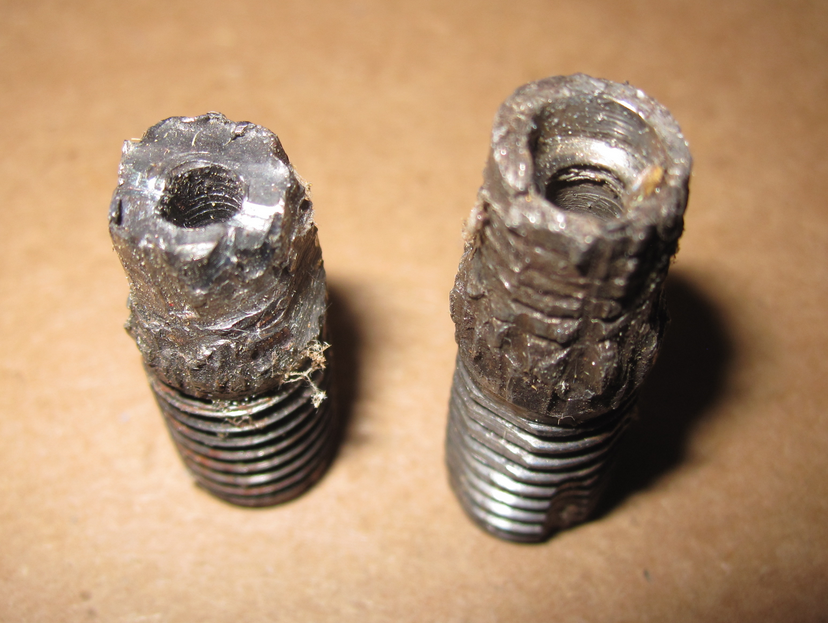
When you slide the drive shaft out of the transmission, the gear oil will come out unless you have drained it first or have the rear end of the car jacked up. You might want to make sure that you can get the transmission fill plug out to add more before you start. I had the same problem with the diff fill and drain plugs. If you heat the area around the plugs with a propane or MAPP torch you should be able to get them loose. The diff gets pretty hot when in use so the heat shouldn't hurt it. I could not get either to budge until I applied the torch.
-
Back on topic (yippee)... Maybe this old quote applies (had to Google it to get it right) - "In theory, there is no difference between theory and practice. But, in practice, there is." Jan La Van De Snepscheut (apparently a Cal Tech computer expert) So it doesn't really do much. The Datsun engineers put some effort in to it though. Too bad we don't have those old reminisces from the engineers that worked on it, like we do for some other car makers so we could know what they were thinking at the time.I read your original post. Here's a summary: The car ran with starting fluid through the intake when you got it. Then you "set the motor to TDC". Did some more stuff. Now it won't run at all. It sounds like you just think that you set the #1 to TDC and/or set the distributor wrong. Any way to go back to before you did anything? You must have had the timing good enough to run in the beginning.If the car starts but then dies, it could be the fuel pump safety cutoff. On the 78 I believe it is controlled through an oil pressure switch. The switch has to see oil pressure to close the contact to run the fuel pump. Typically (at least for 76 with the AFM switch) the car will start, run for ~3-5 seconds, then die. Not sure why warmer would be better than cold, but it is something to look at. If this is the problem, then hitting Start real quick as it is dying, will get it to run a few more seconds again (because Start bypasses the switch), although you will get a grind from the starter gears. I had this problem on my 76 which has the AFM controlled fuel pump switch.Don't bite mel marabante. They're just words on an internet page from some anonymous Benny Hill fan... Not worth the effort.Doesn't the coil ground through the tachometer circuit? Just a guess, no real knowledge of what you're doing. But I did see that you have the tachomoter output disconnected, although I'm not sure what effect that would have with your setup..I did not know that. I have a 280. Thanks for the quick correction. I think that the L terminal on a newer alternator still needs 12 volts, low amps, to power the windings immediately. It could be checked with a volt meter, with the key on, to verify. That's where I would start if I had this problem. If the L terminal is not getting power, then you can focus on the wiring. If the L terminal is getting power, focus on the alternator itself. I'll stop now...I'm sure that Zs-ondabrain can explain in depth, but, as I understand the charging system, the L wire does what the "cut-in" speed is doing. I believe that it magnetizes the windings right away so that the alternator can start generating current immediately. The L wire runs through the red charging light (Lamp) on your volt or ammeter. If the red light comes on when you turn the key on, and the other end of the wire is connected to the L terminal, then the windings are getting powered as they should. It goes off when the current starts flowing. Does your red charging light work as it should. Lighted when the key is On, off when the engine starts? I could be iffy on the details, but I'm sure that the red charging light is an integral part of the system and needs to be functional and wired correctly for the system to work as designed.Actually, you missed my point (no pun intended). I do stand corrected though that the L20B came in carbed form in 1978 in the US. It has been a good discussion. Overall, I learned something and if I ever a get a carbed Datsun I will be ahead.This has turned in to an interesting technical discussion (aside from all of the extra stuff). Here is a paragraph from the 1972 FSM, in the Emissions section (page EC-13), but it seems to be a general statement that the coolant lines are there for consistency in fuel supply, by keeping the gasoline at a constant temperature through heating of the carburetors. I could not find a comparable page in the 1973 FSM. Draw your own conclusions.
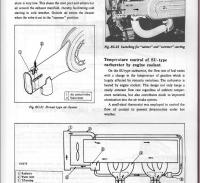 Your page is for a 1978 EFI engine. The discussion is about coolant lines on a 1973 carburated engine. Replay point...

Important Information
By using this site, you agree to our Privacy Policy and Guidelines. We have placed cookies on your device to help make this website better. You can adjust your cookie settings, otherwise we'll assume you're okay to continue.