
Zed Head
Community Member
-
Joined
-
Last visited
Everything posted by Zed Head
-
Most people stretch the 3/8". 8 mm is super close to 5/16" (.315" and .3125"), but 10 mm is between 3/8" and 7/16". .375", .393", and .437". The basic problem is is that they're metric sized fittings. Can't you just lube it up and press it on? Or is the filter nipple too big?
-
-
Found the old thread i was thinking of. She may not have followed through but others did.
-
Very sad if true, but is there a link or some other source? Many John Coffey's on Facebook. Nothing on Benton Performance or Beta Motorsport pages.
-
Removing old tank lining might be where dry ice comes in handy. Make it brittle then throw the nuts and bolts in and break it up.
-
Pretty sure that FastWoman did this, and kept her big bumpers. I think that she has a 78, but I don't remember seeing any pictures. On my 76 the bumper moves inside the rubber end trim, so they'd end up projecting ahead of the bumper. 78 has the accordion style pieces. but after 38 years they may not be flexible anymore. Wish somebody made rubber replacements or modified ends.
-
The instructions for RED-KOTE say it's solvent-based, and they recommend MEK or similar for clean-up. In the solvents world, gasoline would be considered a "non-polar" solvent, and MEK "polar". They're different ends of the spectrum. Just some trivia to explain why it might work to pour a gallon of MEK in to the tank and slosh it around. If it doesn't dissolve it completely, it might swell and soften it enough to break in to chunks. It might be an air cure material, like linseed oil, which would stop it from dissolving but still leave its susceptibility to MEK. They even talk about using MEK to remove other coatings. Edit - looks like RED-KOTE is not a cross-linked or cured material (see MSDS below). So it should dissolve completely in MEK. Sorry Dave, that you spent all that time with the heat gun and blackened char, although yours might not have been RED-KOTE, maybe one of the others. Anyway, were it my problem I'd scrape a chunk out and see how it handled some MEK before throwing a gallon in the tank. p.s. 2-Butanone is another name for MEK. So, about 50-50 acetone-MEK is what they dissolve 27% RED-KOTE in. Edit 2 - on second look it does have a crosslinking agent, at low concentration. So it would probably swell a lot, like gelatin, in MEK. Still an improvement in getting it out. But maybe why the rad guys wouldn't touch it. "Red-Kote is a solvent-based polymer coating " "15. For clean-up use methyl ethyl ketone, acetone or a quality lacquer thinner with no alcohol in it. " "Remove old coatings completely first, using MEK, acetone or other solvent " http://www.damonq.com/techsheets/red-kote.pdf http://damonq.com/MSDSSheets/DMN0142.pdf
-
Seems to have potential. Not mine, don't know whose. Might be worth it just as a spare. http://portland.craigslist.org/clc/pts/5553174595.html
-
Does the meter still show 16+ volts? You might not have the S wire connected properly. Maybe that is damaging the alternator's regulator, or passing too much current, although that should damage more than the just the fusible link, The link is designated for quite a bit of current. You can check both S and L at the alternator with the the T plug disconnected. They should both show battery voltage with the key On. I would do that first.
-
Was it off because of a loose bushing or they just didn't set it right? Funny how they can say "rebuilt" but leave the new parts set for self-destruction.
-
It's in the Factory manual. http://www.classiczcars.com/files/category/4-manuals/

-
How do you know? They're designed to stay fine on the outside while the inside self-destructs. Silicone insulation. Did you reconnect the correct connectors at the battery post? The plastic snap-in ones? One is ground and one is power (with the fusible link in-line). Sounds like you either know something shorted, you saw sparks, or you're assuming. The thing below implies EFI fusible link. I think that the combined EFI and pump relay are on that link. Good luck. You really need to measure things to know, it looks like you're just eyeballing them. " With key on, pushed AFM flap, fuel pump does not engage. "
-
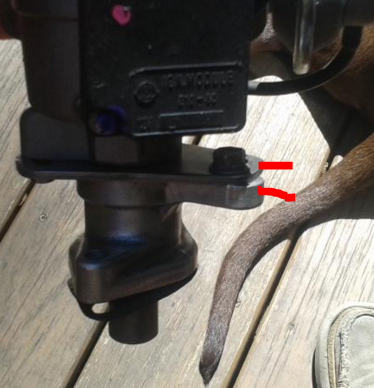
I marked the mark location. It looks fully retarded I think. Rotation is counterclockwise and when you turn the dizzy, you're moving the pickup. So yours shows the pickup moved away from the reluctor as it rotates, which would be delayed or retarded.
-
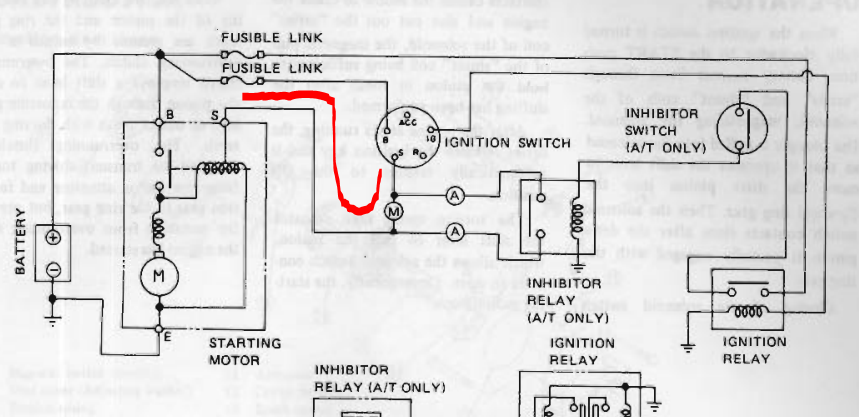
I had a fine hair or thread or piece of dust stop my AFM fuel pump relay contact switch from closing. Never did find the actual thing, I cleaned the contacts with a matchbook striker and it's been fine ever since. So I'd say yes that can happen. I saw a post recently about an EFI relay that stopped working because the internal ground connection broke. I think that yours might ground through the case. You might confirm and check your grounds. And don't overlook a bad ignition relay. Can't remember what exactly it powers but I think that the starter circuit might have its own power, independent of it. Just checked and the manual trans. cars have a direct wire to the starter solenoid. So the engine can spin with a bad ignition relay. My ignition relay was full of rust. One of the Z car vendors out there actually borrowed a pciture I posted of it to help sell his own parts. They're in a damp location.
-
Do you mean that the engine spins via the starter then stops spinning? Or that it actually starts then dies? There 35 pins at the ECU plug. Which don't have power? And did this happen out of nowhere? It was running fine? The EFI system has its own fusible link, attached to the battery positive post.
-
The Service Manual.
-
78 has the system that uses a control relay and a pump power relay. The control relay uses either current flow from the alternator OR current through the oil pressure switch to actuate the pump power relay. Relay powers relay. There's a whole thing about how it works and testing on EF-35. One way people test their pumps with 78's is to disconnect the oil pressure gauge/switch and turn the key to On. I'd guess that your control relay is sticking, and that won't work for you.

-
I haven't done one in quite a while but I seem to recall removing my exhaust system. It looks like you can wiggle the trans.out but it's too close. The FSM says to disconnect it from the manifold but doesn't say to remove it. If you're not on a high lift though I think it gets in the way if you don't take it all the way off. It hangs down and cuts off driver's side access. Another gasket, maybe a broken stud. Be careful. Probably right to do it at home. Edit - actually there's a whole extra set of small problems that can crop up on this job. You'll probably want to remove the console to get to the shift lever. That's a pain, and the three screws in the change pocket are probably rusted and one or two will break. The exhaust system. Might break a stud. You'll probably realize that the slave cylinder hose is cracked and ready to blow. You might find it very difficult to get the hose broken free because it's been on for 35+ years. You'll realize that the rear engine seal is leaking and decide to change it while you're there (it's easy). Here's a tip on the driveshaft bolts - put the wrench on the nut, jam it against the body of the car, and turn the driveshaft by sticking a screwdriver in the u-joint yoke.
-
-
You have a before and an after. This is where the old KIS principle fits perfectly. Check that link. Except - I think that you might actually have a different problem too, or only. Alternators pump out juice according to demand, not all of the time. Short circuits are high demand. You have a short somewhere, most likely. Find that short. The reason for the link wiggling is to check the connection of the link to its terminal. That's also the connection that can open up when it gets hot. Short circuits cause a lot of heat. That's how the fusible links work, they melt to save their cousins, the harness wires.
-
You can spin the rod inside the clevis (fork) using a pair of pliers (edit- from under the dash, everything else still connected), after loosening the lock nut. You might leave a mark on the rod but it's doable. There should be a strong spring on the pedal that pulls it up. Sometimes bleeding brakes can take a long time to get right.
-
The fuse wouldn't be blown, just barely connected. Same with the fusible link. The current flow causes heat which causes expansion which causes movement which breaks the electrical connection. Could just be the ends not making good contact. You could look at the diagram on BE-33 and pull the three possible fuses (all 10 A) that are shown, with the key On. One of them might cause what you see. Do the same with the fusible links.
-
Nissan made some big changes from 76 to 77 if the wiring diagrams are correct. I get the impression though that where the meter is tied in doesn't matter much, which makes sense. It just offers a clue, a better one in your case. In 76 there were all kinds of things branched off the VM source wire. In 77, not much.
-
I'm not sure what I was looking at re my first comment. Have to dig later. This diagram shows a fusible link in line with the meter, as CO suggested, and a fuse. Might be the same fuse that controls the lights. The diagram below it on BE-33 gives some options although I can't follow the maze myself.

-
I didn't even think about why the voltmeter wire would run through the flasher. Not very rigorous. But that's what the wiring diagram showed. I thought. Might have messed it up. I think that there's a fuse for the running lights. Might be overheating and opening. Cools down and close. The voltmeter doesn't really draw much current at all. Almost none. But I'd still trace the path of the wire that moves the needle.