
Zed Head
Community Member
-
Joined
-
Last visited
Everything posted by Zed Head
-
That one is for fuel. "280" is looking for the vapor line check valve. Actually, I was wrong in my earlier comment. Not any check valve will work. How it works is shown in the FSM drawing. Two way, like CO said. It's kind of redundant as far as the fresh air flow backward to the tank since the gas tank cap has a vent also. If you do change it to a check valve make sure that it lets air out. The filter that's on there is probably the best "fix" until you find a real one. But it's not really going to affect engine performance.
-
Not sure where this is going... Do loop... Good luck.
-
Good luck with it. You really gotta be very specific and notice the fine details to solve these sporadic problems. The answer is in the fine observations. When and what. "Jumps around" and "occasionally" don't tell much. No offense. The system is essentially two parts - the "trigger" and the current control. You could buy an MSD unit and run it with your distributor trigger. But if the trigger is the problem it won't help. You could also convert to points for a test. Mechanical system. No electronics to confuse things.
-
I would just set up your volt meter, remove your oil pump sender connection and turn the key to On. The pump will start running. Watch, listen, wait. It should sit at 36-37 psi for hours. That's what it does when you're driving, it just sits back their and spins. Watch the gauge, listen to the pump, and wait for something to happen. If nothing happens and fuel pressure holds steady, you're problem is probably not related to fuel pressure. Break the problem in to small pieces.
-
You don't need it for engine operation. It's an emissions device. Edit - the following statement is wrong >>> Any check valve will work. Cool. I've discovered a new trick.
-
The GM HEI modules are pretty robust once set up right, and cheap. $25. You can use the red and green wires from inside the ZX distributors to drive them. Or get a 280Z distributor and use that. Your tachometer needle is the best clue to what's happening with spark. If it starts jittering or dropping and rising, or doesn't match engine best-guess engine RPM that's a clue. If it rises smoothly and follows RPM then spark is probably not your issue.
-
The pumps do wear out or get damaged. I had one that I picked up from a wrecking yard that worked great for about 5 minutes then slowly lost pressure and started making noise. FastWoman has posted about one that she had in her car that did similar. This might also explain the drop in voltage that you mentioned early on, as the motor gets loaded up and pulls more current. Might be worth your time to remove the fuel pump and bench test it. Or crawl under the car, set your meter up on the pump terminals measuring voltage, and have somebody actuate the pump for you. You'll hear it and see what voltage is doing. If it looks great with a low voltage drop for a minute or two but slowly drops voltage and runs slower, that's a clue.
-
I would start with money and convenience on engine builds. If you live down the street from a shop that knows how to work on these old engines, and has a machine shop with a guy that knows what he's doing, for a good rate, you're probably in good shape. Most of us these days have trouble finding anybody who knows much about them and won't charge a ton for simple operations. I had problems finding somebody that would turn a flywheel for a reasonable cost.
-
The factory 280Zx distributor and electronic ignition module is pretty good. What improvements are you looking for? Black Gold's HEI suggestion is probably the cheapest, and biggest bang for the buck.
-
Shifting in to reverse is the clutch disengagement test. These transmissions don't have synchros on reverse.
-
I did ponder the measurement of resistance on a circuit that had voltage. My reasoning didn't give me an answer. A test light to represent the pump circuit might be a better test. I thought that somebody had found a flaw in Nissan's overall test procedure for the pump control. Maybe that was it. The test results don't fit the original problem very well. As SteveJ noted in post #11. I just tried to move things along. Might have extended the barking instead. Sorry.
-
What is your idle speed? And did you rev the engine up a little bit when you were checking for charging? Have you checked for voltage at the T plug wires? They both should show battery voltage with the key on and the engine off. One senses battery voltage, the other supplies current to the windings. Your 78 came with an internally regulated alternator. Might be that somebody cut your L wire, the one that supplies current to the windings. Does the red Charge light on the voltmeter light up when you turn the key on and go off when the engine starts? It's supposed to.
-
They make nice coffee tables.
-
Edit - the R200's are. Maybe the R180's aren't. The diff axles are different length, left to right side. If you had two short ones in your diff, one of them won't lock in. Shouldn't be any difference in axle length by year. Looks like you have spare parts. Maybe you got some mixed up.
-
What does "baulky" mean? I had an old transmission that took a little while to wear itself back in. The first few drives were tough. The "cones" are steel and can rust. Also, for old transmissions, Redline MT90 is great stuff. Makes a difference worth the extra cost.
-
I think that it's called a "circlip". Circular clip. If you didn't seat the clip in the groove the last time that you installed the half-shafts (that's what we tend to call the u-joint "drive " shafts [which is what Nissan called them back then] then the axle might have been loose and worked it's way out. Or, as grannyknot said maybe it's just worn out. Usually it takes some serious effort to remove the axle from its clip. I use an oiled chisel face myself to wedge it out. They should be very tight. The clip is in the diff.
-
Begin here -
-
Shiny. Apply power, wiggle things. The loose connection will show itself.
-
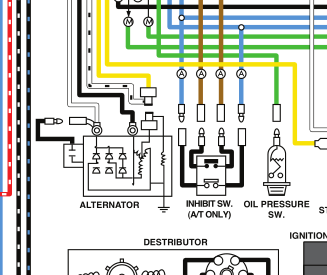
I think it's white/black one. Bottom of the T. But the bad connection could also be at the regulator. Could also be in the regulator. The alternator supplies the ground for the light and energizes the windings so that charging can happen. If it happens again you could check for voltage at various points on the circuit. Follow it from the lamp or back from the alternator. All I'm really saying is that the light should have been on. The fact that it wasn't is a clue.
-
Mmmmm...cosmoline. What does "preped" mean, and "good"? Good for immediate reassembly or good for machine work? Looks like they removed all of the core plugs. Probably hot-tanked it. Was any machine work done? You said engine but just show a block. Are there more parts? Just trying to help out. @Mr. A
-
Was the red Charge light on? It should have been. If it was not on then you might have just lost connection with the L wire at the T-plug. I've had that happen at the alternator and at the starter solenoid. Take it off clean it up, give it a little extra crimp with a pair of pliers. And, by "no charging", do you mean it showed some voltage but less than 12? If it showed zero volts then you have a different problem.
-
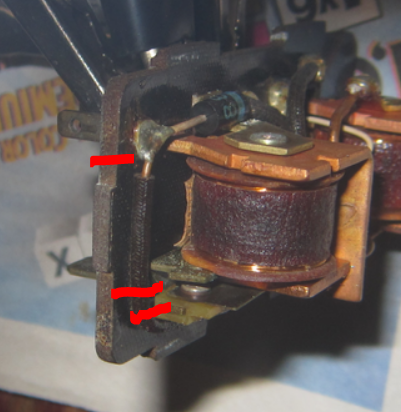
No. Soldering abilities at the Nissan factory weren't very good back then. Broken solder joints and loose connections happen. Some connections are soldered and some are staked. Time to pry those tabs back and take the cover off.
-
Funny, I just popped one of those out the other day. They tend to be difficult. A pair of Channelocks over a few layers of cloth will get it spinning to loosen it up. A big screwdriver in the hold-down slot, with a piece of wood under it for a lever that doesn't damage anything, helps pry it out. But, to confirm what you probably already were thinking - it's awkward and difficult, and they tend to stick. Hard to avoid getting plier marks on it. Most are scarred.
-
They're right here. The tachs seem sensitive to the voltage pulse. People often have problems with the MSD ignition systems too. I had problems with a GM HEI module. The XR700 is about exactly like what you replaced. No real benefit. You could put the old stuff back and keep the Crane as an emergency spare.
-
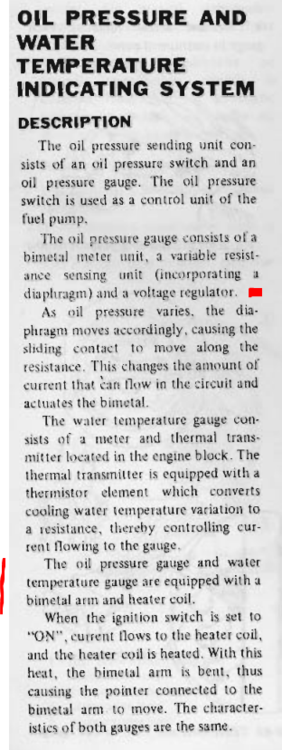
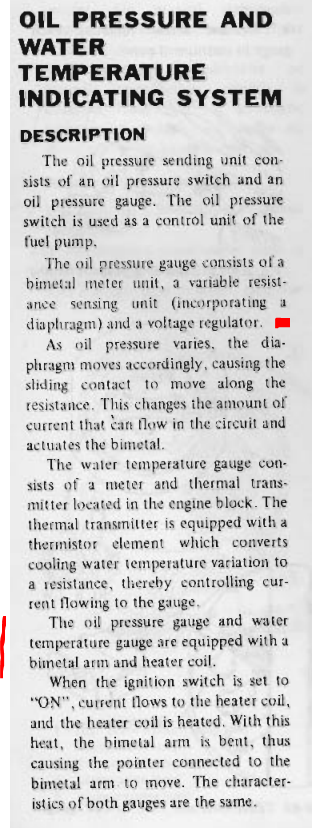
Might be the gauge itself, not the sender. There is some voodoo there also. This is from 1978. They stopped describing it in later FSM's. It's not a great description they don't really tell where the voltage regulator part is. They blend the sensor and dash gauge all in to one. But, it might be the gauge.