



Zed Head
Community Member
-
Joined
-
Last visited
Everything posted by Zed Head
-
Of greater capacity. The crankshaft position and the oil pickup position do not change if you change the capacity of the pan. If the pickup position is changed then an argument can be made for a dipstick that has different marks on it. The marks indicate level. When people say add the quantity that the factory said to use then mark the dipstick, there is an assumption that the oil pan capacity is what the factory had in mind when they put the marks on the dipstick. If you're not sure what dipstick or dipstick tube that you have then remarking your unknown dipstick is valid IF you have the factory oil pan. Most of the statements in this discussion need to be qualified.
-
Let's call this a "bench building" thread, like bench racing. No verification, lots of pontification. On the dipstick, if you put a larger oil pan on your engine do you change the dipstick? No. The dipstick is there to verify the proper "level" of the oil, not the quantity. For some of the very reasons that you described, windage and the pickup tube entrance. Both of those are determined by level, not quantity. Your logic went awry, you made the points against your own "no". Anyway, I was hoping to learn something interesting regarding the odd pressure readings. Didn't learn anything. Lots of contributions, not much returned.
-
Thanks RacerX but I already posted that drawing of the oil passages. And loose and missing are not the same thing. And, you can't know the quantity of oil that will pass through a loose or missing oil galley plug or the pressure drop that will result if a plug is loose or missing. You can only assume. Anyway, this looked like an interesting problem but it's not clear at the end here that the problem was anything more than just a goofy gauge or a piece of crud stuck in the gauge port. Lots of parts moved around and removed and replaced but no reason shown or even guessed at for the low gauge reading. For some unknown reason the gauge now reads oil pressure that is perfectly suitable for the engine. The dipstick is meant to show the distance of the oil from the bottom of the block. That distance could have been confirmed while the oil pan was off. The dipstick has to match the dipstick tube. Carry on.
-
Any chance you could tell the people what you saw while you were in there? Before you move on to the new wiring problem? A story that ends unresolved is very disappointing.
-
Did you turn the Nissan gauge by the body and not by the nut at the base? You can twist the wires off inside. Sounds like an electrical problem. At least you have good numbers. Mystery unsolved. Cause not found.
-
Here's another interesting thread from before my time on the forum. Says that there are also crankshaft plugs. Makes sense, anywhere a passage is created there will be an end that needs plugging.
-
He said he checked it in post #55. But that would not cause his system pressure problem. It just bypasses the oil filter. Won't be a surprise if the problem remains when it's all back together. Here's a question for the engine builders. Maybe it's in Monroe's book. Are there oil galley plugs that could be loose or missing? Of course, they would have to be internal since there are no huge oil leaks. I just did a quick Google and found a reference. Different engine, still Nissan. https://www.311s.org/phpBB3/viewtopic.php?t=10024
-
Even if they were over-torqued that's not going to be the cause of your problem. You've spent a lot of words on torque settings. How did the parts look? The pickup tube and the bearing clearances? Not seeing any signs that you found the source of low pressure.
-
If you read around you'll find that the Mallory distributor seems to be of high quality. I posted a link to a site that might have replacement ignition modules/trigger sensors (the red part inside the distributor). Z car distributors aren't a "buy new and replace" part anymore. They all take some extra work and many of the options don't have the best advance curves for the engines. After doing some reading it looks like if you do decide to disconnect the MSD module then you'll have to use a ballast resistor to avoid damaging the Mallory module. They were developed before current control technology was incorporated in to the modules. So, don't just disconnect the MSD and run it, or you might burn up the Mallory module. So, no easy routes to a fix. If you do buy a new distributor and use it with the MSD and find that you still have the problem at least you'll have a spare. You could probably replace the MSD with a GM HEI module as a cheap test. But, still takes some electrical knowledge. We could go round and round for quite a while.
-
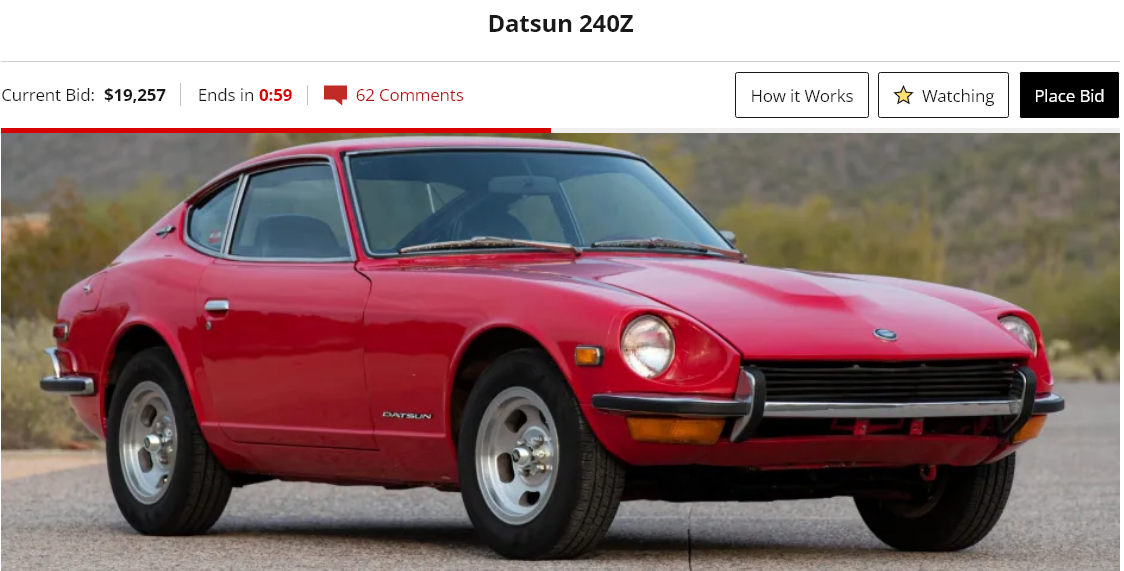
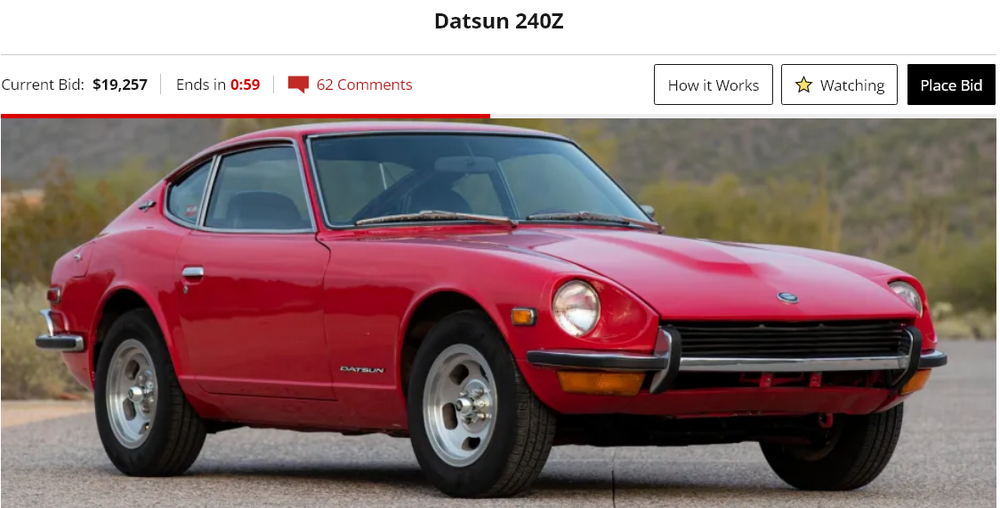
Here's an interesting one, ending today. Probably going to be RNM, based on the seller's comments. A PO "rebadged" and retitled it with tags that don't match the VIN. Then it got retitled with a brand new AZ VIN. Just sold for $19,600. The seller said he had more in it for restoration costs. https://bringatrailer.com/listing/datsun-240z/
-
Just posting this for future reference. Don't know if one of them fits yours. Get the number off of your part. https://www.summitracing.com/search?SortBy=BestKeywordMatch&SortOrder=Ascending&keyword=Mallory Replacement E-Spark Modules
-
I would just focus on the MSD and the Mallory parts and the coil to start. Look for signs of overheating, clean things up, assess the quality of the parts. Be careful moving things around the Mallory module might be adjustable. p.s. I didn't really study your pictures before. Looks like you have the full Mallory distributor. Not sure if you can get replacement parts for those.
-
The heat comes from the electrical current. It might be worthwhile to disconnect all of the connections and clean then up then see what happens. Bad connections can cause heat, and they can also open up after they get hot. It might not be one of the two ignition modules. Then you'll know exactly what you have and what state the parts are in.
-
That's an old original Mallory Unilite. I don't know much about them, except that I think that Mallory sold a complete distributor but might also have sold a conversion kit. I think that you have the original light triggered Unilite. The black disc on top has a vane that breaks the light beam. I think that Pertronix might have converted the "light" trigger (hence Unilite) to magnetic. Here's an old thing I found. https://www.zhome.com/ZCMnL/tech/MalloryDist.htm Since you're in there you might as well check your mechanical and vacuum advance mechanisms. See what shape the distributor is in before deciding how to fix it.
-
It's probably the Unilite or the MSD box. Both electronic. One easy thing that you could do is to disconnect the MSD and just run the Unilite. If the problem still happens it might be the Unilite. The Unilite should have its own ignition module. Also, if you do take it out again watch the tachometer needle immediately after the problem happens. I assume that it is manual transmission. Hopefully there is room on the road to leave the car in gear so that the engine continues to turn. If the engine is turning but the tach needle is not moving then you have a spark problem. Apparently Pertronix bought Mallory. Can you take a picture of what's under the distributor cap? Not clear what exactly you have. https://pertronixbrands.com/products/pertronix-ml-182-ignitor-mallory-unilite-8-cyl
-
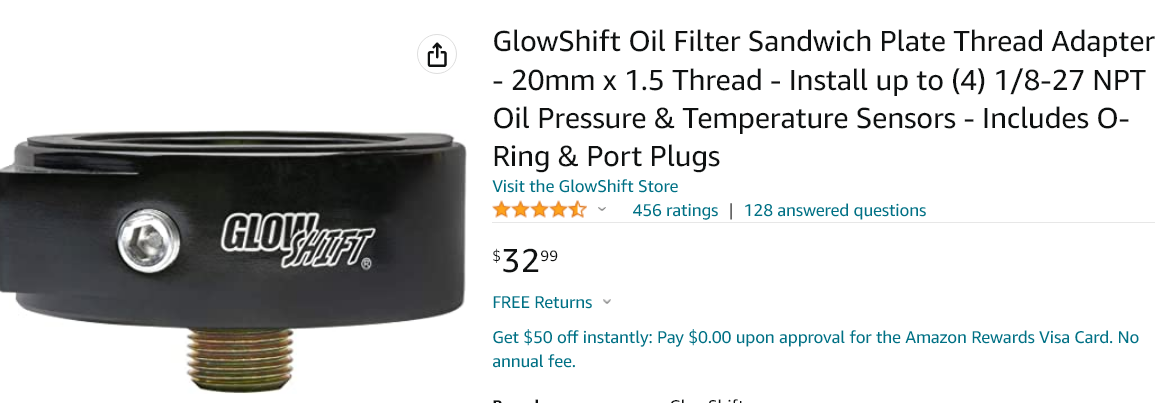
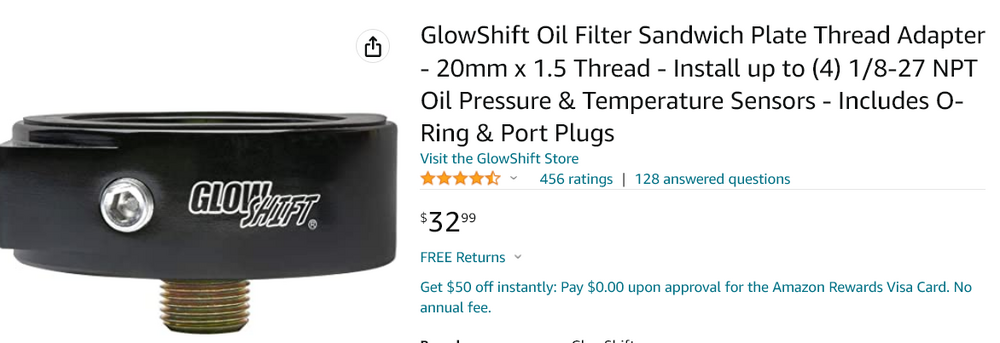
There's always a way to not get things done. It was a concept idea. You could poke around in the port hole too. Ponder why the gauge needle would move so rapidly when it's just sitting there on the small channel to the oil filter, which is like a big buffer pool of oil. Anyway, just offering ideas about what I would do. I really hate how Google or eBay or whoever adds so much extra crap to eBay and Amazon links. Probably contains all of my recent browsing history, in code. Here's a picture instead.
-
I think I already wrote this but I would spend more time on being sure the pressure reading is correct. If you get it back together without discovering the source of the problem. The small passage that the gauge is ported in to could have flow disruptions that give erroneous readings. If there is a constriction or obstruction the fluid could have a low pressure point at the gauge port. The fluid is moving. If it was mine and I was unsure I probably would have tapped a hole in to an oil filter and stuck my gauge there, just to verify what the gauge port showed. The filter is full of very slow moving oil.
-
Some people think the multiple discharges reduce the number of misses at idle. So it might help a bit for emissions. This still seems like an odd thread. Lots of work to try to fool the emissions tester. Whatever you think about the purpose of the laws, really, this thread is about breaking the law. Why not stick with stock, pass the test legally, drive it around while you're in CA and build a separate motor the way you want it to be? You don't even know what the stock engine is like. You can do the lightweight flywheel and lower gearing without worrying about emissions.
-
I think that you might have to get Piston #1 to the bottom of its stroke so that the counterweight is up in order to get the pan off. Too late but I would have spent more time at the oil pressure gauge port and maybe even at the oil filter when everything was together. Watched some oil come out, see what it's doing. Oh well. You'll know a lot more about your engine when you're done.
-
Can't tell much from the pictures. It's the same basic EFI system that the USA 280Z's use. You can even see the EGR valve in one of the pictures. The key is probably somewhere in whatever was changed from when his dad was driving it to now. Something that got disconnected or bumped or moved intentionally.
-
What are they? He is convinced that he only has 10 - 13 psi at any RPM. Are you suggesting that he needs a new gauge? Or that 10-13 psi at the gauge port is just fine? No offense, but your posts are of the "nope, not right" variety, but no concrete actions suggested. What should he do now? He has a new gauge, he made a fuzzy video. What are you suggesting today?
-
Seems like a lot of effort being expended here that will most likely lead to failure to pass. As I understand California they have the visual inspection, the idle emissions measurement, and the 2500 RPM cruise emissions measurements. Three chances to fail. I used to spend a couple of hours messing around back and forth at the emissions station in Oregon (free checks as you long as you're making improvement), dialing in the AFM, the timing, sometimes the fuel pressure, so that I could pass just idle emissions. On a 76 with no catalytic converter, mostly original engine parts. The MSA AFM that I had bought in the past just ran rich at idle so I would have to change back to an older original AFM that I had picked up. Then after a couple of years of dinking around with the engine just to see what it would do the idle emissions would be out of spec again.
-
So, what path forward are you suggesting?
-
I think that you're headed in the wrong direction Wally. I only mentioned the oil filter relief valve as an example of a relief valve. The pressure is still caused by the resistance to flow of the main bearings and head oil supply orifice. The pump produces pressure which forces the oil through the passage that the gauge port is on. If there's nothing holding the flow back then pressure will be low. I'd put the old oil pump back on before doing anything else. If pressure is still low then the problem is farther down the line. Or on the supply side, with air leaks or obstructions at the oil pickup.
-
157 posts before that one. Too many to go back and try to figure out the history of the transmission. 3rd and 4th use the same shift rod. Are you shifting with the clutch pedal down? Rolling the car a bit? You said "shouldn't it go in to gear if in neutral". Doesn't make sense. Neutral is not in gear.