LeonV
Community Member
-
Joined
-
Last visited
Everything posted by LeonV
-
Steve, looks like we think alike! I have a WB02 system (14point7) sitting on my desk all ready to go. I am having my exhaust guy put in two bungs, one per pipe when I head over there today. I really don't want the bungs on the header though, hopefully we can fit them on the pipes. If not, my NLA header will have some new holes in it. It's going to be one loud ride with these open headers, gotta make sure to grab some ear plugs! For now, I may just fine-tune my idle circuit with the wideband, since I don't want to change jets until after I establish a new baseline. Thanks for your input!
-
Nice Julio, you gotta love days like that. Sounds like an awesome ride!
-
I'm curious as well, especially with the stock cam! I do highly doubt that I will gain anywhere near 12% just by virtue of the header. On my L24, that would take it from 121whp to 135whp! It's just not gonna happen, maybe on a hopped up L28 or stroker but even then I'm not convinced you can gain 12%, let alone 15%. Is it worth it? It depends on cost and your goals. To someone building a race engine, yes it is worth it. To others, maybe not, it depends on how much one is willing to pay. I got the header for a good price and it's in good shape, so I'm going to use it. If it alone doesn't improve performance at all then I'm at least happy with the sound it makes!
-
Steve, I decided not to do AFR logging, since I didn't feel the need to do so (no tuning runs, just baselines). I plan to do AFR logging in my next baseline, as well as tweaking the mix and spark. Basically, I'll do another baseline with nothing changed except the exhaust and then go on to jetting, etc. I could've logged AFR and made jetting changes, but my budget is not unlimited and I don't have any spare jets to play with. I'll do my best to keep the comparisons valid. As far as volumetric efficiency goes (VE), it is directly proportional to torque output. Therefore, the VE changes will be seen in the torque curve. I don't think that the header will make a big enough difference to wildly swing AFR, based on other's test results. Like I said in my conclusion, spark and mixture tuning should yield more gains then just switching out exhausts, although the header coupled with twice pipes should have a noticeably different torque curve from a stock manifold and single pipe.
-
Not sure, probably a mistake. It should be registered as a '71, considering it was manufactured after August.
-
Well, I just installed them, so I guess we'll see! They're in better shape then the rest of my manifolds (stock 240Z, Clifford Research, or Hooker Super Comp). Install was fairly painless, besides the light burn I gave myself when I was checking for leaks (they get hot real fast!). I did disconnect the steering rod at the steering coupler but that was just 2 bolts. After a little maneuvering they dropped right in. Clearance is tight at the floor with only a few millimeters to spare, but as the engine spins they will tend to move away from the floor. They sure sound mean as hell, though! The exhaust note is noticeably different then with the stock manifold, but I only ran it for 30 seconds or so. Should be off to the exhaust shop tomorrow!
-
Wrote up an analysis to the aforementioned dyno testing: http://www.classiczcars.com/forums/showthread.php?43323-260Z-Dyno-testing-exhaust-system-analysis-with-pics-and-videos&p=372877#post372877 Also in the process of installing a header!
-
Dyno Testing My 260Z This is an analysis based on my dyno testing from 8-20-11. Test Parameters The reason for the testing was that I wanted to log a baseline for my 260Z before going further with more engine modifications and to make a comparison between different configurations. The baseline settings are as follows: early 260Z with 1972 L24/E88 that was installed by the previous owner triple 40DCOE-18 Weber carbs with K&N-style filters, not jetted yet, just bolted on and sync'd Cannon long-runner manifold stock exhaust manifold to single 2.5" crush-bent pipe stock cam and internals refreshed cooling system with aluminum radiator, new water pump and hoses heater loop is blocked off at both ends Mobil1 synthetic 10W-30 in engine, Redline 75W-90 in transmission (GL-4) and differential (GL-5) MSD coil, NGK plug wires The two pipes to be tested: \ Test 1: Long 2.5" pipe with straight-through muffler in the rear VIDEO Initial Thoughts and Numbers: I know actual dyno numbers don't mean a whole lot but I came in thinking that I'll be happy to break 100hp! The Z feels very torquey and quick but we all know that the almighty butt-dyno isn't very representative of reality, so for all I knew I could've been making 85hp... I was also pretty convinced that I would not be over 120 hp as the carbs are not jetted and I have not even touched the spark timing. However, according to the dyno that day, I am making 121 hp @ 5200 rpm and 136 lb-ft @ 4000 rpm! At the very least, this indicated that my engine is fairly healthy and that my tune is not completely off. A happy side-note but we're here for comparison purposes not peak numbers. On to part two! Test 2: Stock downpipe, cut after the merge VIDEO Results SOLID lines are long-pipe runs DOTTED lines are short-pipe runs *Note: there are local peaks at about 5850 rpm, and they are there for both runs so it very well could be due to the tune. The long-pipe made slightly more torque on the top end, but the short-pipe made more low-end torque. Analysis On the surface, the results look counter-intuitive. After all, shouldn't a short pipe be better for top end and a long pipe better for low end? How about the "mechanic" that's been "doing this for years" that says "well son, when there's less backpressure you lose all yer low end torque. You need some backpressure." Well in this case, running it with no muffler and a cut after the merge increased low end torque. So please, get any thoughts of backpressure out of your head when speaking of exhaust tuning. In fact, forgot the word completely, it is not a very useful term in the exhaust theory glossary, besides wanting as little of it as possible. The results come out as expected after you look at the differences in the two pipes. The critical difference between the two being the length of the secondaries before the merge into a single pipe. Take a look at the second picture from the beginning of the post, showing both collectors. Take note of the differences. The long pipe exhaust merges the secondary pipes quite a bit earlier than the short pipe, meaning that the short pipe secondaries are actually longer. Thinking back to wave tuning, whenever there is a discontinuity in a pipe (e.g. a change in pipe diameter or merge), the compression wave coming from the open exhaust valve gets reflected back as an expansion wave. A tuned length of pipe allows the expansion wave to travel back to the exhaust valve just before it closes, further dropping pressure in the cylinder. This draws out more burned exhaust gasses as well as draws in more air-fuel mixture during the valve overlap period (scavenging). Keep in mind that a tuned length is only good for one engine speed. As pipe length before the discontinuity (merge) changes, so does the time it takes for the wave to travel out the exhaust valve, down the pipe, reflect and come back to the exhaust valve. A shorter pipe before the merge decreases the length of time it takes for the wave to reach the exhaust valve, therefore it is more efficient at higher engine speeds. The opposite is true for a longer length of pipe before the merge (longer wave travel time = lower rpm efficiency). This test also shows that a single 2.5" pipe is ample for my L24 spinning to 6000 rpm, because it essentially mirrors the short pipe and actually outperforms it at high rpm. The large diameter pipe allows for the collector to do its work without hindering performance post-collector. Conclusion and Discussion The results nicely agree with the exhaust theory that we've covered in this thread. If I took the long pipe with the muffler and cut it after the collector, it would perform better, but the difference would likely not be discernible. On the other hand, if the pipe coming off the collector were smaller than 2.5" then pumping losses would begin to climb and performance will decrease across the board, especially at high rpm since frictional losses in a pipe increase with the square of velocity. In the near future, I am having twice pipes made and I'm curious as to the effect of keeping the secondaries separate. It may cause a small hit in performance, judging by how much of an effect moving the secondary merge point had, but carb and spark timing tuning will be a much more drastic change. I broke off a stud at the exhaust manifold-to-exhaust connection point, and although there was no detectable leak, I may just put on my Nissan Motorsports header and build the pipes off of that.
-
They are not "anti-stall" devices. If your car stalls without a throttle dashpot, then something is wrong. The reason for these devices is to keep the throttle slightly open on abrupt closures in order to keep hydrocarbon emissions down, i.e. it creates less unburned fuel.
-
I'll make a thread in a little while describing the testing. Sorry to leave you hanging, for now!
-
Dyno time! DuySVvde-Pc
-
Do you have a small mic that fits through the grommet holes?
-
Look in the FAQ section at hybridz.org.
-
-
One of the reasons I like the M Coupe is because it's so reminiscent of the 240Z! It has a similar "swoopy" but muscular design with a sweet straight six under the hood. The S2k also reminds me of the Z, as it's fairly lightweight, curvy and muscular and has a hell of a drivetrain. Back on topic, looks like you have your work cut out (literally). Keep up the great work!
-
Off topic, but is that your M Coupe? I love those cars, and am considering getting one (if I don't get an S2000)!
-
Cutting springs is not a bad idea. However, I would not cut stock springs, they are too soft to begin with. By cutting them, the car will drop but the ride will not be pleasant, likely bottoming out on large disturbances. Ride comfort is determined by the combination of springs and dampers, with the dampers affecting comfort more-so than the springs. I think Eibachs with Tokico Illuminas should give a comfortable yet sporty ride, plus the Illuminas have adjustability so they can be set for cruising or racing. You say you'll be using Tokico dampers, but which ones? From your sig pic, it looks like your Z is already lowered. Are you trying to lower it more?
-
-
It's been done many times. Make sure the cam spins free when the towers are torqued and you're good to go.
-
Why? Just swap cam towers and be done with it, procedures are on the web if you search. Basically, slowly tighten the towers down, making sure the cam spins free. Some slight tapping with a rubber mallet may help...
-
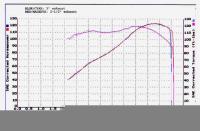
Yes. A 3 inch will very likely improve upon a 2 inch pipe, an be on par with the 2.5 inch (diminishing returns). A 3 inch pipe will certainly not hurt performance in any part of the rpm range, contrary to what myths say. I am doing a bit of exhaust dyno testing on the 20th and will report the results, but as far as the 3 inch pipe comparison, well that's already been done. Courtesy of zhome.com
-
-
Poor neglected cooling systems, wonder what'll pop up next!
-
The very early 240Zs had two levers, but they definitely weren't split up by carb. One lever was the start enrichment and the other was an idle speed lever. I think the reason for removing the idle speed lever was because of safety concerns (people using them as cruise control), but that is just what I've read and not necessarily factual.
-
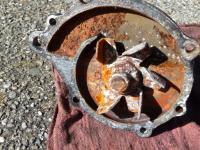
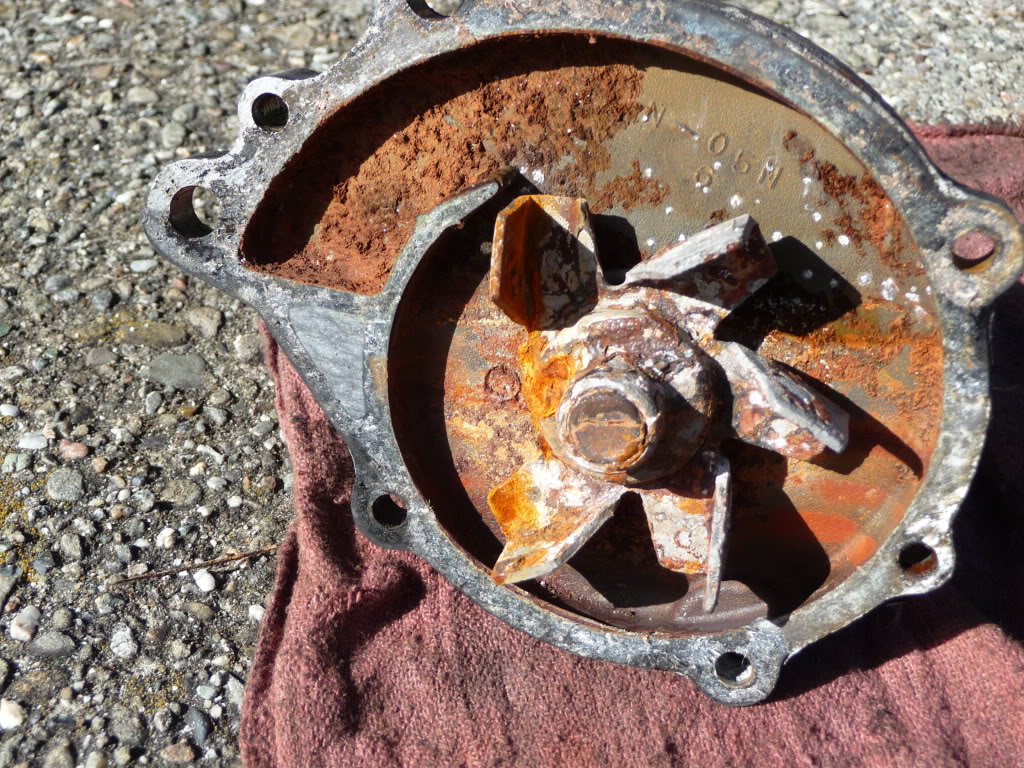
BTW, don't you just love surprises when pulling water pumps! Here's one of mine: I flushed (many times) with water with the thermostat houshing and water inlet off (those were also replaced).