26th-Z
Community Member
-
Joined
-
Last visited
Everything posted by 26th-Z
-
Serious encouragement, seerex. There is a haven of Z restoration in the Tampa area. This Fairlady is here and I would be willing to help with part sources and shops. RETIRE THAT CAR TO FLORIDA FOR SPA AND RESTORATION!!!!!
-
Ah yes, good 'ol floor tar. Use a heat gun - hot air - to get it warm and it scrapes right off. The tar mat is used for sound deadening and the car will be pretty noisy without it. It also acts as thermal insulation. Of course, the problem with the floor tar is that any moisture will get trapped and rot the floors out. (Which is probably why you took it off in the first place.) Ask Chloe at MidwestZ if she has any more left. She had authentic Datsun stuff some time ago. Or, try automotivecarpet.com
-
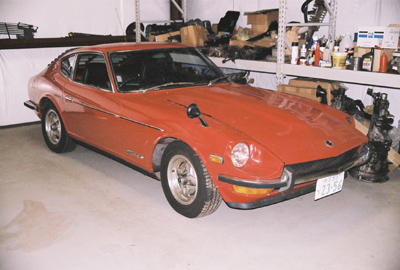
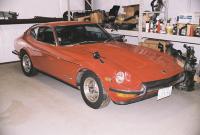
What has me dumbfounded is the rear red marker light. None of my photographs of Fairlady Zs show this marker light and I thought the red marker light was for export. The vented quarters would make sense - except for a '69 car. The steering wheel is not stock. I wonder what this model really is! Japanese market Fairlady Zs came with a 2 litre, six cylinder engine until October 1971 when they were replaced with the 2.4 litre. A title is a government registration of the ownership. It records the owner and the serial number of the car. Without one, the car can not be registered to drive. Of course there IS a title somewhere, but it may require a significant amount of research to find it. That car is in seriously bad shape. Wayyyyy beyond "tender loving care", it would require a complete chassis up restoration and compared to my project, I would guess in the $30,000 range to make it pristine again. The engine is seized? Zowie! That poor thing is a parts car. And I see a few things I would like!
-
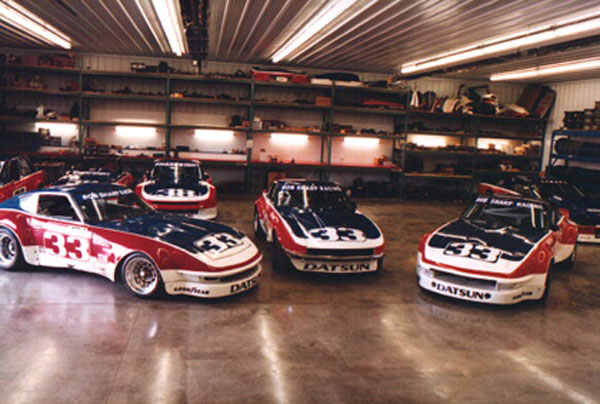
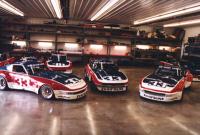
Before you bid, ask for the documentation. I would be amazed to find this car as the seller says. One quick internet search "Bob Sharp Racing" will give you a list of sites to visit including a club. Here is a photo of what Bob Sharp Racing 280Z's looked like. I would imagine these cars are in collector hands and just think of this logically. No one would put an authentic Bob Sharp racer with racing heritage back on the street.
-
 Whoa! Your'e getting there!
 -
That's nothin! You caught it just in time! Yea, that undercoating does deceive, but you have little to worry about. My encouragement! Now, you may be having some problems inside the frame rails and I suggest you drill holes in the bottom of the rails to clean out what is inside and inspect. Best of luck. :classic:
-
Hello halz, I have a couple of Competition Parts Catalogs listing headers and exhaust systems for the 240Z. These catalogs are fairly early, addressing the L24 engine through 1972. Datsun USA shows a part number listing "240Z Exhaust System" - a complete muffled dual pipe exhaust system from the engine to the back of the car. 99996-E1045 No photograph is shown. The Japanese Competition Parts Catalogs "HS30 Sports Options Parts" 12/73, as well as "Fairlady Z, RS30 / HS30 Sports Option Parts" 3/76, lists 14004-E4620 for the headers and 20000-E7276 for the exhaust tube kit. Other parts such as gaskets and hangers are shown and noted, but the descriptions are all in Japanese. Hope this helps. NISMO indeed is the performance / racing arm of Nissan.
-
There's a lot of info on the net about using acids for rust removal. Some of the more concentrated acids such as Naval Jelly (35% phosphoric acid) can do some damage if not cleaned off properly. Acid in that high concentration will eat the metal. Something like OPSHO (less that 12% phosphoric acid) is considered a rust encapsulator because it is so weak.
-
Vicky, Yes probably as my parts fiche lists superceed numbers up to 12 / 79. It gets quite confusing, but just dealing with the right side of the car, and both inner and outer panels are involved, the outer panels are: 73120-E4100 - roof panel 73270-E4100 - tail rail 78100-E4600 - rear fender There are a number of inner panels as well as a corner brace involved that make up the box section through that area. I could look, but I'll bet there is an inner panel seam to match the outer. In my Chassis and Body Service Manual, this area is described through section E-E of Figure BF-59 "Sealing Body Panel Joint" and appears on page BF-31. Of course, this is all early series information, but it seems to be all the same up to 1979. I have had this area down to bare metal before and the seam in Her Majesty is filled with lead. It does crack and heating the area is done to fill it again.
-
Bob, Spots are usually bigger once you get in to them, but if they are less than 1/2" diameter, you can drill them out an exact diameter and weld a flush "punch" back in. Look for a slug punch tool from some place like Eastwood that makes a metal slug in a specific diameter from sheet metal. There are a range of sizes available and it beats trying to make a patch. Drill a hole that is much bigger than the rust bubble to get the rust around the edges of the bubble. The slug fits flush and it is a true metal patch. Watch out with acids. Make sure you clean the area to get all the acid off.
-
Vicky, That seam laps multiple sheets of stampings and on the early cars is a real lead filled joint.
-
And this is the racing variant. It is lighter and spends money faster.
-
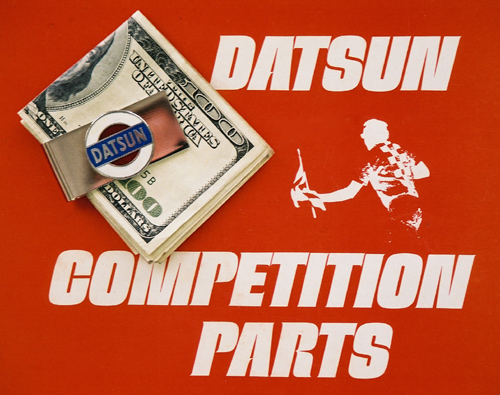
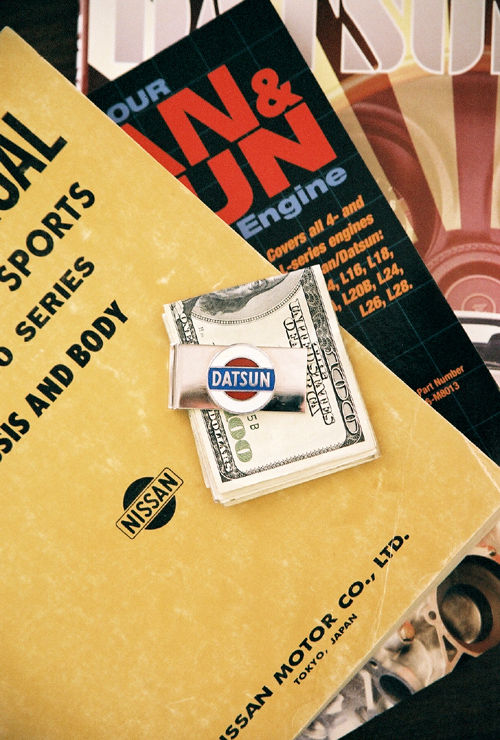
You need to get the Magic Datsun Money Clip. It never runs out. This is the restoration variant.
-
The Blues Brothers As long as you are going to mention LeMans with Steve McQueen (don't even talk to me if you haven't seen it 20 times and bought the DVD), don't miss Grand Prix with James Garner. The new BMW films are pretty good, too.
-
I'll confirm that!!! I spent $6500 on Her Majesty in 1991 and I'm about to do it again. And she's been in storage for five years! I guess if you are going to take your car down to a stage that you can sand blast, you won't abuse it so much by letting it sit out in the rain. Down here, it's not good to let the car see sunlight.:classic: I might suggest that a car completely stripped is the best candidate for sand blasting because the mess can be cleaned up the easiest. I aggree it's too messy to blast areas without taking the car apart. And there are areas in the frame that would trap media and be difficult to clean out.
-
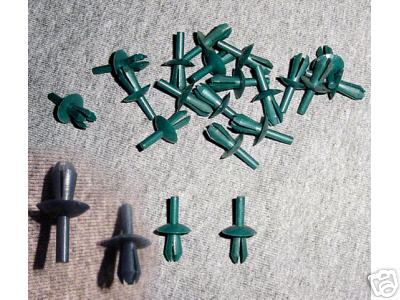
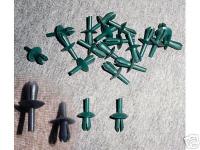
The plastic interior panels are held in by plastic expansion rivets that attach by pushing the pin in after the rivet has been secured. You need approximately 25 to do a car. They are usually available in any color you want as long as it is black and I'm guessing they run $1 each (usually in packs of 10). There are some areas that use screws, and the screws are either chrome counter sunk phillips head or black anodized counter sunk machine screws. This also depends on the model. A few areas require a chrome scew and grommet, either chrome or clear plastic. Here are some blue 280ZX rivets on eBay now
-
Oh...Here we go again!!!!! ROFL
-
Thanks. Lets see how this works. Edit: Perfect! Thanks Old dog just learned a new trick!
-
Thanks kats. The hubcaps are great! I wonder if the hex caps fit on the hub cap like the "D"s do. Just great many thanks. edit: No! They are part of the pressing. Just great.
-
Sorry to take so long getting back to this. Somebody needs to coach me through the quote insert part. I don't know how to insert a quote. Hello Alan! You listed some part numbers for fuel door locks. You'll get a kick out of this - it is so Datsun. My fiche lists the two thumb latches as 84360-E4601 and later E4602. I believe 01 is plastic and 02 is metal - both chromed. The two 78820-E8200 and E8201 numbers are listed as key cylinder type and optional. No dates are listed and there is no 78820-E4100 listed. So Datsun. I'll mention this for interest. I don't know what you think of the idea, but molds can be made of the emblem / badges and reproductions cast - easily in plastic. I am casting plastic and rubber parts. It is quite likely that a chrome finish could be applied to the plastic casting. Hey kats! Please post a picture of the hubcaps. I would like to see what they look like.
-
I can confirm the vented hat brake rotors from HLS30-00026. I believe I have the same problem with the rotors, and noticed the difference when I bought replacements, but now I will look into restoring them.
-
I saw a new kit from Studio 27. A Group C March 87G (Calsonic) Nissan from LeMans 1988. The V6 twin turbo car prior to the GTP Nissans. $150!!! Zowie! I picked up the Fujimi Fairlady Z432 I have been looking for and a Fujimi Fairlady PS30Z 432R. One was $19 and the other was $24, both with engine detail.
-
Hey Marty! I was looking for that thread where we were discussing LeBaron-Bonney and came across this one. The sample arrived today. It is from page 92 of their catalog - part US 121, 35" wide rolls at $3.99 a yard or something like that. The insulation "jute" is a synthetic fiber mat about 1/4" thick and it is grey in color with red fibers - grey red. It is not brown (light or dark) like original, but it is the same consistancy and thickness. Actually, this is much nicer material than original. Much more dense (denser?). The finish is fibrous but smooth and it looks like two bonded layers - one side is greyer than red and the other side is redder than grey. I could easily use this under the tunnel vinyl and my only hesitation about using this under the carpeting on the floors, would be the horror on the faces of the purists who pull up my carpeting to check for rusted floors or forbid, original jute.:tapemouth :tapemouth :tapemouth This stuff reminds me of the "jute" that comes bonded to some carpet kits, but with out the plastic finish.
-
My compliments, Alan. I'm impressed. :classic:
-
Hello Caen Fred and I can't thank you enough for the link www.hlj.com I found EVERYTHING I was looking for, ordered stuff that was even listed as backordered, communicated easily and this morning they shipped it all from Japan. I'll let you know when the stuff arrives, but so far this has been the find of the century for S30 models. Check this place out. It is all in english and they have everything I have seen described NLA on eBay.