



Zed Head
Community Member
-
Joined
-
Last visited
Everything posted by Zed Head
-
The symptoms are the same that I had when my Air Flow Meter (AFM) was bad. But you show that you have replaced yours. Did you get a new/rebuilt one or just a different one?
-
Congratulations on the "new" car and good work on finding all the important numbers on the engine. You probably know already about the free FSMs at http://www.xenons130.com/reference.html . Even with the modifications, there's probably still lots of useful information in the FSM for you. A couple of notes on your pictures - your fuel line is about to split open at the carb (fire!) and it looks like the filter might be bypassed (rust!). And your brake fluid is low in what looks like might be a non-stock master cylinder and reservoir. What's under the distributor cap, points or the electronic ignition setup?
-
Your symptoms don't really indicate a bad ignition module. But, regarding the HEI module that you installed, yes, you do have to ground the case of the module for it to work correctly. A grounding lug is molded in to one of the mounting holes. It is well-documented in all of the installation instructions (surprising that missed it, hope it didn't do any damage) that you have to ground through one of the mounting holes. Some people even run a separate ground wire from the mounting hole. From what I've read (I have one on my car but it has always been grounded, so can't say for sure) they will be damaged internally if they lose electrical ground. Might be worth grounding it and trying again. The critical mounting hole has a wide flat grounding area, it's easy to see. Edit - If you have a voltmeter, check for battery voltage at the coil terminal, both sides, when the key is on and when cranking. Also, the magnets under the stator plate can break on the 280ZX distributors. Connect a voltmeter to your positive red wire from the distributor and see if it is generating the voltage pulse necessary to fire the module, while cranking,
-
A new clue! - it died while going up a steep hill, but it did run and drive for ten minutes. It either died because the engine was loaded and that made a problem worse, or maybe it is a fuel supply problem. Did you have a full tank of gas? How far did you go (ten minutes at 55 mph or ten minutes at 15 mph) before you climbed the hill and how far up the hill did you make it? What did it do before it died, did it cough and sputter or did it just quit? Climbing hills takes more gas supply than just cruising. The better your description the more ideas you'll get back. Just trying to help, you could give more information about how the car actually runs, when it does run.
-
Coincidentally, I just ordered one from OReillys, picking it up tomorrow. 1976 280Z. Baxter Auto Parts and Autozone carry them also. Autozone ships to your house from orders off their web site.
-
If one half-shaft moves (rotates) with the wheels on the ground, it could be a u-joint or both (or loose splines but that is unlikely, I believe). With wheels on the ground the half-shafts should not rotate at all, they should be locked solidly on to the wheel. It's hard to see the u-joint move with the half-shaft on the car, even with a bright light and your head twisted in to a good position. Sometimes you can stick a screwdriver in the joint and wiggle it around. Look for signs of rust at the seal also, I had a dry one on my car and you could see some rusty residue around the seal. It didn't take much movement to get an audible clank/clunk. You can remove the half-shaft working from the wheel well of the car,with the wheel off.
-
Are you sure that you're not putting them on backwards? Datsun did not use the red = positive, black = negative that domestic cars use. I don't know what happens if you do, but it's worth confirming. Or, could your key be in the On position when you were connecting the battery? Maybe you heard the fan motor? Make sure that the key is off and that you don't have any positive wires shorting to ground. If you have an ohmmeter, you can check the positive cable to see if it has a path to ground BEFORE you reconnect the battery. Put one lead on the negative terminal and one on the positive, without the battery in. If you don't have infinite resistance then you have a short or something is on. Or if you have a test light, hook up one battery terminal, then test from the other unconnected cable to the remaining post. If it lights up, then you have a short or something is on. This will let you find your problem without frying anything. Hopefully you didn't melt anything,but you should probably check your fusible links and look for scorch marks.
-
I forgot about that one. Which is funny, or not, since it actually happened to me once. The message of the evening is check the clutch components for proper operation.
-
You will find that the fluid is low. It is probably in the slave cylinder dust boot. Odds are good that your slave cylinder is bad. If you keep forcing the gears, then something really will be wrong with your transmission. Search "slave cylinder" or "clutch problems."
-
Another good material for cleaning oxidized, tarnished or corroded connections is 3M Scotchbrite. It's not as aggressive as most sandpapers and leaves a nice shiny surface with no grit. It will also hold up to WD-40 or Deoxit or a typical contact cleaner. You can cut a small piece and use pliers or a screwdriver to get in to small places. argniest, I don't know what your weather is like, but if you can get the car out for a spin, you'll probably be more able to translate all of this new knowledge back in to a new description of what your car is doing. I went back to Post #1, and the original issue was that it was down on power and getting poor gas mileage. If you do too many things without re-establishing a baseline you can get lost. I saw your comment about your headlights magically coming on again. That is a sign of oxidation in the headlight switch or in the dimmer switch, from sitting and not being used. From what I've experienced and read on these forums, the old "use it or lose it" axiom applies in full force on these old cars. The headlights on my car didn't work when I got it, but I haven't had a problem since I used some Deoxit to get them working and use them quite often now. Sometimes you can just spray contact cleaner in the switch and work it around to brake up that oxidation. Yours will probably stop working again in the future when the temperature and humidity changes unless you start using them regularly.
-
Can't really understand what the problem is. Can you be more descriptive?
-
This is on the 72 240Z in your profile, right? Did it run before you installed the ZX distributor? And have you reset the timing? Your idle will drop if the timing is retarded with the new distributor. No good ideas on the high-reading gauge. Check your ground, maybe they read high as resistance goes up. One more thing - which year did the distributor come from? Your centrifugal and vacuum advance curves could now be quite a bit different from what you had before.
-
Too bad, I thought you were the lucky owner of four cars, plus parts. Like FastWoman suggests, I have used Liquid Paper/Whiteout to mark the notch. It seems to hold up well. I think I found mine by putting the car in high gear and slowly rolling it along the garage floor by hand so that I could make sure that I saw all of the damper pulley. You can't tell what you're missing when you try to bump it around with the starter.
-
The 77-79 5 speeds and 4 speeds used 3.54 diffs. You should check the FSM or the diff itself to be sure which ratio you have. I think that they changed ratios in the 4 speeds somewhere between 74 and 75, so might have changed diff ratios too. Edit - Agree with Fixitman. He beat me to it. Still worth double-checking what you actually have.
-
Which car, your profile shows four - 1973 240z, 1975 280z, 1976 280z, 1978 280z? Four cars and a spare engine. You must know what you're looking for. Might be that Arne's suggestion is where you'll end up. You can also take your distributor cap off rather than the valve cover) to see when the rotor is pointing at the number one plug wire (should be almost straight ahead ~11:30, I believe) to tell if you're on the compression stroke. Assuming that the car runs now and the distributor is installed correctly.
-
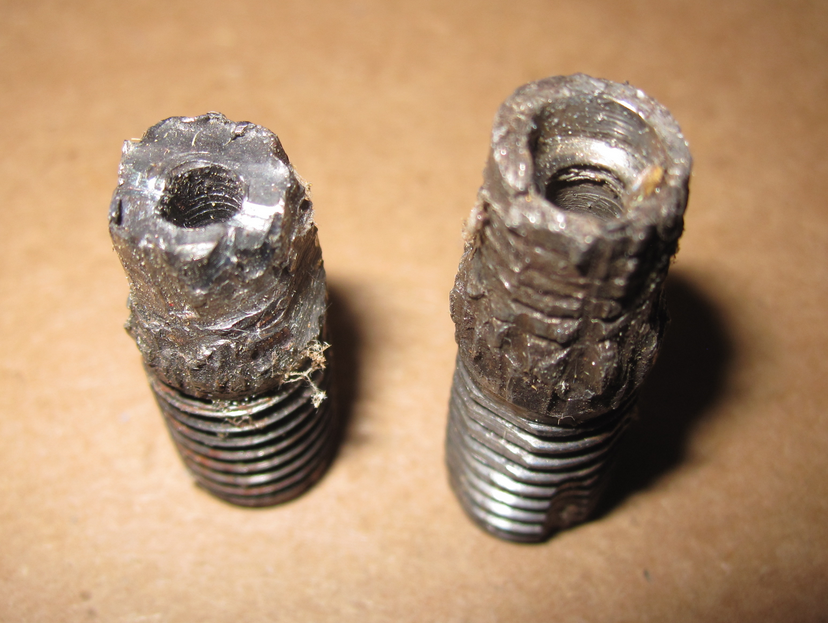
Actually, the L28s did use this tube up to late 1977, I believe, to 1976 for sure (I have one on my 1976 stock N42 head). I'm not sure when they switched to the internal oil passage cam shafts, but the N42 heads up to 1978 are worth checking. You might be able to repair yours by brazing.
-
-
This thread actually changed from the water temperature gauge sensor to the the water temperature switch at justfun13's post #28. The water temp switch is described in full at page EE-26 in the 1976 FSM. Basically, if you disconnect it - circuit open - the car will run on its normal timing both when warmed up and cold. The switch is normally closed, to run off of the other, advanced 6 degrees, magnetic pickup coil (variable reluctor) when cold. I am guessing it's to increase the idle speed up a little while cold. Mine stopped working so I just disconnected it and set the timing where it should be when warm. In theory, you could install a manual switch in place of the thermostat housing switch and run off either pickup coil. The "switch" from using one pickup coil or the other actually happens in the ignition module.
-
3/4 qt. per 1000 miles is not too bad. Seafoam is a once every ten or twenty thousand miles kind of thing, it doesn't repair anything it just loosens up "stuff" that has built up over the miles. It doesn't preserve things either. I would stop with the Seafoam for now. I'm pretty sure that the previous owner of my car had Seafoam in the oil when I got it and that it was contributing to the the eye-burning exhaust. The exhaust smelled cleaner after I changed the oil. You need to get to a clean, normal baseline to work from. Your relative sounds like the sharpest mechanic that has worked on or looked at your car, of all those that you have described.
-
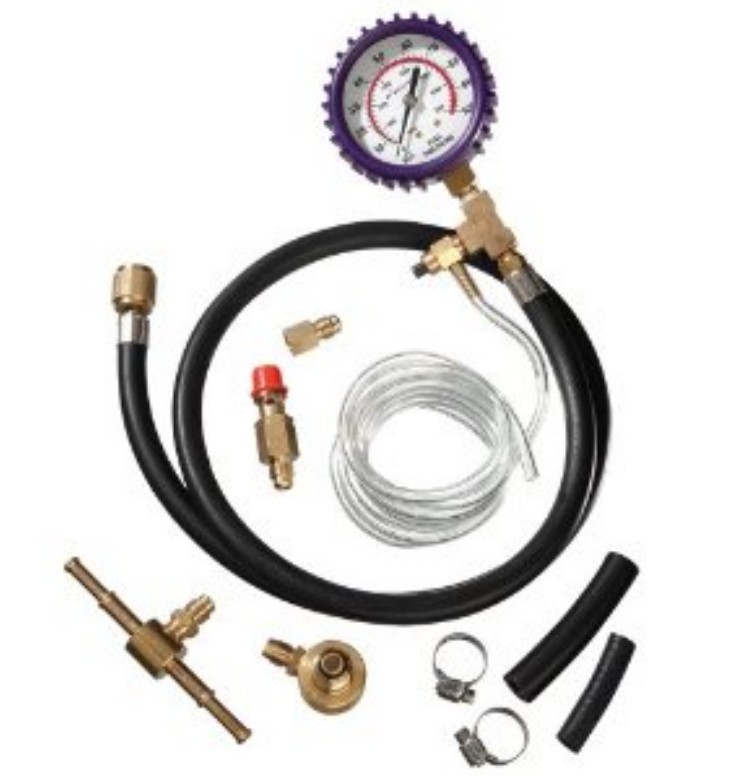
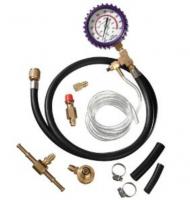
From H to L on your dipstick is one quart. You might change the oil (no Seafoam or other additives) and start over, measuring oil consumption from a known mileage and new oil. Seafoam and other stuff dilutes the oil. I don't want to divert your thread to a "best oil" competition but I did see a reduction in oil usage when I switched from Quaker State 10-40 to Pennzoil 20-50. Most fuel pressure gauges come in a kit and look something like this - http://www.amazon.com/Actron-CP7838-Professional-Pressure-Tester/dp/B0009XQUKC/ref=sr_1_2?ie=UTF8&qid=1294694575&sr=8-2 - and cost about that much. They're usually in a bubble pack somewhere in the store. My car too stunk things up, and got bad mileage, when the fuel pressure regulator was bad. It's always good to know fuel pressure on a fuel-injection system. If your mechanics have not actually measured the fuel pressure yet, then they're not being very thorough, especially considering the symptoms you've described. Edit - FastWoman beat me again!
-
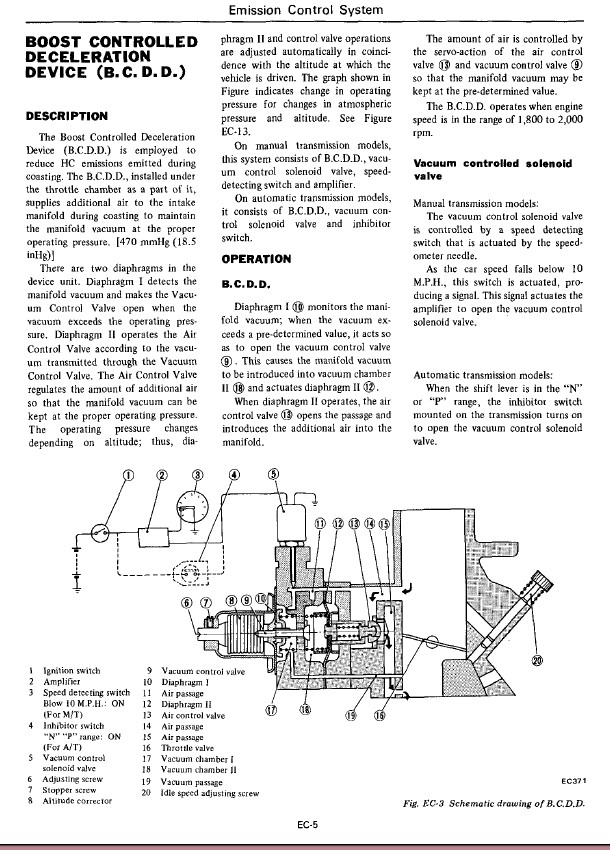
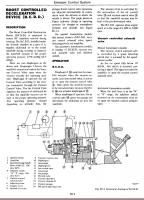
You're probably looking at the BCDD. It's described in the Emission Control section of the FSM.
-
Have you examined anything under the hood? Spark plugs, measured fuel pressure, etc. Does it run rich, with a gassy smell and smoky exhaust? Does it backfire at all? Does it miss? More data... 1,000 is actually a high idle. Spec. is 800.
-
That is another way to get the job done. I almost went that route but I've had the whole thing out so many times I just took it out one more time, and worked with it in the engine bay (didn't want to remove the pickup coil wires). If you go that route, J2Z, don't forget to take the little screw out from the back that holds the pickup coil wires against the distributor body, if you need to. It's hard to see, but it might be difficult to get the pickup coils off if you leave it on. Another FWIW - I just bought a salvage yard distributor a few days ago, because it was there, and cheap, and in decent shape, that had the same curves as my original 76 distributor. I took the breaker plate apart, cleaned it up, put the whole thing back together and installed it. My mixed parts 1978 Frankendistributor worked okay but had a marginal breaker plate. So I'm back to 1976 stock parts now. I'm running about 16 degrees of static advance and really like the way it runs. I use 92 octane fuel and hear no signs of knocking or pinging, although it is fairly cold here right now. I think of my car as a rolling experiment though, so keep that in mind once you get everything working right on your car. Any silicone sealant should be fine between the master cylinder and booster, and might not even be necessary. I seem to recall though that there was no sealant at the bottom when I took mine off. I reasoned that it was left out so that if your master leaks, the fluid will have somewhere to go besides back in to the booster, plus you will see signs of the leakage. It's up in a dry spot in the engine compartment anyway. I didn't seal mine, although I did seal the booster to the firewall.
-
Here is the latest on the "issue." - http://www.classiczcars.com/forums/showthread.php?t=39259 You don't have to compromise the harness. You can make your own jumpers at the harness plug. That is essentially what the adapter does, plus it comes with a diode pre-installed to prevent run-on. Atlanticz and zcarcreations both have write-ups on doing your own harness modifications, but the adapter seems like the easiest, cleanest way to go.
-
1975 has the fuel pump contact switch in the AFM (Air Flow Meter, not maf). It might be that after the car warms up and the idle drops down (because your Auxiliary Air Regulator is working, a good thing) the contacts are opening, killing power to the pump. My 1976 used to do that and I also could hear the relay clicking. When it got close to dying, you could hear the relay clicking on and off, in time to give it some gas. My problem was a poorly adjusted rebuilt AFM, but if your car has been sitting you probably have other issues. I would look for vacuum leaks in the intake system, which would be letting air around the AFM. The system is designed to have all air come through the AFM. Short term, you could just turn the idle up high enough to keep the AFM flapper off the contact, while you look for leaks and tune it up. The Engine Fuel (EF) section of the FSM is well worth reading - http://www.xenons30.com/reference.html