
Zed Head
Community Member
-
Joined
-
Last visited
Everything posted by Zed Head
-
There are good diagrams in the FSMs if you want to compare the pinouts of the ECUs. EFEC section - http://www.xenons130.com/reference.html
-
You unplugged the water temperature sensor that the ECU reads, the one with the same connector as a fuel injector. The water temperature gauge sender (sender is just another word used, the FSM calls it a thermal transmitter) that connects to the temperature gauge only has one wire connected it. The FSM also says that if the temperature and oil pressure gauge act up at the same time, it might be the voltage regulator (the one internal to the oil pressure gauge). How is your oil pressure gauge doing?
-
The 280Z EFI system fires once per revolution according to the FSM. Edit - Deleted my short story, since it was barely relevant.
-
I learned some new stuff. I've seen recommendations of getting a new mount to stop the "clunk" but don't recall seeing the same for the strap. Mine was so loose when I got my car that I assumed it was there for extreme movement or failure. I've never seen the Scarab mount either, though I have seen an L-shaped bracket designed to do the same, but with no credit given to Scarab (I assume that they never saw the Scarab mount either and came up with the L on their own). chacha, there are some good pictures in the 1972 FSM, Rear Axle and Rear Suspension section, showing the differential from the bottom, sitting on the mount and cross member. If yours was misaligned, the front of your diff would not be visible in the same way it is in the pictures. 1970 might be different from 1972 though, since they moved the diff at some point for NVH purposes (as I understand things). If you have a 1970 FSM it might have similar pictures or diagrams.
-
There are many hoses to be concerned about on the EFI Z engines... The AAR should only be active for about 5 minutes right after you start the engine. It has a heater inside that gets 12 volts when the engine is running, so it closes pretty quickly, if everything is working right. It might be possible that your temperature sender is internally shorted. Did you try unplugging it to see if the gauge drops? Made a mistake in my earlier post, I was thinking about 5thhoresman's thread. Still better off with a flow-through rail and FPR system.
-
I don't know the 240Zs but it seems to me that if you have the original R180 differential and all of the parts are installed correctly, the strap should drop right into place. Are you removing one of the big bolts, positioning the strap, then reinserting the collar and bolt? Maybe a 240Z person knows but is it possible the mustache bar and diff mount are on backward and the diff is in the wrong place, moved back? The strap actually has quite a bit of play in it when installed, it's more of an insurance piece to stop excess stretching of the rubber diff mount, or control diff movement when the rubber mount fails. You could drive the car without it, but I would be more concerned with why it doesn't fit. It should be easy.
-
It should be tank>filter>rail>FPR IN>FPR OUT>return line>tank. The FPR is at the end of the system that you want pressurized. Fuel will flow continuously through the lines, rail, and FPR. You have what's called a dead-head system now which is not desirable, especially considering the fuel heating/poor starting discussion in your thread. The only fuel flowing through your rail with your current setup is what goes through the injectors. The vacuum line (small one) from the throttle body is probably ported vacuum and is meant to go to the vacuum can on the distributor. The vacuum line to the FPR (another small one) should come directly from the main body of the intake manifold. The brake booster has its own large vacuum hose. The "bypass plate", if you mean the water line that goes under the AAR, is designed to keep the AAR at engine temperature so that it doesn't reopen prematurely. Best to leave that there is you're keeping the AAR. You probably shorted your temperature sensor wire to ground somewhere. I believe that that is the test for gauge operation. Check the wire that runs to the sensor.
-
Download the FSM and look in the Engine Electrical section - Charging Circuit. It will tell you all about your external regulator, where it's located and how to test it. It's a small metal box in the engine bay.
-
I'm guessing that you're not very confident in how the fuel system is supposed to work on your car. There should be no gas leaks at all in the engine bay. If things are right, you won't even smell gas. The "intake bolts", whichever ones you are thinking of, wouldn't really having anything to do with "getting enough gas to the head". "Idle adjustment" is usually controlled by air flow and shouldn't cause leaking gasoline (although I don't know SUs so maybe they do). Like FastWoman says, I think that you are close to burning your car up. Once a gas fire starts, it's hard to put out, especially if the puddle of gas is under the car. How long have you had the car and how long have the SUs been on it. If someone put SUs on it and kept the original high pressure fuel pump, you could easily get a river of gas and other problems.
-
$150 is a good price. The Oregon junk yards are charging $160 and you have to pull it yourself. And 70k is very low miles. Maybe you should buy the engine too.
-
The swap itself should be easy. There is a lots of information spread around the internet, Google will find many, so will the search function on this site. If you have an early 260, then read the 240Z swaps, late, read the 280Z threads. Junkyards and Craigslist are your best options for finding one. Any 5 speed from 1978 to 1983 will bolt in easily. I believe that the 5 speed was also an option for 1977. If you get in to the clutch, getting a new pressure plate, you might have to spend a little time being sure that you have the right combination of pressure plate height and throwout collar. If you get a clutch kit you should be okay, since the clutch fork pivot ball is in the same relative position on the later transmissions. I don't know what 1974 had for transmission switches, but it's possible that you'll lose a top gear switch also. You might want to check your 4 speed transmission switches to see what you have and decide if you want to keep them. The FSM will describe what they do, probably in the Emissions section. The reverse switch should be there on all of them. These are just generalities. I've only done a 1978 5 speed in to a 1976 280Z myself.
-
Too bad we can't just open the horse's mouth... http://www.lhup.edu/~dsimanek/horse.htm
-
You should find the yellow S wire as Blue suggested and see if it also reads battery voltage. If it doesn't see the loads on the system including the battery, the alternator will just crank out as much voltage as it can. If you still have the external regulator I think that you can just unplug it and measure from the yellow wire connection in the plug to ground. If you have an internally regulated, you'll need to measure at the "T" plug. And as FastWoman suggested, the over-voltage might damage some components. I am fairly certain that my alternator took out my ignition module when it went bad.
-
Everything that I've read implies that the number means very little. I've never seen a table or reference that you could use to find out if the number tells you anything about the transmission..
-
There's a diagram in the FSM that indicates you are right. The two nuts go between the fork and the slave cylinder, as a locked set.
-
Here is a link for the Factory Service Manuals, plus some useful tips - http://www.xenons30.com/reference.html Bear, maybe - bare?, not today. (Obscure Post #1 reference, couldn't resist).
-
I would check the Body Electrical section first - http://www.xenons30.com/reference.html Your year should be in here since your screen name has "240" in it.
-
It should be okay. Datsun went to one inlet to the FPR in 1978, and modified the fuel rail to fit. The fuel will flow through your rail, hit the FPR and flow through the FPR when the pressure builds up high enough to push the valve off of its seat. It would more likely be a flow imbalance. The FPR valve doesn't care where the flow comes from it just opens at a certain pressure. If you wanted one less fitting, you could get a 1978 FPR. It will bolt up in the same spot but only has two ports, instead of three.
-
You don't need the T before the fuel rail. If you're using the stock regulator, you could T after the rail, or block one port. If you T before the rail, you could get a pressure imbalance between the two lines. And fuel could sit in the rail, heating up, while the main flow went through the other side of the T. It might not be a huge deal but if you T after the rail you'll ensure that all fuel passes through the rail on it's way around and back to the gas tank. Doesn't the 78 FPR have just one inlet line anyway. Maybe you're using an aftermarket FPR?
-
Can't tell what you mean by "turn over." Do you mean the starter will not engage the flywheel and rotate the crankshaft? Or that the crankshaft turns but the engine does not start? Do you hear any clicking noises? And do you hear the fuel pump running when you turn the key to start? These would be clues to what things aren't happening that should be. Also, what is an Air Intake module?
-
Pretty sure it's 8 mm metric, but 5/16" works fine. 5"16" EFI hose, 5/16" barbs.
-
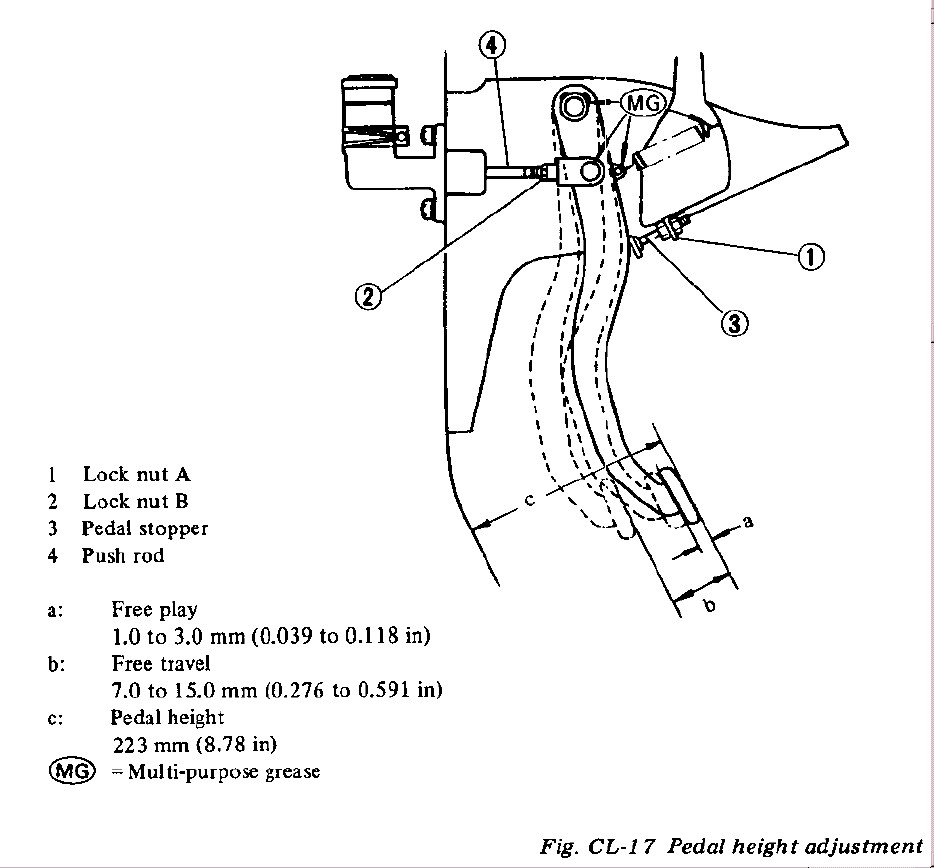
It's a tight fit but you can reach some pliers or your hand up there and turn the rod out by hand,without disassembling anyhting. I had forgotten but my lock nut and master cylinder rod did the same thing last year (similar to what FastWoman described). I thought my slave cylinder had gone bad (again). With 30+ years of wear on the linkage and the combination of aftermarket parts, my master cylinder rod is adjusted out as far as it will go before running out of threads in the clevis (the u-shaped thing). Edit - I should add though, that my clutch disengages with the pedal nice and high. I don't need more adjustment. For the record.
-
Loosen locknut, turn rod with pliers, make rod longer. Two inches is a lot of adjustment though, you might have something else wrong.
-
It would depend on how well you understand fuel injection. There are no bolt on and go systems available, as far as I have heard. They all take some planning before buying parts, and some expertise in engine tuning after everything's bolted together. On your car, assuming its the stock carbed engine, everything from fuel lines to the gas tank, fuel lines to the engine, fuel pump, cylinder head, and intake manifold would need some modification, or replacement. All to work with whatever engine management system you decide to use, to control the firing of the injectors. The more common way to get fuel injection in to a 240Z is to swap in a complete 280Z engine and wiring harness, with ECU.
-
You can buy degrees of completion ranging from a bill of materials to be assembled yourself, up to essentially complete boards and wiring harnesses. I'm sure you've seen this company's site but I'll post it for the record - http://www.diyautotune.com/ They seem to be the most established for Megasquirt, although there are others out there.