



Zed Head
Community Member
-
Joined
-
Last visited
Everything posted by Zed Head
-
Do you even have a car yet? Or are you planning to build an engine first? I had good luck buying a whole car for parts. Check this one out - http://seattle.craigslist.org/sno/cto/5332704588.html Also, the wrecking yard engines can be good. Z's tend to end up in they wrecking yard for electrical reasons, not engine. Who's the guy with the parts? There are some you'll want to avoid or be cautious with.
-
I see now. That is actually just a harness ground, the picture is not-quite-right (I think that picture came from the interweb). It's just an eyelet end on a wire coming out of the bundle of wires there.The EFI ground is the red cable over by the battery. Still, best to check grounds at the ECU connector or whichever device needs them. Then you know that they actually work. Here's a thought - you might have a huge vacuum leak. Maybe forgot to connect the PCV hose under the intake manifold, or you have a split hose somewhere. That could lean everything out so much that the fuel just blows through without lighting.
-
When you press on the clutch pedal you're actually putting force on the crankshaft thrust bearings. Might be why there's a little relief when you let the pedal up. Since you have cylinder pressure, and spark, the most rational reason for no-start, to me anyway, is a timing issue. Fuel, compression, and spark have to occur at the proper times to get combustion. Starting fluid is fuel (along with oxygen), you have compression, and you have spark. That leaves timing, Timing of everything, not just ignition. And you do have the EFI ground, I can see it in your picture by the battery. And the AFM ground is one of the things that you test for in the Injection Guidebooks. But you're mixing your acronyms, which is a concern. Many many people have been in your situation. The best thing you could do is to make a list of all of the things you've tested, with real numbers (not "continuity"), and to confirm the things that people ask you to confirm. Like making sure that the distributor rotor is pointing at the #1 cylinder (the one in front), at the same time as the notch is aligned with the groove on the sprocket and cam shaft retaining plate. Those things are the very most basic of things that need to be confirmed. People often assume that they're right, when they're not. A video of an engine cranking but not starting doesn't give us the numbers we need. And give details on how you did things, like testing for spark. You can get spark at the main wire from the coil, then forget to put the rotor on the distributor. You'll "have spark" it just won't be getting to where it needs to be. Time to get meticulous.
-
In the past, when I had the stock ignition system, I found that the ECU would not fire the injectors if the tachometer was disconnected. Never understood why, and it doesn't happen with the GM HEI module, but it happened on two separate cars with the stock ignition module. Something to confirm.
-
I was just pointing out some things to check. By "ignition timing mark is twice right", I meant that the timing mark will be on the pointer on TDC for the exhaust stroke also, in addition to compression stroke. If you don't check the cam lobes and/or the timing chain sprocket mark, you can get fooled. As Greg W. illustrated. It comes to mind mainly because you said that you have spark, but you don't even get a pop with starting fluid. Spark on the exhaust stroke is spark in to a wide open cylinder. Nothing will happen. Do you have a strong blue spark, or a weak orange one? I've had weak spark outside the engine that won't start it when the plugs are installed. But even then starting fluid would get it going. Something not right if starting fluid doesn't get a reaction.
-
Red herring meaning you thought the low battery was the problem. Alrighty. You're on the edge of following random things without knowing the sequence of events that happens when you turn the key. If the AFM switch is misadjusted or has dirty contacts, the engine will start and run for a few seconds, until fuel pressure drops. The engine should also try to start, combustion events while cranking, from the cold start valve fuel. And, finally, most importantly, you said that you have strong spark. So it should definitely start with starting fluid. You might have a timing problem or some other odd problem like valves not opening. I would run through the basics. Measure cylinder pressure if you can, make sure the valves are opening and closing. Make sure spark is happening on the compression stroke and not the exhaust stroke. The ignition timing mark is in the right spot twice. Check the weird things that happen when people put their engines back together. Spark and starting fluid should at least get a few spins from "fire".
-
Thanks. I missed that last part. And the part about starter fluid. Odd though, that strong spark was observed.
-
So it will "crank" but not fire. It should still start though, for a few revolutions, from cold start fuel. Bad gas, maybe? Way back, a friend and I spent some time trying to get an old 1963 Bonneville to start after sitting for just one year. It just wouldn't fire even though we could see and smell the fuel in the carburetor throat. A farmer happened by on his tractor and told us to squirt some oil in the spark plug holes, the cylinders were probably dry. A few squirts in each hole and it fired right up. Ran great. Anyway, short version, a new engine might not have the rings sealing well. Try some oil in the cylinders. It will burn off. Or some starter fluid. The starter fluid will tell you if the timing, both cam and igntion, is right and if the engine will even run if it gets fuel.
-
The cold start injector opens when the key is turned to Start. The cylinder injectors open when the ECU grounds them after receiving the signal from the blue wire at the coil negative terminal. For most of us, "fire" and "start" are the same thing. So "will start, but not fire" doesn't make sense. Maybe you mean that it will start but not stay running? That might be the fuel pump contact in the AFM. It's bypassed at Start but comes in to play on Run. If it opens, the fuel pump will lose power and the engine will only run for a few seconds. Or maybe you mean it will start with starting fluid but won't stay running. That would be an injection problem. What year car? Not all have the AFM fuel pump switch.
-
All that I see left is a binding suspension system. You've shown that the car is not warped or bent. The struts are the same length. Tires same size. Put mose weight on the high side and see if it can even be forced down to a 1/2" gap. As for Post #83, this isn't a forum for venting your frustrations. You've done a crappy job of answering simple questions. I spent many posts asking you just to roll the car (can't get much simpler than that) to be sure you were doing things right and you just glossed over it like it didn't matter. I asked for three simple measurements and you came back with two of them and one from someone else's question. So you've been all over the map with what you're doing. It's frustrating to watch people ignore good advice. So you screwed up with Post #83. Probably lost a lot of good future advice, and you haven't even fixed the first problem.
-
-
-
That's not true. I've had three items that I can remember specifically moving when hot, locking up when cold - a broken stud in an exhaust manifold would only turn when everything was hot, a front control arm bushing that would only move when hot (using a vice and a socket, didn't want to cut it out), and the spindle pin. Often, the worst thing that can happen to a person is to receive a title. They stop thinking and assume that their first thought must be right. Because they now have a title. The theory may be right, if you give enough time for temperatures to equilibrate. Don't do that. Try my experiment. Your time. Might be fun to prove me wrong.
-
No heat? People just don't understand the power of a billion molecules holding hands. Nobody's surprised when freezing water breaks a block, but the connection to other materials is just a really big jump. An experiment - put 10 or 20 tons of pressure on the press's hydraulic gauge. No movement. Heat the casting with a torch. Watch the pressure drop. No offense intended if you had a torch on the whole time. Or even if you didn't.
-
Are you worried about synchro durability or shifting performance? You can't use the GL-5 spec. to determine if the sychros will fail. There may be a correlation of failure to a few GL-5 fluids, but there is no proven cause-effect relationship. Many GL-5 fluids cause no problems at all with "yellow metal" synchros. The GL specs are about performance, not chemistry. The focus on GL-5 is an attempt to find a "code" that will predict behavior but it doesn't work. So that leaves actual experiences as one rational reason to choose a certain fluid. It looks like a few people here have tried a few different fluids. Many people have used Redline's MT-90. I've seen other posts about the GM/Pennzoil formula Synchromesh. Swepco 201 looks good, besides one report of synchro failure in a race car, during a race. If I were you I'd start a new thread asking what people are using and how it's working. Take a poll. Forget about GL-4 or GL-5 or GLS. Don't forget to read the label or any factory literature about fluids also. If the manufacturer is reputable and says that their fluid will work with "yellow metal" synchros, odds are good that it will. Otherwise they wouldn't be reputable.
-
-
In Post #48 your measurements showed that the strut tower tops were the same distance from ground and the tops of the fender wells. Everything is where it should be. Level strut tower tops, level ground, level fender well tops. But your measurements in #69 with the tires hanging show a 1" difference side-to-side, even though the extended struts are the same length, imlpyng the body is 1" different side-to-side.. So you have two sets of measurements that differ by 1". One shows everything is fine, the other shows a 1" difference. The measurements with the car on the ground will always be suspect because you're not rolling the car. Since you have the struts out, you could remove the springs and reinstall the struts. Let the car sit on the bump stops or strut tube tops if you don't have bump stops. Take a measurement with the suspension fully compressed. Again, they'll be useless if you don't roll the car first. Also, a bound up front strut can affect the opposite corner in the back. The front end will sit higher also if you don't roll the car after lifting. Just to reiterate - if you don't roll the car after lifting and setting it back down, you'll be wasting your time. Good luck. A shop might have some ideas, after all.
-
Well ODM, unfortunately you have left out some critical information. When you lowered the car so that the strut towers were level, did the tires touch the floor? It's not clear if the tires are hanging or if if they have some weight on them. And you didn't confirm that you rolled the car back and forth before measuring. Actually, you've never confirmed that you rolled the car back and forth before looking or measuring. If you don't do this all of your measurements with tires on the ground are wasted Post #69 23 + 4.75 = 27.75 23 + 5.75 + 28.75 From post #48 25 1/4 both sides with strut towers level
-
Just saw this. Looks like it could be a good project, worst case a good price for parts. It's been up for a week, might be too late. http://seattle.craigslist.org/sno/cto/5332704588.html
-
-
Heat guns will put out surprising BTU's. Just takes a little more time to get the parts hot. I had thought of this before, on this topic - it's the opposite of the idea of an interference fit. If you wanted to make two metal parts fit together so tightly that they wouldn't budge after assembly, you'd machine them so that the inner part was bigger than the outer, then heat the outer until the hole grew big enough to fit the inner. Fit them together, one hot, one cold, and they'll never come apart.
-
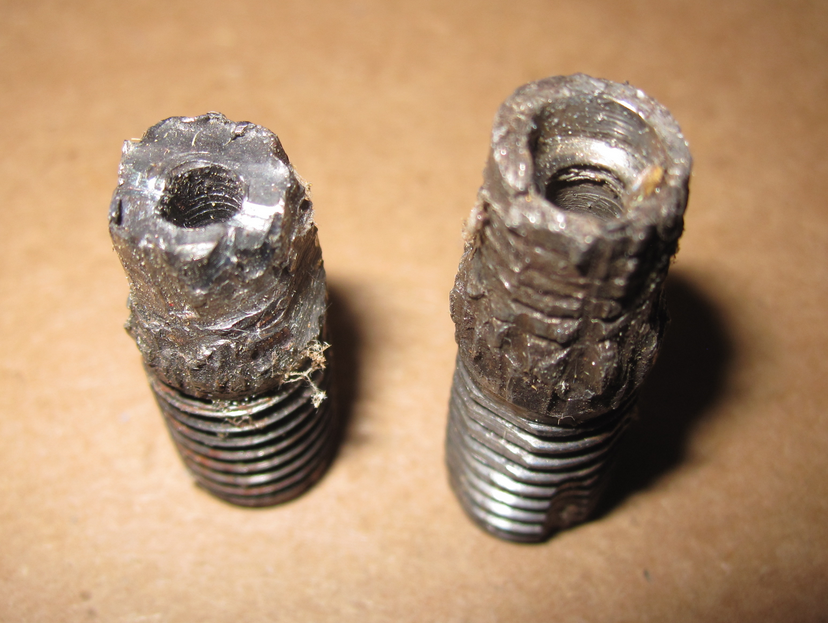
I think that I understand how the puller is supposed to work and I don't think it should break that way. The puller should pull the threaded end off of the spindle pin before that happens. It looks like the inner all-thread rod was being tightened along with the outer pulling tube, causing it to bottom out on the pin shoulder. There might be a technique flaw involved in the breaking of these tools. The inner rod should be held static while the outer pulling tube is turned. I don't know if the all-thread has flats for a wrench but they might help. Anyway, too late now. I don't see a mention of heat anywhere. Might have missed it. Anybody with a stuck pin should immediately go to heat. Probably more effective than PB Blaster or Kroil or whatever. The one pin that I did manage to get out intact would only move when the strut casting was hot. It became immobile when it cooled. I've had the same thing happens with exhaust flange bolts in the exhaust manifold.
-
This would help. With the strut towers level, measure the tire height, the gap between the top of the tire and the top of the fender well, and the distance from the floor to the top of the fender well. Post those three numbers for each side. No discussion about what's what, or what's worn out, or bent, or anything, just six numbers, three for each side. They will tell a lot.
-
It looks like "after adjustment" in the FSM. So #1 should look like "before adjustment". Implying that your #2 hole is as good as you can get between hole #1 and #2 choices. Are you sure that the tight side of the chain is tight? I always have a tendency to over-rotate the engine while watching the damper pulley mark. Then if I rotate the engine backward, I have to turn the timing chain sprocket backward also, independently, to get the chain's tight side tight again.
-
Did you measure the tires height? Hopefully you can see how tire height + gap = fender well height. You can't have the tire heights the same on both sides, and the fender well heights the same on both sides, without having gap the same on both sides. It's impossible. Fender well height = tire height + gap.