
Zed Head
Community Member
-
Joined
-
Last visited
Everything posted by Zed Head
-
A PO might have got them mixed up, who knows. If you did strip the top threads, or they were already stripped and you stripped the bottoms, you might just run a long bolt in there to the bottom and see how much thread you have left. Measure travel from when it grabs to when it stops. Then find an appropriate bolt, or cut a long one to fit.
-
If you have access to a bore scope that would be the thing to do. A broken ring would probably leave signs as MM says. Very light signs, hopefully. I've read of people disassembling old turbo engines that didn't have any visible bore damage and having the rings fall out in pieces. Probably depends on the ring, and the lubrication, and how it breaks.
-
I think that every water pump bolt is a different length. Make sure you didn't get one in the wrong hole. The threads should grab with at least 1/4" of bolt to go before the head, maybe about 1/2". Pretty sure also, that under no pressure, you can have a bad bolt and still have no leaks. I've seen a few broken bolt heads on systems that looked like they were leak-free, even in use. Not recommended but a sign of something off in your case. You might have some other issue going on.
-
Here's a picture of the plate from 1981 ZX engine. Had it off recently. 5 speed manual transmission, all stock junk yard car.

-
Wouldn't be surprised if Datsun Spirit would fix it for you. Only 5,000 miles, kind of looks like a broken ring. Put all of your paper work in order, it probably shows due diligence during break-in and maintenance. Not a huge job, he could probably do it in-car if he wanted to, although, based on reputation, he might want to give it a good look-over out of the car. Forgot that you're on the opposite coast. Still, he might assist financially, at least with parts, if you can find the right shop to work on it.
-
Trust but verify. Eiji could tell you something, I'd guess. Chrome rings can take a while to seat. As Mark M. suggested, a cylinder pressure measurement might be telling also . Leaky compression rings should show there. Bad valve seals and guides can allow blowby on the exhaust side. The head was done by Z Car Performance. Not sure who that is. You're still in that short-term vs. long-term dilemma. Vent the fumes and drive short-term, fix the issue long-term. Interesting problem.
-
Could be he got a rebuilt head from Datsun Spirit and a short block from California Datsun. I'd go through the papers and try to suss out what's what. Why does Datsun come up redlined for spelling?
-
Aren't the two piece units for automatic transmissions? You did an auto to manual swap, right? I wonder if the later auto units have a smaller hole, still two pieces.
-
By the way, older floats are basically just tin bubbles. High pressure can bend/crush them, I think. Carb people went to plastic in later years. Hope you're not at the start of a trail of fixes.
-
Just went over this pump with jxq. That pump uses a bypass port to regulate pressure. I'll bet there's something blocking it. Not sure exactly where the passages are but the instructions describe screwing a bolt in or out to get some variation of pressure, probably by shrinking or enlarging the port. I'd remove that bolt and see what's in there. Here's the instruction sheet - http://www.jegs.com/InstallationInstructions/600/650/650-4070LP.pdf
-
Just had a similar conversation on a different forum, about a 4 barrel carb. The carb manufacturers suggest the power brake port as dual purpose with a T. So it would be the port on the right. But this would run all of the blow-by through two cylinders. I think that people run vacuum logs for situations like this. Two problems really - one is what to do with the blow-by, the other is why is there so much.
-
There's always a way. If you don't want to use the intake vacuum you can use the Bernoulli principle - http://datsunzgarage.com/weber/ If you're using an air filter you can plumb both vents to it. If you're using three air filters you could run a three-way T to each. You could probably place the tube ends in front of the air horns and suck the fumes in that way also if you're running individual filters. You could run a long hose out to the back of the car by the exhaust pipe. I'd find a way to burn them myself.
-
Isn't the bigger hole just for inspecting the core plug area? They probably closed it to keep things cleaner. Look at the all of the clutch dust that would make it past the old one. I'd use the newer one.
-
Run the hose to the intake manifold like the factory did. You'll need to seal the system so you don't suck too much air through the crankcase and screw up your air-fuel ratio. It's not "P"CV until it has vacuum pulling gases through. You might also confirm the "rebuilt by Datsun Spirit" story and get some details. Wouldn't be surprised if they keep records on their work. You could call them with the engine serial number. Nighty-night.
-
You don't really need that second pickup. Although it does take you through engine warmup more smoothly. There is a short time during warmup where the extra timing advance keeps idle speed up. If it's not there the ignition module will just run off of the other one. I had the same problem with the bolt broken off in the housing. You might be able to drill it out. The drill will probably walk off the bolt or through it and in to the aluminum. Mine did but I reused it anyway. Some sealant and a good gasket and no problems. Those are the same. Coolant temperature sensor. For the ECU. The temperature sender (for the gauge) in your top picture just has a bullet connector. That might be the normal mode. Not sure and not by my car. Heat the housing with an air gun or torch. Aluminum expands a lot more than steel. Those sensors will probably come out. Do it while it's on the engine for leverage. But the holes in the housings might or might not match what you need.
-
Hey Mike. The Service Manuals (repair) are there, but not the Owners Manuals. He asked for Owners, specifically. Where's Blue?!
-
I think that's a switch. For the second magnetic pickup in the distributor and circuit in the ignition module. The sensor, for the gauge, has one wire, yellow, I think. It grounds to the housing.
-
Here's an interesting site showing a water pump modification. Just to give an idea of the variation people see. A good understanding of how the pump works and an inspection of what you get is probably worth doing. http://www.wallaceracing.com/water-pump-mods.php Here's the link it came from - http://forums.maxperformanceinc.com/forums/showthread.php?t=411256 I love talking about stuff like this... Edit - just noticed that the thread I linked went on for 1324 posts, over a year and a half. I've only made it through page one, post #20.
-
I used heat shrink also to spread the load at the junction. I think that other switch is the top gear switch. It's for the vacuum advance solenoid switch that lets vacuum through to the distributor. One of those odd emissions things they were doing back then. Pretty sure it's shown in the FSM. Edit - it looks like it's a neutral switch. Not sure what cars had them. Mine didn't.
-
No, I meant the heat sinks used for soldering. It's a metal clip placed between what you're soldering and heat sensitive parts. It soaks up heat that would otherwise pass to the sensitive part. You can use alligator clips but they do make specific clips for the job. http://www.instructables.com/id/Save-your-components-with-a-heat-sink/
-
In general, the automotive manufacturers put much time and money in to designing and testing parts, for performance and durability. Aftermarket suppliers generally put their time and money in to producing a similar appearing product that works long enough to get past the warranty period. The cynical view. I thought that cavitation was a problem with the L6 system. The cast versus stamped discussion covers almost every car brand out there. You can search the Google and find all kinds of reading. I tend towards the factory design generally unless there's evidence shown for a change. Nobody has ever advertised improved performance from the flat stamped steel blades, from what I've seen. Hard to imagine going away from flat and square, if it works, to an intricately curved cast blade, but not totally implausible. Side note - if you misspell performance very badly, "necromancer" is suggested as the word you meant.
-
I was actually going to suggest using the savings on cooling system improvements. Consider the size of the two radiators to see which does more work (or releases it as heat for those physics people out there). You might also consider the potential downsides - more places for oil to leak, and a more brittle oil pan, One missed speed bump or curb and you can be out $500 and have the car down for a while.
-
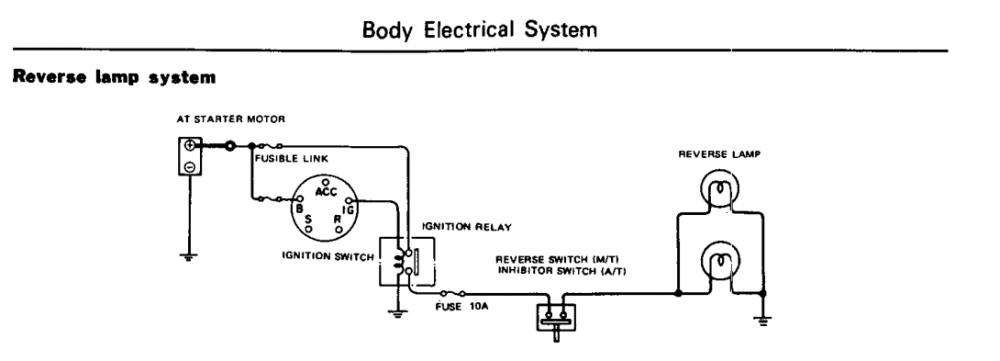
No polarity. The ground is after the reverse light so the body of the switch is insulated, not grounded. To zKars's point - use a heat sink on the base of the terminal, to save the insulation. Pretty sure I just crimped my new wires on, but soldering would work. Page BE-16 shows the whole circuit but here's the short one.
-
It's just a switch. You might consider new, flexible, wires, I've found that the old wires are all stiff from years of heat and getting washed by dirty road water. Probably why they break, any wire movement puts all of the stress on the connection point.
-
Your oil passages and bearing clearances will be the same though. Sounding like you don't really need the pan or the cooler.