Carl Beck
Community Member
-
Joined
-
Last visited
Everything posted by Carl Beck
-
It was actually pretty easy for the previous owner. He had HLS30 00157 in May of 1970. Drove that about 32K miles before he took it completely apart to "put a decent pain job on it"... After #157 was properly restored, he bought a Wine colored 78 280Z to drive (because it had A/C )... then saw the first Black Pearl.. Bought it just to have another "new" Z when he wanted one... as he had heard the body style was going to change in 79... So he just added the Black Pearl to his Collection (a rather extensive collection of many many thing)... He never did wear out that Wine colored 280Z... today it has about 80K miles on it (and still looks new).. His 48 Chevy has almost 28K miles on it, and his 65 Mustang is approaching 10K miles.. When you have 20+ cars and 45+ Harley's... it really is hard to drive them all more than a few miles per year! He still has his fathers 32 Ford Pick-up.. that thing is really getting up there now.. it has almost 40K miles on it.. Now approaching 80 years of age.. he's starting to place a few of the cars and other objects he's loved so much for so many years - in the hands of people he believes have both the resources, and the will, to preserve them for yet the next generation of fanatic Collectors. In general that is exactly how cars like that survive the decades... to delight us at shows and museums around the country. FWIW, Carl B.
-
Sorry - I guess I didn't refresh my screen... took me a few minutes to find the engine photo, resize it and up load it ... and I didn't see your last Post.. Nonetheless.. it's a great picture of Pure Stock and 100% Original... regards, Carl B.
-
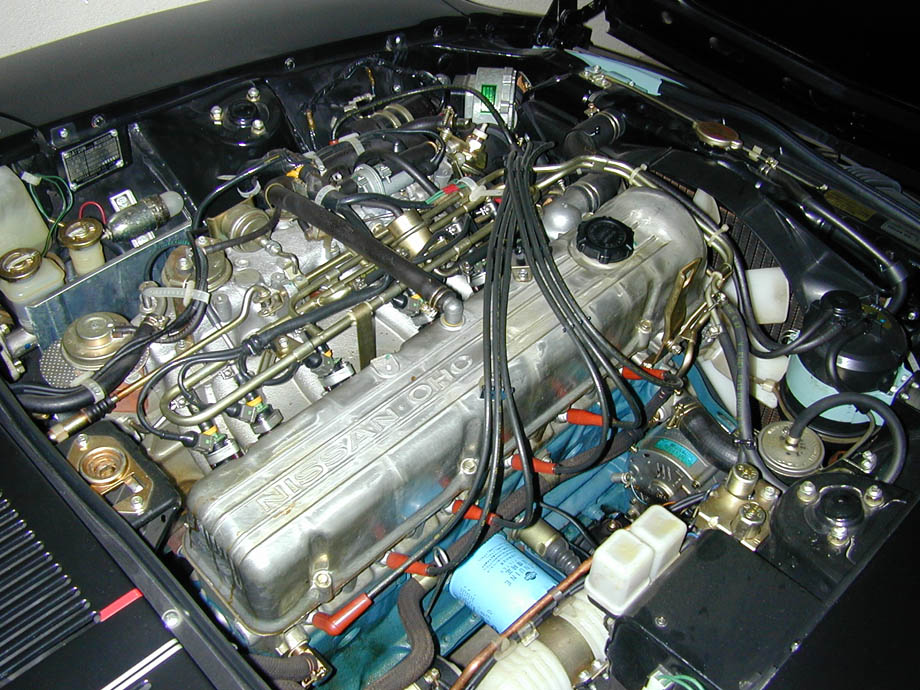
The Fuel Rail was changed 8/77. So the 78 280Z's have the newer type. The picture below is a 78 Black Pearl with 643 miles on it. FWIW. Carl B.
-
I haven't seen a "stock" 280ZX Turbo on a dyno... but I'd guess that they would be in the 140 to 150 RWHP range. The Factory rating was as I recall 180HP. I have seen a few L28ET's "mildly modified".. with the addition of intercoolers, free flowing exhaust, etc etc.... running boost limited to 10/11 lbs... They put between 215 and 235 RWHP down.. Carl B.
-
got it and responded.. regards, Carl
-
I believe that 135 number was based on estimates or approximations - if you wanted to convert 1/4 Mile Speed/weight to HP numbers. Depending on what trap speed and which weight... the early road tests reported for stock cars.. it comes out between 130 and 140HP. If you use the BRE C-Production 1/4 mile trap speed of 108mph and you guess that in racing form it weighted about 2300 lbls with the driver... the rule of thumb shows 243.8 HP... which is a little low.. but then it's a rule of thumb... just an approximation... The BRE engines were said to put out something over 250HP on the engine dyno's.. FWIW, Carl B.
-
Right behind the right rear tire.. there is an access panel held in the inner-fender by about four small screws. Take the RR Tire off to get it out of your way... remove that access panel ... and you should be able to get your hand on the filler hose and filler neck of the tank. There is a large hose clamp that holds the filler neck to the tank - remove it... then as you drop the left side of the tank down - - very gently rock the tank fore/aft, then up/down and usually the filler neck will drop out of the filler hose.. Be careful as you rock the tank - that you don't bend the body work below the rear bumper..
-
Rotate the engine to the point at which it stops... add more ATF to the cylinders and let it sit for at least 8 hours... then work it back and forth by hand. Then rotate it the opposite direct to where it stops.. add more ATF, let it sit for at least 8 hours - and work it by hand again. Yes it is possible that when it broke loose, it left some crud ridges above or below a couple of the rings. Your better than half way there.. take your time and let the oil soak.. Sounds like you will be able to save this engine!! As Gary mentioned - leave the valve cover off while you are rocking/rotating the engine - and watch to see that all the valves are returning to their full closed positions... That "bar" that runs along the rockers is the "oil spray bar". It is not unusual for them to come loose or come apart. Unbolt it from the cam tower - clean it out real well and solder the loose end back in. good luck, Carl
-
Hi Jared: While Brian Little's web site offers a lot of useful information and it's easy to understand - I'm afraid there are several statements there that can be misleading, or are simply wrong. The 82 280ZX Turbo with the T-5 could be specified from Aug. of 1981 forward... ie. the 1982 Model Year. FWIW, Carl B.
-
The front and rear weights are from the US Factory Service Manuals... so yes, they are for LHD models. So far, I have not found an explanation for why the 40lb difference, but I would think you are right - the battery. If you add all the corner weights up they come to 2436lbs.. and that's about what the "curb weight" is. So no driver nor passenger, with oil and 1/2 tank of gas. Carl B.
-
I haven't seen too many of the stock "L" series engines actually measured at the crank, so I don't know about that. However if you use the stated HP numbers for the 240-Z and 280Z... of 151 and 165 respectfully.. then they lose about 25% at the rear wheels. Most of the stock L24's that I've seen dyno'ed at the rear wheels put about between 110 and 115HP. Most of the L28's in stock form seem to come in around 120 to 130HP. So it would seem that a rough rule of thumb would be 25% loss between reported HP and RWHP on the First and Second Generation Z's here in the US. All this is at best - just a rough rule of thumb... FWIW, Carl B.
-
I don't believe it is actually an "overflow"... it's a vent or breather.. to prevent gas vapor from building up in the float bowls and effecting the float level. If the float sticks open for some reason, the fuel level in the bowl will raise above it's prescribed level... and it will run into the carb flooding the engine first... The level of fuel in the float bowl is set to hold the fuel level at the top of the nozzle in the carb... that's why float level is so important to tuning the SU's. Liquid reaches it's own level - and that small formed vinyl hose that connects the float bowl to the bottom of the carb is very specifically designed to allow the fuel level in the float bowls to maintain an equal level of fuel at the carb nozzle. That is why it is not recommended to replace that formed vinyl line with a piece of rubber fuel line. FWIW Carl B.
-
Routing the breather to air cleaner - allow the gas vapors to be sucked into the intake - rather than released into the air. The 240-Z's were originally equipped with a Gasoline Vapor Recovery System... to meet EPA requirements. Carl B.
-
Hi Mike: The US sizes will work - the only problem is that they are in fact slightly larger or smaller and thus you have to either tighten to hose clamps down more than you would have with the proper metric sizes, or streeetch them more than you should have... that in turn cuts into the exterior rubber on the larger hose and weakens them right from the beginning.. in the long run they will crack/leak at the clamps sooner, than if the clamps didn't have to be tightened so tightly to begin with, or the opening stretched so much on the smaller hose. It's no biggie... but I just happen to have kept my Z for a very long time... long enough to see what the difference is between using US and metric sizes, after replacing them several times. The fuel return runs though the metal fuel rail... On the engine you will see that the Fuel Rail has two lines at the front - one connects to the fuel pump and the other connects to the metal return line on the front frame rail. As mentioned - yes -the orange lines are breathers for the float bowl. If you look closely at the air cleaner bases you have - you might see that they have a die-cut stamped in them - where you can punch them out and put a fitting in to connect the breather lines. (depend on what Brand Name they actually are). If you don't see a die-cut stamped in them, you can just drill a hole and put a fitting in them... Good luck, Carl B.
-
Given the noise you mention and the fact that you have the head off anyway- and out being redone.. I'd buy a complete new cam kit... Cam, Rockers, Springs, Retainers. I'd also replace the timing chain, chain tensioner, guide and gear. Make sure that the shop that rebuilds your head - knows Z's... All to many times when installing new valve seats.. if they don't know better.. you wind up with seats that were set too far into the head.. which means that the valve stems will push too high in the valve train. - and at that point you have to start changing the lash pads.. Not all the sizes of lash pads are easily available any more either. If it's a lower mileage engine - and the cam, rockers etc are all within the Factory Spec.'s - no reason to change them out - as long as you were very careful to keep the original rockers with their mating cam lobes. Again the thickness of the lash pads is determined by where the valve seats wind up being installed in the head. FWIW, Carl B.
-
Hi Chris: Glass beads come in about three grades of abrasives... AIR they are Course, Medium, Fine. You can use Medium on very dirty, oxidized or stained wheels, or Fine on wheels that are in better shape. The key is in controlling the air pressure used with whatever gun is used. Most common mistake is to use too much air pressure.. which can take away too much if the material that you want to save. Soda blasting works, but it takes quite a bit longer and on the original rough cast surface it can leave them a bit too polished. That can happen as well with the Fine Glass Beads if you go over them too much. You do NOT want to bead/soda blast the polished lips, unless they too are in very bad shape. Blasting them will leave a very fine texture.. which then has to be wet sanded out 1000 grit then 1500 grit, then polished with metal polish... done by hand that can take a weekend per wheel. If your going to Blast them yourself - do the inside/backs first - so you can see how effective the blasting process is - and then adjust accordingly for the fronts. FWIW, Carl
-
Hi Guys: I bought my first set of Libres from BRE in 1971. They were something like $24.95 each, including center caps and lugs. Since I was working for the Datsun Dealer at the time I got Employee Pricing (cost plus 10%)... and I remember being upset at the additional cost of shipping!!... it was almost five bucks a wheel!! I still have them on my Blue 72 Z. I also have a set on my White 72 Z. Over the years they have always been a royal pain in the neck to get them balanced out properly... It usually took two or three trips back to the tire shop to have them re-balanced, or I had to go to speciality shop that would put the time into the job that it required. Normally that meant having them balanced on the car. When I worked for Firestone (mid 70's), Hunter Equipment did a lot of the training related to how to use their equipment. The proper way to apply counter-weights, was to split the weight needed in half, and put one half on the outside of the rim and one half in the inside of the rim. If you put the weights only on one side of the rim - you risk throwing the rim out of balance in the lateral direction (and its like having a rim that is bent on the car). At that time, good tires could take as much as 5 or 6 ounces of weights to balance out. By the 90's great improvements had been made in both tire technologies and tire balance machines. So it took less weight on average to balance a tire, and the machines were far more accurate. They also told the person to which side of the rim the counter-weights were needed. At that point anything over 4 ounces of wheel weights indicated that either the tire or rim might have a problem. In 2004... the new tire balance machines are far more accurate in pin-pointing any out of balance conditions and they give far more specific information about the amount of counter-weights needed and exactly where to place them on the rim. The tires themselves are also far better from a quality control perspective, so they are far better balanced right out of the mold. The last set of tires I had mounted and balanced on my old Libres all took less than an ounce of weight... and all that was placed in the center of the rim. Smooth as glass up to 90+ mph - right out of the shop first time! BTW - if you want 15" Libres... just convert your Z to a five lug Chevy bolt pattern... Of course they will be five spoke rather than four. FWIW, Carl B.
-
Hi John: While I have heard of this problem, I've never personally ran into it. Is this caused by getting the wrong M/C (right part number but wrong part in the box). Or is it a case of the wrong internal parts being used when the M/C was being rebuilt? Or is it caused because of the two different manufacturers brands (Tokico/Nabco). thanks, Carl B.
-
Hi Mike: Get on the phone and call some local Auto Parts Stores.. and ask them if they carry metric fuel line sizes. When you find one that does - simply cut a 6 inch piece off the different size hoses that are on the car and take them to the store with you. As the car seems to have the earlier SU's now - no you shouldn't need to retain the fuel line insulation. FWIW, Carl B.
-
Hi Arne: Measure the distance at the front end of the rocker panel, from the ground to the bottom of the rocker, and let us know what you find. Then do it again after you install the rear springs.. thanks, Carl
-
Hi Guys: During our discussion, we may be introducing some misunderstanding or errors in terms... So this is how I understand it... Stock Ride Height: Measured from the garage floor - to the bottom of the rocker panel, at the front and rear jacking points - a stock 240-Z sits about 7 3/4 to 8 inches high (the 73's actually sit a bit higher than the earlier cars do to the headlight height standards and bumper height standards for that year). Bottom of the rocker panel - means just that - NOT to the pinch weld that sticks down farther... (this is from the Factory Service Manuals, not from older springs..). Installed Height: "Installed Height" = the height as installed on the car. This is not the compressed or non-compressed length of the spring on the strut before it's installed on the car. So shock travel doesn't effect installed height. Free Length, Spring Rate and the Load placed on the spring does. (that way the shock can travel higher than the installed height - as well as lower). Coil Springs compress at a "more or less" constant rate - once they are pre-loaded to about 80% of their length. The rate will vary greatly during that first 20% because the distance between the coils and shape of the spring wire at the top or bottom are made to sit in the different types of spring perches. So Free Length and Load are managed to provide the desired Installed Height at any desired spring rates. Once the spring is installed on the strut, and the car is sitting on the strut - from that point forward the spring rate will be more or less constant. So only three factors determine "ride height" as far as the springs are concerned(ruling out wheel/tires) ... once the spring is installed on the car. The Installed height of the spring is determined by its Free Length, Spring Rate and Typical Load. If the Free Length of the Stock and Euro.Spec. Springs were the same to begin with..and the only difference between them was their spring rate - then yes - the stronger spring would result in an increased ride height. But that isn't the case.. the Stock Front Springs have a Free Length of 14.7 LF and 15.2 RF with a spring rate of 83 in/lb. and an Installed Height of 7.9 inches. Typical load is 604lbs on the Right and 562 lbs on the Left. The Euro Spec. Stage I Springs have a Free Length of 13 inch, a spring rate of 102 lb/in and an installed height of 7 inch. So if everything is to spec. - The Euro Spec. Springs "should" lower the front of the car 0.7 inch. The Stock Rear Springs are 15 inch in Free Length, are rated at 103.6 lb/in and carry a typical load of 635lbs. So their installed height comes out to 8.86 inch. The Euro Spec. Stage I springs have a Free Length of 14.2 inch and are rated at 112 lb/in.. with a typical load of 635lbs. - - - so their Installed Height is supposed to be 8.86 inch as well. For a rough aproximation of the installed height - you can take the Free Length and apply the Load to a given Spring Rate... The spring rate isn't as constant at it's free length - but you'll be close to the real world.. Stock Rear: 15 inch free length minus (635lbs divided by a 103.6 lb/in rate) =6.13 inch of compression) = 8.87 inch installed height Euro Spec Rear: 14.2 inch free length minus (635lbs divided by 112 lb/in rate)= 5.67 inch of compression) = 8.53 inch installed height. Of couse all this is based somewhat on the Factor Spec.'s being correctly rounded, converted and reported... FWIW, Carl B.
-
Hi Jeremy: I understand. One of the advantages of a public discussion here, is that incorrect or misleading information might be questioned as well as corrected and/or clarified if necessary. I questioned the "81 T-5"... with the hope that in the end, we'd both know if that was correct or not. As it turns out - if it's a T-5 it had to come out of either an 82 or 83 ZXT, as the 81's were available with only the A/T. FWIW, Carl B.
-
For the life of me - I only remember the 81 280ZX Tubo being offered with and A/T. I'm pretty sure they didn't get the T-5 until 82...
-
Hi Jeremy: 134 RWH is very commendable... The car looks super too,... pays to keep looking until you find a good one and it looks like you did. A T-5 from an 81?... Carl B. Carl Beck Clearwater, FL USA http://ZHome.com
-
Just wanted to get to you before Alan did ! <img src=http://www.classiczcars.com/forums/images/smilies/c.gif> Just too funny.... by the way... is that 213 or 223? The image is a little fuzzy..