LeonV
Community Member
-
Joined
-
Last visited
Everything posted by LeonV
-
Not a great place to be for those spectators and corner workers!
-
I'm not aware of the use for the second port at the rear. I don't think it was used, not on US 240Zs anyway, but my memory is fuzzy as I haven't run SUs in a while.
-
Does the Healey have manual brakes? The Z needs a fitting near the back for the big brake booster hose.
-
Oh boy, if I had a penny for every time I heard those words... Could you then please explain how tire width affects ride quality? Could you show any testing to prove so? You really think that a lowered car should bottom out? That is exactly what you're saying. When your suspension bottoms out, your spring rate becomes that of your chassis (gets very stiff, very fast). This creates a harsh ride. This is what you said earlier: If you bottom out, your ride will be harsh, no matter what. If you have shocks with too much compression damping, your ride will be harsh. If you've lowered your car enough to leave only and inch or two of bump travel, then you will be bottoming out a lot. Changing tire width will absolutely not help this. Changing sidewall height will make the ride softer, at the expense of handling (repeating myself here). If you don't mean to imply that he's going to have trouble, then why mention it at all? Also, where are you getting this extra 4+ inches of track? Track width stays exactly the same, given that you're using wheels with the same offset and just changing tires. You can say that the steering will get heavier, but it sure won't "be heavy like an old truck" unless your old truck's steering felt like a Z-car's. Going to 225mm wide tires is not going to make the huge difference that you make it out to be. The effect is minor, especially considering that the OP is choosing between a 215 and 225... The steering will be noticeably heavier if your new tires are "stickier" than the old ones (as is often the case when upgrading to a larger tire). I know you want to start an argument, but I'm just clearing up the facts for the OP so that he can make a wise decision. Pete, your steering effort and ride will be largely unchanged since your keeping sidewall height close to equal (staying with 14" wheels). Your decision to not go with staggered sizes is a good one with regard to handling, and if you're running the stock front valence then I think anything wider than a 205 is going to start getting close. A 215 should fit up front, but see if the tire shop can put on one tire to test fit and turn the steering through its range of motion. You should do this with the suspension compressed as well, but the initial test should give you a rough idea.
-
I had no trouble with my steering running a 225/60-14 up front, when compared to 205mm or 195mm wide tires. It's not going to make your steering "heavy like an old truck". A harsh ride, when attributed to tires, would be mostly due to the sidewall height/stiffness (not width) of the tires. With regard to street tires, a 70 series will be softer than a 60 series, which is softer than a 50 series, etc. Yes, 195/70-14 will make it ride better, but corner worse due to more sidewall flex. This is the reason for your harsh ride, you're bottoming out your suspension! At that point, your ride will be harsh no matter what tires you use. If you don't like the ride and are bottoming out, it's time to do something about your suspension.
-
Sounds to me like your pedal got caught on the floormat.
-
Mike, you have to take into account that you are using a Xenon air dam, just as I am. I've had no issues with rubbing either, but I haven't tried a stock front valence.
-
Absolutely fantastic work, Tom! That is going to be a stunning 260Z, great job!
-
I forgot to mention, this is with the car lowered by about 1.5 inches.
-
I'll link this thread just for reference. I don't think it has spring lengths posted, but it's a nice comparison.
-
I had 14X6 mags with 225s and then switched to 16X7 Panas with 225s. Front and rear fit without rubbing in both cases. Take note, however, that I'm using a Xenon air dam up front and not the stock valence. I believe that's where the rubbing issue tends to be.
-
I saw the Frisselle car a few years ago at the historics. I'll have to dig the photo out tonite.
-
I'll second that one. It's a very good point, let alone the tire rotation factor, although I suppose if one never drives the car hard they'll never tell the difference.
-
You're welcome! Blue has also compiled some fantastic "Tech Tips" over at atlanticz.ca that I'm sure each one of us has used at some point of Z ownership.
-
Invest some time (i.e. a lot of time) in the free FSM. Get it at xenons30.com.
-
No problem. Sounds good to me!
-
Ah, the dreaded flat-spot! Enriching your idle circuit will probably mask the low-speed stumble, but you will get worse gas mileage. You shouldn't get popping at high rpm, your main jet must be way out of the range of what your engine needs. If you didn't have these problems beforehand, I'd look elsewhere though. Are you sure you didn't obstruct a fuel line or change something regarding the fuel system? I would check all filters and lines before doing anything else. Maybe you kinked a fuel line upon engine/transmission installation?
-
It's simply because the conditions for knock were right. It might be too low octane, too high intake temperature, engine running too hot, etc. There are many factors that affect when knock occurs, and it just may be that it happens before MBT timing. This is more likely to happen around torque-peak, where cylinder pressures are highest (max. volumetric efficiency).
-
I'll second that. Adjust the valves first. Running the engine will increase compression in an engine that hasn't run in a while. I've had an old engine test 90-120 psi, ran it, retested, and got 180-195 across the board.
-
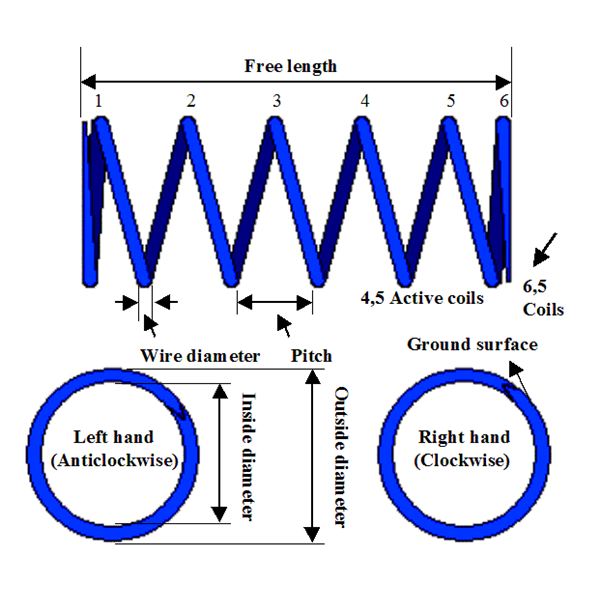
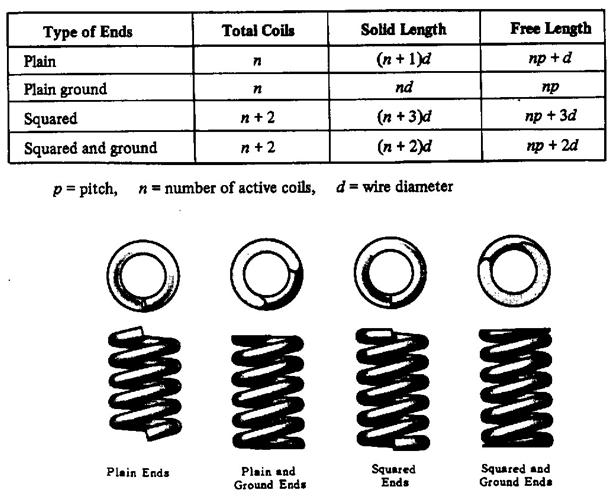
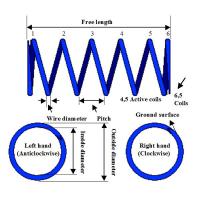
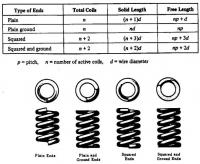
Take the total coils and subtract two, if the spring has squared ends (flat top and bottom). If your spring has 9 coils, then the calculation with 7 active coils (197lb) should be close.
-
No, unless it's in better condition, I suppose. If the current starter is functioning fine, there is no need to replace it.
-
But of course, calculus is the foundation of physics! Yeah, the main topic of the paper wasn't up to snuff but the reason I brought up the paper was to help explain MBT. I think he did a pretty good job of it. There is definitely a window of spark advance where torque doesn't change much, this is evident during dyno tuning. However, as you advance more, you bring yourself closer to the knock limit. That's why when dyno tuning a spark curve, you will see max torque over a certain spark advance range, but set it at the lowest advance needed to hit that mark. It's better to be on the approach to MBT timing rather than overshooting.
-
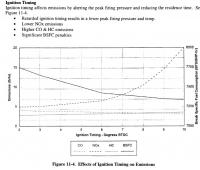
NOx climbs with increasing combustion temperatures. Therefore, in a nutshell, NOx does climb as spark timing is advanced (higher cylinder pressure = higher temp). NOx emissions and EGR are very interesting subjects. I have a summary/explanation posted on HybridZ, it can be found here. NO! Absolutely not! I don't mean to yell, just want to emphasize the point. I'll try to summarize why this is so. Once the mixture is ignited, it burns and releases its energy over a certain period of time. The whole point of having the spark timing advance is for the mixture burn time to match the engine speed. Burn time is essentially constant (depends on AFR, combustion chamber geometry, fuel composition, etc.), but engine speed is variable. Therefore, the burn must start earlier at higher engine speeds. There is an optimal point at each engine speed, where the burn must release a large part of its energy. In relation to crank angle, this is at about 15 degrees ATDC, if I remember right. If you ignite too late, the burn happens late, and your maximum energy is less (piston is dropping = bigger volume = less pressure) since it occurs at a less favorable crank angle, thus you make less power. If you ignite too early, your peak energy release occurs too early, when there is less leverage on the crankshaft (rod almost, if not completely vertical). Your goal when tuning a spark map is to find the "happy point", the technical term being Max Brake Torque (MBT) timing. The knock limit comes into play if your fuel does not match your engine (too low octane, too high compression, high intake temps, or combination thereof). The thing is, the knock limit can stop you before you reach MBT. However, if you reach MBT but have not reached the knock limit, then you can easily over-advance the timing. Therefore, just because you advance to just before the knock limit does not mean that you will be at MBT (the optimal spark advance for that specific engine speed/load). If you are interested in more, here is a great paper I just found on the topic: http://www.vehicular.isy.liu.se/Publications/MSc/06_EX_3809_JM.pdf Another great reference for those truly interested, is "Internal Combustion Engine Fundamentals" by Heywood. This is the ICE bible. You usually need to calibrate those sensors so that you're making sure they don't give false alarms. However, once you reach high enough rpm, these sensors tend to pick up a lot of noise and give false alarms, at least on our solid-rocker adjuster L-series engines.
-
Nice find!
-
Somewhat, you're getting close. The burn is long completed by the time the valve opens but the burn does begin later, thus the maximum combustion temperature occurs later in the power stroke. This gives less time for heat transfer to occur between the end-gas and the cylinder walls, thus the exhaust coming out of the cylinder is hotter but the combustion temperature is cooler (lower cylinder pressure). As spark timing is advanced, exhaust temperature drops leading to a decrease in HC oxidation, thus HC emissions increase. HC are a product of combustion, you're not going to run your engine without HC coming out. However, HC emissions are not highly influenced by spark timing, not nearly as much as NOx emissions. Yes, however, an air pump will catalyze the oxidation of HC. As you can see, that guy is spreading misinformation, at least in the quote you posted as I didn't have a chance to read more. The burn is long done before the valve opens and there is no incomplete combustion to speak of. In fact, retarded timing stabilizes engine running (to a point, obviously), as discussed earlier.