


HS30-H
Supporting Member
-
Joined
-
Last visited
Everything posted by HS30-H
-
Rick, Its still possible to get UK-style plates made up if you want. The mid to late-Sixties silver-on-black style is in my opinion the best looking. However, one thing to keep in mind is that the typical UK plate sizes for both front and rear of the car were much bigger than the USA ( and Japanese ) plate sizes. They don't actually fit the S30-series Z all that well.........
-
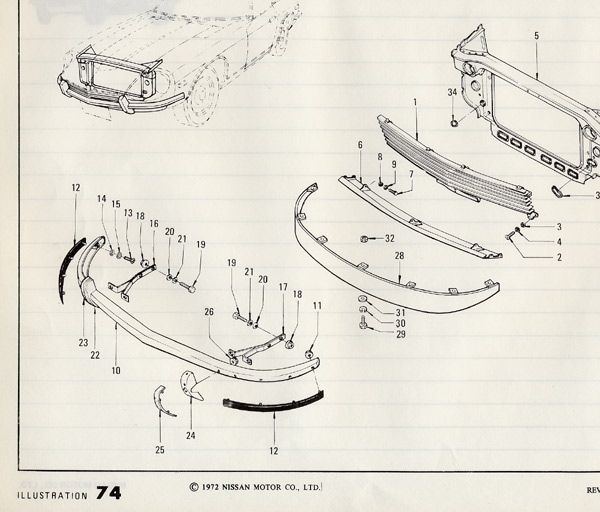
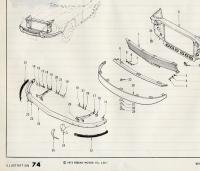
As addition to the good information posted above, here is a scan from Nissan's "R-DRIVE" parts lists. The illustration shows what they call the "European Air Spoiler" - numbered 28. *98300-E8100 ASSY-FRONT AIR SPOILER ( EUROPE ). These were indeed made from Urethane foam with a hard skin on the outside ( hence they were still slightly flexible ). However they hardened up with age, cracked and also deformed in bright sunlight over the years. The steel brackets that were moulded into the Urethane also went rusty after getting wet over the years, and tended to swell up - with the brackets eventually failing...... Good condition original spoilers are like gold dust in the UK these days. I have not seen an NOS one like 26th-Z's pictured item for many years now. The last couple of half-decent used ones I had were sold to Japan. I could be wrong, but as far as I know the Fourways Engineering item is not actually a replica of the original UK market "European" spoiler - but I can look into that and post an answer later today. UPDATE EDIT: OK - I looked into this a little further. The Fourways Engineering item is not actually a replica of the 'European' spoiler on its own. They sell a single-piece fibreglass moulding that replaces the front centre valance and two corner pieces, and which has the shape of the 'European' spoiler moulded onto it. When it is all fitted, and with some paint detailing ( satin black on the spoiler part ) it looks very similar to how the UK-market cars looked. Rick, if the UK-market car featured in that car magazine you found is yellow, then it will be the car restored for Nissan UK to use in advertising and promotional duties a couple of years ago. As far as I am aware, that particular car is NOT wearing the UK-market 'European' front spoiler ( a good condition item could not be found for it ) and is wearing a one-piece moulding similar to that supplied by Fourways Engineering. It fools a lot of people. Do be aware that the Fourways Engineering part is "made to order" too. Cheers, Alan T.
-
Relax Jason, Just think of it as a "Holiday in Cambodia" :knockedou Alan T. ( ps - I gave JB a lift in my car once, would you believe? ).
-
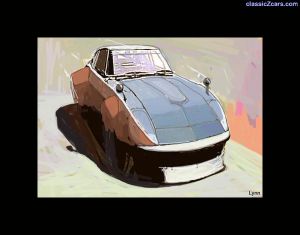 Bob Sharp? Looks to be RHD and with Japanese market fender mirrors. Did Bob Sharp ever use an RHD car? Was this based on an existing photo, Jerry?
 -
Ron, This was one of the comments on this thread that caught my eye: I obviously misunderstood what "world" means to some of the people that inhabit the World..... It's perplexing to see people happily talking down the value of these cars. To me, it seems like a weird form of inverted snobbery.
-
The most valuable in World terms ( ie - not just the USA, and USA-market cars ) are already changing hands privately for prices above US$100K. It's just not necessarily happening in the USA, and it certainly isn't happening on eBay. I think you'd have to say that any genuine ex-Works race car is going to command the highest sale price, and don't forget the rarer models when talking about the complete range of S30-series Z cars that were made ( not just 'HLS30-U' models...... ). Yes Ron, I'll have to 'return serve' that one to you sometime. Cheers, Alan T.
-
This topic ( and this very car ) has been discussed on this forum before. The answers are in the replies to other photos in the Gallery: Sports Car Grafitti event pic Sports Car Graffiti event pic - another one
-
I think you misunderstood what I wrote. A "a non-USA / Canada market LHD 'Datsun 240Z'" means an 'HLS30' made for, and exported to, a market other than USA or Canada. Like France, Spain, Germany or Belgium for example.
-
Hi Christopher, The core point of my 'theoretical' question was what class would such a car be put in? I'm not talking about 'Stock' or 'Modified' here - that would be relatively easy to discern. For example, a stock unmodified 1969 Fairlady Z-L. I see only '240Z', '260Z' etc etc in the ZCCA judging guidelines - so would the Fairlady have to be entered in the '240Z' class? On the face of it, that would seem to be a ridiculous situation. It would be even more ridiculous if a stock 432 was forced to enter the '240Z' class. My question still stands. Does - for example - the '240Z' ZCCA class essentially mean 'HLS30-U' only? Yes, a 432-R would be a guaranteed nightmare. No two built alike Alan T.
-
Ron, Speaking for myself here - I already am using restraint and manners. I thought this particular exchange was fairly well-natured and pleasantly conducted, actually. Maybe you might be reading a little too much between the lines? :tapemouth Again speaking only for myself - if I see something that I believe to be incorrect or misleading, and it is on a subject that I feel passionate about as well as having spent some years researching and learning about, then I'm going to pipe up. Works Z rally cars are a good example of this. How about yourself? If somebody wrote something on classiczcars.com that you thought was incorrect or indeed complete crap - wouldn't you want to correct them? Not to humiliate or embarrass the poster, but to avoid nonsense becoming *fact* because it is repeated often enough. How about if I wrote that the BRE car you replicated originally used a stock 4-speed transmission? You'd correct me wouldn't you? I like to think ( and hope! ) you would....... The only thing I can suggest - if you really can't stand it any more - is to make a complaint to management. Or how about putting me on your 'ignore' list? You won't have to see any of my posts then. American Chopper? You've got me there. I have no idea what this is / was. I presume it must be an American TV show? Regards, Alan T.
-
Sorry if this is going off at something of a tangent, but can I ask a hypothetical question? What would the ZCCA judges do if the owner of a non-USA market car turned up at a show and wanted to enter, say, the 'Stock' class? Would he be allowed to enter? Hypothetical examples I am thinking of for the '240Z' class ( as this is classiczcars.com ) would be Fairlady Z, Fairlady Z-L, Fairlady Z432, Fairlady Z432-R, Fairlady 240Z, Fairlady 240Z-L, Fairlady 240ZG, etc etc. Or even a non-USA market RHD 'Datsun 240Z' ( for example UK / Australian / NZ market model ) - or, possibly the thing most likely to cause maximum confusion, a non-USA / Canada market LHD 'Datsun 240Z' ( complete with Factory 5-speed, rear anti-roll bar, stiffer springs, dampers, front ARB and lots of other market-specific Factory items ). Are the ZCCA-sanctioned events for USA-market only vehicles? My Fairlady 240ZG was ( rather reluctantly, it must be said ) 'entered' into a show competition here in the UK once. The judges had no idea what they were looking at. Perhaps - on reflection - it was silly for me to expect them to? It makes me wonder whether the theoretical appearance of a very good example of a non North American market car might cause some headscratching and some questions to be asked. Or maybe it has already happened?
-
Nice backpedalling Carl, but it won't save you. If you are going to mention anything in relation to cars OTHER than Z cars on this site, you had better make such quite clear. If you are NOT talking about Works 240Z and 260Z rally cars - which is what you implied here: ...then I think you should make it clear exactly what cars you are talking about. Andy Dawson may well have used QUAIFE gearsets in his Team Datsun Europe / 'Dawson Auto Developments' cars - incidentally run from a base not two miles from where I am sitting writing this - but they were NOT Z CARS, and they did not use the same type of transmissions as the Works 240Z / 260Z rally cars. In the period you refer to, he was running 160J Violets. The cars Dawson was using were built and prepared as rally cars in Japan - so it is correct to call them 'Works' cars - but any modifications that Dawson performed on them himself in the UK were NOT 'Works' modifications. This includes fitting QUAIFE gearsets, or JACK KNIGHT gearsets, Crownwheel / Pinion gears and LSD units. The D.A.D Violets did not even use the same type of transmission as the Works 240Z / 260Z rally cars. That will be FIRST gear that is over to the left and down. Fifth is over to the right and down.
-
No they didn't. QUAIFE ENGINEERING made sets of dog-engagement straight-cut gears for the 240RS rally cars in the early 1980s. These fitted into the 'dog-leg' shift-pattern direct-drive ( ie - non overdrive ) 5-speed transmissions used on the 240RS, but were not supplied direct to the 'Works' ( ie - in Japan ) and were available either direct from QUAIFE ENGINEERING or from Bill Blydenstein and Tony Pond, who sold the majority of 240RS homologation specials in the UK. None of this had anything whatsoever to do with the Works 240Z and 260Z rally cars, as it happened over a decade later........
-
Dan, I'm located on the other side of the Atlantic Ocean from you, so I'm afraid I can't recommend a Weber parts supplier in the USA from experience. It should be easy to find one though. Either Google it, or look in the back of a magazine such as GRM or Vintage Motorsport for specialists. My only advice would be to make sure that you tell them your carbs are 45DCOE 13-series. That's probably the most important thing. Series type is very important when dealing with old Webers. Good luck, Alan T.
-
Yes, you need them before you start the car. In fact, I'd get them before you install the carbs on the car. It won't be funny trying to put the special bolts in them without crossthreading and stripping the threads in the carb bodies whilst working virtually blind. Make life easy for yourself and get the bolts and lock tabs now.
-
Hi Eric, These Japanese year dates refer to the year that the incumbent Emperor ascended the throne. The Japanese Emperor known in the west as 'Hirohito' ascended the throne in 1925. In Japan he was known as Tenno ( Emperor ) 'Showa', so 1925 is the first year of the 'Showa' era... In the case of the '44' number you see ( a very important year to we Z enthusiasts ) this is actually 'Showa 44', or the 44th year of the reign of Emperor Showa. Just add 25 ( from 1925 ) to get the western ( Gregorian? ) calendar year - so 44+25 = 69 ( 1969 ). Easy isn't it? It only starts getting difficult when one Emperor passes away and another ascends the throne. Emperor Showa passed away in 1989 ( I think? ) and his son Akihito - known as Emperor 'Heisei' ascended the throne. So we are now ( in 2005 ) in the year Heisei 16 ( I think? ). You might sometimes see these Japanese dates written as 'S44' or 'H16' - in which case its much easier to understand what they refer to. You might also see both western and Japanese systems being used - for example on some of the components on our cars. Depends on what company was making it, and when. I hope I explained that properly.
-
Agreed. I remember we have had discussions on this site in previous threads as to exactly 'when' our cars could be considered to have been 'born' on the production line ( I think it was on the 'Philosophy' thread? ) and it was clear that for some people this was at a different point in the production process than it was for others. Depends how you want to think about it, I suppose. Personally speaking, I reckon its hard to ignore the feeling that a car has a tangible identity once that serial number has been whacked into the firewall sheetmetal - even if its not 'born' as a car yet... 26th-Z, didn't you at one point mention that you thought the point of 'birth' was when the 'OK' sticker got signed, and slapped on the window? I can't come to terms with that. I keep thinking of cars that had been 'born', but had not passed inspection yet. Did they have delayed birthdays? Sorry, but I feel the cars were 'born' before they got their 'OK' stickers.... Hence my worry about actual and stated completion dates ( as in 'stated' on the door jamb tag ). In English English ( as opposed to American English ) I think we would interpret a 'schedule' as something that is due or planned to happen, rather than as a record of what has happened. For example, I believe the figures Kats obtained from Nissan Shatai are a record of what they actually recorded that they made during the periods concerned - not what they thought they were going to make. We would have to presume that the door jamb tags should have been stamped and affixed to the cars according to production records, but it seems that this was not rigorously applied ( anomalies have been cited in this thread ). You would have to say that there might have been occasions where it was beneficial or expedient for Nissan to stamp a month on the door jamb tag that matched up with something more important than the actual month of manufacture. I'm thinking of shipping allocations and things like that. Not really fraudulent practice, but little white lies that might help to 'tweak' numbers so that they were better for the company, or better for the dealers in the USA. It is conjectural, but the whole point of me mentioning what Tsukamoto san told me was to make it clear that the whole process of stamping and affixing the door jamb date tags was likely less rigorously performed and policed than we might like to imagine. Sure, assuming that the production records were accurate in the first place, and that the door jamb tags were stamped and applied to the cars according to those records. It still seems that - in some cases at least - this was not so.... ****-up or conspiracy then? I think ****-up is far more likely when looking at the whole scenario, with the distinct possibility of a little bit of localised conspiracy or number-tweaking here and there. Nissan were not immune to such practices - especially in their race and rally activities. When you mention 'law' I believe you are referring to American law, and I have to say that there is just as much likelihood of number-tweaking and record changing to avoid falling foul of those laws as there is of Nissan Motor Co. Japan back in 1969/70 adhering strictly to the 'truth' and reporting / recording exactly what did happen. True, but it also doesn't mean that it definitely was accurate, does it? For the aforementioned reasons. I don't agree. If the door jamb tags stated the actual DAY the car was built, then I might be more inclined to have faith in them. But given that - as you yourself stated - they could possibly represent a period covering TWO months for any car, I think it is hard to think of them as anything other than a rough guide of when any particular car came off the production line. I don't say that they are all inaccurate ( that's unlikely given the scenario ) but that if a few are proved to be wrong then we can only truly have faith in them when they are added into the mix of data to be found on a car, and used to help make an 'average' through cross-reference. Which is, I think, the point of this thread.
-
Hitachi licensed the designs from SU, and Nissan bought them from Hitachi. No, DCOEs are sidedraught. DC = "Doppio Corpo" ( 'Double Body' in English ) O = "Orizzontale" ( 'Horizontal' in English ) Depends what you mean by "better". Better for what? If you mean for a street driven car then any Variable Venturi design like the SU is probably going to be preferable, but for ultimate power and tuneability in sports and racing applications you need one venturi per cylinder and full adjustability.
-
I didn't know that DBA made a version of the Peugeot disc Mike, so that's really useful reference for the future. I know a DBA distributor in the UK, which will be handy. Thank you for that. Ahmed, The PCD change I mentioned to adapt the Peugeot disc is that of the holes through which the bolts that hold the disc onto the hub pass. This is not 114.3mm PCD ( that's the PCD of the wheel studs - which is not the same thing at all ). The centre hole of the disc needs a very slight amount of machining to make it fit snugly on the Z hub, but its the re-drilling of the bolt holes that is the major operation. However, this is pretty simple as you just drill the four holes with the correct PCD in the space between the original Peugeot mounting holes. I don't have the sizes for the centre hole and PCD to hand ( they are in my garage I believe ) but you can get them quite easily by measuring your original Z discs. All the data that NZeder posted is good. I'll have to dig out that disc-to-hub PCD of the Peugeot disc, although to be honest it is immaterial to us as we know its wrong! Cheers, Alan T.
-
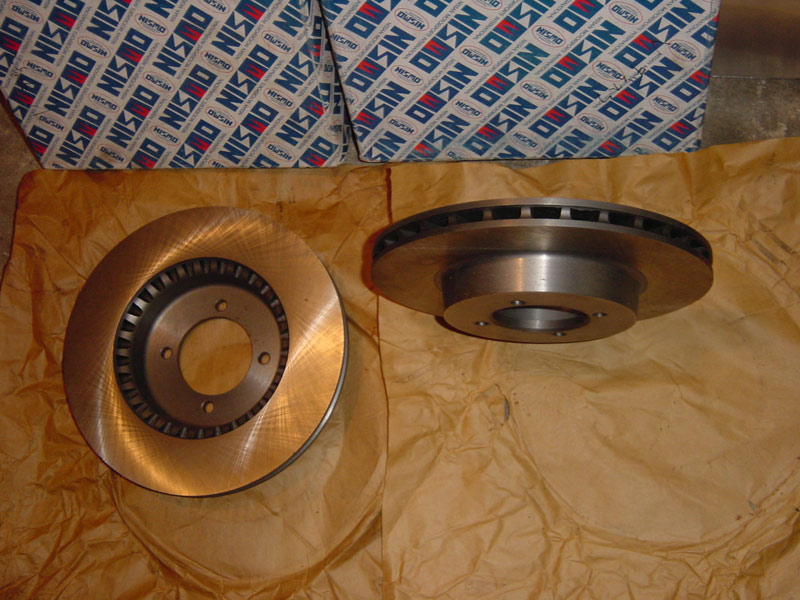
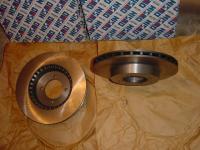
Hi Eric, The Sports Option lists carried both solid and vented discs to go with the solid and vented disc versions of the MK63 4-pot calipers. There were 'early' and 'late' types of disc to suit the 'early' and 'late' front hubs ( 'hat' depth being different ). PGC10, KPGC10 and KPGC110 Skyline GT-Rs had solid front discs and two-pot calipers as stock fitting. Ahmed, Yes, they probably would match up with the Toyota calipers. However, its academic now. NISMO don't make them anymore. Prices of NOS pairs are sky high in Japan when they turn up. Peugeot 505 GTI vented discs are a good alternative, and only need a different disc-to-hub PCD drilling mod to make them fit. Here's a pic of my NOS discs before I fitted them to the 432R replica project car:
-
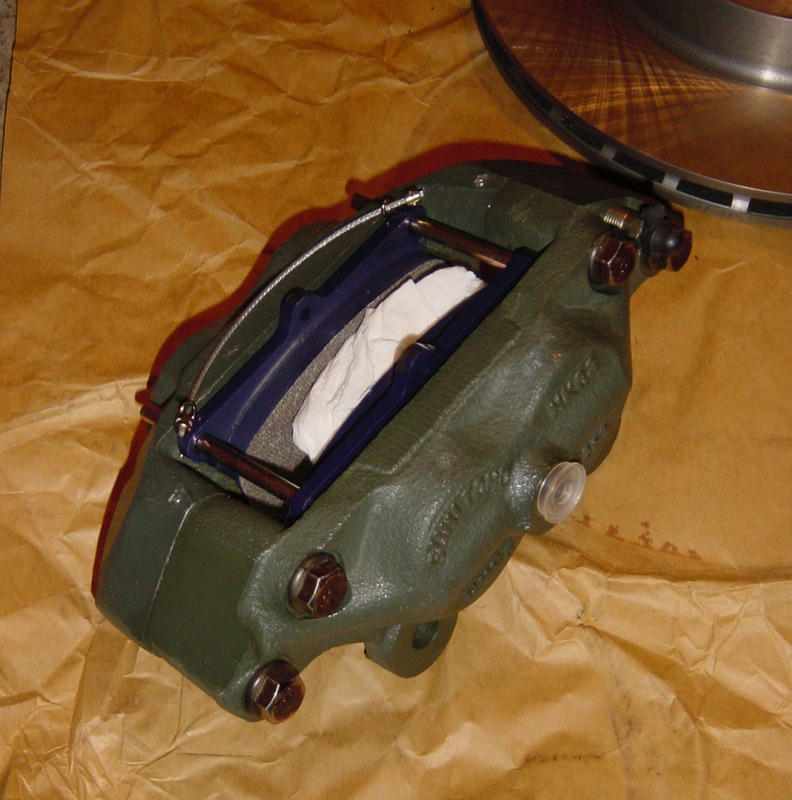
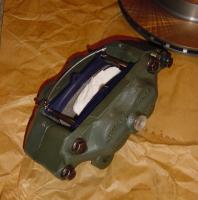
Hi Mike ( NZeder ), Here's a pic of one of my new vented-disc type MK63 calipers, before I fitted it to the 432R replica project car. I think the split-line of the two halves of the caliper should be visible in the photo, and you can see that there is no spacer there. Nothing wrong with a spacer as long as it is well engineered and safe, but the original vented-disc type calipers didn't have them. Cheers, Alan T.
-
, Thanks, Christopher. "I'm lovin' it"
-
Sorry to jump in with a different view here, but I don't believe the proper vented-rotor version of the Sumitomo MK63-20S four-pot 'FIA' calipers used a spacer. They were a quite different casting to the non-vented version....... I've had quite a few pairs of these calipers pass though my hands over the years - both vented and non-vented versions. I have a pair on my ZG, and a pair on my 432R replica project car too ( both vented ) and I have never seen a pair of originals that used spacers to allow for the extra width of the vented disc. The vented types always had extra 'meat' on the casting. To be honest, the non-vented version kind of misses the point. They are OK until you use them in anger a few times, and once they get the disc hot enough its fade city. Vented version is definitely miles better. Be careful to note that pad shapes are different between vented and non-vented versions. Unless you are a fan of period-correct options and accessories for these cars, the 'FIA' brake calipers might not be the best long-term solution. Especially when you price up seal kits and replacement pistons.
-
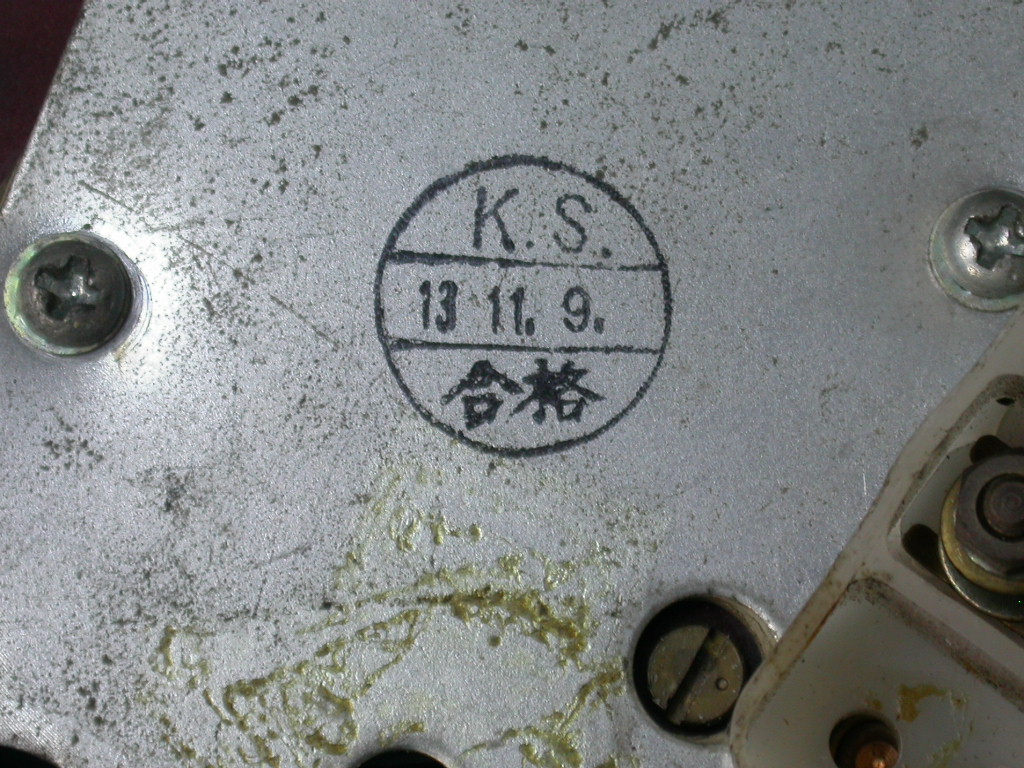
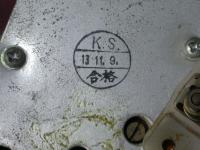
Hi Kats, Nice thread idea. I think we have to think about the 'Law Of Averages' as well as 'Fudge Factor' in this kind of discussion. Considering the amount of companies engaged in manufacturing parts for the Z cars, as well as the natural possibility for parts manufactured, say in January 1970, to be either mixed up close to the production line with parts manufactured in, say February 1970 - you would have imagine that a little bit of crossover in dates or lag would have occurred. These were the days before the "Just In Time" parts supply system was implemented, so I would guess that a kind of 'rubber band' effect would have been observable in parts supply at that time. With batches of parts being manufactured and date stamped, and then being sent out to Nissan in regular ( or possibly irregular ) shipments, there would - I guess - be times when parts may have sat around for a period of time before being attached to a car, with some later-manufactured pieces 'jumping the queue'? .... From what I can tell by cross-referencing the dates on my own cars, and from a few others, it seems as though the Law Of Averages shows that most parts were used within a month or two of being made ( this is what you are seeing on your own car, isn't it? ). That's just me comparing and cross-referencing the date stamps and marks found on each one of my cars - if you see what I mean. I don't think anybody who has a non-USA market model should be "worried" about not having the door jamb tag, if that is what you are saying? If it is not supposed to be there, then what is there to worry about? It seems to me that the door jamb tags of the HLS30-U models are not really the most reliable source of actual manufacturing date on these cars. Simply having a month of manufacture stamped into them must mean that some will be at least four weeks more accurate than others. That's not close enough for me! ( I want to know the DAY it had its OK sticker signed and slapped onto it, and even that might not be the same day as it reached the end of the production line! ). Added to that, there is also the question of exactly where and when the door jamb tags were stamped and attached to the cars......... Do you remember I told you before about my old Izakaya friend Mr Tsukamoto ( now sadly passed away ) who used to work for Nissan during the period we are concerned with here? We had some discussions once about the door jamb tags on an HLS30-U that a friend of mine had imported to Japan as a project car, and we were not sure that the door jamb tag was the correct one for the car ( we thought it had been altered and switched from another - later - car ). Anyway, Tsukamoto san laughed at us when we asked him how accurate the door jamb tag should be. He told us that they were sometimes attached at Hommoku Wharf just before the cars were put on the transporter ships, and were stamped according to the shipping schedule - and how many cars would fit onto each sailing schedule. He even hinted that there were cases where tags were sent to the USA after the container ships sailed ( and presumably attached to cars in the USA ). I don't think this would drastically affect the noted 'manufacturing date', but I think it would be a good idea for us to treat the door jamb tag dates as - in some cases, but not all - possibly up to a month or two 'out' in comparison to the real production date. Just like all the other components on the car. In short, they are certainly not 'Gospel' truth.... I can't imagine a case where the door jamb tag of a car might pre-date the average date of the components on the car, but it would be great fun if one did turn up. Just for a little fun, and in comparison to your Kanto Seiki speedometer date stamp Kats, here is a stamp on the back of my tachometer. 13th November 1969?:
-
@ Beck. Everybody else has beliefs, but only Beck has the facts. So Carl, you get to decide exactly where the "beginning" and the "end" are, right? You might like to be a little more circumspect about reading a translation ( it ain't that simple you know ) of a ghost-written text compiled from a few interviews with Matsuo san. Lots of room for interpretation and misunderstanding there - which is just what you have done: Rubbish. You really don't know what you are talking about do you? The L20 was specified for the car BEFORE the S20. Indeed, Katayama wanted a bigger capacity for the Export market version - and hence the L24 was also specified. There was NO POINT at which just the S20 and L24 were on the drawing board. This is just you misinterpreting what has been written because of your perspective. Matsuo was not saying that the S20 came before the L20 - quite the opposite. Matsuo quite clearly relates the story that the insistence of his superiors to use the S20 engine in a special version of the car came after they were already a fair way down the road with the L20 and L24 engined designs. If you are trying to re-write history by suggesting that the L24 engine came before the L20 in the S30-series Z design process then all must be made aware that you are distorting the story. In fact, you had better go and look into your S20 engine history a little more closely before writing stuff like this. You might find that the S20 didn't exist until well after the L20 was specified for the car. You also need to be a little careful about your L24 design history. No more of this nonsense about it being a Bluebird four-banger with a couple of extra cylinders tacked on please. The L20 six quite clearly came first. This is FACT. Not my fact - just historical truth. All of this demonstrates the truth of what Christopher writes: namely, that to truly understand the export cars you have to understand the domestic cars. Of course, if you think the domestics are an "irrelevance" then you are going to be missing half the story. You seem to love representing a subjective view as reality. Its really only your reality though. You flit between the "preliminary" and "final" designs, attaching your own interpretations of what they represent. You present your beliefs as fact - but the truth is that they are open to different interpretations even amongst the major players in the process ( let alone you and me - who are nobodies in this story, and don't you forget it ). I don't remember anybody saying that they "just" got lucky. That's a gross distortion you are giving to the suggestion ( justified, I believe ) that at least a little bit of luck was involved in the timing. Had the product come to market slightly earlier or slightly later than it did, then it would not have done so well. Matsuo himself has acknowledged this, and I remember him saying that he would not really have wanted to design what became the S130, as times had changed and things were becoming a lot harder. Carl, you always overstate the case of the 'opposition' to your views - to the point where it sounds stupid to try and reply to your 'defence', which itself is always vastly overstated and full of hyperbole. I don't remember anybody seriously stating as 'fact' that the HLS30-U was a 'version' of the domestic market models, and if they did it was probably just a little bit of chain-pulling aimed at winding you up. There is plenty of evidence ( even if you choose to ignore it ) that BOTH domestic and export and versions of the S30-series Z were designed, productionised and produced AT THE SAME TIME. That would be enough for most people to believe that the domestic models were an important part of the design process, and the fact that - being a Japanese-built car - the S30-series Z would have some natural bias and design concession in favour of an RHD configuration, even if it was a case of force majeure! You only have to look at the layout of the engine, transmission and final drive ( and the domino effect this had on exhaust system location, fuel tank location and a whole raft of other design details ) to understand this. I believe that the 'truth' is far more subtle and subjective than you ( or myself even ) try to portray, but if you ignore the domestic ( and the export RHD ) models then you have no chance of putting it all into perspective, let alone making your own take on the 'truth' reflect what really happened. So much for "The True History Of The Z Car", huh? Alan T.