HS30-H
Supporting Member
-
Joined
-
Last visited
Everything posted by HS30-H
-
Hi Nate, Check out post #54 on this thread: That's the core of the design team right there. Mr Yoshihiko Matsuo - Chief Designer & team leader. Mr Akio Yoshida - General Exterior & Interior Design. Mr Itsuki Chiba - Interior Design. Mr Hiroo Miyate - General Body Design. Mr Hitoshi Uemura - Mechanical Design ( esp. suspension ). Mr Tsuneo Benitani - Engineering. Mr Kiichi Nishikawa - Draftsman. Mr Hidemi Kamahara - Engineering. Mr Eiichi Oiwa - Designer. Plus a cast of hundreds........ Alan T.
-
Page 64 is titled "WHAT'S IN A NAME? PART 1", and is a discussion of the origins of the 'Datsun' name. Unfortunately, it is riddled with mistakes - most of them originating from its quoted source; the book entitled "Essential Datsun Z - 240Z to 280ZX", by Colin Shipway ( Published by Bay View Books in 1994. ISBN 1 870979 51 6 ). I want to point out some of the mistakes in order that they can be noted by us all here. Maybe it will help to guard against the mis-information being repeated, and gradually becoming *fact*. I'm going to send this information to the publisher too. Quote: "An American-educated engineer by the name of Sotaro Hashimoto founded a company called Kwaishinsha in 1912........." "Kwaishinsha" should be Kaishinsha. Quote: "....he named his first vehicle after them by using the first letter of their surnames - Kenjiro Den, Rokuro Aoyama, and Metaro Takeuchi." "Metaro" should be Meitaro. Quote: "....because in Japanese, DAT means "hare" and a hare is generally quick.................... it might be just a coincidence." There are not really any hares ( as we know them ) in Japan. The closest Japan comes to a hare is a type of wild rabbit called a 'No-Usagi' ( literally: 'Field rabbit' ) and the more likely transliteration of the Roman letters 'DAT' from 'English' into Japanese Kanji ideograms, and then back into English, would be pronounced 'Datto' ( literal meaning: 'as fast as one can', ). 'DAT' does not mean simply 'hare'........ It is much more complicated than that. Quote: ".....DATSON, now a part of the Tobato Imono Company........" "Tobato" should be Tobata. Quote: "....the holding company's name was Nihon Sagyo......" "Sagyo" should be Sangyo. I can't understand why the Colin Shipway book was used as a quoted reference. All of these mistakes are put right in Brian Long's book "Datsun Z - Fairlady to 280Z", ( published by Veloce in 1998. ISBN 1 901295 02 8 ) and the whole subject is covered more accurately. Why use the earlier book as quoted reference when the later book is better? Am I the only one who finds this strange? The Brian Long book is not even quoted in the list of sources on the 'Credits' page. Alan T.
-
Well, I've had a few more dips into the new book over cups of tea. I'm spotting more and more silly mistakes......... :disappoin 26th-Z, I think you have been very positive and very diplomatic in your posts on this thread - so I'm wondering how far to take this. I don't want to criticise the book and the author 'just for the sake of it', but if we spot glaring errors and bad information in the book isn't it better for our 'community' that these things are pointed out and discussed? Alan T.
-
Well, my copy of the book arrived today. It is bigger than I was expecting, but there's a lot less actual writing in the book than I was expecting..... And during a quick flick through, a major clanger just popped out at me - as it did for daddz: Page 123 shows two pictures of the same car, and the text discusses the Fairlady 432 and 432-R. But the car shown is clearly not a 432 or 432-R..... In fact, I believe its the 'LY' Crossflow-engined Fairlady Z owned by Akamatsu san of Japan - probably photographed on one of its trips to a National Convention meeting in the USA ( ? ), and clearly illustrating that it is a later build year than 1973 ( the last year for 432 / 432-R production ) by its rear light arrangement. Here's what the text on page 123 says: "Among the ingelligentZia ( sic ), an original Fairlady Z432 or 432-R from the Japanese market ranks among the most desirable classic Zs. Total production was 420, built from 1969-1973, with a 2.0-liter engine that produced 160 horsepower. The LY-designated engine was a high revving motor, with four valves per cylinder and three carburetors. The R model was for racing purposes, and was much lighter with a fiberglass hood, Plexiglass side and rear windows, lightweight bucket seats and other R-dedicated components. These cars are rare and desirable." Mr Evanow is getting the S20 mixed up with the 'LY'. The 432 and 432-R had the S20 24-valve DOHC, and the 'LY' was essentially a Crossflow conversion for the L24, with just 12 valves and SOHC. They are two completely different engines, and I'm very surprised that this ( and the photos ) slipped through the net. The red car in the photos does not illustrate a 432 or 432-R, and also has non-stock 'Datsun' emblems and rear marker lights. Did Mr Evanow see Akamatsu san's LY-powered Z at the National Convention and mistake it for a 432, or did the bad information come from elsewhere? This doesn't bode well........ Alan T.
-
! Thank heavens for that. You had me going for a minute there..........
-
Alfadog, Yes - to clarify: On most first-generation models, the stamp in the firewall sheetmetal was always above the Master Vac and clutch MC whether the car was LHD or RHD. So looking into the engine bay from the front of the car, the VIN stamp is to the left on an RHD car, and to the right on an LHD car. I've seen LHD-to-RHD conversions that left the VIN number in its original position, which can make some people do a double-take. 'Big Sam' is a good example of this. Stephen, you most certainly DO belong on this thread. I for one didn't know that the firewall stamp on the '280Z' model was on the left side of the firewall. I'll make a mental note to remember that. I learn something new about these cars every day......... Cheers, Alan T.
-
Hi Rick, Martin Buckley was wrong. So were the other authors. Its a big self-perpetuating myth started by Goertz himself, and it keeps going because none of these authors ever questions what they read in other books and magazine articles. It has become *history*....... Believe me I have tried this a few times over the years. I have spoken to various journalists from car magazines here in the UK, and its like knocking your head against a brick wall. They keep pointing back to older books and magazine articles, and saying ".......its in this book - so it must be true." Once these things are in print they might as well be set in stone. Very few publishers or authors seem to want to go back and revise what they have written for later editions of the same book, and 'corrections' in the June issue of a magazine that made mistakes in the May issue might as well be written in snow for all the good they do in the long term. I've had three of my Zs featured in magazine articles up to now, and when I was 'interviewed' for the articles I tried to get across the point that Goertz had nothing to do with the real process of the 'design' and engineering of these cars. In the May 1999 issue of 'PRACTICAL CLASSICS' magazine, the journalist ( Martin Buckley, funnily enough ) brought up the subject of the dispute about who really designed the Z. Matsuo's name is given as "Chief designer of the 240Z", but Buckley chose to give Goertz space for a personal quote. Here's the quote: "I may not be the best designer in the world, but I look back at my record and I'm satisfied. I did two classics, the 507 and the 240Z. Name me three other designers who can claim as much." So you see, the MAIN problem here is Goertz himself. He's a fraud, a liar and a scoundrel. Matsuo and his team haven't had a look in for several reasons - but two of the main factors have been language barriers and the fact that Matsuo quit Nissan on bad terms in 1973. Carl Beck has done some excellent research and writing on this subject for zhome.com, and when anyone looks at the facts ( clue: Goertz doesn't pay much heed to 'facts' ) it is quite clear what the true situation is. But still we are fighting the myth. Last 'interview' I did with a journalist on the subject of the Z was with Mick Walsh for 'Classic & Sportscar' magazine here in the UK. He took the point and didn't mention anything about Goertz in the article ( which was good ) but he still misquoted me about another matter. What are you gonna do? Journalists ( at least in my opinion ) have a duty to carry out proper research and get to the bottom of the story, rather than simply rehash the information already published in previous books and mags. The problem is that most of them don't when it comes to the S30-series Z, because the real *truth* is too much like hard work to dig up and look into. And its in Japanese........... Alan T.
-
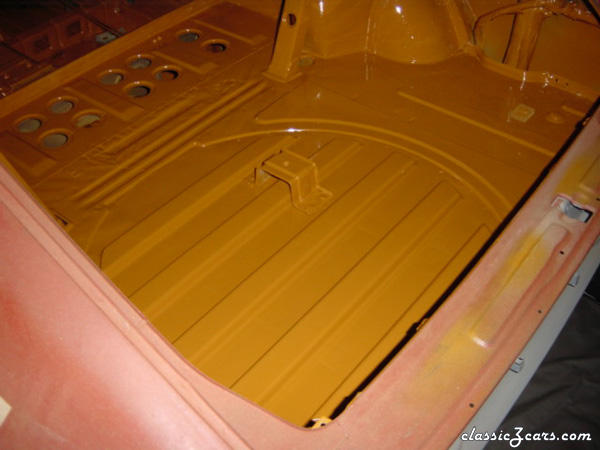 I'm making up an accurate replica of the 432R tank, but there's no way that I need 100 litres of fuel in the tank ( much less afford it! ). I'm toying with the idea of putting a fuel cell INSIDE the replica 432R tank - so that it can't be seen, and so that I don't have to have 20 litres of fuel sloshing around inside a 100 litre space........
 -
Chris, Many thanks for your kind offer - but I've already pre-paid for it. I reckon it should be here any day now. That's good about Goertz. Although mentioning Goertz at all stokes up those 'no smoke without fire' doubters again. I was mortified to see the pages dedicated to Goertz when Brian Long's book originally came out. I still think he needs to be properly shown as the trickster that he is, and his 'rep' adjusted accordingly...... You may well have created a monster........ Totally agree with you there, daddz. That book is just wonderful. Worth every penny, and a real treasure. I agree with this too. The picture caption mistakes were a real pity, and really ought to have been put right in later editions. I notice that the MIKI PRESS book 'Fairlady Z Story' also had a lot of caption and subtitle errors. Where are the proof-readers? bpilati, May I say that I think we should critique these books when they come out. We should pick up on mistakes where they occur, and we should voice alternate opinions where they are valid, topical and relevant. What's wrong with that? It makes us all more rounded as individuals interested in that subject we call 'Z History', and raises the game for the next pamphlet, book, DVD or simple post on a site like this. It is one of the things that being an enthusiast is all about. Alan T.
-
26th-Z and daddz, I have this book on order with Motor Books here in London, but it seems that the publisher put the first batch destined for the UK on a slow boat. Still not sign of it yet....... And now I'm wondering if its another dud book? I'm already feeling disappointed. I guess I should really hold fire until I see the book myself, but things are already looking bleak judging from the comments above. Is there no *fresh* information about the design process and engineering of the early cars? Are there no interviews with the likes of Matsuo, Yoshida, Chiba, Benitani, Kamahara, Uemura and Miyate? Any discussion about 'design concession' and the differences between the 'Export' and 'Domestic' cars? I'm sorry, but I really CANNOT understand why in this day and age - with all the benefit of the 'carchaeology' that many people have been involved in ( with a LOT of it on forums like this ) - a fresh book hits the shelves, but brings little new information or insight to the complete story of a JAPANESE car. Is the book as blinkered as it sounds? :disappoin Alan T.
-
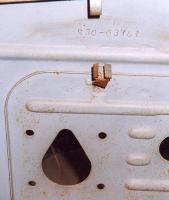
Maybe this photo of my project car will help?
-
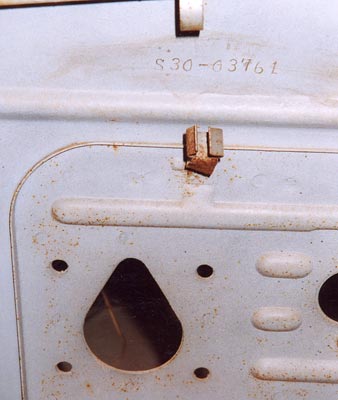
No, it's not normal. But I'm convinced that it IS there, if you know exactly where to look....... Exactly. Stock location on an RHD car is just above the half-round bead rolled into the firewall sheetmetal, right by the metal bracket that holds the vacuum hose for the Master Vac. As a Japanese home-market car, it would not have left the Factory with a door-jamb tag or a dash tag. The only two VIN locations on the car are on the firewall sheetmetal and the 'fenderwell' plate. No. VIN number is always on the drivers side, whether its LHD or RHD. I agree. I think its there but you aren't seeing it. It will be right under those hoses and wires in your first photo, and is probably half-filled with paint and crud. If you get down to bare metal and its still not there, only then you will have a mystery on your hands.........
-
Brad, PM received. Sending you an e-mail soon. Cheers, Alan T.
-
Hi Brad, I bought some parts from Errol at Datrats a few years back. Very nice guy and very good to deal with. Sumitomo are still making the vented disc version of the MK63-20S in small batches. I can probably hook you up with a pair. Can you send me a PM with your direct e-mail address? I'll send you some pics and info. Cheers, Alan T.
-
NZeder, That's a good example of machine translation not really being up to snuff........ 'Kame' is Japanese for turtle alright, but the word 'possession' is not really the most accurate choice to translate the meaning of the second Kanji character ( when it is placed next to the first ). The meanings of some Kanji characters can often be modified depending on what other kanji characters are surrounding them. The best thing to remember is that Kanji characters are ideograms, and that a direct translation into English or other similar languages is not always possible ( or even appropriate ). 'Kameari' is actually the name of a place. Kameari Engine Works used to be based in the town district of Kameari, Saitama-ken. They moved a good few years back now to Yashio City, Saitama-ken. I live in the Bloomsbury district of central London, but nobody here would dream of breaking 'Bloomsbury' down into its component meanings ( probably something to do with flowers ). Our Roman alphabet allows us to see a word and read it without necessarily processing any ideas of how it came to be formed and used, but Japanese and other written languages based on ideograms bring that processing to the fore it seems. You might get looked at kind of funny if you mentioned anything about turtles to the staff of Kameari Engine Works..............
-
Ooh the irony. Ouch. Couldn't have put it better myself. Thank you. :classic: Very well put. Of course, this will all be covered in that new Z book by Pete Evanow ( sp? ) won't it? Please tell me that it will............. :paranoid: This last statement I can't completely concur with. I'd say that there is an interest amongst some Japanese Z enthusiasts for the "AEM" cars / spec, but they are very much a minority. LHD cars re-imported to Japan generally sell at lower prices than original home-market RHD cars. There are of course honourable exceptions to this that prove the rule. Sundowner, I'd advise you to try and gather as much information as you can before embarking on any buying sprees. Come up with a 'look' and a plan, and make 100% certain of what you want before you spend precious money buying any stuff that doesn't fit with the look you are trying to achieve. Good luck! Alan T.
-
Amen to that, but I don't know why you would "hate the argument"? On the contrary - it has everything to do with RHD. What you are seeing is a direct consequence of the fact that the main componentry of the car was biased towards an RHD configuration - descended from Nissan's Austin links. Nissan made a fine job of building-in LHD configuration compatability when they productionised the S30-series Z, but the fact that the basic design is arranged around an RHD configuration seems to pass over the heads of many. Even the hole for the gear shift lever is not 'central' in the trans tunnel........
-
YES! Feels like its all starting to fall into place. Basically, yes. But don't forget that these also have their own sub-divisions ( EG - USA / Canada LHD versions and 'rest-of-the-World' LHD version ). No official exports of 432, 432-R, 240ZG. Of course, we have not mentioned any of the different Export-market 260Z and 280Z models ( although they will be pretty used to that, unfortunately ) or the A-S30 and S31 and their ilk.........
-
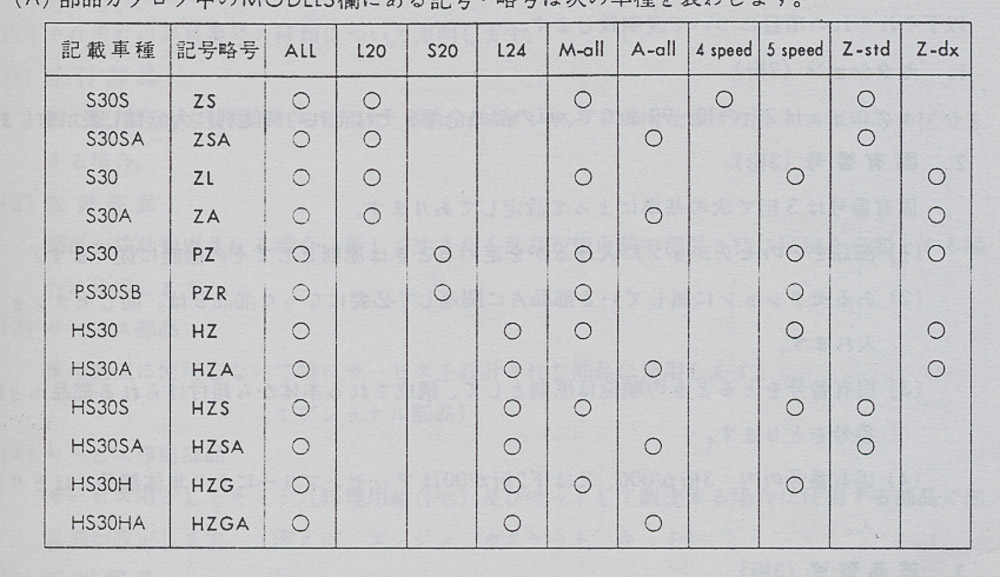
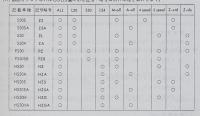
I think you'll find clues in the front pages of your Factory workshop manuals and parts lists, thus: *'HLS30-U' = "Left hand drive for USA Canada." *'HLS30' = "Left hand drive." *'HS30-U' = "Right hand drive." There are lots of other suffixes that denote different specs and options, and these were mainly used internally within Nissan. The Japanese home market - with its many versions and options - was particularly complicated. These full 'Katashiki', 'Ruibetsu' and 'Shashu' codes were printed in the front of the Japanese factory workshop manuals, parts lists and the 'Service Shuho' model information booklets that were used to teach the Japanese dealerships about new models when they were introduced. Here's a scan of one of the Japanese 'Katashiki' tables from October 1971, detailing the suffixes that were added to identify different model types and specs within the S30-series Z range. Remember that the TWELVE codes in the list are covered by firewall stamp VIN prefixes of just THREE types: 'S30', 'PS30' and 'HS30'...............
-
AAAAAAAAAAAARRRRRRRRRRRGGGGGGGGGGHHHH! Groundhog day. We've been over this what seems like thousands of times before. It must all show up if you use the SEARCH function and read, read, read. NO! Fairlady 240Z ( HS30-S model ) VIN prefix stamping = 'HS30' Fairlady 240Z-L ( HS30 model ) VIN prefix stamping = 'HS30' The 'S30' and 'S30-S' were NOT '240Zs'. And stop mixing up suffixes with prefixes. There was NO two litre "Z-G" model ( where the hell did you get THAT one from??? ). Fairlady Z432 ( 'PS30' model ) firewall VIN stamp = 'PS30'. Fairlady Z432-R ( 'PS30-SB' model ) firewall VIN stamp = 'PS30'. THERE WAS NO "Z-G 432" ( arrrrrrggghhhh! ). YES! Bloody hell. This is all written in the book that I know you have on your bookshelf, Sean. How can you make something already complicated even more complicated? I have a headache now. :squareeye
-
You posted a picture of the engine block earlier in this thread. It had 'L20' stamped on it - so yes, it is an L20A and probably the original one that came in the car from the Factory too..... You can't just put an E31 or E88 on the L20A block in place of an E30. You will have to consider 'eyebrowing' or 'notching' your block to allow the larger valves the open at full cam lift without hitting the block. Also remember that the inlet and exhaust manifolds of the E30 head have smaller passages than those of the E31 and E88. Ideally you would want to change manifolds and carbs too. But I wouldn't mess around too much if I were you. Either repair the L20A and run it, or pull it out ( put it into storage ) and put in an L24, L26 or L28.
-
Very nice. Looks like NZ is something of a happy hunting ground for unusual Japanese home market models.
-
Oh dear, I get home from a hard day's work and have to read more bollocks on this thread.............. Show me an "HS30H" VIN and you get a fantastic prize from yours truly. A wooden spoon with your name engraved on it. There ain't no such animal. The 'H' suffix of the Fairlady 240ZG was never stamped on the firewall or VIN tag, and existed only in Nissan's internal documentation and model delineation - in just the same way as the Fairlady Z and Fairlady Z-L shared the 'S30' VIN prefix on their firewall and VIN tag stampings even though one was actually an 'S30' and one was an 'S30-S'......... I need a nightcap. :sleep:
-
It's a 'Ken' or 'Ken-sa' hanko stamp. Quality control in action. Applied by the QC checker at the component manufacturer's factory. We've discussed them on this forum many times in the past. Bullshit. You could have written that in 1905 and been at least partly right, but writing it in 2005 makes it look as though you haven't got a clue what you are talking about. Which surely can't be the case?
-
Sean, I think you got most of the information you wanted from the replies you received via the other forum you posted this question on......... As usual, not entirely accurate about the RHD cars..... "1972 Model Year" is I believe a USA / Canadian market term. Not applicable to RHD cars. As is "Series III" ( along with "Series I" and "Series II" ). And you are forgetting that not all 'HS30' VIN-prefixed cars were 'Datsun 240Z' models. The Japanese home market had the 'Nissan Fairlady 240Z', 'Nissan Fairlady 240Z-L' and 'Nissan Fairlady 240ZG' added to their range in October 1971. All three models used the 'HS30' VIN prefix, and the word 'Datsun' was not written anywhere on the cars. Japanese home market 'HS30' VIN-prefixed models manufactured during the calendar year of 1971 had body serial numbers 'HS30-10001' through 'HS30-10436'. Then the 1972 calendar year had 'HS30-010437' ( note that extra digit ) through 'HS30-012045', whereafter the first digit was changed over to a '1' and numbers 'HS30-100001' through 'HS30-100800' were manufactured. 1973 calendar year production started from 'HS30-100801'.......... You "might" find it if you are looking for it, but more to the point - it was made and it did exist. Alan T.