HS30-H
Supporting Member
-
Joined
-
Last visited
Everything posted by HS30-H
-
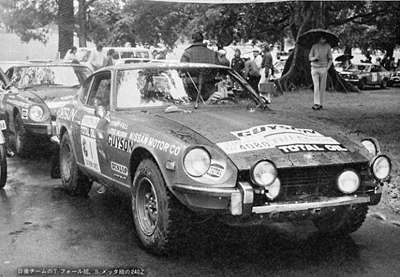
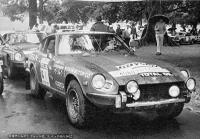
Hi Guus and Rolf and everyone, Since you were asking specifically about the 72 and 73 Southern Cross, I went and had a dig in my archive for those years. I found a few pieces of the puzzle - but some questions still remain. Since the articles that I have sourced this info. from do not always give the full entry list, and certainly do not actually state the registration numbers of the cars, I have had to try a lot of cross-referencing and picture research. It does not always bear fruit, but you might find the following useful: *1972 SOUTHERN CROSS RALLY Car No. 1 - "TKS 33 SA 8075" Rauno Aaltonen / Steve Halloran ( finished in overall 2nd place ) No data on any other "Works" Z entries...... *1973 SOUTHERN CROSS RALLY Car No. 1 - "TKS 33 SU 4080" Tony Fall / Mike Halloran ( Retired ) This car had injected "LY" Crossflow on Injection. Car No. 2 - "TKS 33 SU 3444" Shekhar Mehta / R. Bonhomme ( Finished outside top 10 ) This car also competed in 1973 RAC Rally. Car No. 17 - No data on registration number. B. Watson / J. Beaumont ( Finished 8th overall ) This seems to be a "Works" car with local crew. I have some pictures of the Watson / Beaumont car, but I can't see the registration number clearly from them. Surely somebody in AUS will have the full story on these guys? They did well to come out on top of the other "Works" crews, that's for sure. Here's a picture of Fall and Halloran in TKS 33 SU 4080 before they retired:
-
I still think the definitive version of all this is yet to be written, at least in English anyway. No disrepect to Carl Beck, but there are some errors in his article too. Alan T.
-
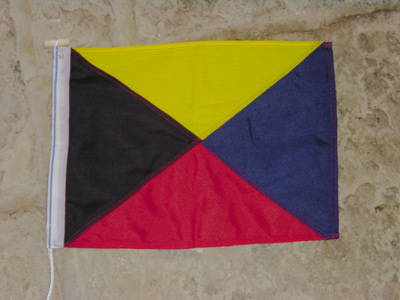
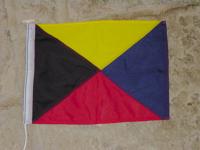
McZ is right about the "mugen" connection, but it has been turned on its head by time and hundreds of tellings. Actually, there is no single Japanese character that reads "Mugen" ( even in Hiragana - the simplified version of Kanji ) and it seems that in the past there was a misunderstanding about the derivation of the "Z" name for the S30 range...................... In explaining the idea of the meaning of the "Z" name, somebody tried to connect the abstract feeling of the "Z" letter of the alphabet ( implying "the ultimate" or "unlimited" ) and attempted to put this idea into Japanese. That's where the "mugen" legend came from; the word mugen could imply "no limit" or "unlimited" in connection with time or power in the Japanese language. Therefore, it seems that the derivation of that particular explanation was from the attempt to explain the abstract meaning of the letter "Z" into Japanese, rather than translating something Japanese into English. There is no single Japanese character that says "mugen".............. From the beginning of the project it had been nicknamed "Z", and Yutaka Katayama was trying to stir up some spirit in the design team - headed by Yoshihiko Matsuo. Mr Katayama sent a naval signal flag ( denoting the letter "Z" ) to Mr Matsuo, and asked him to swear allegiance to the flag as a declaration of the spirit and will to succeed of the team working on the project. Mr Katayama posted the flag to Matsuo in Japan. Mr Matsuo and his team duly did so, and posted the flag back to California. The original flag is ( I hear ) still on display in a frame at the Californian offices where Mr Katayama used to be based. The "Z" naval signal flag is yellow, red, black and blue in triangles. I have enclosed a picture below. Unfortunately, these naval signal flags have more than one meaning. It can be used in conjunction with other letter flags to spell out a message or part of a message, but used on its own it means "I require a Tug" - usually used by a vessel that cannot move under its own power because its engine has died. Oh dear! Alan T.
-
Hi Enrique, You are most certainly not alone in thinking that the VIN / Chassis numbers on the S30-series Z went up numerically with all prefixes included. In fact, each prefix had its own set of numbers. I'm afraid that Nissan / Datsun brought this confusion about themselves by not making it clear from the very beginning. In fact, looking from the outside in, it seems to me that they kind of made some of it up as they went along. There can be no doubt that the huge success in the North American / USA market of the "HLS30" series car was something of a pleasant surprise to the factory, and they were struggling to keep up with demand at first. Naturally they would have hoped for great sales and known that the potential was there, but it seems that the reality was still rather better than they expected. Its difficult, as you may know, to point at a set of figures ( either in a book or any other medium ) and say "There - that is the Definitive Story..............", so I cannot point you to any Holy Bible of Nissan / Datsun lore that gives the whole truth and nothing but the truth without any mistakes or omissions. Most of the data that I have is from Japan, and it is common knowledge there that the S30, PS30, HS30 and HLS30 all had their own numerical series of VIN / Chassis numbers. As I pointed out in my previous post, sometime in early 1970 there would have been the amusing situation of four Z cars existing on planet Earth that were like four peas in a pod; S30-00240, PS30-00240, HS30-OO240 and HLS30-00240. Although they were all very early S30-series Z cars, they were quite different variants of that series, and had chassis prefixes that denoted this fact. However, the numerical part of their VIN / Chassis numbers could easily have crossed over...... hence four cars numbered "240".............. Adding to the confusion was the fact that different specs. of some of these variants were also available. So, S30-00240 could have been either a Fairlady ZL ( S30 ) or Fairlady Z ( S30S ) - but you would not be able to tell from its VIN or Chassis number. PS30-00240 could have been either an ordinary Fairlady Z432 ( PS30 ) or a Fairlady 432-R ( PS30-SB ) - but you would not be able to tell from its VIN or Chassis number. "HLS30" left-hand drive "240Z" cars could be either the "European" market version, or the USA / North American market version - again not possible to discern the difference through the VIN or Chassis number; they got a sequential set of numbers that covered both versions ( and any other left-hand drive market variant, like South Africa or France for example ). Most fun of all are the "HS30" prefixed cars. The very first of these were allocated to the Australian and New Zealand markets, with a fair few going to the Works race car programme from Japan ( and those being quite different to the other bodies in many respects ). The UK market got just a couple of cars in their first year, with strong supply coming on line from mid 1971. The Japanese "Home" market also got the chance to buy the L24 engined "Fairlady 240Z" in several variants from October 1971, and these were also prefixed "HS30", while the S30 and PS30 continued to be sold alongside. So, my Japanese "Home" market Fairlady 240ZG is prefixed "HS30" just the same as an Australian-market "240Z" car or a UK-market "240Z" car, and their VIN / Chassis numbers run upwards all mixed together. Confused? If not - why not?! For further reading, I recommend the following: *"DATSUN Z - Fairlady to 280Z" by Brian Long - VELOCE. ( ISBN 1-901295-02-8 ) *"FAIRLADY STORY - Datsun SP / SR & Z" by Yutaka Katayama and Yoshihiko Matsuo - MIKI PRESS. ( ISBN 4-89522-244-6 ) *"FAIRLADY 1" and "FAIRLADY 2" - both published by NEKO, Japan. I also recommend Japanese magazines such as CAR GRAPHIC, MOTOR, AUTO TECHNIC of the 1969 to 1973 period as good references for data on this and many other subjects pertaining to the S30-series Z. If anyone does not believe you when you tell them, then I do not know what to suggest. Except perhaps to ask them to prove what THEY say is right.................. Maybe you could tell them about my Fairlady Z project car; it has VIN / Chassis number "S30-03761". Find "HLS30-03761" and "HS30-03761" and we have cracked it. "PS30-03761" will not have existed, as the "PS30" VIN / Chassis numbers never got over 600.............. Most of the English-language books on the history / design etc of the S30-series Z contain mistakes and factual errors ( but Brian Long's book is better than most in this respect ), not least of these being the perpetuation of the shocking lie about who really designed the S30-series Z. Now that would make a good thread.... Best regards, Alan T.
-
Just a quick note to point out that this particular car is number 3435 of "HLS30" series "240Z" cars ( and in particular, no. 3435 of the USA / North American version of the "HLS30" ). Please do not get confused about this; the HLS30 was numbered quite seperately from the HS30 ( so there was a car with the VIN / Chassis no. "HS30 - 03435" made too, as well as "S30 - 03435" - although I do not imply that those individual VIN / chassis numbers were built BEFORE "HLS30 - 03435" ) and this means that this car was NOT the 3435th "240Z" made, as the nomenclature "240Z" was given to several different market models.............. Additionally, ALL types of S30 should be taken into account when discussing numbers built - and that means counting the PS30 and S30 models for the Japanese "Home" market that were made from late '69 too. Nissan / Datsun made the situation unclear from the start by numbering different variants of the base S30 model with their own series of chassis / VIN numbers. Therefore it is NOT accurate to state that for example no. 3435 was the 3435th "240Z" built, let alone the 3435th S30-series Z car to be built................. Such an early car is ABSOLUTELY worth restoring and I fully support that of course. However, I do think that it is worth taking a world-wide view on this and not just simplistically assuming that the USA / North American "HLS30" series cars were the first to be built, and formed any kind of "definitive" version of the S30-series Z car. Good luck, Alan T.
-
Hi Doehring, You have really been data-crunching haven't you!? Its going to take a while to wade through it all, but I think I can fill in a couple of gaps for you. I shall have to have a think of how to format it, though - otherwise the list will get longer and longer by repeating itself ( how many pages are we limited to here? ). That Australian Z entry must surely have been Mr Ross Dunkerton? Our correspondents in Australia must surely be able to confirm this. He is a well-known face among the rallying Datto fans down under, and has a lot of successes under his belt. Well done for all that data.............. Alan.
-
Hi 240znz and mperdue, mperdue - you are another member who is looking a little out of sorts in your avatar. Are you living in Fairyland?!.......... 240znz, thanks for the kind word. I might well go to "Billing" this year ( after missing it last year as a conscientious objector ) as long as it does not rain again. My car tends to blend into the mud, and you can't see it............... For all our non-UK correspondents out there, the "Billing" that we are talking about is a yearly meeting called the "Japanese Auto Extravaganza" at Billing Aquadrome in Northamptonshire. That's fairly close to the Silverstone race circuit if you are wondering where Northamptonshire is. It started out some years ago as a small event for Z cars only - with some other Japanese clubs as guests. It grew like Topsy, and now it is one of the largest Japanese-car only events in Europe. I have found that it has degenerated into a bit of an audio sound-off and who's-got-the-largest-diameter-wheel-rims contest lately, but you still do see the odd car that makes you pleased you attended. Things do get a little fractious sometimes with club-against-club and type-against-type cold wars ( I had some potato chip wrappers stuffed up my carburettor trumpets a couple of years ago, and found that my car does not like Cheese and Onion flavour - its more of a prawn cracker fan ). Still, boys will be boys and there seems to be no place for the "Right Crowd, and No Crowding" type of events these days. More's the pity. I have tried to have my own one-man events lately, but I find that the conversation does not flow so well ( he's a bit of a pedantic trainspotter )........................ If you go 240znz, I hope that you will go in an S30-series Z and keep the numbers up. No doubt you will spot me with the white plastic garden furniture and picket fence around my car ( only joking ), and will say hello. You can have a sit in the "brown Ferrari GTO replica" and pretend you are Nick Mason. Here's praying for a blue sky ( they don't call it Billing AQUAdrome for nothing............... ). Alan.
-
Hi Alfadog, It will depend on the spec. of the donor car as to what engine and driveline it came with ( that's stating the obvious ). The 240C and 240K that you are talking about were basically export versions of the C110 Skyline range as far as I am aware. The C110 Skyline came with LOTS of engine & drivetrain specs, and you might even find some Japanese Home-market spec. versions over there in Australia ( that might have been privately imported ). Your Australian market 240C and K probably came with L24 engines ( single carb ) - which were essentially the same internally and externally as the L24 in the S30-series, but less compression / smaller valved and tuned for smoothness rather than power. Not worth using in a Z as a straight transplant, but good for a base to start tuning on ( although you need to change more than on the Z engine ). Transmission and diff. wise you will also find a lot of variation. You will find both R200 and R180 diffs. in the cars, depending on spec. and market, and both four and five-speed transmissions. The five-speeds are the FS5C71B, but the ratios might be different depending on the market version ( Japanese Home-market ones had different ratios ). You need to check out the chassis type and number on a case-by-case basis to get the information to start your research on. I might be able to help you decode those numbers if you tell me what you have found. In Australia you probably have the best chance to find something useful from the Nissan stuff you got that we didn't. Its a real can of worms, but can end up as caviar if you know how to cook it! Good luck, Alan.
-
Zvoiture, you are looking a little pensive in your new avatar. Is there something troubling you, or is it just the moody lighting?! Don't start re-allocating new meanings to Nissan's chassis numbers, even if you are joking. You will start a fire that we can't put out!.................."Homologation Special" indeed....... "H" prefix = L24 engine code ( same as on your HLS30 ). "S30" = The first Z base model code ( same as on your HLS30 ). "H" suffix = Factory code for the ZG. They never did anything as logical as giving acronyms for chassis codes and designations. That would be too easy. However, they DID try it a little; did you know that the chassis number suffix for the 432-R was "SB"? ( PS30-SB ). They said it stood for "Sports Bersion".................... Yes, its that old Japanese pronunciation gremlin again - mixing up B with V......... Vye for now, Alan.
-
Thanks for the kind comments about my car, and I am very flattered to have it chosen as Car of the Month. Thank you. Just to re-iterate; the body shape and paint colour of the car is EXACTLY AS IT CAME FROM THE FACTORY in late 1971. The body type is the "HS30-H" Fairlady 240ZG, which was a limited-volume Homologation Special for the Japanese home-market only ( it was put on sale to the public in order to allow the factory race team to use the aerodynamic parts and the "overfenders" for domestic racing ). The ZG was only available in three colours; Grand Prix White, Grand Prix Red and Grand Prix Maroon. My car is Grand Prix Maroon and the factory paint code is 116. As an aside - here is another piece of trivia; the colour name "Maroon" was one of those typically-Japanese mistakes; it was actually meant to be called "Marron" ( the French word for a chestnut, or chestnut brown ) but it got lost in the mix at Nissan's advertising agency and has been known ever since as "Maroon". When you see it in natural light, it is most definitely brown and not the reddish hue of maroon. Many many people ( even Z enthusiasts ) have no idea what my car is, and I have become accustomed to uninformed comments and taunting from people who really ought to know better. Standing near the car at car shows or events, you will soon hear comments such as "why the hell did he pop-rivet those tacky flares to the car?" or "fancy painting your car brown!?". The best one so far was "those Ferrari 250 GTO body kits are not very good are they?.........". It's OK to hear this from non-Z people, but it really starts to grate when so-called Z enthusiasts try to tell me that I have "ruined" my car by putting a stupid body kit on it! THATS HOW IT LEFT THE FACTORY, EINSTEIN! Most of the accessories / option parts on the car are original Nissan factory items of the period, or are well-known aftermarket options of the period. I have a 3.1 litre engine under long-term construction here at home, which will stretch the "period" theme a little thin - but it should look quite "old-timey" at least. This is fighting for attention with my other car project ( a 432-R replica ) which is sucking up quite a lot of money and time at the moment. Regarding those questions from Zvoiture - we actually had the "260Z" here in the UK from '75, and the "240Z" was still on sale in '74. The model terminology and chassis designations crossed-over quite confusingly, and it was particulary difficult in the Japanese market. Here in the UK we never had the "280Z" at all - we went straight to hell with the 280ZX. For further info, I suggest the best source of information as Brian Long's excellently researched book "DATSUN Z - FAIRLADY TO 280Z" published by VELOCE. ISBN 1-901295-02-8. This is the most accurate book on the early Z cars, and takes a worldwide rather than single-market based approach. Thanks again for the nice comments. I know my car is not everybody's "cup of tea" - but I always use the defence that if the factory made it then it can never be "wrong"................. Alan.
-
Hi Escanlon, Nice to hear that you appreciate the trivia that I can come up with. This is the product of a nose for the unusual, and a desire to get to the bottom of a story as far as is ever possible. However, please be assured that I am most certainly NOT rich - and I detest having to pay a lot of money for anything ( especially car parts! ). I would prefer it if I could get them cheaper, as long as they still retained a little exclusivity. Whatever cars I have owned in the past, I have always been attracted to the rare or unusual specs. and options - usually those that have a sporting or competition flavour. On the early Z cars, these can be particularly rare ( in some cases, rarer than the coolest of Porsche or Alfa Romeo parts that I used to hunt for ) and if I was a millionaire I would give up work and roam the world to hunt down what is left. However, I am most certainly NOT a millionaire - so I have to keep dreaming about what I CAN get, and keep hunting....... Alan.
-
The Japanese Home-market mirrors are surprisingly good to use. Because of the distance between the eye and the mirror, it means that you do not really need to re-focus when looking from the road to the mirror and back. The distance between the viewpoint and the site of the mirror actually means that any movement of the viewpoint ( such as movement of the head or a slightly different interface between posterior and seat... ) does not result in much of a difference in view. The glass in the mirror also slightly magnifies, and is convex - so acts as a wide-angle lense. Once you have adjusted them into the best position, you really do not need to mess about with them any more.............. In fact, these styles of mirror were necessary on cars in the Japanese market because of width restrictions related to taxation class ( not because of any difficulty in using door mirrors effectively ). The taxation classes for vehicles stated the parameters for width, height, length and weight, as well as engine size and other details. Of course, this was to make an incentive for the Japanese people to buy smaller and less polluting cars, as well as to make them more practical for use in the tight urban and rural roads of the 60's and 70's. The taxation classes have changed quite a lot since that era ( and so have the roads ) but you still see the evidence of this legislation in the automatic-folding mirrors of most Japanese Home-market cars. The Japanese market mirrors have a really big mounting hole, with a screw hole either side. They have an internal spring which allows the mirror to spring back off its base ( for safety ) and that is why the big central mounting hole is necessary; its where the spring mechanism is mounted. Apart from drilling great big holes in your car, they can make great holes in your pocket. They are not cheap. "Reassuringly Expensive" I would say............... Pedants like me enjoy the fact that so few Z owners seem to like them. For most Japanese Z owners, it is quite funny seeing the mirrors that were fitted in other markets. In the UK, the official Nissan importers fitted Sunny wing mirrors to the cars..........
-
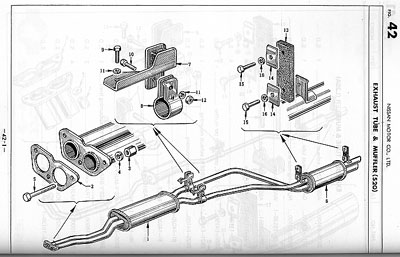
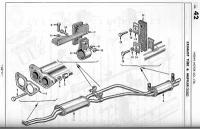
Hi Zvoiture, There are NO silly questions ( apart from those "how fast will my car go if....?" ones that you sometimes see ). Like your new avatar - great! The original system on the PS30 ( for the S20 engine ) was twin piped all the way through from the manifold. They go through the muffler boxes ( the pipes were perforated inside ) and out the back, changing from side-by-side to one-up one-down just before the rear box. FUJITSUBO ( famous old muffler company in Japan ) made their own version for the L-series engined cars very soon after the Z debuted in 1969, and such systems have been popular there ever since. They offer advantages in clearance over a single big pipe, and they sound quite distinctive too. I think the MSA "Twice Pipes" system must have been based on a similar theory, although I have never seen one one in the flesh. And hey, over here HLS30's are pretty exotic creatures - so don't get the feeling that I have a superiority complex going or anything. I would never diss a North American market Z ( apart from the handbrake being on the wrong side of the tunnel and the fact that the factory left you without five-speeds, rear anti-roll bars and decent diff. ratios - Miaow! ). Alan.
-
Oh, and the rear spoiler on the ZG was just the standard spoiler like all the other ones ( except the optional "deep" spoiler with the two ribs on the window side ). However, some ZG's came out of the factory with no rear spoilers and the dealers or owners fitted them later. That's why you sometimes see different emblem postioning on the rear spoilers of genuine ZG's. Anybody looking for a schoolmasterly talking-to on the subject of these models please form an orderly queue here.......... Alan
-
You can't get the genuine ones from Nissan anymore. That's why the replicas started becoming available ( from about 1974 onwards actually! ). You can still get the bonnet hinges ( different on the ZG ) and the headlamp covers, but none of the genuine plastic parts. Incidentally, the front "bumper" was made of expanded urethane foam. Its kind of soft to the touch, like old skateboard wheels. There are replicas and there are replicas. The better kits seem to come from Japan ( five pieces for the nose and then the four "overfenders" and the headlamp covers are seperate ). Even then they leave a lot of fabrication, whereas the genuine factory part was laid up really well and had loads of captive nuts in it. It really was a "bolt-on" job. However, bolting all the parts on ( even real factory parts ) did not make a "normal" Z into a true ZG. Some of the kits that are available in the aftermarket are not very good.......... Alan ( pedantic ) T.
-
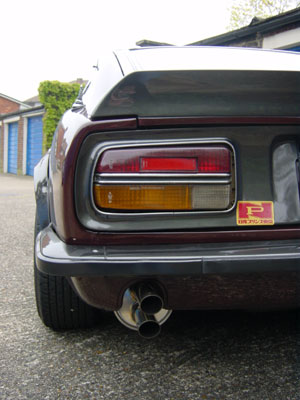
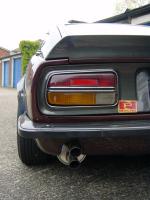
Hi Alfadog, The twin-pipe system seems to be an acquired taste for some people. I have a full stainless system on my ZG, and some people look at the back of the car, then get down on their hands and knees, get back up, and start laughing. Seems they think that it is something I dreamed up after eating too much cheese before I went to bed. Poor souls don't seem to know that the twin pipe system was standard on the 432 and companies like Fujitsubo have offered them for the L-series engined cars from the year dot onwards. These sniggerers are usually to be observed walking back to a sorry-looking S130 series Z with a really bad paintjob and a giant eagle sticker on the hood..................... Don't know if it will come put all that clear, but here's a scan of the back of my car. Say you don't like it at your peril!........ Alan.
-
Hi Alfadog, From the badging on the bottoms of the front wings, and the exhaust tailpipe, it looks as though your new acquisition is a 432. Its going to cost you a lot of credits to get her to perform.........! Alan
-
Gav, You'd better be careful about what you say regarding early chassis numbers - its a real minefield. We have two cars here in the UK with "HS30" chassis numbers in the low thirties - but that does not mean to say that they are older than for example an "HLS30" chassis number in the low thirties, or any PS30 or S30 chassis number in the low thirties. Nissan gave body / chassis numbers to different chassis types of the Z range in parallel. Hence you would theoretically be able to find the following cars out there in the ether: S30-00240, PS30-00240, HLS30-00240, HS30-00240 etc etc. That does not mean that an earlier number definitely precedes a higher number, as the model-type build date has to be closely examined........ If the early car you saw was HS30-00044 then it does not mean that it was built before the S30, PS30 or even HLS30 chassis numbers that have higher numbers. The HS30 chassis types started mainstream production in early 1970 - so that would make it quite a long way down the line ( somewhere within the first few thousand rather than in the first fifty ). As for the Fairlady ZG - I have a genuine one here in the UK. Please do not think that its just a case of bolting on a few bits to make the ZG specification! The "ZG" style bodykits that you can now buy in Japan and the USA are nothing like the real thing I can assure you ( although the five-piece front end kits from Japan make a better job than most of the kits available in the USA in my opinion ). You might like to make a note that the genuine ZG ( factory variant "HS30-H" ) even had different bonnet hinges to the standard bodied cars. And if you fancy fitting a ZG-look body kit to your Z without the "overfenders" or headlamp covers, then you will end up with neither fish nor fowl............. Please note that only a genuine factory built Fairlady 240ZG ( HS30-H ) can be described as a ZG. Simply bolting on some parts will not make it something that it is not, even though it might look like it. If this was the case, all those Ferrari 250GTO "replicas" out there would have to be called real ones...... I advise you to go the whole hog and try to make it look like a genuine ZG ( with the overfenders too ). Don't forget the gunmetal-painted rear bumper ( with rubber strip between the two corner pieces ) and you must have a set of humungously wide wheels and tyres too, even though the genuine cars left the factory with standard steel wheels and the dustbin-lid hubcaps. But please don't think, like some people seem to do, that you have a genuine ZG. It will only be a replica. I get touchy about this subject, as you can tell! Good luck though, Alan.
-
Hi Alfadog and Cuong, Thanks for your kind comments. Alfadog, you made some interesting comments about values again. I think that if you look at it globally, the prices of these cars are on the up. HOWEVER, I think that we will see more separation in prices linked to condition soon. In the UK, there are many cars that are changing hands for around £3000 to £5000, and many people who are buying an early Z for the first time seem to expect to find a good one for even less than that. In my opinion, even these £3000 to £5000 cars are in reality of a LOW standard. They might look good on the outside, but if they are original UK market cars then they are almost always showing signs of extensive welded repairs ( often leaving the chassis / unibody out of alignment ), badly repaired crash damage, and lots of plastic filler in the body. Added to this, there are MANY cars that have incorrect parts, bad-taste modifications or just plain bad maintenance. The better cars are actually changing hands DIRECT ( ie, outside the "For Sale" ads in the classic car magazines ) and they are going for higher prices than people realise. Some cars are being advertised at very high prices ( like the one that started this thread! ) but the owners seem to settle for a slightly lower price in the end. The point is that the BEST cars will always change hands at a high price, and in this country ( and the rest of Europe too ) there are just not that many GOOD cars out there.Seems that the rest of the world ( mainly thinking about the USA and Australia ). Your perception of the Z432 as a fire-breathing monster is a bit like mine was until I drove one! In reality, it has only a very little more peak power in standard form than the L24. Tuning the L-series engines brings quite big results for not much work and not very much money, but tuning the S20 is a high-cost exercise that yields little bang-for-buck. However, top tuners can get pretty good power from them ( and the factory were getting more than 250BHP from their injected race engines in the early 70's ) and the engine is a REAL thoroughbred. When I drove a 432 in Japan recently, I was reminded of what a good combination the S20, five speed trans. and 4.44 LSD combination is. It makes a real drivers car. and the gear ratios seem really close ( because of the 4.44 ratio diff ). Because the engine will happily spin up to 9000 rpm and still make power, it sounds and feels as though you are in a race car, even though you are not actually going all that fast! A tuned S20 just SOUNDS amazing though................ Cuong, your car looks mighty impressive in the photo! I have seen a few RB-engined S30 bodies in Japan - but most of them were normally-aspirated and the smaller-capacity blocks. To go the whole hog and fit the full RB26 in turbo form deserves a medal. Looks like that cage should stop the car twisting up like a rope when you get traction! I will e-mail you some pictures of my Z432-R "replica" project to your private e-mail address later this week. I have to say that it is a very large kit kit of parts at the moment, and the body has only been painted on the inside ( not outside yet ). Look out for a message from me later this week. All the best, Alan T.
-
Hi Ross, I am no expert on the GRS30, but as far as I am aware both the Australian and UK market customers pretty much had to take whatever came with the particular model and colour they chose. And I don't think it was possible to walk into a Nissan dealership and order up a particular paint and trim colour combination either, at least not in the first few years of production. It might well have been possible to reserve a particular body style ( say, 2+2 rather than 2 seater ) and a particular colour, but I do not think that the factory would "make" that car for the particular order. There was not such a big body range and colour / trim choice - so the dealer would probably just earmark something that he knew was already on the boat................ Certainly the UK market was run this way, and I bet the Australian market was similar. The USA / North American dealers might have pretended that they had more power over what arrived from Japan - but I guess in reality it was much more anarchic! The only market that got a PROPER choice of model / engine / trans / diff / colour / trim colour was the "home" ie Japanese market. They also had the "Accessories" option list to choose from ( spoilers, fog lamps, bumper over-riders etc etc ) as well as the really fascinating and extensive Sports / Competition Options lists to choose from. The Nissan "Sport Corner" dealerships could supply and fit these to the customer's cars. Of course, the local dealerships in the specific territories could choose to supply locally-sourced accessories ( such as driving lamps, sports wheels etc etc ) but these would not normally be officially-sanctioned option parts. Don't ask me about the trim or options on your particular car, as I would be pretty sure that it just had the particular differences that were current on that model / year / month / day of production - as the factory tended to phase different specs. and parts in gradually. This means that it is possible to see cars with chassis serial numbers OLDER than other cars, but which were actually built with parts that belong on YOUNGER cars! The whole thing is very difficult to pin down............. Good luck, Alan.
-
The GRS30 was the factory designation for the 2+2. "G" = 2+2 "R" = L26 engine "S30" = Model designation ( yes, it too is an S30..... ) This model was called the "260Z 2+2" for the export market, and being right hand drive ( no "L" prefix on the chassis designation ) makes it a relatively rare variant of the S30. Yes, the "GRS30" is the first part of the chassis number, and the actual number of the car comes after it. This is stamped on the firewall as well as being on the chassis plate. I did not mention anything about the RS30 series in my original post ( that would have made it even more complicated! ), but of course they too are part of the S30 series................ As an Australian-market export version, your car is very similar to the UK-market export version. However, there was no actual designation on the chassis numbers to indicate a particuar market version. For example all of the first series S30 left hand drive export versions had the chassis prefix "HLS30" - but this did not differentiate between USA / North American market versions ( mostly 4-speed ) and the European left hand drive market version ( mostly five speed ). This can lead to confusion at the very least! In Australia, the first S30 series cars to be imported were all prefixed "HS30", and were very similar to the UK-market export version "HS30" apart from a very few small details ( like lighting regulation compliance, for one ). Further factory-designated model identification came from the chassis SUFFIX - but that was not indicated anywhere on the actual body of the car. It was usually only on the paperwork of the car, and this was mainly used in Japan ( on the registration documents and the bill of sale ). For example, the factory code for the "Fairlady 240Z" ( available in Japan from October 1971 ) was "HS30", and the "Fairlady 240ZG" ( also available from October 1971 ) was also "HS30". However, the Fairlady 240ZG was actually called an "HS30-H" by the factory, and it does not appear on the chassis number or anywhere else on the car - only on the official paperwork that came with the car. If you know where and what to look for, you can find some "secret" factory codes on the cars that were involved in the build process, but by and large it is only on the original paperwork. Fascinating and sometimes confusing!....................
-
Actually, it depends what you really mean by your question. If you are asking the difference between the Japanese ( Home ) market Z cars, and the North American / USA export-spec. cars, then you have to refine your question to WHICH type of S30 Fairlady Z you are comparing to. From the viewpoint of the Japanese, your question asks the difference between ONE type or variant of the S30 ( the "USA" or North American export version of the HLS30, as opposed to the European export version of the HLS30 ) and ALL the other versions. These other versions include the PS30, PS30-SB, S30-S, S30 base model, HS30 and HS30-H etc etc. The point being that there are LOTS of versions of the "S30" type Z, and from the Japanese viewpoint ALL of the cars are in fact S30-type Fairlady Z cars. Please do not make the mistake of thinking that the USA / North American export version is in any way the "definitive" or base version that all the other derivatives come from................. Quite the opposite in fact. What I suspect you need to know is what the differences are between the S30 and S30-S Fairlady Z and Fairlady ZL. and the USA / North American HLS30 "240Z" - am I right? Unless you are getting confused and asking about the PS30 and PS30-SB ( Fairlady Z432 and Fairlady Z432-R ) with the S20 twin-cam engine? Main difference was the engine size of course, and the fact that the Japanese had a choice of base or luxury spec. ( giving improved trim and detailing and a five-speed trans ) up until late 1971, when they got even MORE choice with the introduction of the L24 engine to the Z range. There was a HUGE range of trim and drivetrain choices available to the Japanese, whereas everybody else pretty much had just one choice................. Best to buy a good book to wade through all this information. I recommend "Fairlady to 280Z" by Brian Long ( pubished by VELOCE ) which you should easily be able to find online at a site like Amazon. This is one of the only books in the English language that goes into depth about the Japanese home market versions as well as everything else. Highly recommended reading. Good luck, Alan.
-
 Hi Cuong, Thanks for the rating. No, I did not import it myself. A Japanese businessman brought the car over from Japan in 1988 as part of his personal collection while he was working in the UK. When his business failed, he left it here. It eventually ended up with me, and I have done a lot of work on it over the last six years or so. There are always quite a few of these cars for sale in Japan ( but you have to be careful, as there are many "fakes" or lookalikes too. Are you interested in getting one? Your car sounds like it would probably eat mine for breakfast......
 -
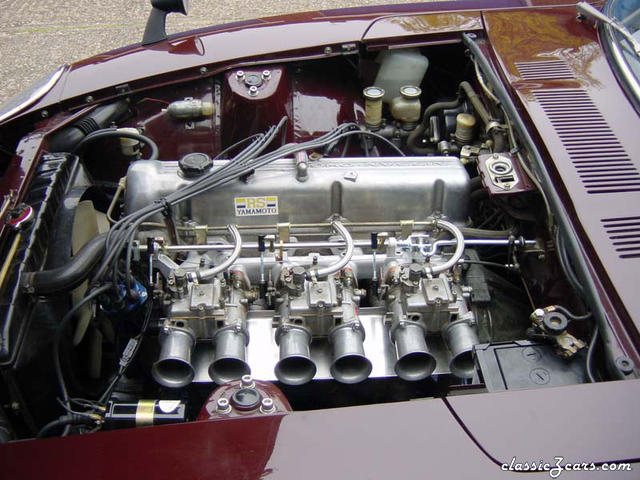
Rolling-road dyno set up showed 167 BHP at rear wheels @ 5800 rpm. Largely achieved by high compression ( 10:1 ) , "Rally" cam and fully ported / gas-flowed head.
-
From the album: Fairlady 240ZG ( HS30-H )
1972 Fairlady 240ZG ( HS30-H ). Owner: Alan Thomas. London, UK. Engine bay; 40PHH Mikunis, Sports Option ex. manifold, etc.