HS30-H
Supporting Member
-
Joined
-
Last visited
Everything posted by HS30-H
-
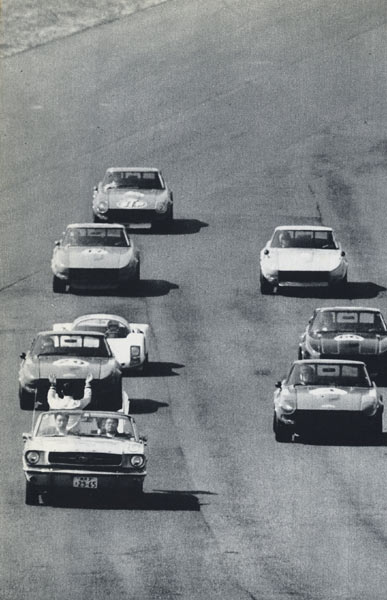
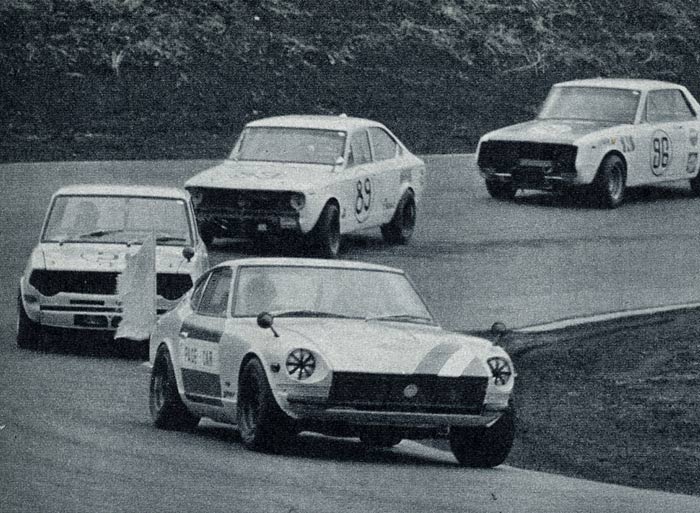
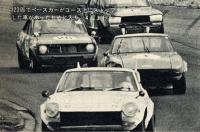
Eric, I asked that question a long time ago, and was told that the regulations for most of these JAF regulated races stipulated a minimum length of breather pipe for the 100 litre endurance tanks. I think it is safe to say that they made them that long for a purpose. When the regulations forced them to use bag tanks inside alloy housing a bit later, the breathers seem not to have been necessary any more. The regs changed pretty quickly in the early Seventies. Just as a little bit of a fun diversion ( and at the risk of going off my own topic ) here's another Japanese race pic featuring a pace car. Unfortunately, its not a Z pace car - but considering the cars behind the pace car are 'on topic', and the fact that the Porsche 906 in the group got beaten outright by a Works 240Z ( tee hee ) , I thought I'd post it anyway......... Alan T.

-
And here is a car appearing to be in a similar spec ( although I can't say for sure if it the same car or not ) carrying out pace car duties at the 'Race De Nippon 6 hours' event at Fuji Speedway on 10th April 1971. GTS-3 Class and Overall winners of the race were Hasemi and Takahashi in their SCCN 'Works' 240Z, with Miyakodaira and Teranishi in another 240Z following them home in second place. The photo is not a very good one - but Z pace car photos from Japanese events are pretty hard to come by......... Alan T.
-
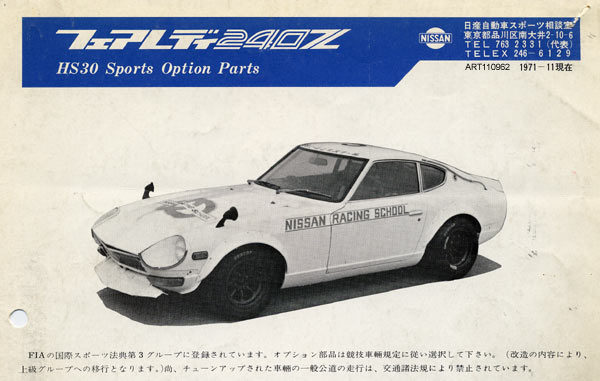
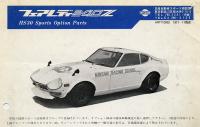
Getting back on topic a little, here's a pic of one of the Nissan Racing School Z cars that was probably used as a pace car in races at FISCO and Tsukuba during 1971 & 1972. This is a scan of the part of the front cover of the November 1971 'Sports Option' parts catalogue for the HS30 '240Z' model which had just been released for sale in Japan. As can be seen, the Nissan Racing School car pictured is sporting the Overfender kit and a chin spoiler.
-
Its hard to quote race weights for the two different models without having to resort to a little bit of generalisation, as the specs on these cars were changing so rapidly during their race careers that they become 'moving targets'........ But I do have data showing that the Works PGC10 ( 4-door ) race cars were running at around 960kg weight in late '69 and early '70, whereas the Works KPGC10 ( 2-door ) race cars were being tested and developed at around 1045kg in late '70 and early '71. My "interesting" quote to Gav was hinting at something that is kept fairly quiet to this day. Namely that the first Works GT-Rs were sometimes running somewhat light in comparison to their homologated race weight, and were reputed to have very *special* bodies indeed :tapemouth Alan T.
-
Would make a bloody expensive coffee table. This is a re-list I think. I didn't see what it went up to last time without meeting its reserve, but it probably won't sell on Yahoo without a lot of direct contact in the background ( he says it is "rebuilt" - but that covers a whole host of possibilities ). Ahmed, Actually I don't think the brake and clutch master cylinders on an LHD shell would interfere with the S20 exhaust manifold all that much, if at all - but the steering shaft would be a factor. It would require a custom manifold to avoid the LHD shaft. A smaller battery, and battery tray mods, might be needed to clear the induction side ( esp if using the original S20-type air box ). I've certainly not heard of an S20 in an LHD S30 body ( there were no official LHD S20-engined models of Z or Skyline sold to the general public ), but I have heard tell of at least one S20 engine being in the USA. Be aware that - as a 'Skyline' engine rather than a 432 engine - the oil pan on this Yahoo auction engine will not fit into an S30 body. The 432-type sump, oil pickup and pre-filter and the 432 dip-stick location would need to be used. Alan T.
-
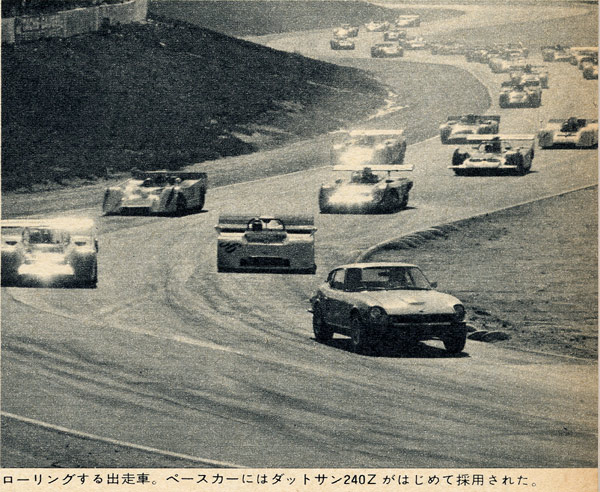
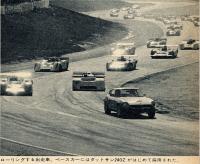
As a kind of branch to this thread, and with reference to that now-locked USA pace car thread, I thought I would post this photo. It was taken from a Japanese magazine reporting on the final round of the 1970 Can-Am ( Canadian American Challenge Series ) races - the "L.A. Times Grand Prix' - which was held on 1st November 1970 at Riverside Raceway in California. The photo shows a fairly stock looking 240Z - which I would assume was almost certainly an HLS30U road car - being used as a pace car during the race. Caption ( in Japanese ) under the photo implies that this was the first instance of a 240Z being used as a pace car in the USA. Alan T.
-
Hi Ben, Yes - they were almost certainly the Kobe Seiko magnesium 8-spokes as offered in the Sports Options list for the 432R, but possibly only the 8j x 14 size ( which was the only size listed in the first Sports Option list for the PZR ). I think it might be the Dunlop race tyres that are making them look so wide. They only just fit under the stock arches..... I think the pace car / Nissan Racing School car was a 432 upgraded to 'R'-level specs, with all the Sports Option suspension parts / plastic panels / acrylic glass / 4-point cage / stripped interior and Ikeda Bussan seats with 4-point harnesses. Probably not too much in the way of engine tuning. Without doubt the spec would have changed fairly regularly. Within a couple of months of their debut almost all the Works PZRs were wearing Overfenders and starting to sprout the vestiges of aerodynamic aids - especially in the front grille area. I'll post some more images of later cars in this thread after I scan the images and make proper notes about them. Stand by. Zedrally, No sunroofs on these Works cars, I'm afraid. PhilUK, The sketch may have originally been in colour when the artist did it, but it was only reproduced in b/w in the 1970 literature that I have. Sorry. Cheers, Alan T.
-
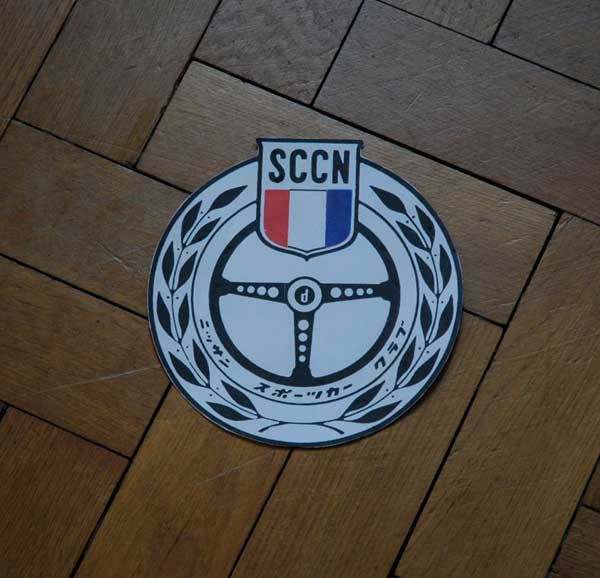
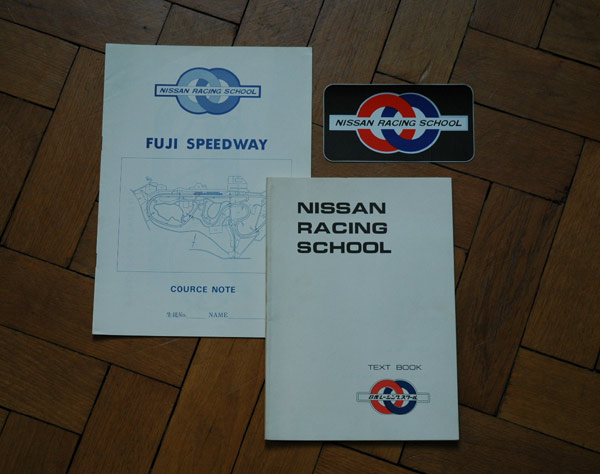
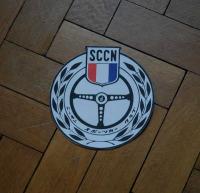
Hi Gav, In that particular race the 432s were up against the PGC10 4-door GT-Rs ( this was before the debut of the 'K' 2-door ). The weight issue must have helped, but there were races where the Z was beaten by the GT-R overall even though they were racing in different classes. Incidentally - the 4-door GT-R was lighter than the 2-door, which is interesting isn't it? Bambikiller240 & Alfadog, I doubt that this particular car survived its Nissan Racing School career, and I have certainly never heard tell of such a 432 surviving. The only Nissan Racing School Z car to survive as far as I know is the LY-engined 240ZR that NISMO restored a few years back - which is a much later car. Unfortunately it was probably the case that the cars were worked to death and then split for spares or scrapped within just a few years. ChrisA, The emblem that you see on the centre of the grille is the 'SCCN' ( Sports Car Club of Nissan ) steering wheel / leaves / tricolour shield emblem. SCCN was in effect the organisation that the Works team drivers belonged to ( and were employed by ) and which entered the Works cars in the races. The Nissan Racing School was also part of the SCCN organisation, along with the NDC ( Nissan Drivers Club ). The Katakana script around the rim of the steering wheel on their emblem reads "Nissan Sportscar Club" - which does not actually match up with the SCCN acronym...... I am attaching a photo of an SCCN sticker below: MikeW, Don't forget that this particular race was not actually the race debut of the Works cars. You might be more impressed to hear that the race debut of the Z car was on 18th January 1970 - in the "All Japan Suzuka 300km" race. SCCN works driver Moto Kitano was leading the race in his 432R until he was hit broadside by another car - destroying the first Works 432R race car in its first-ever event. 1GENZED, The Nissan Racing School was set up initially to recruit and train drivers to become members of Nissan's race teams. They mainly operated out of Fuji Speedway and Tsukuba Circuit, and the teachers themselves were Works drivers and SCCN team members. This was purely a race driving school, and was not set up to sell Nissan products, or to instruct customers who had bought Nissan cars in how to drive them - so the comparison with Bob Bondurant's school would be a good one. They used many different types of car, ranging from Fairlady roadsters, Sunny Coupes, Skyline GT-Rs, Cedric and Gloria stock cars right up to single seaters. The school was still running until recently - so they would have used many many cars over the years. See the photo below of an early Nissan Racing School 'starter pack' of text book, FISCO course map and Nissan Racing School sticker. Alan T.
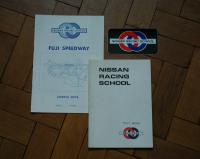
-
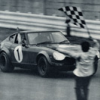
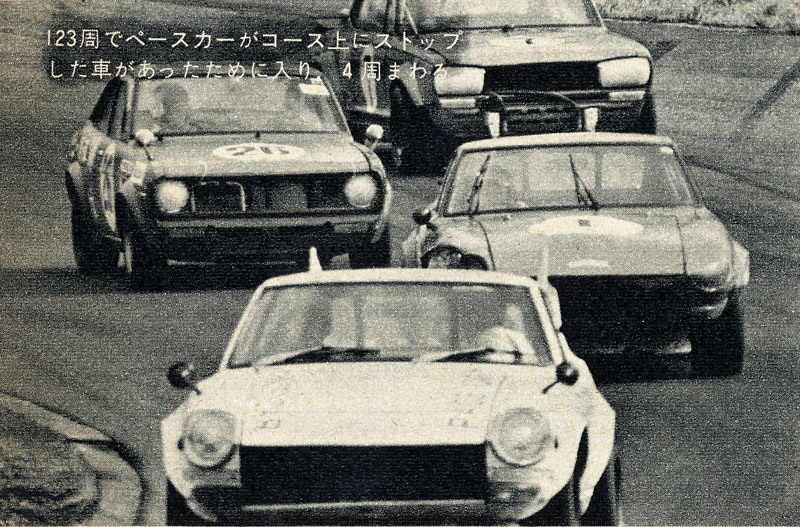
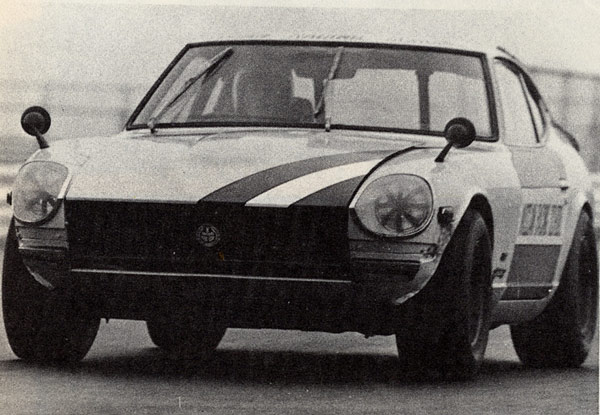
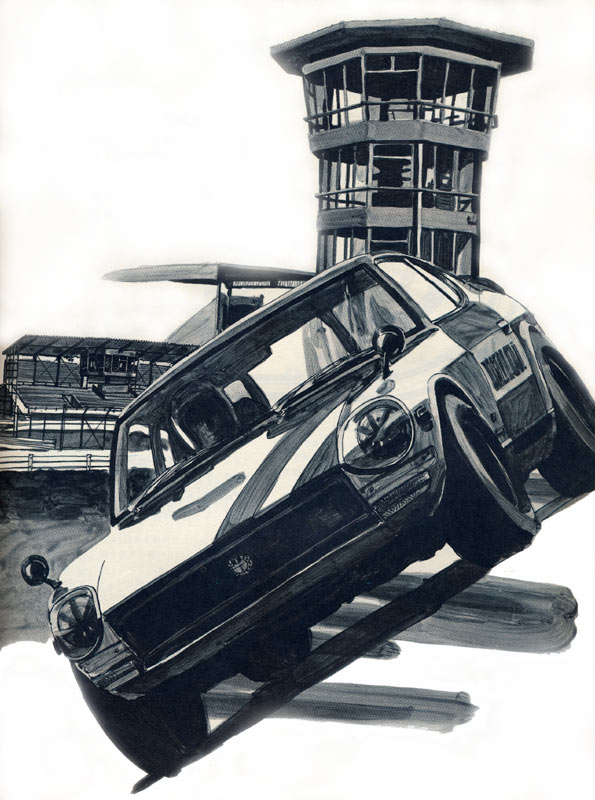
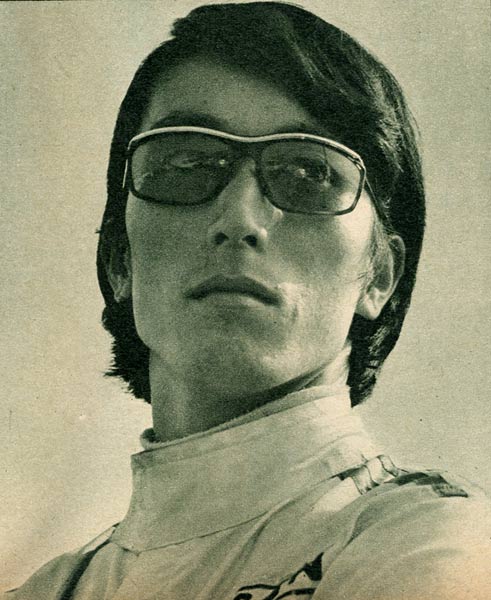
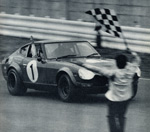
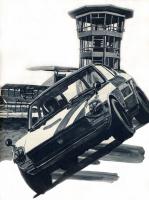
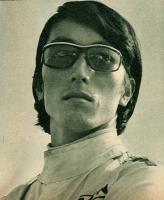
After a discussion arising from a recent thread, I took a closer look into the question of 'The first Z pace car'. That is to say, the first S30-series Z car to be used for 'Pace Car' duties in a race event worldwide. I have been encouraged to post this information here on the site for all to see, so here goes: The first instance of use that I can back up with solid documentary evidence, data and pictures is at the 'Race De Nippon' event - held on 12th April 1970 at FISCO ( Fuji Speedway ) in Japan. This 6-hour race included 'TS-II', 'TS-III' and 'GTS' classes, with two SCCN ( Nissan's works team ) Fairlady Z432-R cars entered in the GTS class. Car no.1 was crewed by aces Hasemi and Kitano, and car no.2 was crewed by Teranishi and Yokoyama. The main challenge to the two Z cars for overall victory was to come from a gaggle of Skyline GT-Rs in the TS-III class, a brace of very hot Mazda rotary coupes also in TS-III and a couple of quick Isuzu Bellett GT-Rs running in TS-II. Several Fairlady SRs were running head-to-head with the 432-Rs in the GTS class, and as these were pretty much at the end of their development period they would have been well-sorted and still fairly quick. The no.1 432-R of Hasemi and Kitano took the overall and GTS class class win - covering 959km over the 6 hours, with Skyline GT-Rs following home in second and third positions. One of the Mazdas came in fourth. This was the worldwide first ever race win for the S30-series Z car....... A pace car was deployed more than once during the race, and it is this car that is the subject of this thread. It was a Fairlady Z432, and was actually one of the cars that was part of the Nissan Racing School fleet - which was based at FISCO. For this event, JAF ( the Japanese Automobile Federation ) 'borrowed' the car from the Nissan Racing School, and used SCCN race team driver Yasunori Toshimori as the Pace Car driver - accompanied by a JAF official in contact with the Race Controller by radio. As one of the cars in the Nissan Racing School fleet, the 432 was prepared for fast circuit use - with many of Nissan's own 'Sports Option' list and Works parts fitted to it. It would certainly have been able to keep up a reasonable speed on the circuit, especially with Toshimori driving. Below are pics of the car in question. First pic is of the car being used in the race after an incident. Second is the same car in its Nissan Racing School livery. Third is a nice illustration of the same car in some Nissan Racing School publicity, and the fourth pic is a portrait photo of SCCN team driver Yasunori Fujimori, who drove the Pace Car illustrated. I hope this is of interest to some site members. Alan T.
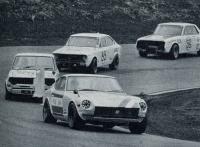
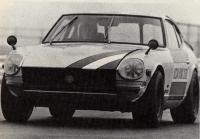
-
Marty, Most of the early UK-market cars had big door mirrors like the ones seen on the yellow car that Mr Camouflage posted pics of ( Nissan UK's current press car ). These were I believe actually fitted by the concessonaire in the UK at the time ( Datsun UK ) rather than being fitted at the factory in Japan. What you are describing sounds different. Got any pics? Alan T.
-
I think it is quite possibly the Fourways Engineering item. I can't say with 100% certainty that it is the Fourways piece, but it certainly looks just like it.
-
'FRP' = Fibre(glass) Reinforced Plastic. Same as 'GRP', 'Fibreglass' etc.
-
Doesn't it just! It has been bumped up to around 2.3 ( big bore kit and longer stroke crank ) and has a straight pipe with side exit - so that helps a bit. I hope my one sounds even half as good as that when its installed and running...... It got my goolies as well :eek: I think a lot of the attraction comes from the fact that we have to dig deep to find the treasures. Cheers, Alan T. :classic:
-
Hi Mr C, That's exactly the car I was talking about above; restored on behalf of Nissan UK for them to use in press and promotional activities. It is indeed an aftermarket front spoiler - in fact, it is the one-piece FRP item that replaces the spoiler, front valance and both corner panels. If you look closely you can see that there is no join between the nearside corner panel and the front valance...... Cheers, Alan T.
-
Hi Jim, Unfortunately it isn't an original 'Works' car. It is a race car built by 'R-Factory' using quite a lot of modern componentry. The transmission, suspension and brakes are nothing like the spec of the original Works cars. And this sequence was shot at Sugo circuit rather than FISCO. Sugo is a really great little circuit with a lot of elevation change, and has an atmosphere that reminds me quite a lot of Brands Hatch here in the UK. I have been to see all sorts of races at Sugo - including Group C and Group A ( in the era of the R32 GT-R's dominance ) and it was always a great place for a spectator, with lots of good vantage points within reasonable walking distance. Kurosawa was one of Nissan's top SCCN team drivers ( nicknamed the 'Seven Samurai' ) back in the Sixties and early Seventies, and drove in lots of different machinery and categories. He even drove Works circuit race Z cars with some success. By all accounts he's a bit of a miserable sod though Hope you don't mind my correction. Cheers, Alan T.
-
Rick, Its still possible to get UK-style plates made up if you want. The mid to late-Sixties silver-on-black style is in my opinion the best looking. However, one thing to keep in mind is that the typical UK plate sizes for both front and rear of the car were much bigger than the USA ( and Japanese ) plate sizes. They don't actually fit the S30-series Z all that well.........
-
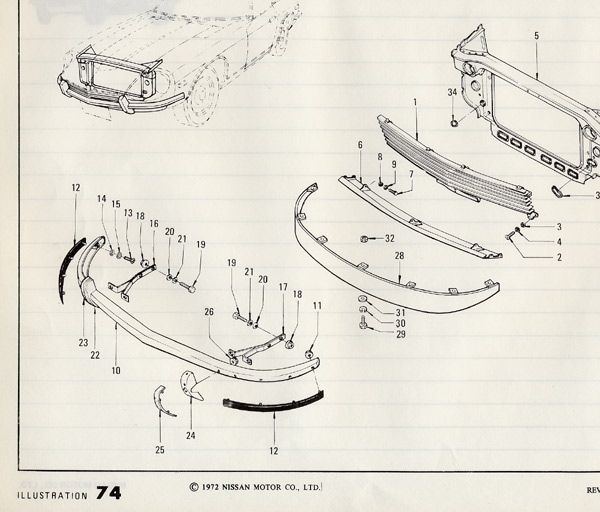
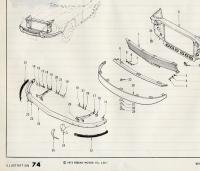
As addition to the good information posted above, here is a scan from Nissan's "R-DRIVE" parts lists. The illustration shows what they call the "European Air Spoiler" - numbered 28. *98300-E8100 ASSY-FRONT AIR SPOILER ( EUROPE ). These were indeed made from Urethane foam with a hard skin on the outside ( hence they were still slightly flexible ). However they hardened up with age, cracked and also deformed in bright sunlight over the years. The steel brackets that were moulded into the Urethane also went rusty after getting wet over the years, and tended to swell up - with the brackets eventually failing...... Good condition original spoilers are like gold dust in the UK these days. I have not seen an NOS one like 26th-Z's pictured item for many years now. The last couple of half-decent used ones I had were sold to Japan. I could be wrong, but as far as I know the Fourways Engineering item is not actually a replica of the original UK market "European" spoiler - but I can look into that and post an answer later today. UPDATE EDIT: OK - I looked into this a little further. The Fourways Engineering item is not actually a replica of the 'European' spoiler on its own. They sell a single-piece fibreglass moulding that replaces the front centre valance and two corner pieces, and which has the shape of the 'European' spoiler moulded onto it. When it is all fitted, and with some paint detailing ( satin black on the spoiler part ) it looks very similar to how the UK-market cars looked. Rick, if the UK-market car featured in that car magazine you found is yellow, then it will be the car restored for Nissan UK to use in advertising and promotional duties a couple of years ago. As far as I am aware, that particular car is NOT wearing the UK-market 'European' front spoiler ( a good condition item could not be found for it ) and is wearing a one-piece moulding similar to that supplied by Fourways Engineering. It fools a lot of people. Do be aware that the Fourways Engineering part is "made to order" too. Cheers, Alan T.
-
Relax Jason, Just think of it as a "Holiday in Cambodia" :knockedou Alan T. ( ps - I gave JB a lift in my car once, would you believe? ).
-
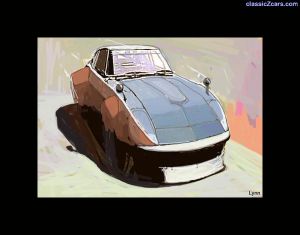 Bob Sharp? Looks to be RHD and with Japanese market fender mirrors. Did Bob Sharp ever use an RHD car? Was this based on an existing photo, Jerry?
 -
Ron, This was one of the comments on this thread that caught my eye: I obviously misunderstood what "world" means to some of the people that inhabit the World..... It's perplexing to see people happily talking down the value of these cars. To me, it seems like a weird form of inverted snobbery.
-
The most valuable in World terms ( ie - not just the USA, and USA-market cars ) are already changing hands privately for prices above US$100K. It's just not necessarily happening in the USA, and it certainly isn't happening on eBay. I think you'd have to say that any genuine ex-Works race car is going to command the highest sale price, and don't forget the rarer models when talking about the complete range of S30-series Z cars that were made ( not just 'HLS30-U' models...... ). Yes Ron, I'll have to 'return serve' that one to you sometime. Cheers, Alan T.
-
This topic ( and this very car ) has been discussed on this forum before. The answers are in the replies to other photos in the Gallery: Sports Car Grafitti event pic Sports Car Graffiti event pic - another one
-
I think you misunderstood what I wrote. A "a non-USA / Canada market LHD 'Datsun 240Z'" means an 'HLS30' made for, and exported to, a market other than USA or Canada. Like France, Spain, Germany or Belgium for example.
-
Hi Christopher, The core point of my 'theoretical' question was what class would such a car be put in? I'm not talking about 'Stock' or 'Modified' here - that would be relatively easy to discern. For example, a stock unmodified 1969 Fairlady Z-L. I see only '240Z', '260Z' etc etc in the ZCCA judging guidelines - so would the Fairlady have to be entered in the '240Z' class? On the face of it, that would seem to be a ridiculous situation. It would be even more ridiculous if a stock 432 was forced to enter the '240Z' class. My question still stands. Does - for example - the '240Z' ZCCA class essentially mean 'HLS30-U' only? Yes, a 432-R would be a guaranteed nightmare. No two built alike Alan T.
-
Ron, Speaking for myself here - I already am using restraint and manners. I thought this particular exchange was fairly well-natured and pleasantly conducted, actually. Maybe you might be reading a little too much between the lines? :tapemouth Again speaking only for myself - if I see something that I believe to be incorrect or misleading, and it is on a subject that I feel passionate about as well as having spent some years researching and learning about, then I'm going to pipe up. Works Z rally cars are a good example of this. How about yourself? If somebody wrote something on classiczcars.com that you thought was incorrect or indeed complete crap - wouldn't you want to correct them? Not to humiliate or embarrass the poster, but to avoid nonsense becoming *fact* because it is repeated often enough. How about if I wrote that the BRE car you replicated originally used a stock 4-speed transmission? You'd correct me wouldn't you? I like to think ( and hope! ) you would....... The only thing I can suggest - if you really can't stand it any more - is to make a complaint to management. Or how about putting me on your 'ignore' list? You won't have to see any of my posts then. American Chopper? You've got me there. I have no idea what this is / was. I presume it must be an American TV show? Regards, Alan T.