EScanlon
Community Member
-
Joined
-
Last visited
Everything posted by EScanlon
-
The seller obviously does not know what car this belongs to, and has probably NEVER seen a Z. Or.... Has anyone ever seen one of those low-budget outrageous car modification nightmares? Remember the VW Beetle with the fake "Rolls-Royce" front end? Personally, I think the Bug carries that look off well, but I have seen autos that have had the same transformation effected to them. Imagine a Ford Pinto or Mercury Bobcat. The Bobcat had a small grille that ~kinda~ suggested the RR Grille. Well, I saw one done that way, except the Rad/Grille was at least 5" deep. I don't think the original is that big. Additionally it had the Continental Spare Tire kit in back that was only the top HALF of the kit. (No room or space to allow the spare to be full size.) To top the whole thing off, a Landau Vinyl Top had been added, with a 2" Chrome edging. Last but not least.......a Lighted Flying Unicorn Radiator "knob". Way too much if you ask me...... Then I saw this on e-Bay and I figured I'd go trolling....... The emblem I ~believe~ is actually from the Mercury Zephyr. Anyone remember the Ford Fairmont? The Zephyr was it's twin for Mercury. As to whether I would ~actually~ mount it on a car of mine, well, who knows, I do have a parts car to get rid of ... Enrique
-
What do you guys think of this Z emblem? http://cgi.ebay.com/ebaymotors/ws/eBayISAPI.dll?ViewItem&item=2454968311&category=33643 Personally, I think it would look good when I finally get my chopped and lowered Rolls Royce Radiator Grille installed. Anyone know where I can find a Continental Spare Tire Kit for the back end? Due to the shortened height of the back end, I think the Half kit would be best. Thoughts? Enrique
-
POR requires that the next coat of paint be applied EITHER After a period of time after the last coat of POR was applied when the last coat is "finger-dry". "Finger-dry" being when you can drag your finger on the surface and feel the drag on your finger, but not when you would still disturb the "skin". This goes for additional coats of POR as well as any other top coat. OR After applying their activating primer "Tie-Coat". OR After proper preparation of the prior coat. This means sanding or scuffing. Personally, I opted for number 1. The couple occassions when I had to scuff, I felt it was a laborious chore at 400 grit. I switched to 220 and knocked it off in just a few minutes. If I had to do more sanding I think I would opt for the lower grade even going down to 180, especially if I were to be applying a subsequent layer of POR. 2¢ Enrique
-
Wait a minute!! If you've allowed the POR to completely dry to the point that there is dust on it, then you'll need to scuff up or re-activate the surface before it will allow more POR to bond to it. POR sells a primer that will allow you to paint either more POR or some other paint over it AFTER it has dried. You can paint over it shortly after you've painted the ORIGINAL coat of POR but you need to let it set to the "finger-drag" stage. 2¢ Enrique
-
EEEEEWWWWWW!!!! Band Nerds!!!! :classic:
-
As crazy as it sounds, it is such a common occurrence for the floor to buckle due to a misplaced jack that that is why you've heard from several members stating that that may be the cause of it. As to the similarity of your floor dent with a friend's car with the "same" or similar dent? Again, it is a COMMON occurrence. Next ask about Rust in the Floorpans, or in the bottom of the front fenders, or in the hatch area, or.... Get my drift? Good Luck Enrique
-
Carl beat me to it. If you look at My Gallery you'll see how I did it. I took a PVC 45° elbow and fitted it into the drain hose from the cowl, then used ziplock tie straps and some silicone to ensure they stayed fastened. To the lower section of the elbow I inserted some clear flexible PVC tubing that I had exit the fenders behind the rubber flaps. I cut the PVC at an angle facing towards the back and down to the ground so that it wouldn't catch air as I drove along. As far as the fresh air vents that are located right by the cowl drain hoses, they receive their intake way up front by the radiator. If you've had the fenders off the car then you've noticed that big "frame" member above the tire and out from the shock. That tunnel is actually the fresh air intake feed tube. Hope this helps. Enrique
-
I concur with Carl. More than likely a misplaced floor jack caused that dent, or hitting a concrete parking lot railroad tie. If it didn't affect the reinforcing channel under the floor, you should be able to pound it out with a sledge hammer. Hope this helps Enrique
-
Stephen's polished rim look is OUTSTANDING! I admit that I'm not a big fan of the Iron Cross look, but the way they look polished really sets them off. If you were to insist on painting them, the original look is to paint the inner part of the cross black, but I think that if you were to OUTLINE the center parts with either black or another high contrast color the effect might also be remarkable. 2¢ Enrique
-
When my fan started making noise, I had access to a Z only boneyard here in the NW. I bought a replacement MOTOR and the cage came with it. I didn't get to install it till later, that's when I discovered that it was the CAGE and not the motor. Now I have a spare motor and a bad cage. You might ask Chloe if she can source it. Enrique
-
There is little cross through ventilation going on through those holes. The Z's that I've seen have had the vinyl glued to the inner rocker panel in such a way that those holes were sealed. Additionally the rocker panel has two drain holes as well as being opened to the reinforcing panel for the door hinges as well as to the rear fender area just behind the locking mechanism. I used POR as a rust protectant inside the rocker panel, so I wasn't too concerned about leaving it open to ventilation. I did seal all the holes on the inner rocker panel, the inner rear fender (in front of the rear wheel) and the result is that the car is so much quieter than any other Z I've driven in. 2¢ Enrique
-
If you'll note those "holes" actually are pressed into the metal such that they have an indented edge. That indent provides for a lot of structural strength to a piece of metal. You CAN cover those holes up, just be sure that you've shot some sort of rust protectant into the cavity behind as that is your rocker panel. When I closed mine off, I used pieces of plastic "cardboard" cut into the size of the hole and then siliconed in place before I covered them with Q-Pad sound deadeners. In my opinion, that makes the car that much LESS noisier. 2¢ Enrique
-
I'll take the blame. Rick's original post was a conversation starter, and I objected to my perception of Carl and Victor's replies and may have made a hairy nuisance of myself. I'm the one that got deep and proceeded to dig further. I will excuse myself with the following: I will admit to responding to posts with more than a dash of thought provoking commentary (or at least, I HOPE it's thought provoking). The members of this group in general, give their best replies to thought provoking discussions. Then again, we're all guilty of the bonehead response to one or another topic. I'm not refering to debates on the best method to remove the center instruments, or how to remove the spindle pin, as these tend to generate agreement over time, as the different methods are tried and dismissed. I'm referring to topics such as Alan's "Interior Ergonomics" post. There are others, but that one has to be the all time winner with regards to responses that continue to engender other posts. It is these thought provoking posts that, to me, make this site as interesting as it is. Yes our group tends to be a bit more "conservative" than other sites which will remain nameless. And maybe it is that conservatism that has drawn such notable folks as Carl Beck, Carl Stahlnecker, Alan T., Victor Laury, Ken Mack, M. Perdue, and so many others that it is my lack of total recall that limits the list and not their notability. We do have our younger and our older, and maybe conservative is not the term I should use. Some might explain it away as dedication to the "true spirit" of the Z that Mr. K introduced in 1969. So many of us fell in love with the true blue limited sports cars of those days and found our dreams far exceeded the availability of the cars and that only by winning the Irish Sweepstakes might we be able to achieve them. The Z offered us a way to fulfill those dreams. It was and is yet, affordable and available. It's distinct lines, appeal, and speed are but the tip of why we love them. Again, this post is guilty of being a bit deep. Happily the members of this site are miners. 2¢ Enrique
-
The early Z's did not have automatic self-adjusting seatbelts. Even I find myself somewhat "strapped" in when I adjust the seat and shoulder belts to where they will hold me. 2¢ Enrique
-
I hope that we can continue this without anyone taking offense, and I will once again apologize to anyone that feels that my comments were offensive. Opinions are like derrieres, everyone has one, some are extremely comely and others would scare a baboon whilst others would gag a maggot. Regarding corporate sponsorship of most (if not all) major events...no argument. Sadly there are few opportunities where people get together and effect worthwhile and notable events without someone in the corporate world seeing it as a viable mode of advertising. Then again, and also sadly, there are way too many individuals out there whose "altruism" is a thinly veiled veneer for massive greed. Those individuals would sell their mother's hide if they could. Unfortunately, nowdays without some form of sponsorship from someone with the bucks, few events would be produced. "Altruism" is a label used for some of these people's motives, when in fact, Self-Agrandizement best describes it. Maybe I'm too much of a cynic, but behind so many "altruistic" motives lies a big chunk of selfish ego building. Oh well, maybe sometime in the future we'll begin once again being helpful without expecting something. This club is a good example of what a true altruistic forum can be. We help each other out with information, advise and even exchange parts in the hopes that our fellow Z owners will also have a Z to admire. Is there a touch of selfishness there? Probably, whether it's recognition amongst our peers, or the hope that all Z's end up being desireable therefore evaluating their own or.....? 2¢ Enrique
-
BEFORE you go buying a new motor, take your unit apart. You may find that the ONLY problem with it is the connection of the plastic squirrel cage to the motor. What you might need might be JUST the squirrel cage. I had the same problem with my Z, and since I did have a replacement motor, I went to do the transplant. When I removed the squealing motor, I discovered that the squirrel cage had literally reamed it's splined shaft hub. Additionally, the remainder of the hub showed some stress cracks all the way through. Repair was deemed a loosing proposition, I replaced the cage and eliminated the squealing. Unfortunately, if you do NOT have a replacement cage, it might be a bit of a challenge to fix it as the hub not only needs splined teeth within it's shaft opening, but the whole hub is integral to the strength of the cage. 2¢ Enrique
-
I'm going to presume that the original comment was indeed sincere and heartfelt, since that was the way I read it. So, upfront I'll apologize to Carl and Victor, but without mincing words: WHAT THE HELL IS WRONG WITH YOU TWO? Again, sorry if this upsets you, but having declared yourselves bored and hard to please couch potatoes, must you really belittle one of the events that the WORLD considers beautiful and spectacular enough to see to BROADCAST IT WORLDWIDE?? I don't wish to start a flame war, but there are always events in one's own city, county, region, state that we choose to ignore because of the "tourism" angle, or because of the crowds or whatever..... However we need to recognize that there are many people out there who spend a lot of time, effort and money to put together these spectacles. That they choose to do so, is their choice. Would you believe that there is another group of people out there who choose to expend a lot of time, effort and money to restore Z cars . They get together in groups on occassion to gawk at, compare and compete with their passion and would have the rest of the world take notice and respect their endeavours. 2¢ Enrique
-
I also have an R/C boat that had had the muffler mount screw holes broken off (accident that sheared off the muffler). Realizing that I had the choice of buying a new $40 muffler or giving it a shot at repair, I used some JB Weld. That stuff not only allowed me to repair the mount, I also re-tapped it with the original thread diameter and pitch so I did not have to find new muffler screws. As you know, the muffler and cylinder head are the two parts of the motor that get the hottest. I've since used that motor about 15 DAYS worth of boating and couldn't guess at how many individual runs that amounts to, at a guess figure 5-8 runs per day averaging 15 minutes or more. JB Weld withstands temperatures up to 550° F if I recall, that should be about 288° Centigrade. The key to working it is to make absolutely sure there isn't any grease or oil on the surface, mix it real well and let it sit no less than 24 hours before you get in there and start trying to work it. It sets best if the temp is maintained over 70° F (21° C) for the whole curing cycle. Although you can "speed set" it with a hair dryer or a heat gun, it can make it real runny at first and cause you more problems if you aren't careful. Hope this helps. Enrique
-
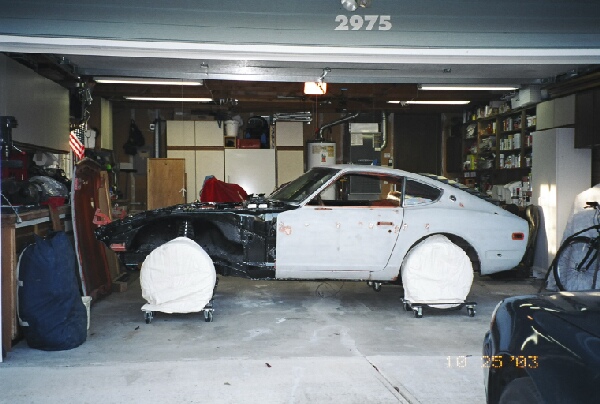
Beandip needs your help clubmembers! He's been laboring very intensely on completely restoring his vehicle. He drove the car into his garage whereupon he promptly removed bumpers, front fenders, engine, transmission, interior and just about every removable piece from the car. Now, in order to assist this, he purchased a set of wheel caster beds. These allow you to rotate the car...as long as it's on a flat pad of concrete. Well, if you look closely in the picture, you'll note that "eye-level" which is what the camera was held at, is approximately right above the door panel's. This means that standing in the driveway leading to the garage at less than 10 feet distance you are already a fair amount BELOW the floor level of the garage. Now, this picture was taken back in October, and since then the vehicle has gained a bit of weight, hence making it VERY tricky to roll part of the car out on the driveway hoping to straighten it out. He needs to straighten out the car soon, as with the snow we've received in Portland this past week, his owner or SWMBO is really beginning to not like trudging through the snow just cause Beandip got the car stuck in the garage. So, do you guys think we can come up with an answer? EnriqueLOL
-
Another thing that you could fix with that tape is the Center Vent Bellows connector. That's the part BEHIND the Chrome Center Vent drum. Time and heat have usually cooked the foam padding to dust. Be careful how you build up the foam especially to the sides where the thumbwheels can rub on it. They DO rub, just not so much as to make it difficult to rotate the vent. The foam should "seal" the upper and lower edges of the bellows connector to the body of the Vent Drum Holder. Hope this helps. Enrique
-
We need Alan or Carl Beck in on this one. If I recall, from prior discussions on this subject, there were several reasons for the changes in body weight AND engine displacement to satisfy / comply with the Emissions Guidelines for IMPORTED cars (as opposed to American Built). In the EARLY 70's the price of Oil had gone from less than $6 a barrel to close to $39 (if memory serves me correctly). In addition to this there were NEW requirements for vehicle crash performance, the 5mph bumper is the most notable one of these changes. There was also a strong movement to reduce / eliminate emissions from vehicles. The advent of "Air Alert" days or Smog Warnings etc are proof of that. Although emissions from industrial smokestacks was also in the process of being addressed, the government saw fit to address vehicles first as the most noticeable and measureable reduction in those levels. In the old "muscle car" era, the EASIEST way to gain power was to increase engine size. The other easy way was to stuff the cylinders full of gas / air mix. Think of how many buddies you recall that tell you about having a 327 bored out 80 over, or a 350 supercharged with a Quadra-Jet carburator. There were other variations, polishing the intake manifold, adding additional carburators, and later, changing compression rings, seating valves better, balancing crankshafts, cams etc. All of these were small but cumulative changes to the Internal Combustion Engine System. Now if you put them into the time line as far as the Z is concerned, then it's easy to note why the 260 gets a bad rap, as well as why some of those changes were effected by Datsun / Nissan. The 70 Z is the lightest of ALL. It's Engine Torque to Vehicle Weight Ratio made it one of the nicest FASTEST sports cars around. Nissan was looking to make its next vehicle to take over from the Roadster 1600 / 2000. Now remember, the 1600 and 2000 for all the sales they did have, you're talking a vehicle whose TOTAL numbers are less than the first few years of the Z. Nissan did NOT expect the Z to take off like it did. In order to RACE it, they needed ~so~ many units PRODUCED for sale. Race it they did, and WON many events. I will admit to not knowing the whole racing story, that's where Alan is sure to chime in and give us a good background. Suffice it to say that the Z since it's introduction and to this day, has won and continues to win major cross country rallies all over the world. Then sales took off in the U.S.; also other countries, but the market in the U.S. and it's POTENTIAL is what induced Nissan to make the car more sales worthy. During this time frame, both in the races and with customer use, it is noted that the vehicle is a bit too light as well as prone to crumpling during an accident. So they decide to increase the metal thickness and stiffen the car up a bit in the next production run. At about this time, you start seeing the FIRST of the Vapor Recovery Canisters come into use. Due to the construction of the Ventilation system, those first few vehicles have a very unique Canister. They are plastic and very few have survived to this day. However, during the INITIAL sales year, (69 + 70) a strong and potentially hazardous intake of exhaust emissions INTO the vehicle is noted. The ventilation system is reworked and the vents that were originally mounted in the Hatch are moved to the Roof Pillars and the hatch skin is changed. The Vapor Recovery Canister is changed in shape and slightly in location. Inner Plastic Trim Panels are also modified to provide the different vent location and the presence of the Vapor Canister. The beginnings of Smog law requirements are felt and the infamous Smog Air Pump is added to the car. Although literally a "Band-Aid" fix, it does meet with whatever standards were in place. Up to this time, the additions in weight and torque robbing smog pump have not seriously affected the Z's performance. But the further mods and changes and additions are starting to bog the engine down. This causes the engine to work harder and the first few noticeably strong overheating problems are noted. Not only in that the engine overheated, but also in that "vapor-lock" is a common complaint. More changes to the carburation system causes further and more exasperating overheating. The carburation system is modified and a water jacket is added to try to cool the fuel intake. Again performance suffers and the increasing requirements for emissions really take their toll. The car is further weighted doiwn with the addition of the 5mph bumpers. All in all, the future is looking a bit grim. Nissan, in an effort to maintain it's new "Export King" upsizes the engine to 2600 cc, and fully incorporates the new water jacketed and emissions compliant carburator. Sadly, the results are woefully dismal. The new 260 is plagued with service problems, overheating problems, and the car begins to get a really bad reputation. Add to this increasing gas prices and the reduction in miles per gallon and the car starts to be seen as a rich man's toy. The affordable sports car is starting to look like a typical flash in the pan. I'll admit that I'm not fully conversant on the transition from 260 to 280. Whether it was felt that more engine would eliminate / reduce the problems or fuel injection or both I'm not sure of. I don't myself know of any carburated 280's from the factory, but that doesn't mean there weren't any. Then again, I haven't heard of a fuel injected 260, so which was first? Since then, research into higher compression engines, more efficient engines and other factors have pushed manufacturers in different directions than 25+ years ago. The changes / requirements sometimes affect the direction of future changes just as effectively as a catastrophic failure can. Higher compression is easier to achieve in a smaller cylinder, and hence smaller volume engine. As opposed to increasing the numbers of cylinders, etc which were also experimented with. The added complexity of the engine made it more efficient to concentrate on smaller engines. Honda, Toyota and Nissan were some of the leaders in this effort and thanks to them many of the advances we see now in ALL cars are thanks to them. Don't forget that the reason the foreign companies were more interested in finding ways to work with the laws than GM and the others was due to the tariffs and limitations imposed on them by the government protecting Detroit. Remember Chrysler and Iaccocca? They were loaned the money to bail them out AND to allow them to effect the changes so that they could compete with the Japanese imports. Then you remember the "K" cars? Remember, it wasn't until Iacocca showed GM and Ford that they COULD change, and change well that they started to. Ok, let the flaming begin. Enrique
-
I checked two places for the foam strips, one was an R/V Center (for accessories and the like) and the other was a Building Supplly store that sold to not only plumbers but also to people hanging suspended ceilings. You'll find various widths and thicknesses. What I liked was that I also found different "squeeze" or firmness levels. I picked a fairly soft but resilient foam, grayish black if I recall. You have it right. Remember, the main thing for the foam is to SEAL around the Heater Core and to provide a seat for the edges of the doors. That way the air will go to where you want it to. Good Luck Enrique
-
I prefer Closed Cell Sticky Back Foam Tape in various widths and thicknesses. That's what I used to refurbish my Heater and it works like a charm. When you close the flapper doors, you don't get blow by, and same with Defrost or Vent. The foam goes around the Heater Core to "snug" it into the channel. There are also a couple pieces that go around the inlet and outlet pipes for the core to also seal it there and not have air escaping out of those holes. As far as the internal flapper valves, you will need to experiment and see if you need to get a whole sheet of foam and a vinyl skin, or if you can get away with just using the tape. I didn't have to do anything but reglue my insulating skins back onto the flapper valves. As far as whether or not you should do it now with the added expense and time, or wait, ask yourself this: When is the next time you are PLANNING on having the Heater Core and everything out of the car? If not in the near future, do yourself a favor, clean, get rid of rust, paint and re-foam the box and put it back. You'll thank yourself later. 2¢ Enrique
-
Bill: If you have a Late 71, then more than likely you have a 72 Center Console. If so, then the Choke Lever WAS located to the left of the Ash Tray and behind the Shifter. The picture Mark posted is to an EARLY 71 or 70. That Center Console is different in that the Ash Tray is in FRONT of the Shifter and not behind. Additionally, the Ash Tray cover is a flip up on the Early and a Slide Cover for the Late. Now, since you're not familiar with a choke lever, this is a method by which you enrich the fuel mixture WHILE you warm up the car. (The Z tends to be a little bit of a cold wake-up beast.) Once you have the car warmed up, or you're finally moving and don't need the additional fuel, you can let it off. The Hand Throttle that was offered on the Manual 70 and Early 71's was also for warming up the engine, when you needed the throttle and not the additional fuel in the mix. You could also use it as a form of a Cruise Control, except that it didn't have an automatic shut-off if you braked or pressed in the clutch. Hope this helps. Enrique
-
Check the connections to the Hazard Flasher switch. The wiring for the stop lamps, and turn signals gets fed through there before it goes to the turn signal stalk. If ALL the lights flash properly, then the connection to the bulb is ok, it's the connection that then feeds it to the turn signal stalk that is in question. 2¢ Enrique