



Seppi72
Supporting Member
-
Joined
-
Last visited
Everything posted by Seppi72
-
I'm in the process of installing a Vintage Air GEN II Mini into my '72 S30. I've read many threads on both this and the HybridZ websites and gleaned quite a lot of useful information. However, one thing which has pretty much NOT been covered in any of those threads is how folks have routed the lines to the condenser and then on to the drier. Drier mounting locations are also variable. Mounting the Vintage Air 12" x 24" condenser, you can have the ports on either the driver or passenger side. One of the hoses (from the compressor or to the drier) then has to go across the bulkhead. BTW, I'd imagine the drier always has to be on the passenger side somewhere -- either mounted of the front bulkhead or somewhere forward on the inner fender wall. And then, there's the question of where to locate the high- and low-pressure ports. So, what I'm asking is for you who have a Vintage Air system to take some pix of your hose routings between the compressor and the drier so that I, and others who might do this in future, can see the various ways it has been successfully (?) done and use them as guides.
-
View Advert E-Z Clip crimper tool Does anyone have an old E-Z Clip crimper tool from when you did your A/C installation? I figure this is a one-and-done tool and because it costs $78 new I might be able to save both me and the current owner some money. I would say that around $40 would be a fair price and I pay the shipping. But, you let me know. Advertiser Seppi72 Date 07/28/2021 Price Category Parts Wanted Year 1972 Model 240Z
-
I own two S30s and am an original owner of one of them, for which I have been in the process of doing a restomod for several years. I am also a retired R&D chemist with a background in plastics and rubber chemistry and processing. I have been frustrated several times regarding the various small rubber bits that go into my S30 as, I'm sure, are many other owners of old Datsuns. Many rubber parts are simply "no longer available," at least through the Nissan parts system. With the closure of Black Dragon a few years ago, the situation got worse. And, some of these NLA parts, especially those approaching 50 years in service, are simply "tuckered out" due to the heat cycles and oxidation they have seen over the years. I have tried casting my own urethane parts with limited success but without the expensive injection molding machinery and matched metal molds used by OEMs, my results have been mostly unsatisfactory. This is especially true of parts that have significant 3-D shapes. However, over the past several years, a new process has arisen to aid folks in this situation. It is commonly called "3-D printing" but is more properly termed "additive manufacturing." It is now widely used in many industrial R&D settings and produces parts by "printing" an object layer upon layer from a computer file. Really high-powered operations -- like Formula 1 constructors -- can produce both plastic and metal parts. My first question is whether any of you know of vendors who make NLA rubber parts for our cars? I would certainly like to get in touch with these folks. My second question is if there are no such vendors, would having one make your lives a bit easier? I ask that second question because now that I am fully retired, I have been toying with the idea of acquiring a good 3-D printer to make the parts that I need and, at the same time, help out my fellow S30 (and, eventually, other old car) owners. I would not be not looking to compete with anyone who is currently supplying NLA rubber parts. In fact, if there is such a vendor, I'd welcome the opportunity to become one of its suppliers so it can expand its business and take care of the marketing and sales end of things. While I've had my own business in the past, I prefer to simply be a technical resource at this stage of my life. Please let me know what you folks think of this possibility for supporting our hobby and passion.
-
I'm in this boat now because I scored a nice set of Euro tail lights for my '72 but with no Euro wiring so I have to modify my US wiring and that means replacing a single-filament socket with a dual-filament one in each harness. The Amazon link that SteveJ referenced appears to be 404 so... Darrel, how easy is it to simply push out the old metal socket in order to slide in the new one? I certainly don't want to break that 44-year-old plastic.
-
So, madcaw, have you been able to cc the machined head yet?
-
I'm really liking this thread. I have a set of Mikuni 44s destined for my L28 stroker and am going to commit your info to memory when I get the time to put them on. I also have a set of Weber 40s that I bought as a back-up or to go on my "regular" Rebello L28 at some other point in time. Either way, it's a fascinating (to me) discussion among you guys.
-
I'm not familar with the '78 model. All my Zs are '72s and they do not have this type of A-pillar finisher parts. However... I am familar with automotive plastics and if these are rigid parts they are undoubtedly made from ABS plastic. For many decades, most interior trim parts have been made from ABS of one sort or another. There are, literally, hundreds of variations in the formulations that have been used worldwide. You can find a pretty good solvent system for ABS in the plumbing department of any hardware or home inprovement store. Get the stuff for cleaning the surfaces prior to gluing parts together. That will mildly attack the surface, removing grime without causing dimensional distortions like swelling and make it more amenable to further bonding. If, in fact, you have the screw bosses, you might consider then using an ABS glue mixture (from the same plumbing department) to reattach them to the main part. After drying for a while, say, 12 hours, you could then bolster the joint by light sanding and coating with the epoxy.
-
Lon: I can't and won't argue with your credentials or advice. I'm just happy there's someone here who knows precision mechanicals. It is strange, though. The speedo pointer went back on its shaft just fine and is nice and snug. However, the tach pointer is way loose on its shaft and I really don't see any reason for that unless something really tiny pulled off with the pointer during removal and got lost on my workbench. The tach's "movement" seems to be A-OK, however. So, what would you recommend I do to "snug up" the fit of the pointer on its shaft?
-
Absolutely. Depending on how "tight" they feel after being reinstalled I'll probably use a toothpick to put a dap of either cyanoacrylate (super glue) or epoxy at the joint. BTW, the pointers look really sharp now that I've spray painted them with fluorescent orange. I'm anxious to get the gauges reassembled and see how they look but I've got to paint the insides of the "canisters" with bright white to reflect whatever color LED ends up being in them.
-
Those pointers took a LOT of force to remove!! I actually had to use a paint can lid removing tool to generate enough force to pop the speedo pointer. BTW, Dave, thanks for the tip on letting the speedo needle hang before removal.:classic: There was a little white dot on the face of the OEM gauge where it rested and I marked that on the backside edge. Now, I just have to spray paint the pointers DayGlo orange (or black) before I reinstall them. White pointers don't show up too well on white gauge faces.
-
I plan to put the white-face, self-adhesive, vinyl overlays on my various gauges and have a relatively simple question: How do you remove the tach and speedo needles without doing any damage? At first, I thought they would just pull straight off, but after applying what I feel is enough force, they remain on the spindle.
-
I need to do some repair on a 240Z front frame rail (its bent inwards towards the engine) from about the strut tower to just behind the T/C mounting bracket. I can get donor parts from a 280Z 2+2 but I'm uncertain whether these would be interchangable. I don't have my S30 parts CD with me today so if anyone knows the answer, please post it. I suppose that I could always fabricate what I need, but using good donor parts seems the better way to go.
-
I'm planning to pre-empt any such problems on my rebuilt original-owner '72 by going with Techno Toy Tuning's adjustable control arms (front and rear) as well as its adjustable T/C rods (http://www.technotoytuning.com/productlist.php?vehicleid=11). I have the latter on my other '72 - the one I "bent" a year ago during an off-road excursion - and I am very happy with the parts. The really nice thing about the TTT rear arms is that they allow adjustment of camber, caster and toe on the rear wheels using turnbuckles and (for caster) shims. I also think that the front arms will allow for even more camber range than using the typical slotted shock tower insert - and be more stable to boot. And, yeah, perhaps the $1000 this will cost is a bit much for some people's taste, but it is at least money spent making the car corner better - something an extra $1000 in the paint job (flames and a hood mural, anyone?) can't do for me.
-
My body guy was lining up the other set of MSA fiberglass bumpers to determine where the "cut ins" needed to be on the rear quarter panels and saw that those brackets didn't line up very well either. But, he took a different route to fixing the issue. :bulb:He used a cut-off wheel on the resin holding the bracket edges to the inner bumper wall and they came off just fine. He then ground the residual bumper resin smooth and bolted the MSA brackets to the car's brackets. He put what he calls "panel adhesive" on the roughed up MSA brackets' surface and pressed the bumper onto them, aligned it with the car (using shims and C-clamps - I presume) and let the adhesive set up. Voila! The bumper, she is properly aligned and firmly affixed. Well, I guess that's what years of experience retoring cars will do for you...
-
You could go to ww.BRE2.com and buy what Pete and Gayle Brock have there. I don't remember the BRE jacket from the 70's, but they do have the BRE polo shirt that is a direct reproduction of the team togs. On top of that, any profits go to a guy who put the 240Z on the map in the U.S. His wife, Gayle, does most of the business communications, but she's very nice and will carry on a conversation with a BRE groupie for as long as you're interested. I'm presently waiting for my Pete Brock / John Morton autographed 1/18th scale #46 240Z model to arrive. I am #10 on the sign up list and they're only autographing 146 of them.
-
I also cannot tell you about a 280Z experience. However, I bought two sets of the MSA fiberglass bumpers for my two '72s. I have only installed one set so far. I agree that the finish is good and only needs a modest amount of prep work to be ready for paint. The rear bumper went on fairly easily with all the holes more or less lining up. You have to get the bolts and nuts separately (I used metric SS ones from my local hardware store) and then these have to be installed just so. Mine face inwards with a washer on the bumper bracket (bolt head) side and both a washer and lock washer on the nut side. These went on without too much effort. The front bumper was another story entirely. I found that the holes on the bumper bracket did NOT all line up with the ones on the bodyside brackets. I had to slot one bumper bracket hole almost to the end of the bracket to get proper alignment. Whether this was a part-to-part manufacturing variation or just a one-off bad part, I don't know. However, I would measure the critical distances between your installed conversion brackets and demand that MSA make certain that the parts to be sent to you will have proper alignment. That said, using more store-bought SS hardware was a royal PITA for the fronts. There is not enough distance between the inner side of the bumper bracket and the inside of the bumper itself to make insertion of the bolts an easy task. I had to angle insert the bolts and then hold them in rough place with masking tape so they wouldn't then fall out as the part was fitted up. A "simple" job took me about 6 hours all told.:stupid: Now, because the conversion brackets you intend to get are themselves slotted, things may work out better for you, but you'll still have the issue of maneuvering and holding bolts on the bumper brackets. The end brackets of the front bumper don't line up very well with the holes on my H/L nacelles either and the part looks to be a bit too wide for the car. However, it is flexible and the ends can be "convinced" into proper position. I have not yet done this and the ends are hanging free in the air at the moment. The bumper is stiff enough that they don't droop. I'm at least going to be more experienced when I get around to installng the second set.
-
I had 205/60-15 Yokohamas on Mitsubishi wheels on my Eibach-equipped '72 and there were no problems. This year, I changed to 225/50-15 Yokos and had to install 15 mm spacers and longer studs on the front hubs to gain strut clearance. The same wheel/tires show no problem on the rear (disc brake conversion there). There were and are no fender rubbing issues. Clearly, a lot will depend upon the wheel offset. I would be nice for one of our CAD-loving members to put up some representations of various wheel/tire/spring/camber combos. I also expect that if one knows the various parameters, a calculator could be devised to tell how much clearance one might expect - at least in a static mode.
-
It has always been my desire to take all the exploded drawings on the L6 and S30 chassis from the FSM and/or the parts CD and label each bolt, nut, screw, etc. with both the size and torque value (if any) so that it would be easy to come by this info. I've toyed with the idea of this being a project for when I retire. However, after last year's 401K slaughter, it doesn't look as though retirement is a near-term option for me. Better yet, does anyone know of some other fool who's already gone to the trouble of doing this? If so, I can plan to squander my golden years on something else. Golf, anyone? Nah, just shoot me...:stupid:
-
This is exactly what I ended up doing, Will, finishing the install last evening. I shortened the ARP studs by 10 mm (they have about 3" of thread) so that my wheel nuts could actually make contact with the wheel and force it against the spacer. I don't know what ARP uses in making those things but they are extremely hard. I went through four blades on my Tiger saw to trim just eight studs - even with 8% cobalt blades. Sparks galore. But they did grind pretty easily after that and dressed up quite nicely. I am now officially a happy camper.
-
Pizzaman: Those spacers solve one problem but exchange it for another. Now, you have to machine pockets or a channel into the backside of your wheel to accept the portion of your original stud that extends past the spacer. I had to do that years ago when I put some aluminum wheels on a Honda Accord. It was a royal PITA. The other option is to cut down the original studs so they don't protrude past the spacer. I would think with a 1/2" (12.7 mm) thick spacer, I'd then be violating Arne's rule that engagement = stud diameter. And I'd still have machining work to do to make sure everything was equal. Looks like I'll be buying two packs of the 1.5 pitch ARP studs from my local JEGS store tomorrow. And I just bought some really nice 1.25 pitch tuner nuts last weekend.:stupid: At least AutoZone had the same nuts in 1.5 pitch IIRC. What's another $30?:pirate:
-
I want to run the widest 15" tire I can on my 240 and I've settled upon Yokohama AVS ES100 225/50-15 rubber. However, because of my wheel offset, I need to use a 1/2" spacer to avoid rubbing on the front strut and/or spring. There's no problem with the rear. However, when I put the spacer on the hub, I only have about 5.5 threads left exposed to engage the nuts. The only reason I have this much is because, as I have found out during the course of trying to resolve this issue, a PO swapped out the OEM front studs with some of the longer rear studs. See the discussion from 2005 at http://www.classiczcars.com/forums/showthread.php?t=18276 in order to understand what's up with that. My question is how many threads do I need to have engaged to provide for my safety? I typically torque my wheels to 65 ft-lb. I asked a mechanical engineer with whom I work about this but he was only able to tell me the minimum torque needed to prevent the nut backing off (about 28 ft-lb). As the 2005 thread mentions, I could get longer studs from ARP, but they would have a 1.5 pitch instead of the 1.25 that the OEM studs have. I would probably opt for the Nissan Quest stud that was said to be about 9 mm longer than the OEM 240 front stud, but that's only 3 mm more than what the rear 240 studs have to offer. That would give me about 2.5 more threads to engage, for a total of about 8 threads. Would this (8) be enough threads to provide a safe mount considering the forces that the studs see in spirited driving (not racing)?
-
Yeah, as Weasel said, it doesn't look too bad as long as you can find good metal to weld onto. Plus, with it being a floor, the looks of your welding can be covered up with undercoating on the one side and insulating mat on the other. Then again, this opinion is coming from a guy who's spent $10K fixing up his sentimental rust bucket Z over the past year with perhaps another $10K to go before he's done. I never expected baby ostrich leather seats to be so expensive.
-
My recollection of pulling the liner from my '72 last summer was that it was glued in "spots" to the inner roof panel, but not uniformly. I found a free edge and started pulling carefully. When I ran into a glued region, I used a sharpened 1" putty knife to break the bond as I lightly tugged the headliner. I only lost a tiny bit of the foam backing and plan to reinstall the liner when the car goes back together later this year or early next year.
-
Acetone is such a small molecule - at 58 Daltons, it has about the same molecular weight as rubbing alcohol (isopropanol, 60 Daltons) and is just a little heavier than ethanol (46 Daltons). Because it doesn't have the capacity to hydrogen bond in bulk like the alcohols or water do, it has a very high vapor pressure. Acetone is also very polar. The polarity will allow it to penetrate into paint - even crosslinked clearcoat - and cause the polymeric structure to swell, at the very least. However, if you do not mechanically disturb (touch) the swollen region, the acetone will gradually evaporate and the coating "should" return to something close to its initial condition. Acetone's flash point is only 15 F. This is the lowest temperature at which an open flame will ignite a pool of the liquid. Its explosive limit in air is the range from 2.6 to 12.8%. With its high vapor pressure, it is not difficult to reach that lower explosive limit in stagnant air in a closed room or garage. ATF, on the other hand, is usually composed predominantly of hydrocarbons similar to those found in kerosene or diesel, along with numerous and various additives. The good thing is that the vapor pressure of the solution resulting from mixing acetone with ATF will be lower than that of acetone by itself, but almost all the vapors coming off the mixture will be acetone molecules and so the flammability issue is still there - just somewhat reduced. I suspect that the acetone/ATF mix is very low in viscosity and that allows it to perform its reported penetrating action on rusted materials. That's pretty much the same principle on which Kroil and PB Blaster rely except that they also have rust-dissolving additives to help things along. Besides, Kroil actually smells OK. I think it smells "sweet", if such a thing were possible. It's one of the few automotive chemicals that my wife won't complain about if i'm using it in our attached garage. Motor oil and windshield washer fluid are the others. Anything else and I'd better be using it in my outbuilding workshop.
-
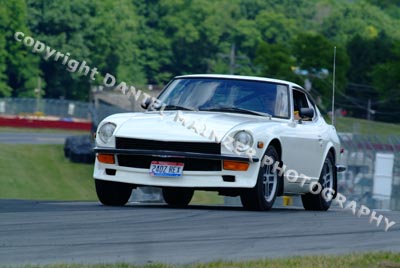
I want to "max out" the tire width on my '72 and with the 15" Mitsubishi wheels that I intend to use (see best photo I have at work from a Vintage GP parade lap at Mid-Ohio - coming off the loop leading into the Keyhole), that sends me to 225/50-15 tires. However, the offset of the wheels means that I need to use a 1/2" spacer on the front hubs to keep the inside wall from rubbing on the strut. Doing so leaves only about 5 threads for the wheel nuts to grip on and that isn't enough to make me comfortable. Is there a general rule about that? I torque my wheel nuts to 65 ft-lb. Are there longer M12x1.25 studs available that would work in the 240Z front hub? I figure that I need about 1/4 - 1/2" more than what the OEM ones have. Also, these are splined and press fit into the hub, are they not? I assume they can be pressed out?