



Zed Head
Community Member
-
Joined
-
Last visited
Everything posted by Zed Head
-
The thing about "limited-slip" lube is that it is designed specifically for limited slip clutches. Which may have different needs than synchro rings. They both slip then grab, but that may not be good enough. The only reason I tried the Swepco, which is really an out-of-left-field option, is because jmortensen recommended it, and had lots of experience with it from working in a shop that used it on hundreds or thousands of cars. It was a proven lubricant. Even so, it's still an odd usage, blended with ATF fluid, which is not GL-4 or -5 rated. Anyway, personally, if I was starting from scratch, I wouldn't use anything that didn't say "okay for yellow metal synchros" on the label. That's what everyone should look for, not GL-5. In my opinion. The GL-5 issue is very well known so if a manufacturer doesn't bring it up, they probably haven't tested. Why they would take a chance on causing damage though, doesn't make sense. They should either have a warning or a comforting message.
-
Has it ever overheated in those miles? The aluminum heads don't like overheating. Depending on your spare parts pile or availability, maybe it's time for another reworked head. Then you'll have a spare to dink around with.
-
The A11 number tells the application. There are many other A11 numbers. Your three should all work the same. superlen has expertise, as well as Captain Obvious (I think). superlen is/was developing an ECU replacement, more modern and tunable.
-
Edit! - no offense to anyone who lives by the "avoid GL-5" rule. I'm just offering a little more background to the issue. If they address the issue, odds are good that it will work fine. Royal Purple is a well-established company. Probably, way back in the past, somebody produced a GL-5 rated high pressure lube that caused synchros to get trashed. From then on, the only identifier that people could tie to the problem was "GL-5". Forevermore, "GL-5 is bad for synchros". This is how out-dated products live on. Wouldn't be surprised (actually I think that I've seen ad copy that does this) if manufacturers of old products helped spread the rumor. I'm using GL-5 rated Swepco 201 right now in my 1980 5 speed. It's been in there for about 20,000 miles at least. Not a single sign of a problem. It's just one of those comfort-level things, and as shown by the Royal Purple product, looking at what the product was designed for. The spec. is just one of many factors. One product can meet several specs. Staying comfortable can be limiting. http://www.royalpurpleindustrial.com/assets/MAX-GEAR-PDS.pdf http://royalpurpleindustrial.com/assets/Max-Gear-product-sheet.pdf http://www.swepcolube.com/products/swepco-201-multi-purpose-gear-lube Here's an old PDF file from Swepco that tells a few things about the confusion. Doesn't seem to be around on the internet anymore. SWEPCO GL4 and 5 TG_199508.pdf
-
The sulfur question is more complicated than just GL-4 versus GL-5. There are GL-5 rated lubes out there that work fine with "yellow-metal" synchros. The GL spec. is a performance specification, and doesn't tell anything about how the formulator made the lube hit the spec. number. It's a pretty interesting area if you're in to that kind of thing. But, overall, it's most effective to just go with what has worked for other people. Redline has a great reputation.
-
That's a good question. I think that the ZX module's have current-limiting technology like the HEI modules, which should work with any coil of higher resistance than stock. But I can't find any documentation, and the ZX coils are 0.84 - 1.02 ohms, higher than the HEI's ~0.5 - 0.7 ohms, and higher than the early 280Z's ~ 0.5 ohms. . You might measure yours, since aftermarket parts tend to vary. If you're around 1 ohm, you're probably fine. Note also that the manufacturer's spec their parts to last 10's of thousands of miles. If your coil's not getting hot it's probably not a problem. It's the heat over time that bakes them.
-
I've read of erratic timing with one of the odd modules, -92 or -93. Fixed by adding a power line to it. Just saying, somehow,there's a way to have a problem, if it's not the E12-80. But you can change them with the distributor installed so not a big deal if you start with one, then switch. Found one thread (nasty people...). classiczcars even got a reference for a picture. http://community.ratsun.net/topic/56630-e12-92-retard-or-no-retard/
-
-
The Datsun transmissions seem to do very well with Redline's MT-90 oil. Better than a generic 90 wt., for sure, with a transmission that has some miles on it.
-
Sorry I missed this. Yes, it should if the 3.9 came from a 280ZX NA engine. The turbo cars with the "Borg Warner" transmission, used the 300ZX bolt pattern I believe, which won't work, but the NA pattern will. The spline pattern and size of the slip yoke (the part that fits the trans.) is the same for all NA transmissions, way up in to the 1990 cars (71C transmissions).. As I said, I have both a square and round flange differential in my garage. One 1976, one 1978. I've had them both in my car with the same driveshaft.
-
I searched Google the other day for "polystyrene and gasoline" and that's what comes up. Not the redneck part but the rest. Pretty sure I'm on a list now. We're all on it.
-
You could hook up a meter and run it through its paces but the tach is a meter and driving is a good load test. The problem with testing them is that they tend to fail under usage, when heat builds up internally, so they'll test fine but still fail when they get hot, just from current passing through the transistor. Looks like 77 stopped using dual pickups so either the GM HEI module or a complete ZX distributor swap would work for you. You might examine your distributor first and see what shape it's in. If the breaker plate bearings and holder are toaste (common), or there's slop in the shaft (eyeball the reluctor/pickup gap) then a ZX dist. swap might be the best bang for the dollar. Otherwise, the HEI swap is cheap and effective, but takes a little bit more wiring work.
-
Cups with polystyrene blends might hold up fine. Pour a little in and see. I was just offering some advice to avoid a melted mess of plastic gasoline on top of your engine if you got the wrong cups.
-
You should call him so that he can make things right for the next guy.
-
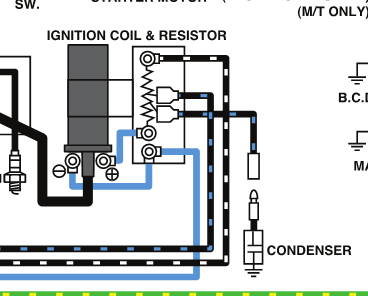
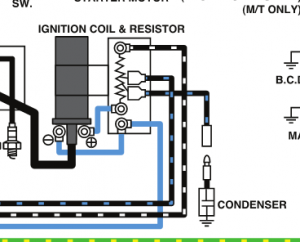
All Z's should have those wires at the ballast resistor location. Here's an example for 1976. One is black with white stripe, the other is back with blue. Your year may have different colors.
-
On the back, running a brace from each tower up the roof might offer the benefits of a roll cage. You can go nuts thinking of all the places that might be braced better. Some one on another forum even noted that their car had better, stiffer handling, when they glued the windhshield in. And there are some that say the car gets flimsy when the floor panels are removed, implying that much load is handled there, they're not inert. So bracing the floor panel somehow should help. And rusty floor panels would be bad.
-
Sometimes the tachometer needle starts acting weird when the module is going bad, also. And the needle will go to zero right away if spark stops and you're coasting in gear, whereas it will still show RPM if you're coasting in gear and it's a fuel problem. Just a clue to look for while you're in the driver's seat.
-
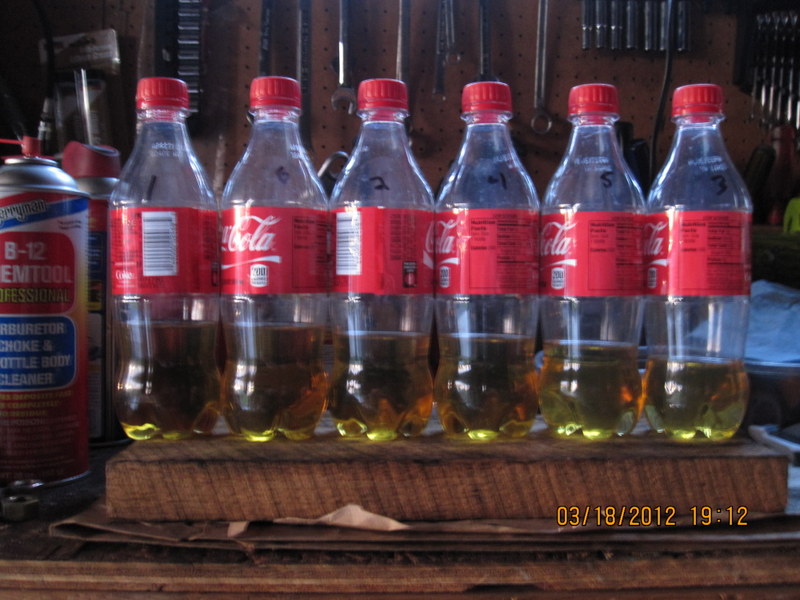
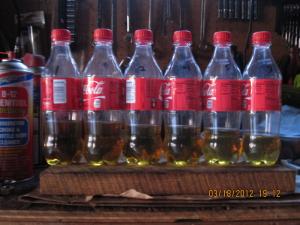
Coke bottles work well too. Be careful on the cups, polystyrene will dissolve (edited from melt) in gasoline. Best test first. I had issues with the first set of injectors on my car also. They were mismatched brands, and a couple looked well-worn, so I just replaced them with new.
-
Make sure that you're actually on the compression/firing stroke before you go too far. Mistakes happen, but it would be a surprise if Rebello made one. Your TDC marks will align two times per cycle, once on the firing stroke and once on the exhaust stroke. The distributor will show 180 off like yours, on the exhaust stroke.
-
Since it's exactly 180 degrees off, the wire swapping should work fine, except that the length of the wires may be tight on some terminals. Curious - Did Rebello install the pump and quill? Mistakes happen.
-
You could run any jumper wire from the coil center terminal directly to ground. No need for a spark to happen, the ECU will still gets its on-off signal from current flow. I agree it's a good way to protect the module, I'm pretty sure I damaged one of my own by leaving two plug wires off after doing some work one day. Don't know if it was the lack of a path or a stray spark but the module definitely was weaker afterward. Had to replace it.
-
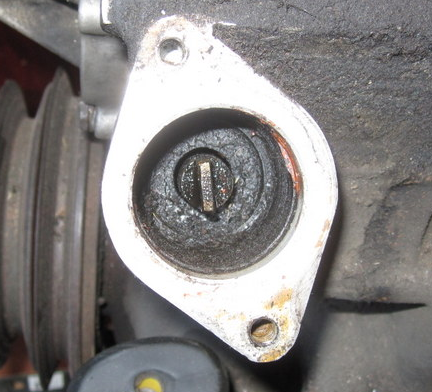
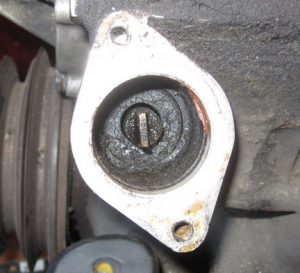
Looks like your moon halves are swapped. Little for big. I think that means you could move your plug wires ahead three holes each and be on track, with a mystery for a future owner. Or you can drop the oil pump and relocate the shaft. Added a picture of mine from a fine-running engine at TDC on the firing stroke. Diseazd makes a good point about firing stroke. Cam lobes up on #1. Can't tell from your picture. Cam timing can also cause problems. If you take the valve cover off, check the notch and groove.
-
You could wire it up and make the final power connection last. I make individual connector pins by pounding a piece of solid copper wire flat. Sticks right in there, converting female to male. Then I use alligator clips. Does take a little extra care though and can make you nervous. If you're just looking for leaks, then pressurizing the rail and injectors would work. If your FPR and pump check valve are working the rail will hold pressure and you only need to run the pump for second or two. I diagnosed a neighbor's injector with shop air. Even with a leak there was enough leftover fuel sitting in it to get pushed out. The body was cracked and it leaked externally. It was an old Porsche injector, that apparently is known for doing that and burning up cars.
-
They would only spray at every third spark. And you probably don't want external sparks while you're spraying fuel, so messing with the coil and ignition would not be an option. Another way to do it would be to run a jumper to ground from every injector pin at the ECU connector. With the key on there should be power to the injectors, grounding them like the ECU would do should open them up. Run the grounds, turn the key on, the injectors open, open the AFM flap and the pump makes them spray. I have not tried this but it should work. Are you looking for spray pattern or do you want to measure output? Because the spray pattern of the stock Datsun injectors is essentially a thin stream. If you're using Bosch injectors, you'll get more of a mist. If you just want to check for leaks, then the AFM-flap method would run the pump and pressurize the rail.
-
Figuring out how the loads get distributed can be hard to do. Under lateral loads, like cornering, you could imagine that the highest loads are at the two inner attachment points of the control arm (transverse link in Datsun-speak), Which transfers in to the links that drop down from the body, and the diff mount/crossmember. The top of the strut only sees the weight of the car, essentially, as you describe, in-line. At first glance, it looks like the tops of the towers are important load-transfer points of a triangular structure. But because of the shocks and springs, and the flexible hinge at the hub, they really only see changes in "weight" of the car. It's interesting to look at because you can imagine a much weaker strut tube than is used. The double wall nature of the strut tube with a shock tube inside is really much stronger than it needs to be. So it leaves up-and-down as the force at the top of the tower, coming from the suspension. Which should really only be unusually high if you bottom out the shocks. So, in travelling over uneven bumps like a driveway entrance, you're probably really combating flex from twisting of the whole metal box/body. Which seems to me like it would a blend of fore and aft, and lateral, a diagonal flex. My 280 creaks the most when a front and rear wheel on opposite sides (diagonal) are unloaded at the same time. Like a driveway entrance. That's just one pass through the brain. Something new pops up every time I think about it.