
Zed Head
Community Member
-
Joined
-
Last visited
Everything posted by Zed Head
-
It will work but the 280ZX starters have more torque, I believe. They are gear reduction starters. The cone nose is a 240Z to 280Z type starter. It's a regression. You can use 280ZX starters on Z's and vice-versa.
-
I think that the pins are held in place by the sides of the bowl. Once assembled they can't get out. Have you examined the valve itself? As I recall, they're typically a rubber coated pointy piece that sits in a precision ground hole. The float presses it in to the hole as it rises. The rubber can get hard or take a set or have a groove worn in it over time, and not seat properly anymore.
-
The oil would have come from the PCV system. Nissan redesigned the PCV hose routing in 1977 to avoid blowby fouling of the throttle body. I'm pretty sure the CO has been in to the BCDD machinations, and that siteunseen has "tuned" his for better operation. They might have some suggestions.
-
Not sure what you mean by "dry" but I would only use a small amount of sealant around the edges of the diaphragm, if any at all, if it looks like the rubber won't seal. The device is only meant for air to pass through and be diverted to desired places. Also hope that you marked your starting points so that you can be close to correct adjustment when you put it back together. There is at least one thread on the site about adjusting the BCDD, even though Nissan says to never take it apart, just replace it. @siteunseen @Captain Obvious
-
Really nice car. But, it's not "restored". Restored means taking it back to original condition. Not sure exactly what a better term would be (resto-mod sounds kind of goofy), but restored is going to draw a different type of looking-to-buy type than what you're selling.
-
That's a fuel pressure gauge. 5 psi might be a little high for Webers, but I don't know Webers. Float bowls and valves are all similar though and 5 seems a bit on the high side. AFR stands for Air Fuel Ratio (even though air actually contains fuel) and AFR meters are used to help make adjustments to hit a certain fuel air ratio. But the old school ways will work also. No offense Travel'n Man. People have tuned many carbs before AFR meters came about. They're great for fine tuning but he can make a lot of progress just by eye, and butt, from where he's starting.
-
I should say that failing valve guides is not a bad guess, although seals would be more specific. They will leak more oil at idle under high intake system vacuum and dirty up the plugs pretty quickly. Then when you start driving much of that will burn off. My original engine had bad seals and would run rough after putting around town, then would clear up after I gave it one of those high rev tune-ups. It was fun for quite a while to have a reason to go beat on the engine, trying to figure out why it ran so much better afterward. After I removed the engine and took the head off, I noticed oil draining down the intake and exhaust valves after just a little while. The seals weren't sealing at all. There's quite a bit on the site about changing valve seals. Pretty easy, I think, and might make a big difference. In short - I second madkaw's thought, in Post #2.
-
That's quite a write-up. I was thinking of your other article when I mentioned that something might be in the Technical area.
-
This site is supposed to be based on actual sales. Pretty sure they start with a a running engine and drivable car though. Your money... https://www.hagerty.com/apps/valuationtools/1978-datsun-280z https://www.hagerty.com/valuationtools/Classifications-and-Conditions https://www.hagerty.com/valuationtools/About-our-prices
-
You should add your car details to a sig, or at least tell people what you're working with in your posts. Pretty sure it's a 240Z, based on the stuck heat lever post. Looks like the plug was firing for a while. Need all of the details on the engine though, and the plug, to make a better guess.
-
I've wondered if a loose chain alone is enough to allow the valves to hit the pistons. Doesn't seem like it should unless the camshaft can some how rotate faster than the crankshaft is pulling it, from inertia. The inertia of the mass would have to overcome the valve springs and friction. Maybe at high revs, on a downshift, or something similar. With no tensioner on the loose side there would be a lot of slack to over-rotate on, if it's possible, even if the sprocket timing was right on the tight side.
-
I think that you need to remove the console and the whole assembly to get behind the panel. It's probably shown in the FSM. Might be in the site's Technical area also. I had a similar problem. The lever pushes and pulls on a stiff cable. If somebody gets aggressive on the push, the cable bends and shortens up. Then it acts like a spring and won't allow the knob to come back. I straightened mine out and had it working for a while but eventually I replaced it with a piece of piano wire.
-
For buying purposes I'd start at about $4,000 (no offense site), since it doesn't run. It could take a lot of work. But it all depends on why you're buying it. If you're buying it to restore, it might be worth more. If you're buying it to drive, and you don't know a lot about old cars, it could be worth a lot less since you'll be spending much time and money on it. If you're buying it as a project to work on for fun, 3-4 seems about right, if it's in the shape it seems to be in. Interior parts in good condition are really hard to find, and most old 280Z's, especially in your part of the country, are very rusty. Probably depends on who's selling it and why, also. If the original owner is selling it, he/she might think it's of high value. If it's an estate sale or similar, an easy sale might be in order.
-
What are you planning for this old war horse?
-
You might consider repurposing a BMW or Ford or other late model car's relay and fuse box. Ford and BMW and several others have a nice weatherproof plastic box with a cover that they mount in the engine bay or under the front cowl. Lots of slots for whatever variety of relays and fuses you like. Found this picture on the internet, for example. 1997 BMW.

-
I live in Oregon and drive in the wet often, but it's clean water. My car has some rust, but it's under the battery tray from lead salts from the battery. Good luck resisting. Wheel spray from your car and others will travel. Salt works fast.
-
You can't think like this with the 280Z EFI system. Just doesn't work. The only emissions stuff of note on a 75 280Z might be the EGR system, for a CA model. There's an extra ignition pickup in the distributor too, but you can't see it.
-
Your biggest rust concern in New Jersey is salt from de-icing compounds. I spent a few years in Philly and my Pathfinder foot rails were rotted out in just a few years. Avoid the roads after weather cold enough for the DOT to start spreading salt or magnesium chloride.
-
I'm sure it reduces the wear on the stock mount by a lot since the stretching motion is minimized. And with less lift, a worn mount might not clunk. When I was messing around with mine I actually had a snubber on top for a while, snugged way down. The nose was clamped top and bottom. I got lots of gear whine in the cabin then. The other benefit to using the GM transmission mount on the top is that you can remove your rear suspension without the diff nose hanging. Which barely matters of course since you can't roll the car around anyway.
-
It should be a straight across super-easy swap. The only difference you would see is in 5th gear, if the 80 has the .773 ratio. 5th gear would be farther from 4th, which makes it a bit less usable, but will drop a few RPM on the highway, for a smoother engine and better mileage. But you should verify that it hasn't been swapped in the past, using the signs 7too mentioned. The speedo gear lock-down screw, and the exhaust hangers. If the 80 car actually has the older 5 speed then you will notice the difference.
-
He'd be back to about a 75-77 engine with the N42 head. That would work. Maybe someone blew a head gasket on a turbo engine and just converted to NA. Might be also that somebody just swapped the damper over from an 81.
-
Forgot to say that the clunk probably comes from the diff dropping back down on to the stock crossmember mount after it lifts up. So you really need a new or good quality factory mount along with the snubber, to avoid the clunk. Many people have found that just paying the $70-80 for a new factory mount solves the clunk. It's so hard to tell that the factory mount is no-good anymore though, that the simple fix is overlooked. The other, original, reason for the RT mount is that it's stronger. Ron Tyler designed it to stop breaking the stock mount on his small-block chevy swapped 240Z. I built mine cause I like building stuff.
-
I have the polyurethane GM mount like wheee!'s and the PU mustache bar mounts. My experience is that it's the mustache bar mounts that transmit most of the gear whine in to the cabin. I was able to reduce that noise dramatically by creating a small air gap at the bushing. Typically the bushing is clamped tightly in place and that allows vibration to be transmitted. The differentiation in usage is that wheee! and me are using the system as a mount. Diseazd is using his as a movement snubber, or strap replacement.
-
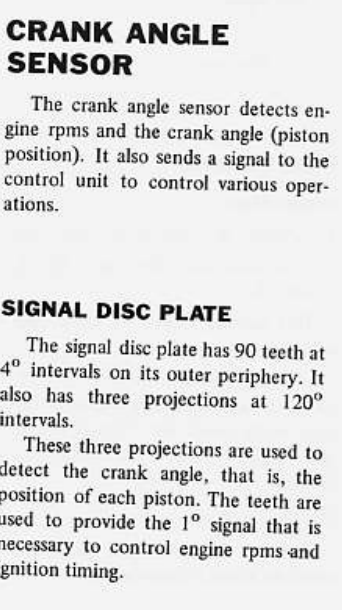
Looks like the bumper duct tape needs replacing. The 81 280ZX turbo engines used a crank trigger. But they had 90 teeth, and three teeth. How many teeth does yours have? Not sure how it would work with the 280Z EFI system unless the PO rigged it to use the three. Are you sure it's active, not just an artifact? Edit - actually my brain just restarted and I realize that it wouldn't work with the 280Z EFI because there would be no timing control. Anyway, looks like a fun project.
-
Might be worth an offer for someone that needs parts. Looks like there's a shift lever in the tub. https://portland.craigslist.org/wsc/pts/d/datsun-series-5-speed/6330093961.html