
Zed Head
Community Member
-
Joined
-
Last visited
Everything posted by Zed Head
-
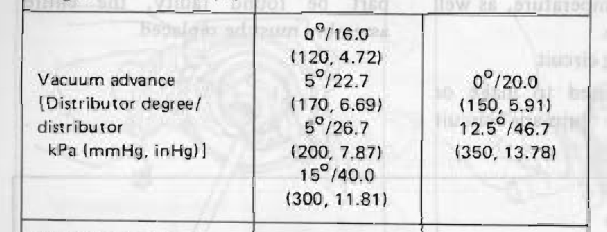
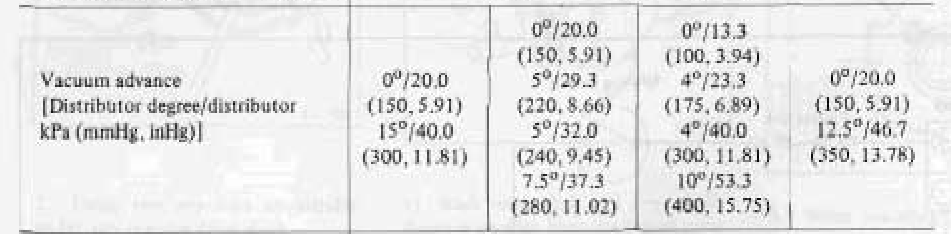
The vacuum advance goes away at any sizable throttle opening. As soon as the the blade opens and intake vacuum drops the advance won't come back until engine RPM increase. So part-throttle acceleration would see a difference but it goes away as you press the pedal farther. All I'm saying is that my math doesn't add up to the lack of timing advance itself as the problem. Maybe the mechanical advance is stuck also. I don't see any timing light info. I just went back through the whole thread and see the things I missed. But, basically, it's an engine with a hesitation at some unknown level of acceleration, and a hole in the vacuum advance canister. That's really all that we're working with. A little work with a timing light would be illuminating. I found the old ZX canister. It's from an 81 2+2 so should have up to 15 degrees. Looks like some sort of two-stage system. Could also be an 80 unit (it had 1980 transmission). Which has even more possibilities. The 80's was the emissions era.
-
Thanks. His site is down now so I can't check it out. The "tweak" is well-established. It's not really a tweak anymore, more actually a "fix". Not really feeling a bad vacuum advance as a hesitation problem, that's why I suggested the fix. DC8 didn't say if he plugged the vacuum leak. It would be a small one but still might have an effect, especially with the an engine on the edge of leanness. The first thing that I would do is to plug the vacuum leak.
-
I took a leaking one apart in the past and the diaphragm material was cracked and brittle. Made me wonder if they lost performance before they actually cracked and leaked. zcardepot has a fuel tweaker? Can you post a link? I looked but didn't find it. Might be a day or two before I refind my distributor parts.
-
I might have a ZX vacuum can that's still intact. I'll dig around. You'll still need a new canister, but I wonder if the hesitation was from the vacuum leak. You might get by in the mean-time by just plugging that hose. Might be a bit "doggy" at part throttle with no advance, but better than hesitation.
-
Is it the vacuum can or the breaker plate? They can both go bad. How did you determine that "it" was bad, whatever it is? The diaphragm in the can can spring a leak or the bearings in the breaker plate can fall out. Both will stop the advance from working. Beside that, your symptoms sound more like a running lean problem. You could try the coolant sensor tweak while you're looking for distributor parts. The problem is pretty common and I think that several 10 ohm resistors have been found in the wiring harnesses of various 280ZX's, if my internet memory serves me right. Today's gas is not the same as 1980's gas.
-
I notice from the schematic that when the wires are disconnected from the ballast, the Run and Start BW wires are disconnected, circuit-wise, electrically. So you could disconnect the ballast of all wires, then check for voltage at the BW wires. One will have power at Run, and one will have power at Start. Then you can use the schematic to connect them properly.
-
Those are good points. Don't leave out volatiles, which can dirty up windows pretty quickly. Hate to be negative but there are many ways to go wrong. Finding a material to make the shape isn't too hard, finding one that meets the demands of use is more work. An installed dash after a test run in Las Vegas summer would answer some questions. Pretty sure that there's a setting in Facebook that opens viewing to the public. Then we could all see it without logging in .
-
It comes in an eight-pack? Scary.
-
I think that the P90 is like the P79 but with square, unlined exhaust ports. Bigger combustion chambers than the N42 or N47. So you're right, it is like the N42, with the square unlined exhaust ports. The P90 is designed for the turbo engine I think, I don't know if the combustion chamber shape is the same as the P79 or not. The turbo engines used dish pistons so there is no quench to speak of. The liners tend to fall out under the heat of a turbo, people have found that put turbos on their N47 or P79 head engines. Nissan probably learned that early and changed the P79 casting molds to square ports, and called it a P90. Nothing wrong with going back to original, or period-correct. Especially if you're going to the car shows. If I had a good-running 240Z with an L24 I'd just leave it and drive it.
-
Actually, a P90 with flat top pistons would be at 8.8 CR. The F54 NA blocks came with flat tops. It's essentially a late 1980 to 1983 280ZX engine. With carbs. 17% more displacement. If I had a 240Z I'd do that swap, if my old L24 was worn out.
-
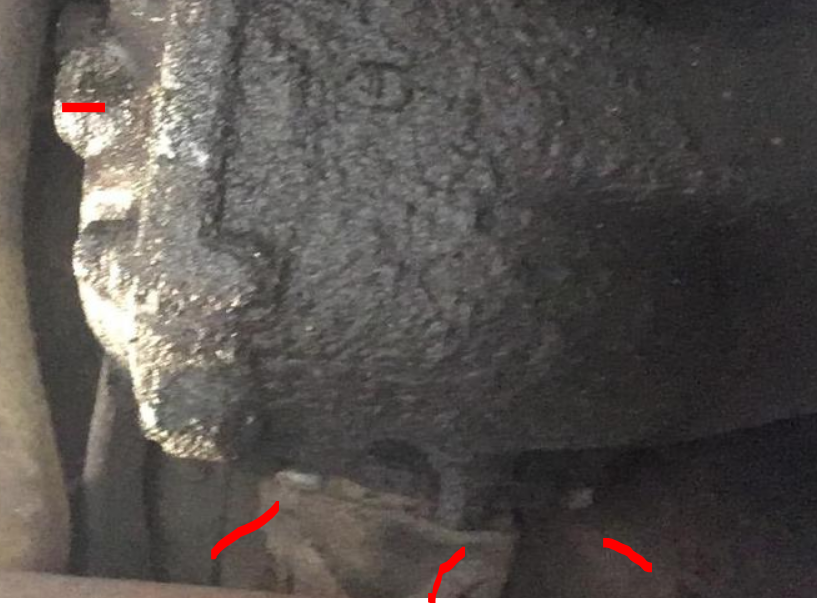
The bolts around the side flange, and the lack of a rectangular slug on the cover, along with the shape are pretty good R180 signs. Plus, no fingerprints in the grease from a recent swap. That grease might hold dirt from 1972.
-
Post up the engine serial number from the tag in the engine bay. Maybe somebody out here has it. That greasy diff in your picture is an R180. You can use the same propeller shaft (Nissan called the half-shafts driveshafts and the driveshaft a propeller shaft) if you change transmissons. The throwout bearing collar must match the pressure plate. Not the transmission, or car. (sorry site) Best to take some measurements before installing. There's a bunch about it on this forum.
-
Only MrChefur knows for sure. Meter, meter, pumpkin eater.
-
There's one at the battery too.
-
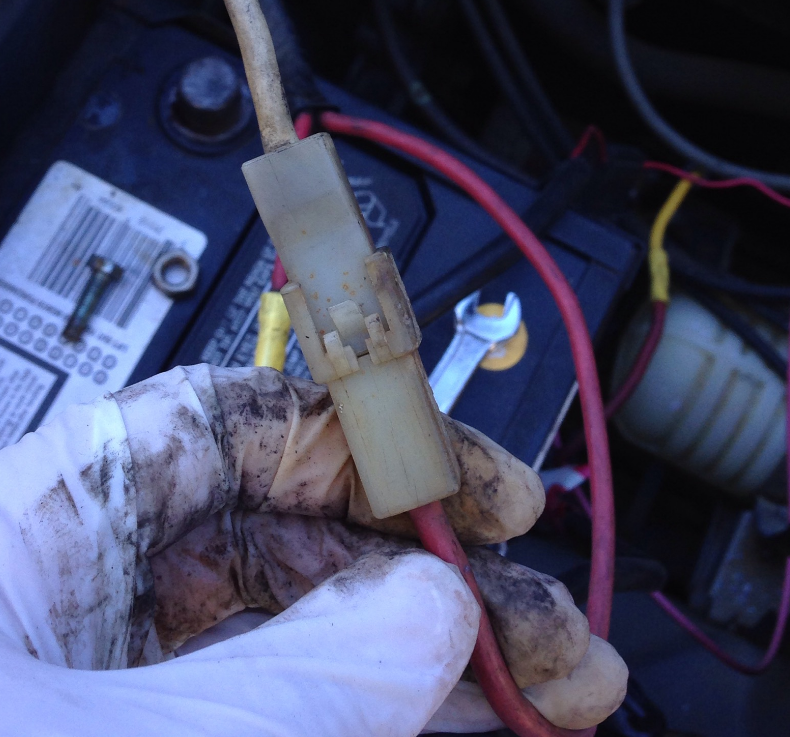
Found a picture on zcar, from Echutton. I think he's a member here. http://www.zcar.com/forum/10-70-83-tech-discussion-forum/398985-78-datsun-power-line-circuit.html @echutton
-
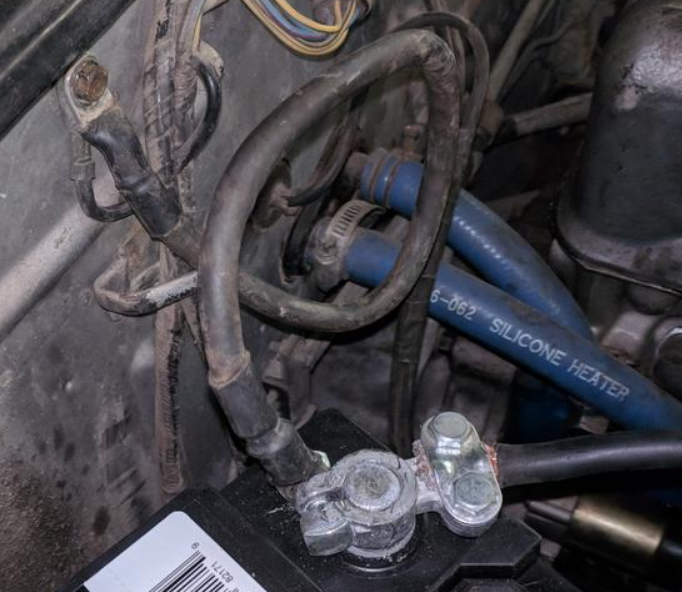
I don't see the other ground wire for the EFI system. It could be attached somewhere else but it came from the factory with a plastic connector, to a pigtail at the battery negative post. Somebody has monkeyed with yours, that battery cable to the firewall is way overkill.
-
If you measure the area of the port without the liners you'll probably find that you'd have to do a lot of extra work to get the header opening to match the head. If the header opening is smaller than the head opening you'll get turbulence that will ruin flow. Beside that, without a lot of other head work, enlarging the exhaust port is probably pointless. Somebody over on Hybridz showed that there's very little gain in flow from removing the liners. They're cast in. Some grinding on certain areas will get them to fall out, sometimes they fall out on their own. Once they're out you'll have a rough casting that needs smoothing.
-
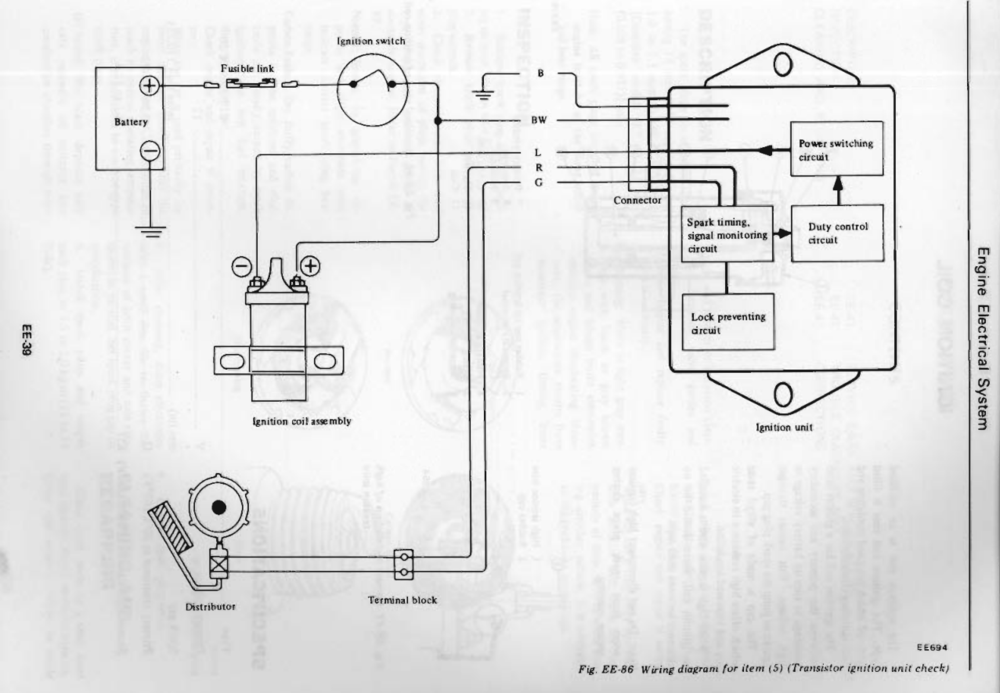
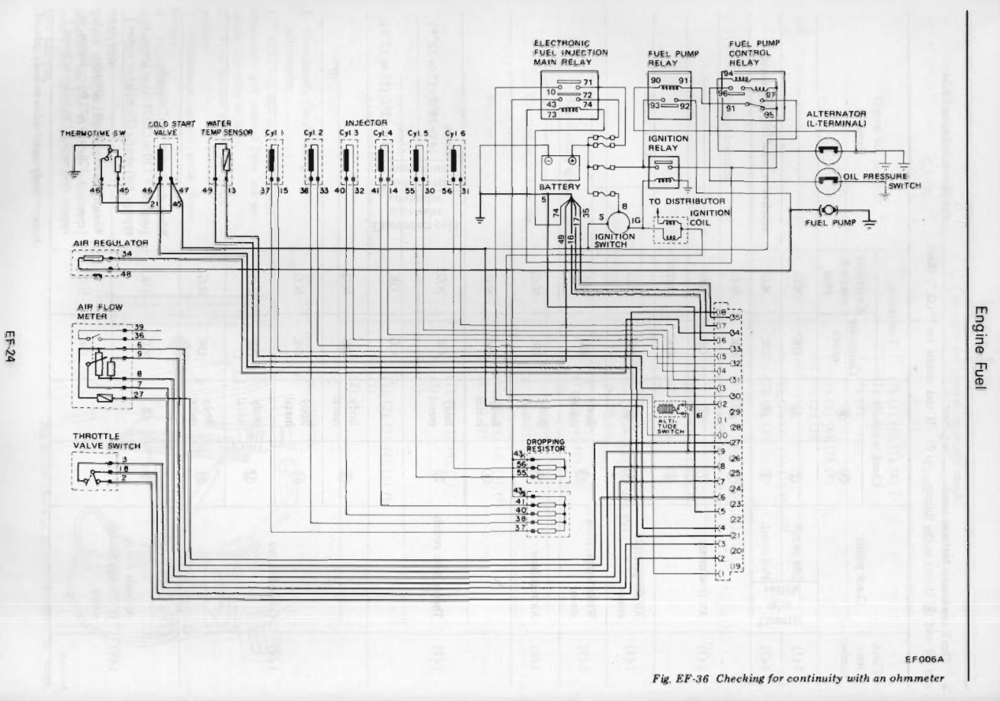
Here's another. I think I mentioned this in your other thread, but when you're working on these old EFI systems it pays to try to absorb what the tests are for and how the various parts work. It really is simple enough that at least parts of it should make sense. Modern cars have so many inter-related parts and are so complex that sometimes all you can do is keep running tests. But these cars can be understood well enough that you don't need the tests after a few run-throughs. You've been working on yours since August, you really shouldn't be too lost. No offense. I have faith. The multimeter is your best tool.
-
You need to start over, measuring the basics of voltage to the the things that need power. You said that you measured voltage in your first post, so you must have more than just a noid light. If you don't have spark and you've lost power to the injectors, check your fusible links.
-
1978 doesn't use the ballast.
-
Basically, I'm just offering things to do because you're completely out of ideas. Better to try them than to overthink, I think.
-
Not sure you understood what I was saying. It relates to "quality" of the Pin 1 signal. The ECU is designed to trigger when it "sees" certain voltage activity on the wire from th coil's negative post. I don't know if it uses "flyback" which would be a big pulse, or if it uses just the up and down from battery voltage to the voltage after the drop when the coil is charging. As far as before your teardown, that was before you tore it down. Who knows what you bumped, removed and reassembled, or did "while you were there"? You're after the teardown now. And, most of us that use a meter a lot, don't use "continuity" for anything. We measure an actual resistance number. It has more information, and is almost as easy to measure.
-
I don't know. All I know is that I've had ECU problems, and tachometer problems, both due to changing one of the components on that branched circuit. You might double check the blue wire connection at the ignition coil, clean it well. The Pin 1 circuit. Maybe you have continuity, but the resistance is too high. Do you have the factory stock ignition system or something else? I think that people have reported the MSD system, and/or Crane, doesn't work with the 280Z EFI. Here's an example from MSA's site - http://www.thezstore.com/page/TZS/PROD/12-4005
-
I missed the ground circuit test mention. The fact that your injectors don't seem to be opening seems to be the key. You've tested everything else. That means the ECU isn't triggering the transistors to ground the injector circuit. Maybe. I don't see any coolant temperature sensor resistance readings. If that circuit is shorted out, the ECU will supply less fuel because it thinks the engine is super-hot. Maybe the noid light pulses are so short that you can't see them. If that circuit is right then a problem with the voltage pulse on Pin 1 seems possible. I've mentioned several times over the years how I've had engines that wouldn't start when the tachometer was out. Not your case since your tachometer is in and seems to be working but it shows that the Pin 1 voltage quality is important.
-
I'm just going to start over without reading the other thread. Your tests so far have shown that you have spark, and timing is essentially correct, and the injectors are powered. Have you checked the ground circuit for the ECU? The EFI system has a dedicated ground circuit to the battery's negative post. Grounds are often overlooked. In all of your tests you have supplied the ground yourself, but the ECU might not have a good ground, for the injector-open circuit. No ground - no current - no injector opening. The Bible has a set of ground check tests.