HS30-H
Supporting Member
-
Joined
-
Last visited
Everything posted by HS30-H
-
A couple of days ago, this thread was started: HS30 #160 for sale It fairly rapidly turned from a "For Sale" ad into a discussion about the earliest HS30 build dates. I wondered if anyone might be interested in pursuing this further without spoiling the original for sale ad? Thanks for starting a new thread Zedrally:classic: To be honest, we have had such a lot of concentrated discussion about this in the past ( see the Build Dates thread, which 2ManyZs linked to above ) that its possible most people will not be very motivated to give their thoughts on the subject. However, I think there are connected areas of this subject that we have not really covered...... Carchaeology is one thing ( and we love that ) but philosophy is quite another. I think many of us will have different opinions, but isn't it worth trying to get a discussion going about the following?: *When does a 'car' actually become a car? I'm thinking about the production line for the S30-series Z cars, and wondering at exactly WHAT point in the production process we can allocate a particular car its 'identity'. Is it when the full VIN number is stamped on a bodyshell? Is it when the car reaches a certain stage of completion on the line? Or is it when the car reaches the 'end' of the production line ( or after it passes its quality control check and gets its "OK" sticker? ). *When we talk about 'Pre-Production' cars, or the first cars that were put through on the Z production line, how do we decide on the identity - or lack of - for these particular cars? If they do not have full chassis / VIN number stamps, can we include them in 'Production' numbers or not? What if "HLS30-#1" or "S30-#1" never actually got stamped with any numbers? What if they DID, but were broken up / disassembled for research and development purposes at the Factory? Do they count in the production figures? What about cars ( like the two North American 'test' cars ) that had different details from what we might call 'final' production spec? Do we include them? What about crash test cars etc? *How are we identifying the actual build dates of certain cars? I'm thinking in particular of cars built right at the beginning, or right at the end of the month, or year. As far as I am aware, we can't identify the ACTUAL day of production for a particular car - so how are we able to allocate it a month of production, and therefore it follows in the case of January and December cars - an accurate year? Do we follow the door jamb tags - where fitted - to the letter? I don't think we should really as it seems clear that they were attached after production, but what else is there to go on? Do we look at componentry manufacture dates, come up with an average and then decide through probability? *Lastly, do ONLY production models - released by a company for sale to the General Public - count when it comes to deciding 'production' of a type of car? I'm thinking of ALL of the first generation S30-series Z types here. Where do we draw the line? Do we have to follow the stamped VIN / Chassis Identification number to the letter? What if there were gaps in the numbers? What about the grey area between full production cars and prototype / production test / production research / assembly test cars etc? You can see why I was calling this a 'philosophical' discussion. :classic: Alan T.
-
Er, thanks Mike! ( Alan T shields his eyes from the array of spotlights on Zedrally's car ) :classic:
-
Kats, Maybe this has something to do with the viewpoint of the owners who want to take their cars to the Convention? I have an alternative suggestion. Maybe some American ( LHD ) owners should take their cars over to Japan for a show in the country where the Z was designed and made...... :classic: :tapemouth
-
Hi Kats, The part number for the 432 and 432R is different because they used the "R192" diff. The bar was a different shape, and a different thickness from others. Cheers, Alan T.
-
I have sore elbows........... I was interested to note ( once again ) a bit of Porsche-bashing on this site. Almost an IZCC mailing-list flashback Has nobody here got any respect for Porsche's pedigree and competition history? Have you ever driven one? Don't let the 'image' - or your perception of it - get in the way. Difficult to think of a 'competitor' for the first-generation Z amongst ordinary road cars available to the general public. Each specific market would be different in that respect I should imagine. What exactly WAS the first-generation Z car anyway? I don't think of it as a classic 'Sportscar' or a true "GT" either. Was it a new species? Contemporary road tests here in the UK stuck the Z up against, amongst others, the Lotus Elan +2S 130, Reliant Scimitar GTE, Triumph Stag, Volvo 1800ES, Alfa Romeo 2000 GTV and Ford Capri RS3100. The Z very rarely, if ever, came out on top in the comparisons. Anti-Japanese bias? Hmmmmm........... As far as racing goes, the major nemesis of the Z were / are the rules and regulations that it had to comply with in the local area where it was being raced. In many cases, these did not allow the Z to use equipment / specs that were homologated and available in the home market, but illegal to use because the local importer did not see fit to make them available. Despite this, the Z still did well. I believe almost any car with comparable power / size / weight to the Z can be 'improved' / tuned to stay with a sorted Z on the track. I've seen bloody Triumph TR4's and Spitfire GT6's show supposedly 'sorted' Z's around race tracks and certainly a properly prepped / driven early 911 will always give a similarly sorted / driven Z a hard time on the track. Any talk of domination or outclassing opponents - all things considered - is probably down to driver skill and capable mechanics maximising the potential of the car. I watched a lardy-arsed MK.2 Jaguar saloon circulating Goodwood circuit last weekend, and I swear it would stomp all over most of the 'sorted' Z cars that ever use that track! The driver was standing that thing on its ear............... In the Z's early days of circuit racing in Japan it had virtually nothing to compete against in the same class. The Z was usually in a GTII class racing for class honours against its own kind, and for overall honours with 'pure' sports-racing cars and prototypes. At the end of its Japanese circuit race career in the Grand Champion series, it was given a very hard time by the Mazda RX3.
-
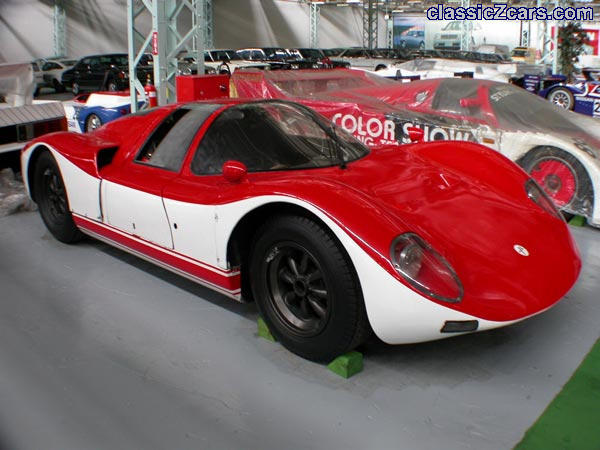 Hi Jim, You are right. I've amended the caption now. This version debuted in April 1967, and the colour scheme is the type they used in August of that year. Strangely, the car was not wearing its "Nissan" script on the rear flanks ( white lettering over the red stripes ). I thought it might be a replica at first ( like the S&S Engineering car ) but it had a lot of patina. I think the body was repainted some time ago......
 -
-
-
Here are additional scans from the second R-DRIVE parts book, which also covers the RS30 and GRS30 models:
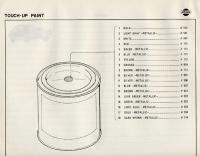
-
Hi Michael, Yes - the scans were from the "R-DRIVE" Nissan parts book that covered the period up to March 1973 by using additional update pages. That particular book says that it covers all "HS30" models - with special notes on UK and Australian market applications. It also notes some applications and options as "Europe" and "Ex. Europe" ( meaning excluding Europe ) - but I would have thought this would indicate the European version of the HLS30, so I'm not entirely sure about those models......... However, it does NOT cover the Japanese market models at all. Cheers, Alan T.
-
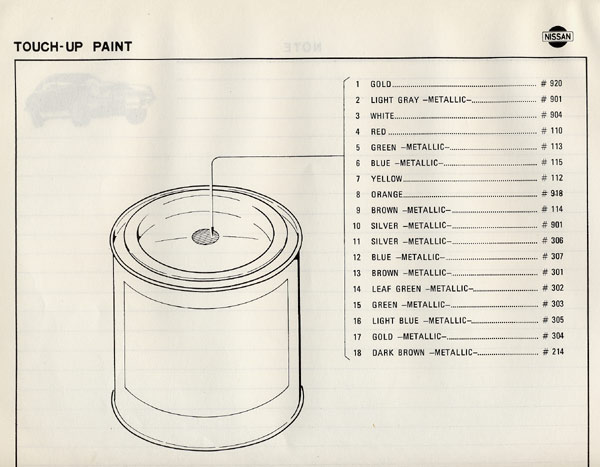
And here's the explanation of the applications of those colours:
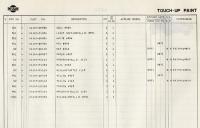
-
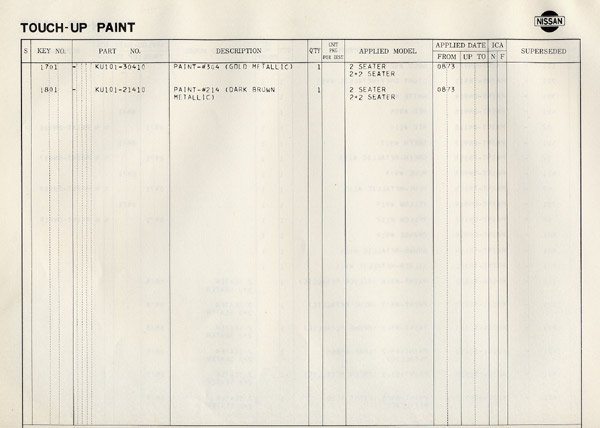
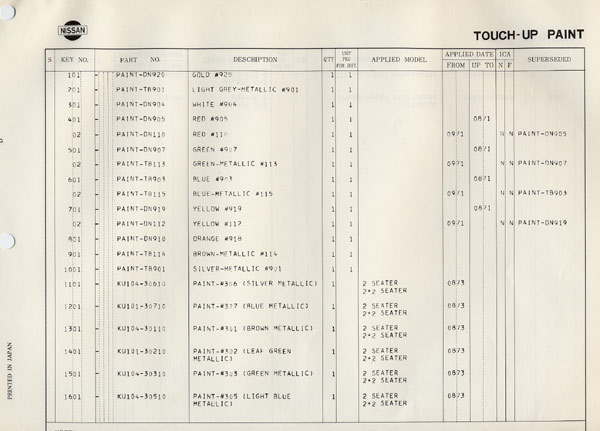
I'm hoping that this scan from the Nissan "R-DRIVE" parts lists for the RHD export market cars will be of use to you:
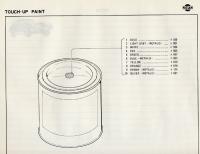
-
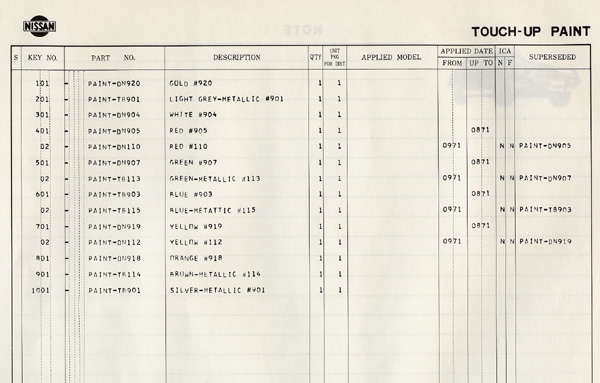
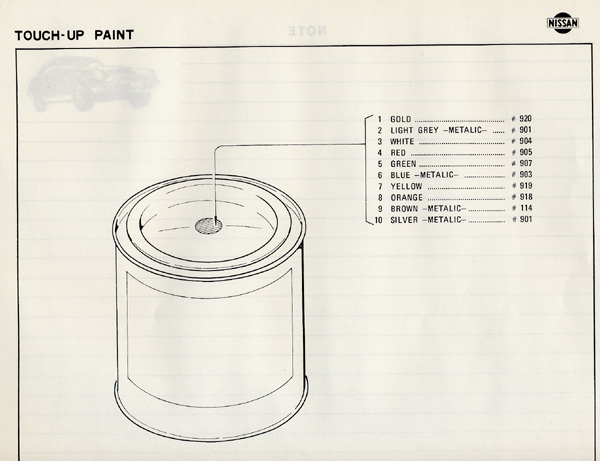
Hi mperdue, Hats off to you for taking the trouble to do this, and I'm heartened to read that you are interested in the colours for the non-US market cars also. You mentioned the colours of the Fairlady 240ZG ( HS30-H ) model, and this came in a choice of three colours. Only one of these colours was initially unique to the ZG: *116 Grand Prix Maroon ( Unique to ZG from Oct.'71 to late 1972 ) *904 Grand Prix White *110 Grand Prix Red From October 1972, the 116 Grand Prix Maroon became an optional colour on all the Japanese market models, and was no longer unique to the ZG. 116 is in fact a pretty classic chocolate brown colour, and not maroon at all. Apparently, it was originally called "Marron" ( French for Chestnut ) and was the victim of a classic Japanese typo.......... Alan T.
-
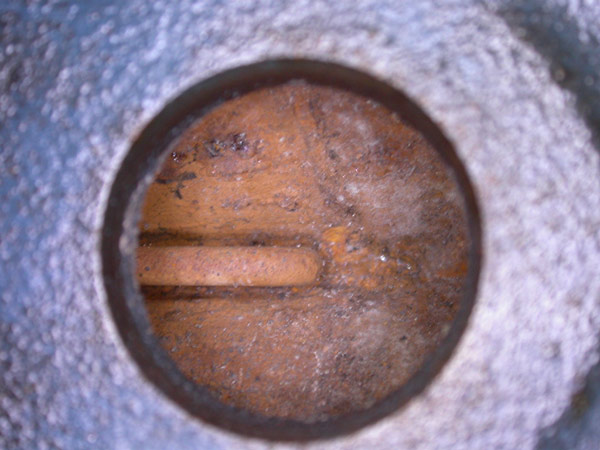
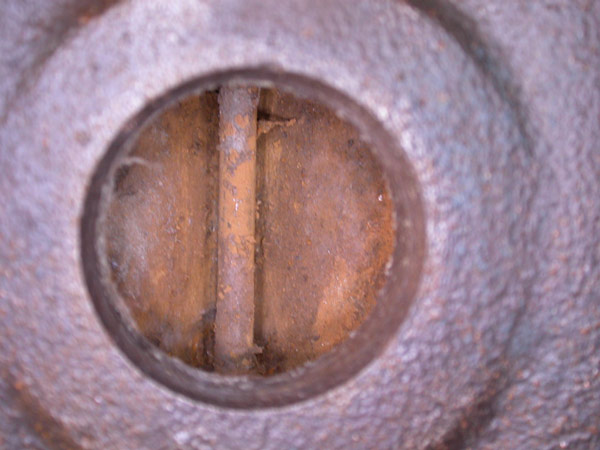
Yes, excellent description / explanation from Panchovisa. That's exactly what I was told about them; they are leftovers from the block casting process and breaking / damaging one of them is not a major problem. They certainly are not oil-carrying pipes or extra coolant passages, or anything like that. However, just as Panchovisa said, you don't want any broken pieces left in the block as they might find their way back to the water pump and damage the impeller. Great post, Panchovisa! Cheers, Alan T.
-
Another ( N42 block ):
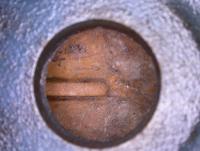
-
-
Original emblems in all markets and on all of the first Z models ( domestic and export ) were die-cast 'pot' metal. No idea when the injection-moulded plastic emblems started to be phased in though. I've got a couple of pot-metal "Datsun" lower front wing / fender emblems that came off one of my old cars. That was a 1973 UK-market HS30, and I suspect that they were original. Alan T. Edit: Sharpshooter 26th-Z beat me to the draw!
-
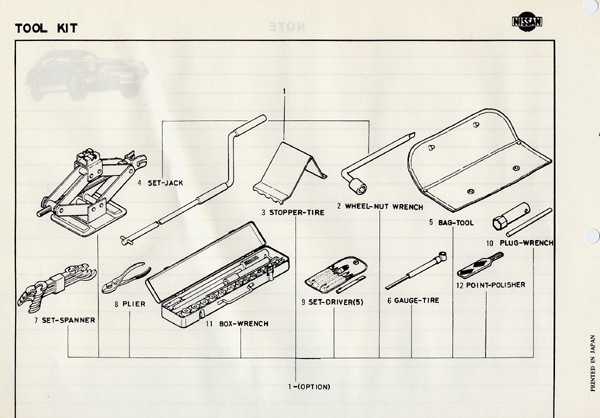
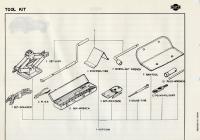
Sorry Mike, my R-DRIVE books only go up to 1974. However, if its any help or consolation, the illustration that applies to the Export "RS30" and "GRS30" is the same as the one I posted. Don't forget that many of the tools on that illustration were listed as "Option" parts. In my experience, that means that 99.9999% of customers buying a new Z were actually unaware that they even existed! I think the 'full' on-board tool kit is a very rare beast indeed. And if a customer specified all of those optional tools on one of the earliest cars, then I think they would surely have trouble finding enough places to store them all? Cheers, Alan T.
-
SiGNAL Z, What's the VIN prefix on your car? Is it "GS30" or "GS31"? If it was built in 1977 it should be an S31, and the 2/2 version had the "G" prefix on the VIN code. You might find that your paint code is 307. Alan T.
-
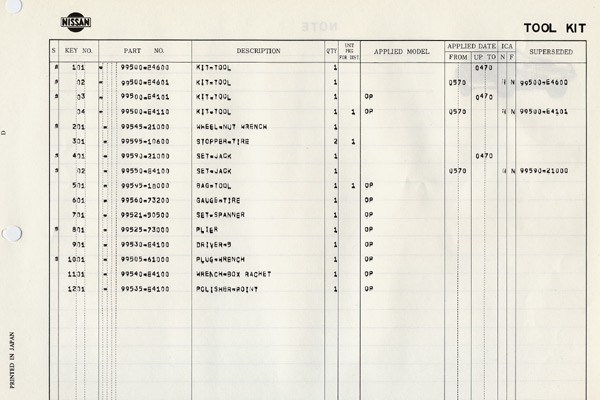
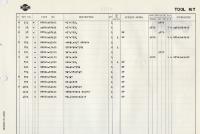
Here's a scan of the relevant page that explains the part numbers and their applications. Hope it helps:
-
Here's a scan from the Factory "R-DRIVE" parts manual that illustrates the tool kit components:
-
Hi 26th-Z, I'll have to dig out some photos of 44PHH Mikunis as fitted to Works cars then. They were pretty much exactly the same as those initially sold through Sport Corner and the Sports Option parts dealers, though. As I mentioned, the castings changed quite a lot and can be difficult to keep track of. Does he think there is something particularly special or different about them? I don't recall any specifics that would identify them as "Works" type or non-Works type, apart from some of the modified trumpets they used. The 16010-E4620 Sports Option part number seems to have been used through a fairly long period, and its hard to say what might have been different from one set to another at any particular period. That transmission part number ( 32010-E4151 ) is that of the standard FS5C71A five-speed transmission ( 19T:6T ) as fitted to all Fairlady Z-L models from 1969 onwards, and as an optional extra on the Fairlady Z from 1969 onwards too. It was also fitted to the non-USA "Export" 240Z models of HS30 and HLS30 from the beginning of production until they switched to the "B" type box ( the "option" being the 4-speed ). As such it would not have been fitted to the car as it left the Factory ( presuming it was indeed essentially a USA / North American market model bought in Japan ). Did Mike mention that it had a close-ratio gear set? I would have thought there would be a good possibility of one of the close-ratio gear sets having been purchased and fitted, given the high spec of the rest of the Sports Option parts on the car, and other fabricated race-oriented bits. It would appear that the original owner spent quite a lot of money on Sports Option parts, so a close-ratio gear set would not be out of the question ( I wonder if he got some discount?:classic: ). I'm glad that Mike does not believe the car to have been "Factory prepared" now. I think all the evidence points away from this. I'm fascinated by the story and the car's life and think its a great part of the history of the Z car. However, it seems a pity that the car is still being misrepresented at zhome.com after all the effort that has been made to track some of its true history. Are those Mike's words in the zhome write-up, or are they those of Carl Beck? The line "....is one of the earliest 240Z factory-built race cars still in existance today, and may be the only FIA car." is particularly disappointing. Its about time that was re-written. No disrespect to the car or its owner intended. Its an interesting and probably unique car in many respects, but it does not need to have any false representation of genuine Works history attached to it. I agree about the nose if that makes a difference; it looked like it was a fairly well-intended but somewhat inept attempt to streamline the car without paying attention to the race regulations ( and bumped it up into the 'wrong' class at Macau ). The Works were working on similar ideas around that time, but their efforts were always very methodically thought through and, it has to be said, very well engineered and fabricated. Isn't it great that this car still exists! All the best, Alan T.
-
Hi 26th-Z, I'm very pleased that you have seen the car and posted some photos. I thought this story was going to be set in stone in Z history without any chance of outside input...... I had some contact with Mike Cammarata a few years ago regarding this car. I spotted it from the zhome article and attempted some research on it, as I found some of the zhome article to be pretty far fetched and somewhat speculative. Above all, I thought it seemed to include a lot of exaggeration by "Jack Pray" that was being taken as gospel truth. Mike Cammarata was very pleasant to converse with, but at that time didn't seem to know much about the Japanese side of the story other than what he had been told. Maybe things have taken a step further since then? I told him that it was EXTREMELY unlikely that this car was ever modified by the "Works" race department at Oppama, or even at Omori. The article makes it sound as though the parts fitted to the car back in the early Seventies were genuine "Works" parts, and that the car was - in effect - a full Group 4 FIA 'Works' spec car with all the bells and whistles. In fact, full 'Works' style modifications would certainly never have been performed on a 'customer' car ( especially an Export-spec car that was sold through a dealership to American service personnel ) as there was at that time no system for such a service within Nissan. Even the regional Nissan SCCN teams and top privateer racers and their teams were using hand-me-down stuff for the first couple of seasons of Japanese domestic racing. It should also be remembered that full 'Works' Nissan Z cars of that period had bodyshells that were built specifically for use as racecars, and were fairly different to the road cars in many areas. It seemed to me that most of the special parts on the car were the over-the-counter Nissan 'Sports Option' parts that were available at the time through certain dealerships, and through the Sport Corner dealership at Omori in particular. These are extremely interesting and very nice to see still fitted to the car that they were originally purchased for, but they are NOT full 'Works' competition parts, and the bodyshell itself is that of a standard road car. I also noticed some modern modifications to the car - so its lost some of its originality, possibly due to necessity in conforming with modern race safety regulations? The car is ( still ) being misdescribed in the zhome article, even though the likelihood of it being anything more than a very interesting locally-created privateer race car was put to rest quite some time ago. The Macau nose was certainly NOT anything to do with Nissan's Oppama race workshops or the Omori site, and was much more likely to have been a local garage confection ( at that time I was told that Jack Pray was stationed in Okinawa, and not Guam ). Despite searching through Japanese domestic race reports for the 1969 through 1975 period, I have yet to see evidence of a non-Japanese driver entering a first-generation Z in a race in Japan during that period, other than a couple of very interesting exceptions. Neither of these exceptions tally with the car and driver in question........... I have the Japanese race reports from the relevant Macau GP support races, and they simply mention that a privateer Z qualified but failed to get to the end of the race. Sadly there are no further details and no pictures. You can bet that if the car had been Works-connected in any way they would have had a little more to say about it. What's this about the Mikunis on the car? The earliest 40PHH and 44PHH models had their part number and model designation on a sticker attached to the main body, rather than any stamp or casting mark. Has he got 40mm or 44mm carbs? What is he measuring? I had a guy tell me that he had "48mm" Mikunis once, but he turned out to be measuring the body bore size on the inlet side.............. Mikuni PHH carbs changed in many details over the years, but the 'Works' and semi-Works teams never used any special carburettor castings that I am aware of. They are more likely to be the normal Sports Option kit from that period. Cheers! Alan T.
-
Great photos! Many thanks for posting them and following up with some stories too. Its good to get a bit of 'background' to help with the understanding of the photos. Actually, Its kind of reassuring to see rain at an American event. I thought you had some kind of deal with the sun out there for a while:classic: Cheers! Alan T.
-
Sean, Surely you mean 'canted' don't you? Cantilevered is quite another thing altogether I think............... Of course - as has already been pointed out - the answer is that the engine was installed at a canted angle to give lower installed height in the car. This allowed a lower bonnet / hood line and more ground clearance for the sump. Don't forget that the L-series 6 engines first fitted to the S30-series Z models - the L20 and L24 - were not designed 'for' the S30-series Z cars. They were in quite a few other models too, and some of these debuted BEFORE the Z car. Transmissions had to be 'canted' at the corresponding angle without disturbing the correct position of the gearlever, and this was achieved by using bellhousings that mated with the engine at the correct angle whilst leaving the gearchange mechanism in a suitable position. Contrast this with the S20 engine, which was pretty-much 'upright', and used a bellhousing which corresponded to that angle. The 'LY' Crossflow was another version of the L6 that was mounted at a different angle to the L20 / L24, and that too had its own bellhousing. Giving extra space & clearance for the inlet / exhaust manifolds and carbs would have been an issue that was taken into account at the design stage of the engine, but I think you'll find it was the installed height issue ( in all models ) that dictated the angled installation, much as it does on many cars today too. They could not lay it over too far though, for obvious reasons......... We could even make a side-thread about the angled installation's advantages / disadvantages in RHD and LHD layouts ( what larks Pip! ), but I doubt this would lead to anything much other than the usual stalemate. However, its well known that the layout of the L-series engines ( with inlet and exhaust on the LEFT side of the engine from viewpoint of the driver ) was an inheritance from Nissan's Austin-influenced days, and so RHD-biased............. I don't think the engine's installed angle has any impact upon its internal or external balance. Alan T.