HS30-H
Supporting Member
-
Joined
-
Last visited
Everything posted by HS30-H
-
Well, my 1970-build Z-L was originally Monte Carlo Silver, and had a very thin layer of Grey primer. And I mean VERY thin........
-
Original Japanese market Factory colours for your car would have been: *#901 Monte Carlo Silver *#905 Daytona Red *#919 Le Mans Yellow *#920 Safari Gold *#904 Grand Prix White ( Optional colour ) *#907 Grand Prix Green ( Optional colour ) *#918 Grand Prix Orange ( Optional colour ) I'd be very surprised if your current exterior colour turns out to have been the original Factory colour. As you get further into the restoration you will possibly find evidence of a different colour in hard-to-get-at and obscure places. The L28 engine would be preferable to the 327 from my point of view! Alan T.
-
Hi NovaSS, Thanks for confirming the full VIN number. It sounds as though your car is indeed a Z-L, with the FS5C71-A transmission and 3.9 diff ratio as standard equipment. One thing that puzzles me is your description of the original Factory colour as being "Plum". I can't think of a standard 1969 or 1970 Japanese market colour that could be described as Plum. Can you find any cars on the Gallery of this site that are painted in a similar colour? I'm wondering if it might have been 920 'Gold'? I would echo 26th-Z's thoughts above, and say that it would be very nice if you could bring the car back - as close as possible - to Factory stock condition, or if you modify it then do it with an eye on a 'period correct' look. However you look at it, the car deserves to be treated with respect to its original specification. That L20 / close ratio FS5C71-A / 3.9 diff ratio combination is well balanced and great fun to drive. Its a rare survivor from 1969 Factory production, and its great to hear that it is still 'alive'. Cheers, Alan T.
-
Welcome NovaSS, Congratulations on owning a very early production Fairlady Z. That's one of the lowest body numbers I have heard of recently. Can we check your body number? Is it "S30-00144" ( five digits after the "S30" prefix, and not six )? What was the original Factory colour? As has been said above - we LOVE pictures here! This would DEFINITELY place it within 1969 production at the Factory, with a very high likelihood of a November build date rather than December. Please don't let anybody tell you that RHD cars were not made until 1970, which you will sometimes hear. The issue of "Model Year" seems to cause lots of confusion. In most cases ( at least for my part anyway ) when we discuss the age of a car we mean the actual BUILD DATE rather than the "Model Year" it was intended to be sold as. Some threads and conversations confuse the two. I'm wondering if you know whether your car is a "Fairlady Z" ( model S30S, the 'base' no-frills model, sometimes known as the 'ZS' or 'Z Standard' in Japan ) or a Fairlady Z-L ( model S30, sometimes known as a 'Deluxe', 'Lux' or 'ZDX' in Japan ). They both have the same "S30" VIN prefix stamp, and the same emblems / badging. You will only be able to tell the difference by looking at the paperwork that came with the car when it was new, or the details of the car. The S30S originally came with rubber mats instead of carpet, no rubber trim on the bumpers, no clock and no hubcaps. They usually had the 4-speed transmission as standard. There were lots of other little differences too. I'm willing to be that your car will be the Z-L, which would be a more natural choice for somebody to have personally imported to the USA. The Z-L had carpet, rubber bumper trims, a clock, hubcaps and usually came with the 5-speed transmission. In many cases these cars were brought home as personal transport by US servicemen and women who were stationed in Japan. I own a 1970-build Fairlady Z-L here in the UK, and it would have been very similar to your car when new. I have a fair amount of spare parts and RHD / Japanese market model-specific information, so if you need anything please let me know. I'd be very pleased to help if I can. Cheers! Alan T.
-
Some relevant information for you in this thread: Tool kit thread
-
Hi Steve, I think you will find that the European port to Croatia leg of the journey is the hardest part to arrange, as Enrique has pointed out. Try these: *RJJ FREIGHT LTD. Suite 10, Unit 3, Orwell House Ferry Lane, Felixstowe, Suffolk IP11 3QN. UK tel: +44 ( 0 )1394 695566 fax: +44 ( 0 )1394 673031 e-mail: jamie@rjjfreight.co.uk www.rjjfreight.co.uk *BRITISH TRANSIT LTD. Bowling Green House, 1 Orchard Place, Southampton SO14 3PX. UK tel: +44 ( 0 )2380 223671 fax: +44 ( 0 )2380 330880 e-mail: info@btl.wainwrightgroup.com www.britishtransit.com *KARMAN SHIPPING LTD. tel: +44 ( 0 )1525 851545 fax: +44 ( 0 )15245 850996 www.karmanshipping.com All three are UK-based international shipping companies that specialise in vehicle transportation. Strangely, you might find that a UK-based company can help you with USA to Croatia logistics. I have personally used British Transit Ltd. for business-related logistics worldwide, and Karman Shipping Ltd. for private vehicle movements from Japan to UK. All three companies are well known and trusted over here. Good luck, Alan T.
-
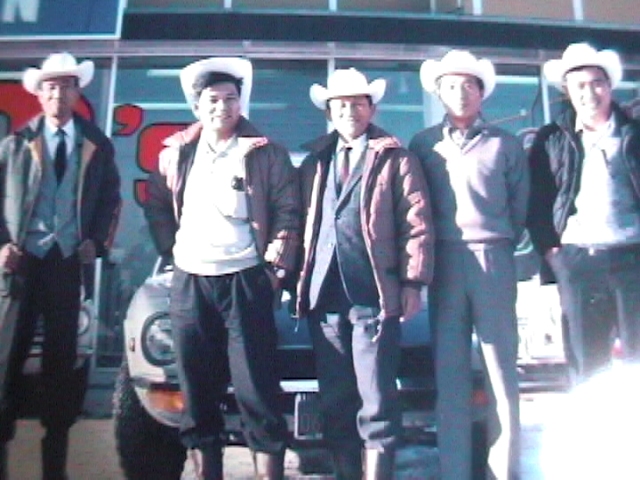
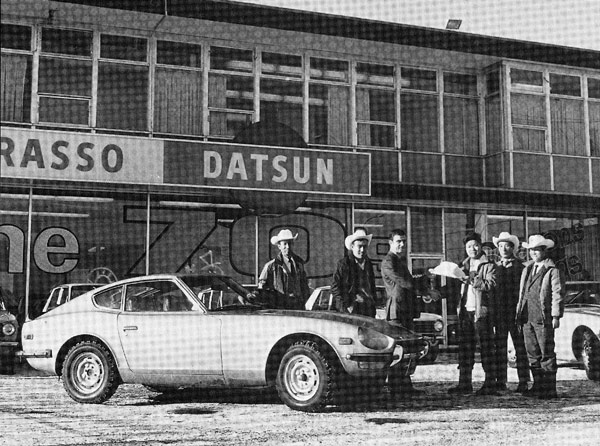
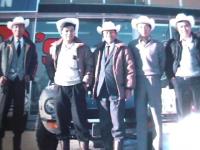
Hi 26th-Z, Here's the cine / video clip still photo - posted by Kats a page back or so on this thread - showing only the first two numbers "06" from one of the two cars from the initial test. I think it must be the initial test, as they are all wearing the white hats that they seem to have been presented with at the Datsun dealership. Kats' photo:
-
Hi Kats, OK - so you think we can get pretty close to the true body numbers of Seisan Shisaku #14 & #15, but maybe not 100% certain? To summarise, Seisan Shisaku #14 & #15 might be HLS30-00004 & HLS30-00005 - UNLESS two "HS30" RHD Export models were made before October 1969 - in which case Seisan Shisaku #14 & #15 would be HLS30-00002 & HLS30-000003...... Realistically, those two possible "HS30" VIN-prefixed cars would have to have been made before mid September 1969 ( at least ) in order for their existence to impact on the Seisan Shisaku quantity BEFORE the two North American test cars were made and freighted over to USA in time for the first few days of October. Great stuff, Kats. Thank you. Alan T.
-
Hi Kats, Yes - "Issu no Kotobuki" ( Kotobuki translates are 'felicitation' or 'congratulation', and Issu as 'seating' or 'chair' ) made many of the other FRP parts for Nissan too. They made most of the special parts for the ZG. Alan T.
-
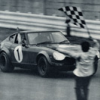
Kats, I can see that the number on the car from your video film-capture starts with "060" - so I'm wondering if its "060 ACJ"? In which case, the photo of the car with that number on it MUST surely be from the main test, and NOT the modified car that was sent over in late December by air? This is the same location / time as the other cine / video film that you took photos from - where they are all posing with their white hats. This shows two cars, and not one - so it must be the main test. Those "2177" numbers must have been issued temporarily, and they changed to the other numbers - one of them "060 ACJ" during the test. Alan T.
-
Hi 26th-Z, You might be counting the January to June 1969 6-month sub total as one extra production number? I read it this way: May = 1 Domestic, 1 Export June = 1 Domestic, 0 Export ( not 1 Export as you quote ) July = 2 Domestic, 2 Export August = 6 Domestic, 1 Export September = 9 Domestic, 2 Export ( so total 19 Domestic and 6 Export versions by the end of September '69 ). Alan T.
-
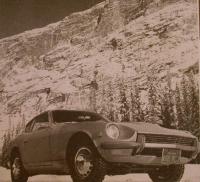
Here's the "060 ACJ" plate pic. I'm still wondering if this is the 'modified' / updated car from December 1969, with all the improvements / alterations from what they learned in the tests? If not, it begs the question as to why its wearing a different California license plate?
-
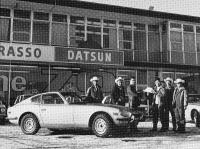
Hi 26th-Z, NMC = Nissan Motor Co. USA. Those "2177" plates appear to be Californian. Could they possibly be temporary issue for a limited-period import? You are right - now that I look at them they DO appear to have the same numbers on them, although I can't see the other digits too well. I was thinking that they could have used Japanese 'carnet' registration plates for temporary use in a foreign country - but of course that would only be possible of the cars had been registered in Japan FIRST. It seems certain that these cars were NOT registered in Japan - so that's why they could not use the carnet plates. Anybody know anything about temporary import use plates in California for the 1969 period? Why would TWO cars have the SAME number? Here's the pic of the "2177" cars:
-
 Great photo Chris! Is this a 'Pro' shot? I'll look out for the mag when I go to the shops this evening.
 -
I agree - that was some drive. What an adventure. Looks like they didn't have too many car problems either - which is pretty amazing. However, we should remember that in some ways the 510 blazed the trail for the success of the Z in the USA / Canada. In some ways they would have known what to expect: In late 1967, Nissan's "Kaku U" group conducted a "Beikoku Yushutsu Tekigo Chosa" ( American Export Adapatability / Suitabilty Test ) with a pair of 510's. The 5-man team left from Los Angeles on October 30th, and drove more than 13,000km over a period of 38 days. They averaged 430km per day, at an average speed of 70km/h. I believe they got as far north as Fairbanks, Alaska. A large proportion of the test was conducted in Canada - with its cold temperatures - rather than further south with hot temperatures. Zedrally made a good point about Nissan testing cars in Australia from back in the Fifties. Don't forget that Japan's summertime temperatures can get very high indeed, too. In fact, Japan offers a great contrast in road types and terrain from north to south, and great contrasts in temperature and conditions between Summer and Winter seasons.
-
Hi Gee and Halz, I was hoping it would take a bit longer for that issue to get published in your neck of the woods.......... I was misquoted! Honest! Actually, its been a salutary lesson in minding what you say and how you say it. Mick was writing things down as we chatted, but I certainly would not have said "240Z" when talking about all the first generation cars. And I certainly don't remember mentioning the name of Mr Burt Reynolds:ermm: He missed out one of the things we discussed at length, and I was really hoping he would point it out in an S30 / Z33 comparison. It was about the fact that the two models have mirror-image Handbrake Lever positionings; The S30 always had the lever on the RIGHT of the tunnel ( whether LHD or RHD ) and the Z33 always has it on the LEFT of the tunnel ( whether LHD or RHD ). I think this shows us something. We have discussed this ad nauseam on here - but I was hoping he'd point it out in the article. He didn't. Actually myself, Len Welch and Geoff Jackson were kind of an 'afterthought' addition to the article. The whole article was pretty much written and finished several months ago I believe. They borrowed the red 350Z from Nissan UK's press office along with their yellow 240Z press promotions car, and took them to Wales for photography. Nissan - I believe - had told them that they were the first to get the two press cars together for a magazine article, and C&SC would have an 'exclusive'. Then their rival 'Classic Cars' Magazine brought out their January 2004 issue with a Photoshopped version of Nissan UK's yellow 240Z ( they changed the colour and put the number of another car on it because they did not want two consecutive cover cars in yellow! ). So the C&SC article was put on the back-burner for a while. Mick then revived it and did a little bit of re-writing, plus the addition of the 'interviews' with the three of us. Mick didn't want to take a photo of the ZG that showed too much of it. He said he wanted to 'save' it for a full feature at a later date. I would have preferred NOT to have my photo taken, frankly! He made a few errors in the text, but I was very glad he made the point about Goertz and Matsuo - which was not from my prompting, by the way. He also made a point about that in his Editorial column elsewhere in the mag. What did you think of the comparisons he made between the two cars? I got the feeling that he didn't really rate either of them all that much, which was a pity. Cheers, Alan T.
-
Hi Kats, Does this mean that Seisan Shisaku #14 & #15 were HLS30-00014 and HLS30-00015? Or were the Seisan Shisaku cars not numbered? Or were they other ( lower? ) numbers of HLS30 bodies? There are lots of secondary questions that would lead on from your answer. I'm still confused about the quantity of cars that did the cold weather tests in USA & Canada. From the pictures I have seen, I can identify THREE different California registration tag numbers. Alan T.
-
Hi Oliver, When you say "European Spec" do you mean UK-market ( RHD ) or LHD continental European market? You say that you are trying to return your car to original spec, so I presume that you do not currently have the EGR stuff installed? What's the VIN, and can you provide any other data? If its a UK-market RS30 then the spec details can be very hard to pin down accurately for each individual car. I have seen all sorts of confusing anomalies on these cars. Cheers, Alan T.
-
Hi 26th-Z, I feel like I have to be careful when discussing the LHD cars, and especially careful when putting forward any thoughts that might be seen as the equivalent of blasphemy A couple of quotes from the article you mentioned jump out at me as worthy of question: *"According to Nissan Motors, they usually do not release any of the first twenty to twenty five cars produced, when starting the assembly of a completely new model". Well - this calls into question what Nissan would include in that first twenty to twenty five cars produced. We know that some very low number HS30 models made it out of the Factory and were sold to the General Public, and surely you would think that the difference between the LHD and RHD 'Export' models might be enough for Nissan to include some of the RHD Export models in that 'first 20~25'. Moreover, you would expect that the Domestic-Market models ( which we KNOW were produced in higher numbers than the LHD Export versions during 1969 ) would have to be included too - if not indeed getting their own 20~25 cars for R&D / crash testing etc. I would have thought that the Domestic cars could even be subdivided themselves ( between S30 and PS30 prefixes ) as they were different enough from eachother to warrant different post-build inspection and even different crash testing etc? I don't personally know any super low-number VINs for Japanese market cars, although I HAVE seen PS30-00013 in the metal ( it still exists ). *"Rumor has it that #00009 - #00015 were sent to Nissan Canada for cold weather testing. These cars were not completed production units - but rather were test mules." If these cars were numbered as quoted, then I wonder if they are the same cars that appear in the photos of the USA / Canada testing runs that we have discussed in the past. Those cars were very clearly not the same spec as the first of the production models that were delivered to the public for sale, and not even - seemingly - the same spec as nos 00007, 00008 & 00009 which still exist and are well known in the USA? There is some conflict in this information. I agree with you that if Nissan quoted HLS30-00013 in the R-Drive book that there is a very good chance it made it outside the Factory - and may have been sold to the general public. Certainly if you cross-reference this with the fact that HS30-00003 is quoted in the R-Drive parts book for the RHD Export cars, and we know that this car was indeed sold to the general public, then it might well hold true. Our "Part Number One" discussion still fascinates me. I agree that a 'White Body' or spare bodyshell WITHOUT a stamped VIN number would have to be classified as a spare part, but spare unused bodies WITH complete VIN numbers DID make it outside the Factory. In some respects, I find myself unable to shake off the feeling that such a bodyshell has a firm identity and needs to be included in our discussions - if only to establish that such a number existed. Alan T.
-
Sorry - I don't think I can be of much help on this one. I can give you part numbers from the Nissan R-DRIVE parts books, but not specific details on what was fitted when, or what side the tuning knobs were on for each particular market. However, its clear from the parts books that there were 4 different radios for the early cars ( two types of Auto-Tuning version, one ordinary 5-button and one AM-FM especially for Europe ) and also two versions of the combined radio / 8 Track tape player....... All of the above were listed as 'Optional Equipment' for the UK / European market. I'm sorry - I don't know what Hitachi model numbers the above-mentioned part numbers relate to. I don't have that data. I don't even have one of the push-button radios for the ZG. I have the original radio / 8 Track - but its not installed in the car - its buried deep inside my garages somewhere - so I'm afraid I can't confirm on which side the tuning knob is located. Do you think they really made RHD and LHD versions? I can type out those part numbers if you think it might help - but I don't know what you are going to cross-ref them with? Alan T.
-
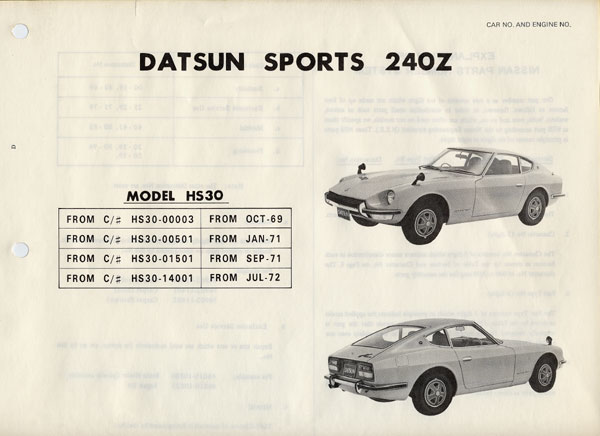
Yes - the Nissan 'R DRIVE' parts books are really useful and informative. The question is - just how accurate are the numbers they show for engines and body numbers? If you believe the one for the 'Export' HS30 ( RHD model 240Z ) then HS30-00003 was "from Oct-69".......... Here's a scan of the relevant page:
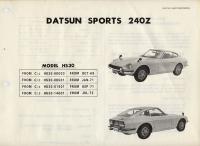
-
Hi 26th-Z, An S30S is Z Genesis S30S = "ZS" = Z Standard. Your basic 'cooking' Z. No carpet, no hubcaps, no bumper trim, no rear demist, no clock, no radio, no frills, no mention on zhome.com ( poor thing ). You didn't take my bait about the L20 engine having no VIN prefix denomination letter. Spoilsport. Maybe you knew what was coming. :tapemouth
-
Maybe this is getting back to the 'philosophical' slant to the original thread, but I just can't bring myself to accept that when that 'OK' sticker hit the window is when the car was 'born'...... Personally, I tend to think of the real 'birth' of the car somewhere further back up the line. Don't know where exactly, but sometime around when it got its own unique VIN / body number combination is - I feel - when it at least started to become an individual car. 'Course, it wasn't a whole car at that time.......
-
What model got the "HR" prefix? There was no letter designation for the L20 engine. Guess why. VIN prefixes for Japanese-market cars were as follows: S30 ( for S30 / S30A / S30S / S30SA ) PS30 ( for PS30 and PS30SB ) HS30 ( for HS30 / HS30S / HS30A / HS30SA / HS30H / HS30HA ) .....and then RS30 / GRS30 / and S31 etc etc.
-
Lachlan, You are misinterpreting it, mate. He's making the point that its NOT the usual GT-R replica, but that its a GENUINE GT-R. Its a corker isn't it? Alan T.