


Carl Beck
Community Member
-
Joined
-
Last visited
Everything posted by Carl Beck
-
@SpeedRooThanks - the old links in my bookmarks wouldn't load.... so I used the image I had saved at the time.
-
THANKS - Last sold on BAT - 15 July 2023 for $39,250.00.
-
Wonder what the VIN is on that 73.
-
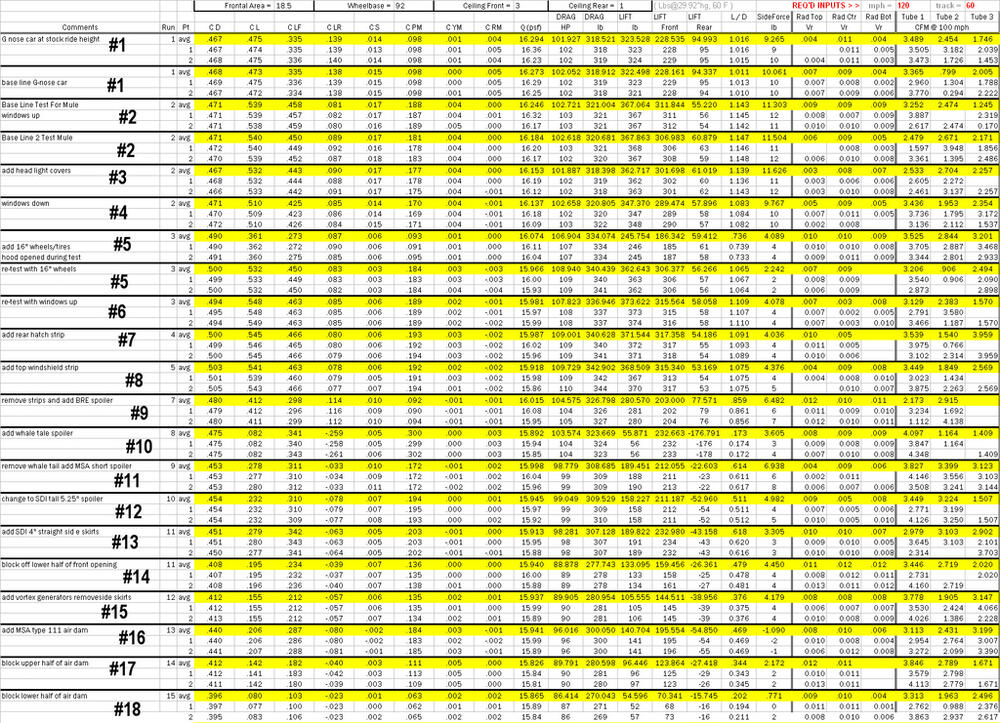
The test data from HybridZ... the numbers for a stock Z (test #2) Cd /CL etc are pretty close to what Kats Posted.
-
With the rust in the roof and the patched-up floorboards - given the last two or thee months of market pricing - I was surprised it sold for over $18K.
-
-
-
This "seems" like it would be a reasonable buy - if you are close it might be worth taking a look. https://www.ebay.com/itm/325567090216
-
It is a lot of money for the school and a little bit for the Datsun. Several people contributed directly to the school as well.
-
The VIN stamped on the Firewall was HLS30 14160 - The first series of chassis serial numbers ran up at least HLS30 20533. The second series of chassis serial numbers (aka Series II) started at HLS30 21001.
-
Sounds like we had similar experiences during the 73 Model Year. I was the New Car Sales Manager at Jaremko Motors in Spokane, Washington. Far too many very unhappy Z Car Customers ! I moved from Washington State to Florida in 1974 and worked at Clearwater Datsun / BMW. Bobby Clark the Dealership Manager was also a Racer. Clearwater Datsun installed the Hood Scoop on two 240Z’s that I knew of. Related to the problems with the 73/74 Flat Top Carbs, Mr Uemura writes in his book; "DATSUN 240Z Engineering Development" https://www.lulu.com/search?adult_audience_rating=00&page=1&pageSize=10&q=Datsun+240Z "Executive Director Ryoichi Nakagawa, the chief of the engine departments, gave us a pep talk, saying, “In a car, the worst case that can happen with this defect is the engine stalling, but if this happens on a plane, it crashes.” Although the engine design departments also tackled countermeasures, satisfactory results were not obtained, and the manager Harada of the Third Design Department asked us to cooperate in coming up with countermeasures for the vehicle itself. As a temporary measure, a heat shield plate was placed between the exhaust system and the carburetor, glass fiber was wrapped around the fuel system pipe, and louvers were cut in the engine hood to vent heat. But this was not enough. Then, as the last resort, a powerful sirocco fan, which began to turn when the temperature in the engine room rose above a given temperature, was installed in the engine room to pump out the heat. This almost solved the problem, but it was never perfect, because the fan would turn for a while or sometimes started turning suddenly even after the engine was turned off, surprising drivers. Assistant Department Manager Shidei, who was the chief engineer at this time, visited America to persuade Nissan Motor Corporation U.S.A., to deal with the problem using this tentative measure for a while until a proper countermeasure could be taken. I can’t imagine that would have been an easy task for him. One year later, we solved the problem properly by abolishing the carburetor and adopting the L28 engine with electronic fuel injection."
-
A year and a half ago - this would have been at least $45K to $48K. At $37K the Buyer got a great DEAL IMHO.
-
My "Ben Herman" story: Around 2000 a guy that had won a Nissan Vintage Z at a charity auction in Miami, Fl contacted me for information and advice. He had kept the VZ for just over a year and decided to resell it. He had bid on it just to contribute to the charity and wasn't a "Z Guy". I told him as much as I could about the VZ's and suggested putting it on Ebay with a reasonable reserve. At that time, that would have been something around $20K. (it was an A/T example). About a month later I saw it on Ebay with an opening Bid at $9,000.00. I was surprised that I did not see the usual “Reserve Not Met”. So just to check, I put a Bid of $9100.00 in - and still not seeing any mention of a Reserve, I contacted the Seller suggesting that he end that auction, then re-list it with a Reserve. He did not do that and instead seemed angry with me for suggesting its sale on Ebay. I would find out a little later why the seller was mad at me…. Ben Herman put in another bid a few seconds before the end of the auction and “won” the car for $9,200.00. Ben wrote me a day or two later to say he was sorry to have “snipped me” on that auction. I replied saying that I had not put any higher bid in on the car, as I had no intention of buying it - I was just checking to see if there was or wasn’t a Reserve. (AIR - I had about 6 or 7 240Z’s already and no place to put any more). A few days later - I found out that Ben had ask the seller to hold the car for him, for 3 or 4 months, as he needed to sell some other parts to raise the money. The Seller told him that would be fine, if Ben sent a 10% non-refundable deposit. A couple more months went by and Ben had not sent the $920.00 deposit. Now I knew why the seller was upset, but I never understood why he blamed me for his mis-handling of the sale. So, I told a friend of mine about the situation and suggested that he contact the seller directly and offer to buy the car. Which he did. The Seller and Buyer reached an agreed to price and the Buyer picked the VZ up the next day.
-
No way that I have found to confirm it - - but it is the highest number VIN I've seen so far on a Datsun 240Z. According to the VIN information published by Nissan - in the Factory Service Bulletins - HLS30 172732 was the last North American Spec. According to my notes - HLS30 172733 is in Colombia. HLS30 172753 was in New Zealand . Who knows? - might have been a couple more with higher VIN's sent to Europe/Africa etc. As of 1999 - it was owned by Tom Faulkner. Tom said the 240Z was originally sent to "Europe" directly from Japan. Tom bought it from the original owner in Switzerland and brought it back to Chicago six years prior. (so around 1993). Tom wrote: "It has a five speed transmission and left hand drive. The two front turn signals are not the curved type but are mounted on the top of the front bumper. It has a black air foil on the back door lid. It doesn't have any air pump stuff like the previous 240Z I had." It was on Craigs List in Tucon, AZ in 2015 having been inherited... FWIW, Carl B.
-
Up to $19,720.00 with 8 hours to go.. Looks like it might be a very nice 240Z - and with more/better pictures and an owner willing to answer questions - on BAT it might bring bids over $40K today. However on Hagerty Auction, a potential buyer just isn’t going to get enough information to risk much more than $30K. We’ll see how it goes... The diamond vinyl on the trans tunnel and rear shock towers is a wrinkled mess.
-
It was on EBay 17 April 2021 - asking $46,369.00 Smyrna, TN.
-
I'm sure this would be very helpful indeed - to anyone seriously considering placing a Bid. Don't we all wish we had an expert avalible to physically inspect any 240Z prior to purchase!
-
Great video - it is important that people understand the need to tighten/torque suspension bushings with the weight of the car sitting on the suspension, so the bushing is clamped down at the center of its up/down movement. If nothing else take the car to a shop with a drive on lift - and pay them put it up in the air for you. My only suggestion is - get yourself a good brass hammer, to apply to the end of the wrench - and quite beating on your hands.
-
From Mr. Uemura’s Story: DEVELOPMENT PROCESS - - Vehicle Durability Tests - - - Heat Resistance and Cold Resistance Tests The heat resistant performance was evaluated at an external temperature of 95ºF (35°C) for the domestic models, and at 104ºF (40°C) for the North American models. The tests were mainly conducted on the heat-resistant chassis dynamometer. However, because the wind flow can be different from the vehicle tests, performance was also evaluated on the test course. Eventually, field tests for this model were done in the United States and Canada. The heat resistance test done on the chassis dynamometer includes many items, such as whether the temperature of the water or oil is normal during high speed operation, whether the engine speed becomes unstable while the engine is idling after high speed operation, and whether the engine can be restarted after the ignition is turned off. If it fails any of these items, heat resistance performance is considered insufficient. We aimed at keeping the engine oil temperature within a specified range even if the car ran continuously for 118 miles (190 km) without an oil cooler. In fact, we had no problems with the engine oil temperature. The differential was also designed to keep the oil temperature in a specified range even after 118 miles (190 km) of continuous driving. However, because it was at the far rear of the floor, the differential did not get sufficient wind even if a baffle plate was used. In the end, it was not able to clear the 118 miles (190 km) continuous driving at a 104ºF (40°C) external temperature. If consumers complained, we were prepared to offer an optional oil cooler for the differential oil, but this problem did not arise. Probably as no one drives a car continuously at such high speeds in the United States, and because temperatures do not go up that high in Europe. DATSUN 240Z Engineering Development https://www.lulu.com/search?adult_audience_rating=00&page=1&pageSize=10&q=Datsun+240ZIt is a sliding cloth or ragtop sunroof - used on some early VW Beetles .. I’ve seen a few on 240Z’s...SERIES II For Sale at Mecum Auction Kissimmee, FL Jan. 4-15, 2023 A Series II BMW 507 - A Million Dollar Offering? I'll have to attend the auction, just to see one in person. https://www.mecum.com/lots/FL0123-545398/1959-bmw-507-roadster/ FWIW, Carl B.What do you see? - Fan?... Isn't that a pretty late car needing V-3 kit?Is the NISSAN Logo - pressed into the acrylic on that one?




Important Information
By using this site, you agree to our Privacy Policy and Guidelines. We have placed cookies on your device to help make this website better. You can adjust your cookie settings, otherwise we'll assume you're okay to continue.