
Zed Head
Community Member
-
Joined
-
Last visited
Everything posted by Zed Head
-
Fixing old posts - the relief valve in the stock Datsun fuel pump actually has a range of 43 to 64 psi. For future searchers...
-
Fixing old posts with new knowledge - The stock Datsun fuel pump reliefe valve (bypass above) had a range of 43 to 64 psi, not just 43.
-
Just fixing old posts with new knowledge. The JEGS liquid-filled gauge I discussed actually turned out to be very inaccurate once it got warm. It read low, disguising a high fuel pressure problem for quite a while. Stay away from liquid-filled gauges in hot environments, especially the inexpensive gauges.
-
You should download the Factory Service Manual (see the web site below) if you don't have one, get a multimeter and test things. The AFM test is pretty simple (it's in the Engine Fuel section). Some here have had good luck just cleaning the AFM contact area. I bought a remanufactured AFM but only after lots of testing to confirm it was bad (the resistance readings were off and it popped and bucked when I drove it). Spend a while testing components and you'll know what to think about when it still doesn't work right. Deoxit is a good contact cleaner but the others work well too. The electrical connections tend to corrode over time. http://www.xenons30.com/reference.html The 76 manual is broken in to chapters, the 77 wasn't last I looked.
-
Another Oregonian. Woohoo. How come you're not watching football? The thermotime switch only comes in to when play you're Starting. Maybe, instead, you jumped the temperature sensor that tells the ECU how warm the engine coolant is? If so, you told the ECU that your engine was very hot. Or you think you jumped it but actually just disconnected it. In that case, you told the ECU that your engine was very cold. That would give lots of rich black smoke. Did you just get the car? The symptoms look like those of a bad AFM. I had a bad one and mine idled fine, went well at 3/4 to full throttle, but did what you describe at part-throttle. There is a test procedure for the AFM and most of the other EFI parts. You can spend a lot of money replacing parts, when all you might need is some contact cleaner. By the way, your first post was pretty well formatted except for the large, bold font. Second one looked like cell phone.
-
I was in the FSM the other day for some reason, and realized that on Page EF-15, the description of the relief valve says "43 to 64 psi". I too was under the impression that the relief valve let go at 43 psi and have stated that several times myself in previous posts. I'm not sure how I missed the 64 psi upper limit but it should be noted that 64 psi is a possibility. So it is possible to have a plugged line or regulator and get pressures considerably higher than 36 psi. It would be interesting to pinch off the return line completely on a stock fuel pump and see where the relief valve lets go. Might not be safe though.
-
Thanks for reminding me. I do remember reading some posts about that, with descriptions of the bearings that would work. I'll search it out.
-
Or your local high school auto shop might take a measurement for you for free. Although you might be too close to having just got out to want to go back and visit.:sick: Just a thought. Your car would be a great example of the basics of fuel injection.
-
Thought I would put this out there for future searchers who are hearing noise from the vicinity of the water pump. Check your AC idler pulley first, if you have one. The external heater core to engine hose sprung a leak on my 1976 280Z and sprayed half of the coolant out as I drove home one night. I replaced the hose, refilled with coolant, then soon after (days), I started hearing what sounded like bad bearings from the front of the engine. I thought for sure that my water pump bearings had cooked themselves after the hose had burst. But before I got too deep in to it, I remembered that my AC idler pulley had made some noise in the past, fixed at the time (apparently temporarily) with a drop of oil and some WD-40. I took the AC belt off and was back to quiet running. Winter's coming and it need charging anyway, so it's a spring project now. Just putting it down for the record. It's easy to loosen the AC idler pulley and remove the belt, to see if that's the source of the noise.
-
I have to ask, just to satisfy my curiosity. Are you avoiding measuring the fuel pressure because the gauge is expensive? I know that I did not want to pay $45 just to measure something once or twice and then put it on the shelf. Or did you measure it and it checked out okay? If you're not going to measure it, it would be nice to know why. You can't have good fuel injection without proper fuel pressure. As far as the ECU swap, be careful, you could end up in this guy's boat - http://forums.hybridz.org/index.php/topic/95747-z31300zx-ecumaf-to-280zxt-problems/page__p__900526__fromsearch__1#entry900526 Plus you'll never get any help from the SU guys then...
-
Dave, you seem like a very helpful, knowledgeable guy. But I have to say that it is ironic that the "Electrical Hero Wanna Be" says to ditch the electronics and go back to mechanical. I'm just sayin'. It's funny.
-
The BCDD is not designed to "hold the idle" at low RPM. It is designed to maintain a certain pressure in the intake manifold at high RPM, throttle closed operation. I have read that they can get stuck but giving a high idle, not a low one. And the AAR is on its own circuit, designed to hold the idle up for a short while after starting. You could take it off and test it or disconnect the hose and block both ends to see if it has an effect. The BCDD is described in the Emissions section of the FSM and the AAR in the Engine Fuel section. 15 mpg is still pretty bad. How's the fuel pressure? Don't forget to get a new low pressure fuel pump or low pressure regulator if you go carbs. Otherwise, you'll really be running rich.
-
2nd edit - So, it sounds like you can buy a new cylinder, take it and your key code or the key you want to match to a good locksmith, and get back to brand new, one key operation. I didn't realize that it was that simple. I didn't fully understand Unkle's Option #2...
-
Is replacing the wafers a locksmith job or a DIY? That plus a new code-cut key seems like it gets you back to brand-new, with a single key for locks and ignition. Minimizing the number of keys. Everyone is happy.
-
I had a new key cut for my car using the code number on the glove box door. More accurate even than measuring with a micrometer, I assume. The old key would barely work on one door lock only, not at all on the other. But, unfortunately (or not depending on perspective), the new key still easily comes out of the ignition switch at any point in its rotation. Just one real-world experience with a new key on a 1976 car. I added a fuel pump cutoff switch because of this, mainly to stop joyriders since my car wouldn't be worth extended effort to steal.
-
Are you II, III or IV? What is a 500Z? Ford 5.0 engine?
-
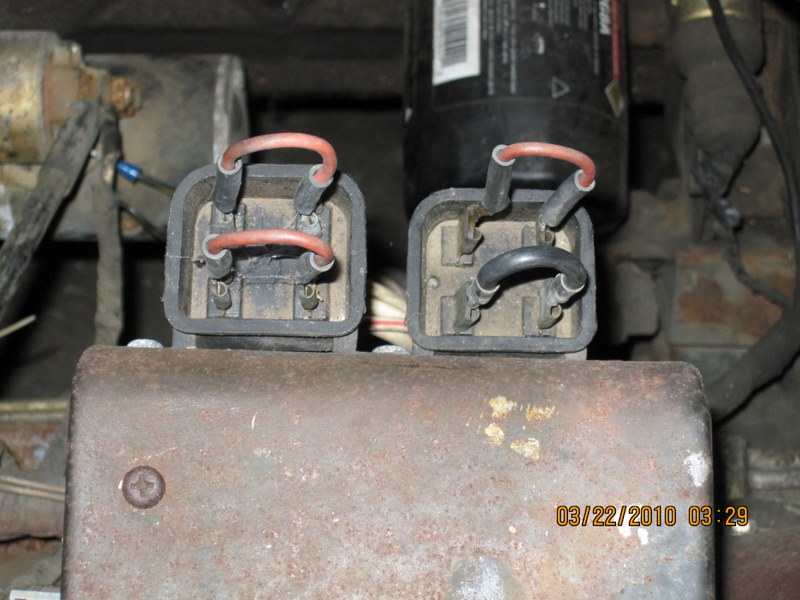
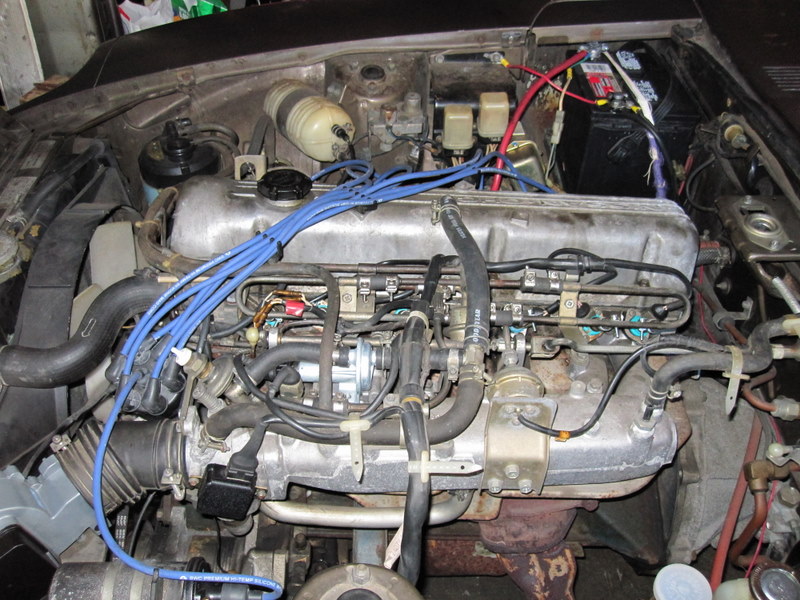
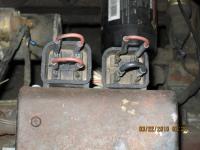
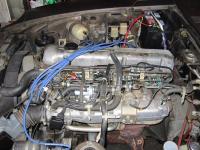
It looks like someone removed your fusible links and mounting fixture entirely. Here are a picture of fusible links from a 76 and 78. The 76 is the full engine shot. The 78 is the closeup from the top. Your 77 should look very similar. The red/white wires in your picture probably used to run up to the bottom of the fusible link fixture. The links are under the two white plastic covers in the full engine bay shot. You should probably re-protect those wires while you're finding and fixing your short.
-
Did you have the oil changed at one of the name brand quick oil change shops or the local mechanic? Maybe someone took a joyride. 32 psi is below the 36 psi recommended in the FSM. But your black plugs suggest rich running so that doesn't really fit your picture since low pressure should run lean. You didn't put a number on cylinder #6 - "The 6th one has on it." ???? You say the car will run until it warms up. Do you mean it will actually drive down the road like a normal car when cold, then lose power when it gets warmed up? Or it will run in the driveway, then backfire when you give it gas after it warms up?
-
The sound of "valves about to jump out of the motor" while climbing an incline might actually be "knocking" or detonation, which could be from incorrect timing. It's very bad for the engine.
-
You don't want to "pump." Press down, hold down while releasing the bleed screw, tighten bleed screw, then release pedal. That's why an assistant helps. If you let the pedal up with the bleed screw open, air will suck back in to the lines, whether working at the master or the slave. Things will get worse because you pump fluid out and let air in.
-
-
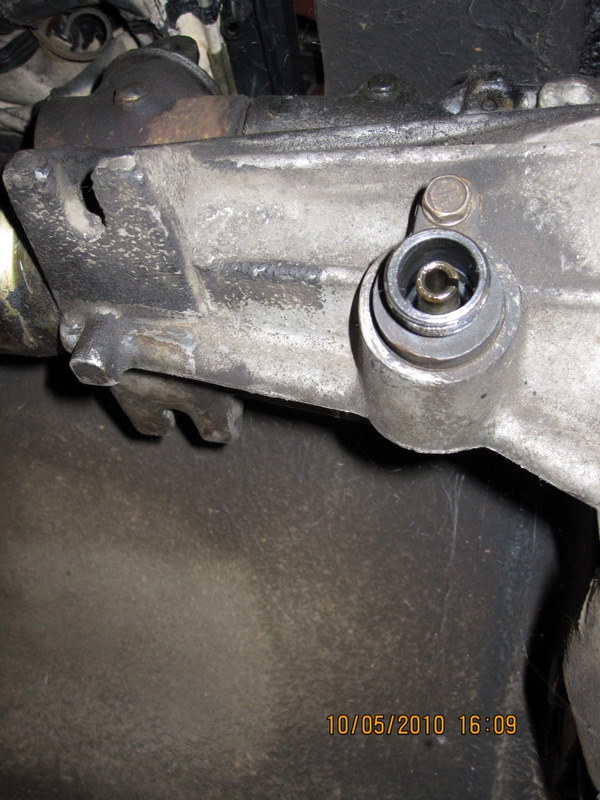
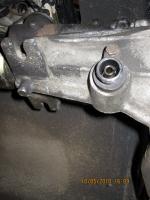
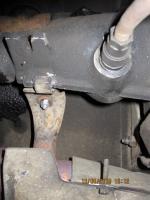
I've seen this topic come up several times but never found a good description of how to tell. I realized today that I've seen one distinct difference between an early 280Z four speed and a 280z five speed. So I took a couple of pictures for the record. One is a 1976 four speed, the other a 1978 five speed. The difference is in the straightness of the housing across the bottom of the speedometer drive gear mounting area. The five speed is essentially straight while the four speed diverges at the housing. The old timers probably know how to tell at a glance, but I have not been able to find a good writeup of how to tell them apart visually. Both are mounted. The 76 4 speed is first, not in use, but mounted in a car. The 78 5 speed is second, currently in use.
-
It looks good in concept. But I think you'll find that when you tighten the nut down the top plate will pull down until it's edge (front or back, can't remember which) contacts the "diff mount front member" (cross member) lip. Effectively giving you a solid mount (metal on metal). The "clunk" will be gone but you might get more vibration. If you don't crank it down, you'll need a self-locking nut or similar to keep it tight. Not trying to be joy-killer, just something to watch for when you tighten it up. I have stared at that edge for quite a while trying to figure out how to work around it. the designers made it so tight, it only sits about an 1/8" above the lip normally.
-
I hate to ask, but have you or Mike's measured the fuel pressure? Sounds like you're a little low, maybe a clogged inlet screen, clogged filter, or bad pump. If you have good pressure, then you'll know to look somewhere else, like timing or vacuum leaks. And it sounds like they might have swapped in a used AFM? You didn't say "new." Coughing at part throttle is what my bad AFM was doing. But it went pretty well at open throttle. Idle - good, part throttle - stumbling and bucking, open throttle - goes fast. I would check fuel pressure first, check timing and make sure it advances properly, and look for vacuum leaks. I've been talking quite a bit out here on classiczcar. Hope no one minds. I don't want to monopolize the conversation.
-
Choke?