HS30-H
Supporting Member
-
Joined
-
Last visited
Everything posted by HS30-H
-
Hi Eric, I used to own a '65 Mustang many years ago, and my main memory of it is that the suspension squeaked a lot. Didn't matter what I did, we couldn't stop it squeaking. Since I bought an early Z,its now me that squeaks. R.S.WATANABE wheels are still made by R.S.Watanabe in Japan, and I would presume that you are interested in their classic 8 spoke design ( which have always been known as the "Hachi Spo" in Japan ). Watanabe still make the classic deep-dish version in both Aluminium and ( very expensive ) Magnesium. They also added a split-rim version some years ago. They have many other designs of wheel available too. Check out their website at: www.rs-watanabe.co.jp Its mostly in Japanese and can be quite hard to navigate and see what you want - but I can assure you that its all in there somewhere. They have some data for the S30-series Z car with recommended fitment sizes. The 15 inch rim diameter is more useful these days as its much easier to find suitable tyres for them. If buying used R.S.Watanabe 8-spokes, be careful that you do not end up with a set that was designed for a later model ( wrong offsets ) or a FWD type ( very wrong offsets ). Watanabe have made these wheels for many years and for a great many applications. Be careful. The early Seventies castings ( and Magnesium forgings ) are becoming quite collectable in Japan now. Most early ones had a manufacturing date on the back. Good luck ( hope you get a Z ), Alan T.
-
The original IMSA cars looked great, but this attempt is quite far away from looking like one of them. I was particularly amazed by the efforts to make the nose look something like a Ferrari GTO ( notice the low oval air intake and the three scoops above it ). I wonder if that was part of the original "kit" or a further modification by the original owner. The wiring looks very professional ( not ). Love that Nitrous bottle ( not plumbed in of course ). Zedrally and 240Z what are you both thinking of!!?? Have you been looking at the HybridZ site too much lately? Alan T.
-
It's a new George Barris design for the 2003 PopeMobile.
-
Too late DRECORD, I already saw it. I've already got the intravenous drip attached and I'm waiting for the Ambulance as I write this.................. Alan T. ( I lost my heart to a Starship Trooper ).
-
Cuong is travelling in the Far East at the moment, so don't be surprised if he doesn't answer this for a few weeks yet. All the best, Alan T.
-
Hi Gavin, Thats a relatively low chassis number that you have there. The actual date of manufacture was not "officially" marked on most of the early RHD models as far as I am aware. However, I wonder of the Australian market cars had a similar tag on the inside of the door jamb ( just by the catch ) to the LHD cars, which stated a manufacturing date for local compliance purposes? The UK and Japanese home-market cars certainly did not. I can't remember whether they did or not - but if you DO find one please bear in mind that the RHD cars had to stick around in Japan for a lot longer than the LHD cars, while they got enough made / ordered for a consignment to be sent out. Some of my Japanese friends have told me that they remembered RHD Z cars sitting at the dockside in Yokohama for weeks and even months before being sent out. Compare this to the USA / North American market cars which were being sent out just as fast as they could put them together. Add this up, and it means that quite a lot of early RHD cars ended up at their destinations quite a long time ( relatively speaking ) after leaving the assembly line. For this reason, the local compliance / date of manufacture tag ( if fitted ) would not necessarily all that accurate on an RHD car compared to an LHD car. Based on the manufacture date of other cars that I know, I would think your car is indeed a mid to late 1971 manufactured car. To pin this down more accurately, you might want to get into Sherlock Holmes mode and start sniffing around your car for clues. First place to look would be the cloth tags on the seatbelts ( presuming the original Takata Kojyo belts are still in it ). These state the month and year of manufacture, and can provide a good clue. Usually they were made only a few weeks before the car was put together. Other places to look are on things like the back of the ashtray, the fusebox, back lamp housings and other items like that. You will quite often, but not always, see a round-shaped ink-stamp with a series of numbers in it. This is usually the manufacturing date of that item - but its in Japanese year date system according to the incumbent Emperor's reign ( in the case of your Z - it was still Emperor Hirohito, who the Japanese know as Emperor "Showa" ). To get the "correct" year date, just add 25 to the last two numbers on the date stamp. This is because the "Showa" era started in 1925. You will be therefore probably be looking at date-stamp numbers that end in 46 ( meaning 1971 ). If you see more than one 45 number, your car could well be an earlyish 1971 car. However, from your VIN number I think its a later 1971 car ( arguably one of the better dates to have in an RHD car ). You can also date these cars from the glass manufacturing marks and other more obscure places - but that's too complicated to get into here. Have a dig around your car and see what you can come up with datewise. If you need any help I would be glad to try to assist. I love early RHD cars in particular. Glad you are not too upset by the fact that its not some kind of Homologation Special. All too often people mis-identify stuff because they do not have much data on it. I guess this is what happened with the person who described your car as something other than a "normal" early RHD car. What you actually have is something rather good anyway. Remember that the early RHD cars were a much better spec. than the LHD cars ( 5-speed, 3.9 diff, rear anti-roll bar and the driver sitting in the "right" place! ). Hope that you take it back to its original colour, and close to original spec. if its been modified in any way. These relatively early HS30's are worth looking after. All the best, Alan T.
-
Sorry Gavin, but that "World Rally Spec." thing is just not true. ALL of the early "HS30" VIN prefixed cars ( that's RHD L24-engined cars ) had the 5-speed "A" type transmission - which had fairly close ratios anyway. The ratios changed to a more widely-spaced set when the "B" type 5-speed was phased in, so this is why you tend to hear about the "Close Ratio" gearbox thing. I quite often see comments from USA owners about "special racing transmissions" or similar when they are merely describing either an early "A" type 5-speed or one of the Sports Option transmissions available from Nissan Motorsports in the USA from the early 1970's ( which, apart from the proper "Dogleg" shift-pattern competition boxes, are usually just the 5-speeds that were stock in other markets except the USA ). The E31 head was also stock on most early cars ( what's your VIN number? ). Please don't believe any of that "special run" talk, as the only way that it can be seen as true is in the fact that there really were not all that many early "HS30" cars IN COMPARISON to the amount of early "HLS30" models that the Factory knocked out........ There was no real "Special Model" for Australia; you have to count the "HS30" VIN prefixed cars that went to Australia as very similar to most other "HS30" VIN prefixed cars, although they were arguably more similar to the Japanese market "HS30" prefixed cars than they were to the other ( mainly UK market ) "HS30". This was mainly due to the retention of the proper wraparound front indicators at the front where the UK version had compliance problems with them and switched to a rather ugly version on top of the front bumper. Take those figures from z.home as "gospel" at your peril; they purport to indicate production figures that relate to RHD cars for export. They do not seem to include any of the Japanese home-market cars ( very important ) and they come from the notoriously inaccurate "Datsun 280ZX" book that NMC published when the ZX was launched. They certainly will not help you in relation to how many cars made it to Australia. I would guess that "accurate" figures for Australian-market "HS30" VIN prefix cars would have to come from sources within Australia ( who must be privy to more and better info than that available elsewhere ). This must be known by the Z clubs in Australia surely? Be careful of conjecture though. A nice 1971 HS30 is a good thing to have. Are you sure that it really WAS made in 1971 ( and not 1970 ) - as I would have thought the E31 head makes it statistically more likely to be a 1970 manufactured car. This would be even better ( especially for those early VIN number lovers ). Like I said - what's the VIN number? Maybe this will help to identify it properly. Good luck with it, Alan T.
-
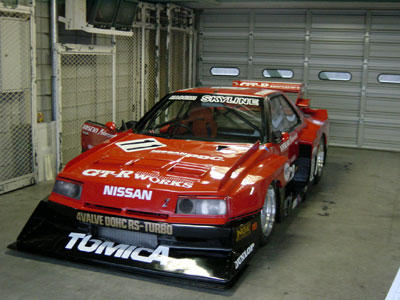 Hi Ben, Sure, I've got this one in a pretty high-res. version too. I will mail it to you direct. This is one of the cars that features in the Skyline Racing video that I'm sending to you - so you have a good bite of flame-spitting and tyre-spinning video image to look forward to. At least in the video its in the dry ( but at tight Tsukuba track ) which it was not at the 2002 Nismo Festival ( very hard to control ). By the way, did you know that the Japanese nickname for the Gr.5 Skyline Silhouette racer was "Deppa"? Its a good one to remember if talking to any Japanese R30 fans. Basically it relates to the habit of spitting metre-long flames out of the side exhaust on the over-run. All the best, Alan T.
 -
Hi Lee and George, I can tell you that different markets got slightly different colour choices and combos. For the most part they were the same, but there were differences that throw everything out of the window. Most of the data that you will find refers to the USA / North American market cars ( not the same as other markets ). I can tell you that ( like George's car ) there were a lot of Green cars with Black interiors in the Japanese market - so you can bet a lot of the other RHD market cars were in a similar position. All the best, Alan T.
-
Hi Rolf, Happy New Year. Actually, most of the RHD market cars did NOT have the little tag on the door jamb that quotes a manufacturing date.................... Like I said, its a lot easier to track the true age / manufacturing date of a LHD market car than an RHD market car............ I have to say that I think this concept of "Model Year" is confusing, and is linked more to marketing / sales than to any reality of manufacturing date. I have never heard the Japanese talk about a "Model Year" ( EG "1971 model" for a late 1970-made Z ) and to my mind it can only be a local market idea that is propogated in order to help sales. As far as I know ( and I could well be mistaken ) there was never any such idea as this at Nissan Japan in the early 1970's period. I also have a very strong suspicion that a lot of the dates on those door jamb plates were "tweaked" to suit business needs in Japan........................ Not that Nissan would ever admit it. Alan T.
-
Right ionman, I see where you are coming from. Amen to what you say. Mind you, I can see the attraction for people to try to make their cars ( not just Z cars ) something more ( to their way of thinking ) than they already are. I guess that's human nature. Any of the modifications / additions / deletions that I make to my Z cars conform to a sort of self-imposed set of rules that I have made for myself. One of these rules is to try to keep everything "period" correct for the early Seventies period. Hence the 14 inch wheels ( which make it a pain to find good tyres that are not too "modern" in profile ). I also try ( sometimes with more success than others ) to find parts that were available as Nissan "SPORTS OPTION" items in Japan during the period when the cars were current. As far as I am concerned, this makes them legitimate and "correct" to use. Like I say, its a self-imposed set of rules that I just have in my head. Your car looks super clean and original. These days that makes it unusual. Thats sure to give you even more satisfaction, and I can relate to your way of thinking. Best regards, Alan T.
-
Just to clarify this point, my comments on previous posts about skipped sequences in the numbering of S30-series Z cars were in connection with the RHD models. This is very well known in Japan. As far as I know, there is no evidence that any numbers in the HLS30-series VIN prefixes were skipped - so you do not have to worry about it for the LHD cars. The LHD VIN numbers make a lot more chronological sense than the others - so they can be relied on to provide more accurate dating info. Alan T.
-
Hi Otso ( 260z ), Can't imagine the temperatures you have over there in Finland. It was pretty cold here in Sapporo last night, with about 4cm of snow - but only about minus 7 Degrees. Surely those extremely low temps must hurt your car? ( or does it preserve it?!.... ). I've not heard that story about matt black hoods being to stop reflections ( but maybe that would be a useful side effect ). To be honest, I think its a case of style over effect. I don't have "blood" roots in Japan ( just my in-laws ) but we always come up to the north for New Year. The rest of the time we are in London or Tokyo. I didn't import my ZG to the UK myself ( and they were never officially exported outside Japan ) - it was brought to the UK in 1988 by a Japanese businessman with a large car collection. Its been owned by quite a few other people before me, but I think I've owned it the longest now ( and spent the most time and money on it ). It had a great body when it came from Japan, so its always been in good condition and only needed painting and detailing. I have done a real lot to it under the skin, and further improvements are in hand ( suspension ). When you ask about "original" G-nose parts, I presume you mean the original Factory-built parts. These are all but unobtainable from Nissan ( although I have seen some NOS parts in the hands of a collector over here in Japan ). I myself have a spare NOS front pan section ( the biggest part, which goes under the whole front of the car ) which I know is now very rare. The one thing that needs to be understood is that the ORIGINAL parts / panels were of amazingly good quality and construction. To replicate this would cost a real lot of money and time, so thats why the replica parts are usually of inferior quality. As I say, replica parts ARE available here in Japan from several different sources. They vary in quality, but generally speaking the 5-piece kits always work / fit better than the others. There are a couple of companies in the UK that supply the inferior kits ( and they import them from the USA as far as I am aware ). I don't recommend them. Better to spend extra and get a 5-piece Japanese kit. When I get back to London I'll look into putting up photos of my "other" Z cars ( although the 432R Replica is still in the paintshop and looks like a big kit at the moment ). Kats! Happy New Year! Nice to hear from you......... I flew up to Sapporo CHT from Kansai KIX last week on an ANA flight ( I wondered if I should ask the pilot if he knew you! ). Actually the pilot was really nice and made announcements in English ( just for me???! ) - the flightpath was really interesting too and Fuji-san looked beautiful. We are going back down to Tokyo tomorrow night ( ANA again ) so I will tell you about it. We fly back to Amsterdam then London on 7th with KLM ( horrible ). Actually, I have found that in the original road tests of October 1971, different testers / press called the ZG either the "Grand" or "Grande" Nose ( just different spelling ). I think this is just confusion from Journalists, and now we do not know which was correct. The Factory themselves also used different spelling in different advertising and brochures, and the Factory parts book lists the Manual Transmission ZG as an "HZG" and the Automatic version as the "HZGA". Interesting. I understand what you mean by Japanese English causing confusion - but you have to expect it, with such a big gap between languages. I have to say that however much the Japanese mis-use English, the English-language speaking world mis-uses Japanese just as much! It does not matter. What is more important is communication ( and one day we will be able to communicate without language, I hope ). I can imagine the feeling in the early 1970's - with the Japanese people wanting to dream of more modern and glamorous things. That's why they were using such interesting names for things ( and it still happens ). I like it. Its all part of the attraction of these cars. How about the example of the Cherry X1-R? It sounds like a cross between a space rocket and a fruit cocktail. I admire their boldness in using names like this ( even though it sounds funny outside Japan ). Outside Japan, I think we abuse Japanese terms just as much ( words like "Kamikaze" are used without people knowing the true origin of the word ). I think if we look at it chronologically, we can see that Matsuo san and his team realised that the aerodynamics of the first S30 series Z car were not satisfactory. You can see that the ZG influenced the styling of the S130 series Z ( and indeed there were originally plans to make the G-nose standard for the RS30 onwards, but they were dropped ). For the Japanese market, there was a period from late 1971 when the Automatic transmission Fairlady ZG ( "HS30-HA" ) was the MOST EXPENSIVE of the whole range, and was seen as the top model S30-series Z. This is why the ZG has always commanded higher prices and more demand than the "standard" Z cars. Prices of good condition ZG's are third in line behind the 432-R and 432. Kats, when I get back to London shall we start our campaign to promote Matsuo san as the true leader of the S30 design team? I am looking forward to it. Best regards, Alan T.
-
Yikes Ben you got me ( Im feeling very far away from home at the moment over here in Japan ). You are dead right, I shouldn`t have tagged a T on the end of that engine spec. ID. Sorry. See what happens when I try to rely on my drink-addled memory....... Good excuse dept: I`ve found some nice new Skyline books over here and have had my head buried deep in them over the last few days. Maybe that`s where the "L20ET" mis-ident came from. Regarding the Japanese "Home" market speedos; the one on my ZG goes all the way up to 240KPH. I think all the L24 engined cars all had these in Japan. The 2-Litre L-series cars were probably the ones that only went up to 180. As far as I remember the S20-engined cars ( PS30 and PS30-SB ) went up to 240KPH too ). Makes Phoenix_400`s possible purchase car sound more and more like a Japanese market car that was brought back by a serviceman. Ben, I share your thoughts about the ignition upgrade and open trumpets on the Webers; that`s typical Japanese street-tuned car stuff. That makes two us who think its a serviceman bring-home job. Alan T.
-
That reversed lettering moulded into the front airdam / spoiler clinches it; that`s definitely a part I have seen before. Forget about the "built for racing" and "European family" stories - as I think they are not accurate. I am willing to bet that the car has never been to Europe and was never intended to be a race car. Sounds to me like a Japanese "Home" market "S31" Fairlady Z ( roughly equivalent to the US spec. "280Z" - but with the L20ET injected 2 litre ). Again, I think it was probably brought back from Japan by a returning serviceman ( sounds like you might be in the right area for this kind thing ). Now you need to convince yourself that the condition of the car makes it worth getting involved with. Make sure its what you want. As Beandip says, everyone here is friendly and willing to help with advice - so they are not just trying to put you off by making cautionary words that sound negative. Some of us have learned from bad experience that a rusty car is a liability. Make sure you don`t let those Webers persuade you to buy something thats actually not all that good. Good luck, Alan T.
-
Hi there 260z, Thanks for the nice comments about my car. I have something in common with you at the moment; I am guessing that you have plenty of snow up there in Finland at the moment - as I am up to my nose in it here in Sapporo, Japan. I`m on holiday visiting relatives, and the weather up here is very interesting........................ For a "standard" G-nose and Overfender installation, you would not technically have to cut the rear arches. The point is, however, that you would probably want to fill up those rear arches with some fairly wide wheels and tyres ( although the ZG came stock with the standard skinny steel wheels and hubcaps...... ). Usually this means that you are forced to cut / clearance the rear arches to avoid cutting your tyres. The matt-black bonnet thing was also popular in Europe during the mid Sixties and early Seventies period. Originally thought of as an aid to dissipating engine heat, it soon caught on as a racy street modification. Its also quite handy for disguising the bad gelcoat finish on Fibreglass parts. Alan T.
-
Good point 2Many, I think it sounds like that "GS31" VIN prefix is correct ( and I`ll eat my hat if its not a Japanese "Home" market car that was brought back to the USA by a serviceman making use of "free" shipping from Japan ). Don`t get too excited about the internals of the engine; fairly impressive performance can be had from pretty much standard internals on the "L" series engines. If it was a Japanese street fighter its probably fairly standard internally. Try to see what size Webers it has on it ( are they 40DCOE, 45DCOE or bigger? ) - you can see the model type stamped on the top covers. Also try to see what "series" they are: you will see this number after the model type ( EG: "45DCOE-9" ) which will help to identify how old they are / what state of tune the engine is in. Notice anything else that looks "racey" on it? This might also help to identify its origin / purpose. Is that front airdam / spoiler signwritten / painted - or has it got "EVA" on it as part of the moulding? I`m very far from home at the moment, but I have a picture or some data of something like that at home in my archives. When I get back home I`ll try to find it. Alan T.
-
Gavin, That`s a good plan; get the car paid for and running right before "Gilding the Lily". Time is on your side ( I think you have got your Z at a much younger age than I was when I got my first one - which should be to your advantage ). Good luck with the new job. Fingers crossed. If I can be of any assistance with the car please don`t hesitate to ask, mate. Oasis? They are from Manchester! I`m London born and bred - which makes me naturally opposed to anything from "Madchester"....! We are like cats and dogs. In any case, I`m sorry to say that I am not that big an Oasis music fan ( and Liam`s a bit of a nut case by all accounts ). Sorry - I must be getting old! Ionman, I appreciate your right to like or dislike the G-nose. However, the REAL Fairlady ZG ( "HS30-H" ) was built by Nissan - and I really don`t think that they were trying to make it look "like" anything else in particular. The main reason for building the ZG and releasing it for sale to the public was in order to allow them to Homologate the parts for their Group 4 race programme in Japan. Without building a certain number of road cars they would not have been allowed to use the parts as a base for even greater modifications. Think Plymouth Superbird or Alfa Romeo GTam. If anybody wants to build a replica of these cars, then its OK by me ( they are rare enough as it is ). The only thing that causes problems is when people try to pass fakes off as the real thing. Otherwise, its all fair in love and war. My car is a "REAL" Fairlady 240ZG ( built by the Factory ) - have a look in my Gallery pics - so where does that put it in your line of thinking? Its not a replica Ferrari, and its not some aftermarket thing I tacked on to it, so its kind of hard to know what you would classify it as according to your previous post. I always get lots of people asking me what it is ( and a lot of negative comments!.... ) - but what I always try to get across to people is that its not ME that was responsible for it! In my way of thinking, it just IS what it IS - and you have to just love it, hate it or not care either way about it. However - before you write anything off or damn it with faint praise you MUST know what it is and all about it. Otherwise, you are just basing your opinion on whether it pleases your eye or not. I have lost count of the number of critical comments that I get about the "Overfenders" in particular; people always seem to think that I dreamed them up myself. I totally agree with people who say that they look tacky and cheap ( "Afterthoughters" - !! ) but that`s what Homologation Specials are all about.................... As for performance, the Japanese road tests back in October 1971 clearly agreed with Nissan that the aerodynamic parts improved high speed stability, cooling and breathing - so clearly the parts worked. I can vouch for this, as my car certainly behaves differently at Motorway speeds to my other "normal" Z cars. I`m not taking about very hight speeds either; it works noticeably from around 60 MPH up ( and especially in crosswinds ). I agree that spoilers / airdams are not REALLY necessary - but variety is the spice of life. Like I say, I have the ZG and a "normal" unadorned 1970 Fairlady Z-L. I love `em both! All the best, Alan T.
-
Gavin, The car in Eric`s photo looks like a genuine ZG to me ( a proper Factory fitment ) although it could be a very good replica. This means that the G-nose kit is a proper 5-piece item, and is well fitted. That alone makes it ten times better than a lot of the bad aftermarket stuff that you see knocking around.......... I reckon that`s what puts a lot of people off the ZG look ( they`ve never seen a real one in the flesh ). Incidentally, did you know that the "ZG" was designed by the same man who designed / styled the S30-series Z car - Mr Yoshihiko Matsuo? This particular car in Eric`s photo is also wearing the "B" Type front airdam for the ZG ( the original item was available from Nissan as a Sports Option part ). However, it looks a bit odd as the car is not wearing the extra wide "B" Type Overfender kit that went with the front spoiler. These wrapped under much more at the front and joined up the the spoiler. When the "B" Type Front spoiler, super-wide "B" Type Overfenders and big three-piece rear spoiler were used in conjunction with the G-nose in Japan, the whole kit was nicknamed the "Full Works" kit. This is because the final versions of the 240ZR Factory race cars usually used these parts as a base for their own mods. These were available from mid-1973 onwards. I just helped a friend here in the UK obtain a full ZG and "B" Type Full Works body kit for a car he is building ( its a replica of the 1975 / 1976 Le Mans 24 Hour race car ). He said he was pleasantly surprised at the cost - but shipping was pretty expensive. If you are SERIOUS, I could put you in touch with the suppliers - but they don`t like giving price quotes that include shipping costs unless you are pretty much set on buying the kit from them. This is because shipping costs are different for each territory. They also recommend shipping by AIR, as the volume is usually not enough to make it worth sending by SEA. This particular company is quite shy of dealing with non-Japanese customers / enquiries. They told me that they had some bad experiences in the past of customers ordering body parts and then baulking at the cost of Freight / Duty / Handling charges at the point of entry to their country. In the end, they had to receive the parts back in Japan ( it cost them a lot ). Anyone ordering parts from Japan needs to remember that it will cost fair bit in Import Taxes and Duties on top of the Freight and parts costs. Don`t forget that you would need to obtain the different hood hinges for the ZG ( which aint cheap! ) and then the headlamp covers ( which aint cheap! ) and then cut the rear wheelarches ( which aint for the faint-hearted! ). Added to this, the cost of REALLY wide wheels and tyres to fill those mega wide arches. Have a look at my Gallery pics for the full "B" Type kits fitted to cars in Japan ( one of them is the Real Thing ). I love this look, but I also love the pure clean lines of the "standard" cars too. I want both! Gavin, send me a PM if you want more info on a ballpark price for the parts from Japan. I`m afraid the Exchange Rate for $AUS to Japanese Yen will be pretty painful though. All the best, Alan T.
-
Hi guys, looks like a fair bit has been happening since I last looked in. Carl, thanks for the endorsement - but I think you might be slightly overstating my expertise ( especially on the Left Hand Drive side of things )! I have an interest in the Right-hooker cars in particular - so I`m always glad to try to help in any way that I can with that side of things. I`m still learning though - and you can never sit back and think you know everything about the history of these cars............................ Phoenix_400, I second all of BambiKiller`s advice to you regarding the demon RUST and getting yourself into a project that you will never finish. I`ve been in that situation too, and tried to kid myself that it would all turn out OK in the end. In the end, the rust caught up with me and now that car is a very expensive parts donor for other projects ( the body was beyond saving ). Once I started to cut it up, it frightened the life out of me to see what I had been trusting my safety to; the internal structure was really badly gone, and the previous owners had just patched over the top of patches. Really nasty......... These cars are "Unibody" in so far as they have a monocoque structure ( no separate frame ). Those front chassis rails actually do extend under the floor ( the floor forms the fourth side to the box section - if that makes sense ). Its a real big job to replace them properly ( although good repop parts are now available ). The floors are more easy to replace ( in comparison ) so I would not necessarily worry too much about that. However, like BambiKiller says, this kind of rust is not usually confined to what you can SEE. All in all, its a sign that there will actually be rust all over most of the car. To cure that properly you are really looking at a total strip and lots of welding. Please be careful about what you are getting yourself into................. As to the history of the car, I would be willing to bet that the car possibly has not even been to Europe. My gut feeling is that its more likely to be a souvenir brought back from Japan by a serviceman. There are actually quite a few of these knocking around ( hey - I own one too! Its a 1970 Fairlady Z-L that ended up in Europe after spending time in Japan and the USA on a tour of duty with a USAF pilot ). The stories about it being an ex race car / built by a race car company may very well be simple exaggeration. Its much more likely to have been a street fighter at home in Japan ( with the triple carbed L28 replacing its standard L20ET engine ). That "EVA" name rings a bell - but I might hazard a blind guess that this is the company that made the front airdam / spoiler ( there was a Japanese company called EVA who were famous for making spoilers.............. ). See if you can find any more about the details. All the best and good luck, Alan T.
-
Hi Phoenix-400, I`m over in Japan at the moment, but I live in London, England. I can possibly help with tracking down the former life / builders of this particular car if you can give me some more details. I`ll be back in London from 8th or so, but I might be checking into the site every couple of days or so whilst in Japan - so I should see any reply you make. Are you sure it came originally from Europe ( meaning it was a RHD Export model if it was destined for the UK ) or was it originally a Japanese "Home" market car? The "Fairlady Z" emblem makes it sound as though it might have originally been a Japanese market car ( we never had the 280Z in Europe ). I have never heard of a British company called "EVA Racing", but that does not mean that they do not / did not exist. They may have even been in mainland Europe - but a European racing Z would have been a notable rarity................. I HAVE heard of a company called EVA who made parts for race cars though. Have a look at the VIN number on the firewall ( its stamped above the brake booster, and you might need to move some wires / lines to see it. That`s more likely to be still in place than the aluminium VIN plate in the engine bay. I have a hunch that its originally a Japanese market car......... Anyway, if you need any help / data etc. please do not hesitate to ask. I know how it feels to try to identify something that you don`t see much data for. Bambikiller`s advice on rust etc is well worth taking note of. Its also worth taking care on any car that is described as having been a race car ( sometimes very badly put together! ). I have a feeling that we may have heard of this particular car on this site many months back ( it rings a bell....................... ). Good luck and Happy New Year, Alan T.
-
Wow CoastGuard, that's a big homework assignment you've given me............... I'll have to simplify this to make it more manageable, so here goes; S30 = basic model type for ALL the below cars ( its not strictly correct to call them all "240Z", as that's only one variant..... ) VIN prefix / model type: *S30 = Fairlady Z ( Japanese market ). From October 1969. Can be divided into two sections for early cars: either the basic "S30-S" Fairlady Z with 4sp trans or Auto and "basic" equipment, or the deluxe "S30" Fairlady Z-L with 5sp. trans or Auto, with carpets, hubcaps, rubber bumper trim, tints, etc etc. Both the above had the L20 2-litre six on twin Hitachi SU's. *PS30 = Fairlady Z432 ( Japanese market ). From October 1969. Either the "PS30" Fairlady Z432 ( street model ) or the "PS30-SB" Fairlady Z432-R ( race homologation model ). Both had the S20 24-valve twin-cam six with 3 x 40PHH Mikuni sidedraughts, 5-speed "A" type manual trans, R192 LSD with 4.44 gears, Mitsubishi electronic ignition and loads of detail differences from the L-series engined cars. The 432-R had the 100-litre fuel tank, GRP hood and many other detail differences from the standard 432. *HS30 = Fairlady 240Z ( Japanese market ). From October 1971. Can be divided into three sections: "HS30-S" the "basic" model very similar to the "S30-S". "HS30" the "deluxe" model very similar to the "S30". "HS30-H" the Fairlady 240ZG model with FIA / JAF Group 4 homologation aerodynamic parts. All the three above types came with the L24 engine, and either the 5-speed "A" type manual box or Auto trans. Note that the "ZG" name derived from the "Grande Nose" appelation, but the suffix "H" on the type code denoted the fact that it left the factory as a ZG. VIN prefix for the ZG was just "HS30". *HS30 = Export model "240Z" for Right Hand Drive markets ( notably Australia and UK ). Correctly termed "HS30-U" by the factory. From early 1970. These cars were similar to the deluxe Japanese model, and came with the L24 and "A" type 5sp manual trans or Auto. Usually with 3.9 ratio R180 diff and proper rear anti-roll bar. All but the very first came with an ABS rear spoiler and urethane front bumper. UK cars were modified after first consignment to comply with height regulations on front indicators ( the front side corner indicators were deleted and small repeaters mounted on top of front bumper ). Australian market cars did not change from wraparounds. *HLS30 = Export model "240Z" for Left Hand Drive markets ( notably USA / North American market ). Correctly termed "HLS30-U" by the factory. I won't go too far into these, as most of you will know the spec. and the fact that they had a 4sp manual or Auto and no rear anti roll bar. There was also the "HLS30" export model for Left Hand Drive markets other than USA / North America ( notably Europe ). These cars came with the 5sp. "A" type manual box or Auto, and DID have the rear anti roll bar. I'm not going into the RS30 / RLS30 / GS30 / GRLS30 etc series here as I would be up all night. Generally speaking, the early years of Japanese domestic market cars were all 2 Litre ( L20 SOHC or S20 DOHC ) until Oct. 1971 when they also got the choice of the L24. Most export markets started with the L24 until the L26 and L28 were phased in. As you can see above, everybody else got the 5sp manual ( "A" type box ) or Auto. from the very beginning. Only the USA / North American market cars got stuck with the 4sp or Auto choice ( bad luck.......... ). The only code prefixes that you see on the VIN numbers for the earliest cars are "S30", "PS30", "HS30" and "HLS30". All the other info on model type is in the Factory code suffixes, and these are not usually marked on the actual car. So, for example, it might be difficult to discern between a Japanese home-market HS30 and an Australian-market HS30 export model without digging deeper, as both of them would have the VIN prefix "HS30". I know it sounds awfully complicated ( maybe its my fault for explaining it badly ) but its simpler than you might think. It just gets confusing when the RS30 and others start getting phased in, and Japan carried on using some of the old prefixes. Remember I'm only talking about up to 1974-ish here. Any use? I'm off to Japan for a week or so tomorrow, so please don't expect any replies to further questions until at least 8th Jan. Have a good New Year. Regards, Alan T.
-
Sorry T.O.G. - can't help with any numbers or proportion of Auto to Manual trannies on the Australian HS30's. You can bet that they were a very small proportion compared to the manuals though. I'd take a stab at something like 1 in 50 or less being Auto. Sorry to say that this does NOT tend to make them more sought after or more expensive than the manual trans versions. I think you can guess that the majority of people searching for a Z to buy are going to be looking for a manual version. The Auto's are rarer ( and nice to see them around ) but it just doesn't make them more valuable monetarily. Rick, don't ask me about girls. I'm looking for tips myself........... Sorry to have waxed lyrical about those Japanese dates and lost you a bit. I think all you ever need to remember is to "Add 25" years to Japanese date marks that appear on an S30 series Z car. Most of them are going to be in the mid Showa '40's and '50's - which means the 1969 to 1979 period roughly. Regards, Alan T.
-
Like I said on my first post above, Nissan made a big jump on chassis numbering on the "HS30" prefixed cars around late 1971. This is why your HS30 100243 VIN number does NOT mean it was the 100234th HS30 built................. They made the big jump BEFORE it was actually needed ( i.e. they did not roll around to "HS30-09999" ). I have never been able to ascertain exactly when the big jump was made ( i.e. after which number ) - but I have a fairly good idea. You also will not find any info. on particular specs. from the VIN number ( such as whether is was Auto or Manual trans ). Only the basic model type can be gained from the VIN, and the final specs. would only be identifiable by looking at the car itself. For the Export market, Nissan tended to stick to one basic spec. for each particular country. This is why most of the "HLS30" and "HS30" cars in each particular market all tended to be pretty much the same - just the paint / interior colour and trans. choice to decide on. Contrast this to the Home market, where a much bigger choice of body / engine / trans / trim was available. On the Japanese paperwork for each car, the spec. is quite clearly stated. Most Export markets never got this. Alan T.
-
Damian, With respect to your particular car, the situation is slightly easier than the one Rick is facing. The VIN numbers for the "HLS30" prefixed cars are much easier to date than the "HS30" prefixes ( although the "S30" and "PS30" prefixes are also difficult, they are a lot more easy to make sense of than the "HS30" ). Most of the "HLS30" cars went to the USA / North American market, and this was subject to a lot more documentation on the receiving side. You can bet that your car was made pretty much around the month that is marked on the extra door jamb VIN plate that most of the "HS30" series cars did NOT get ( if its still attached ). As to your question about how many numbers were used between October 1969 and April 1970 - then the answer is fairly easy; it was almost exactly 3091st of the "HLS30" prefixed cars. The very first "HLS30" prefixed cars probably did not make it to the USA, so your car would probably have been at least something like the three thousand and eighty something-th car to hit the beach in the USA. Just remember that having a VIN of "3091" does not make the car the 3091st S30-series Z car off the production line................ you have to count the "S30", "PS30" and "HS30" prefixed VIN numbers that ran in parallel with the "HLS30" numbers. That would be an almost impossible figure to ascertain. I presume from your gallery pictures that you bought a USA market "HLS30" and privately imported it to Holland? In that case, you are in a fairly good position to find out more about its true age. Victor, your discoveries sound like a nice bit of carchaeological evidence! If you can post pictures before 28th Dec. ( GMT ) then I might be able to help you read the Japanese on them. I will be off to Japan on 28th and returning on 8th Jan. Did you discover any other writing anywhere? You can sometimes find Factory internal build info. on places like the steering column support bracket and the underside of the glovebox floor. There are sometimes other little messages and graffitoes on the hidden parts of the cars, which the Factory workers scribbled to entertain themselves on the line. I asked a Nissan production line worker who was present on the SP/SR lines and also the S30 Z line about these. I showed him a photo of a scribble on the underside of my dashboard panel ( which read "warau" in Japanese ). He told me that it just meant "Ha Ha!" - and would have been a little joke between the workers on the line, intended to make the working day go just that little bit faster. I thought it was rather heart-warming............. All the best, Alan T.