HS30-H
Supporting Member
-
Joined
-
Last visited
Everything posted by HS30-H
-
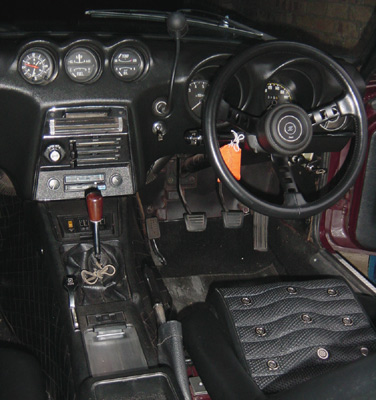
Morning all, Don't forget that my ZG is a Japanese Home market only model. The Japanese Home market cars had almost nothing on them identifying the "Datsun" branding of the export cars.............. This even went down to the detail of the door sill step finishers, which were plain instead of "Datsun" scripted. Also, the steering wheel on my car is a rather rare "Datsun Compe" item - and can use the steering wheel boss from the stock steering wheels. I have chosen to use it with the Japanese Home market "Z" script boss - which the car would have originally had on its steering wheel. Japanese market Z cars hardly had the "Datsun" brand on them anywhere. In fact I'm trying hard to think of a component that had the Datsun brand on it - but can't think of one. In Japan the Z is a Nissan - not a Datsun. Alan T.
-
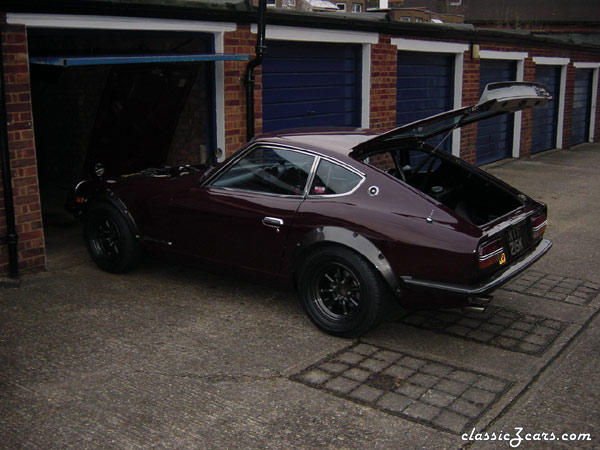
From the album: Fairlady 240ZG ( HS30-H )
Squeezing into a London-sized garage. -
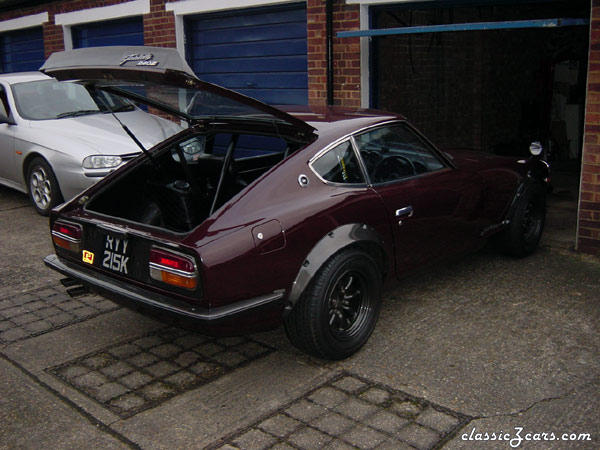
From the album: Fairlady 240ZG ( HS30-H )
Squeezing into a London-sized garage. -
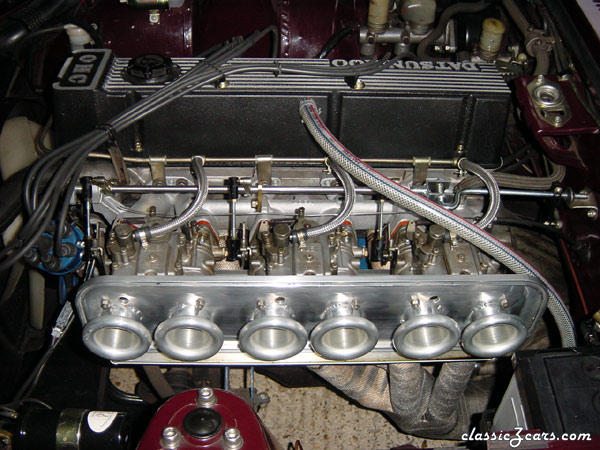
From the album: Fairlady 240ZG ( HS30-H )
Engine near-side. -
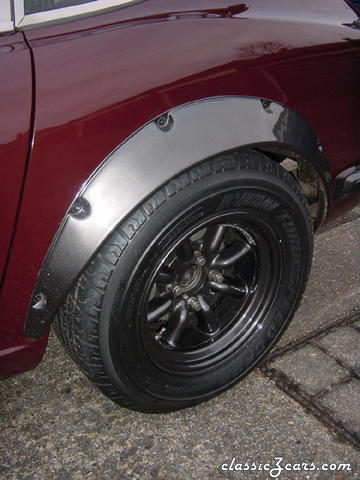
From the album: Fairlady 240ZG ( HS30-H )
Near-side rear wheel. -
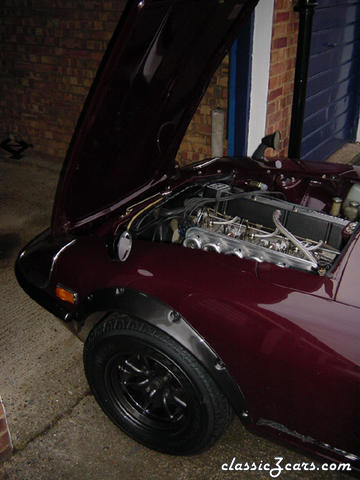
From the album: Fairlady 240ZG ( HS30-H )
Near-side front wheel. -
By the way, that "An American car, built in Japan" quote was from www.zhome.com - and the "Z History" section of that site contains some very interesting theories. There is a lot of stuff in there that I totally agree with, but a few things that are perhaps somewhat overstated............ The last time I criticised zhome here on 240z.org I very swiftly got my knuckles rapped. However, I think zhome is big enough to take a little critique and I'm not daffy enough to think that my opinions will cause anything on that site to get changed. The biggest problem I have with a lot of the English-language writing on the S30-series Z in general ( notice I didn't say "240Z" - as its only ONE version of the S30-series ) is that it almost totally writes off the Home market and RHD export market cars. Its like they almost didn't exist. The "HLS30" version of the S30-series Z became the most successful of the range in terms of numbers sold - but this should not be allowed to crowd out the fact that the S30-series Z debuted in Japan and RHD versions were productionised alongside the LHD versions. I think if you read the stories, and particularly on zhome, it would be all too easy to believe that the "HLS30" 240Z was some kind of father to ALL models of the early Z car. This is quite definitely and positively NOT so. The people who designed and built the car certainly do not accept the LHD version as definitive, so why is so much emphasis put on that model when the model's history is under discussion? These "other" models were designed and productionised alongside the "HLS30" 240Z, but very rarely are they given credit for being there at the beginning of the story. Sorry if it seems as though I'm trying to "knock" the HLS30 and America in some way. That's just not the case. I'm trying to stick up for the RHD versions as they seem to be crowded out of the story, and add a little balance. Generally speaking, early Z owners from the USA / Canada seem to be very interested in the models of Z that they never had in their particular market. I very often receive nice PM's and messages about my own ( Japanese market ) cars, and people ask very pertinent and interesting questions. One thing that seems to surprise many of them is that the 432 was made from late 1969 - just like the HLS30 - and that other markets had 1969 and 1970 models with 5-speed transmissions and rear anti-roll ( "sway" ) bars. There's often surprise shown when the contents of the Japanese "Sports Option" lists are revealed, and they can see the depth and quality of parts that were never seen outside Japan. When I myself first discovered all this, it dawned on me that I didn't know the half of the true story of the cars that I had come to love. Unfortunately, it seems that some out there would prefer not to know and are happy with the story as dished up in badly-researched magazine articles ( especially in my own home country ) and half-baked books that purport to tell the "Complete" story. Hats off to zhome for trying to get beyond that, but I think there's still much too much emphasis on just one local-market variant. Maybe I'll be admonished for being negative or something, but I think its worth trying to make the point all the same. Sometimes it feels a little like preaching the New Testament in Baghdad, though!......... Cheers, Alan T.
-
Yes, sorry - I can see now that I was not making it clear that I was referring to badly-engineered RHD versions of cars from LHD markets ( like my Alfa Romeo 156 - which infuriatingly has the indicator stalk on the LEFT side of the column, which makes the busy nature of negotiating busy London traffic a real pain ). I was trying to point out that Nissan thought of this point, and very kindly placed the indicator stalk on the left side of the column for LHD cars, and on the right side of the column for RHD cars. Thus leaving us free to change gear with one hand and flick the indicator stalk with the fingers of the other hand. There's a joke in there somewhere but I'm damned if I can find it... Alan T.
-
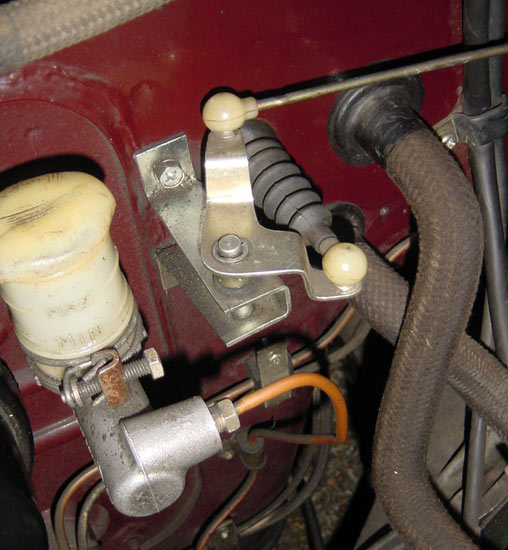
and here's what happens at the other end: NOTE: Some of these parts were also used in the throttle linkage of the S20 engine in the 432, which of course had its carburettors on the opposite side of the engine to the L-series. Apologies for the non-standard carburettors on my particular car, but I think the firewall part of the linkage is what's important here. As far as attachment to the original SU's goes, you can see the parts that are different from LHD versions.
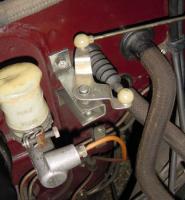
-
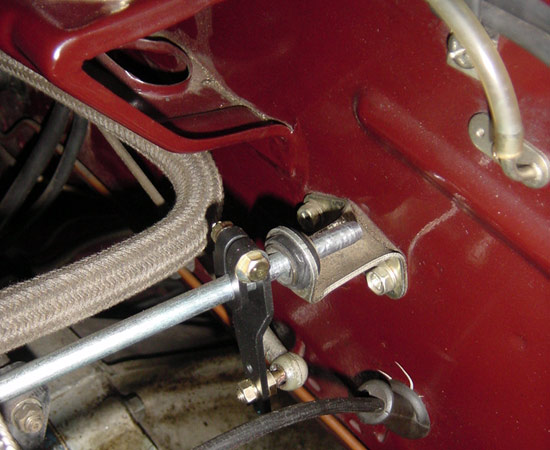
and here's part of the throttle actuating mechanism on an RHD car: ( Again - apologies for the grime. Nothing like a close-up flash photo to remind you its time for a Spring clean.... )
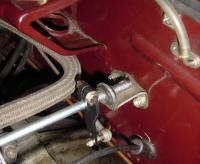
-
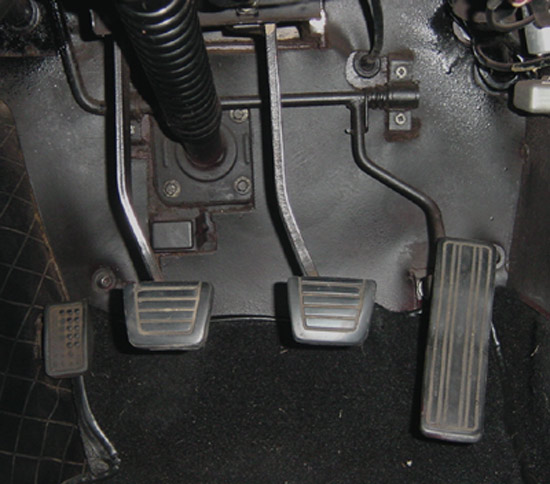
and here's a picture of the pedal layout in an RHD car ( I think you can see that there is plenty of space down there and nothing is difficult to use or unergonomic ). Notice the clutch-foot rest next to the tunnel and the space around the throttle pedal. Its all pretty well laid-out down there. Apologies for the dirt and dust..........
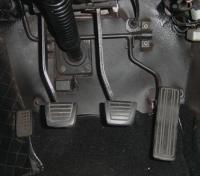
-
Here's a picture of the controls layout on an RHD car:
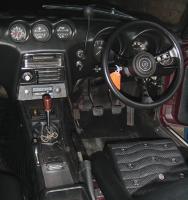
-
Enrique, you certainly offer good bang for the buck! Your two Cents worth goes a long way. I have to chop it up into bite size chunks just to even attempt to answer it. I hope this site has enough bandwidth to accomodate our answers to eachother.:classic: Reading through the above, it was slowly dawning on me that you might even think that ALL right hand drive cars must be un-ergonomic for the majority of the world's population ( seeing as we would have to use our left hand to change gear ). Surely you can't be implying that!? Don't go there!.......... But regardless of what side of the tunnel the Handbrake is on -you still need to use your right hand in LHD and your left hand in RHD, so the question of right-handedness in humans is a distraction. My point is that I thought it was a little bit far away for LHD version drivers. 2manyZ's hinted that he might agree, but Victor said he was happy with it where it is. I don't think we'll find many RHD owners who would say that they thought it was too close for them ( oops! - that's tempting fate ), but the majority of LHD owners also seem to be happy. These are the kind of responses that I was interested to hear when I started the thread. The Monte Carlo rally car that I posted photos of was built in Nissan's Competition Department workshops at Oppama in 1971 for the 1972 event. LHD cars were also entered in the 1971 event ( built in late 1970 ) and these too had the transposed Handbrakes and Consoles. I have seen very good period pictures of one the late 1970-made cars in a stripped-down condition. They quite clearly show that the tunnel pressing itself was different - so it was not just a case of moving the lever and mechanism over. They went the whole hog and made a special tunnel pressing to do it. This was much too late in the day to be anything to do with pre-production or prototypes of the bodyshells, and I am told that when Rauno Aaltonen first drove a factory rally Z he insisted that the Handbrake in the LHD version be moved to the left side of the tunnel. The Consoles were hand-made to suit in the Competition Department. I think that's interesting. I don't think we could say that I might be looking for the answer to a question that was never asked. I feel SURE that this matter was discussed at the design stage ( I can't believe that it would not have been, given the level of detail that went into the productionising of LHD and RHD versions ). But after input from LHD owners, it's starting to become clear to me that most LHD owners don't have a problem with the Emergency Brake / Handbrake positioning, and would not appear to believe that it might be slightly less ergonomic than having it on the same side of the tunnel as you are sitting. That in itself may have answered my question, and provide the answer to why Nissan decided it would be fine to have it ALWAYS on the right hand side of the tunnel. I'm going to post some photos now, but the discussion has moved on a long way from when they were really needed - so I hope you'll be patient and go back to that point in the discussion again. Cheers! Alan T.
-
No Fred, I think its quite clear that by the time they were getting ready to productionise the car, the major SALES target was the USA / North American market. I don't think that this meant that they had to design something that would be seen as "American Inspired" - surely a lightweight two seater sports car of that period could not be described as "American Inspired"? Wasn't that class of car usually seen as a foreign import ( with the extra touch of glamour that this implied )? I think your "World Car" quote is quite apt though - as the late Sixties and early Seventies period was when auto manufacturers ( particularly in Japan ) started to realise that this kind of thinking would pay off for them in the long run ( you would have to go back to the days of the Model T Ford to see the start of similar thinking - but in those days the cars for a particular market were made in a factory in the country of sale ). I certainly don't think that Nissan would have KNOWN that the S30-series Z was going to be a major sales success in that USA / North American market, but its quite plain that they were HOPING that it would be. By all accounts, its runaway success exceeded all of their hopes - and in fact led to major problems in keeping up with demand. This delayed the release of the Export RHD cars ( but not the Home market RHD cars - which were produced right from the beginning ). I don't think that the design of the S30-series Z was inspired by much from America. Anybody who is interested in automotive styling of the late Twentieth Century would probably acknowledge that the big Italian styling houses were the major influence. Mr Matsuo and his team were certainly fans of the products and styling exercises of these companies. Anyway, I think the 'styling' of the car is something of a different subject to its interior ergonomics - which is what we were originally discussing with relation to RHD and LHD versions. I've just come back from taking some photos of the layout of the RHD cars, but its going to be a little while before I can download them. See you later, Alan T.
-
Enrique, Many thanks for putting such serious and logical thought into the discussion. I thought this debate was starting to peter out on its own, but you've come in with guns blazing and it feels as though the thread has woken up again. I quoted your ( very snipped by me ) post above because you have brought up some very pertinent points, but posed the same unanswered question about the Emergency Brake / Handbrake position. Its quite apparent that Nissan made huge efforts to engineer the cars for both LHD and RHD versions, but the question still remains to be answered - why did the Handbrake always stay on the RIGHT side of the tunnel? As many people in the USA / North America may not have seen an RHD S30-series Z in close up, I'm going to endeavour to take some detail photos of one of my cars later today. I shall try to get good shots of the cockpit and its controls ( including the pedal layout ) and also the carburettor linkage. These might be of some interest to people who have not seen the RHD version before. Just as a last thought, one of the things that I was hoping to get a discussion going about ( using the Handbrake positioning as a starting topic ) was this whole idea of the S30-series Z being designed specifically "for" the USA / North American market. I have always thought that the car was very cleverly engineered for both RHD and LHD versions, but that the RHD was in no way secondary to the LHD version ( the transmission and engine configuration would always put paid to that theory ). What I want to defend is the integrity of the RHD version. Its most annoying to read that quote describing the Z as "An American car, built in Japan"and I think all the evidence of the hermaphroditic nature of the bodyshell that Enrique has posted above shows that the RHD version of the car was taken just as seriously by the factory as the LHD version. I'm off to try and get some decent photos now, All the best, Alan T.
-
Hi Carl, I DID enjoy another Orion, and now I'm regretting it ( they are huge bottles and 5% alcohol ).......... Just wondered about a possible Pleasanton / Pleasant Valley connection - but was obviously barking up the wrong tree. Thanks for straightening me up. SAFEWAY is on the rocks! They are the subject of hostile takeover attempts from both MORRISON'S ( a Northern English phenomenon that us soft southerners have never heard of ) and SAINSBURY'S ( a dynasty not unlike the Kennedys ). Poor old Safeway is the rope in a rough and tumble tug-o-war for Supermarket supremacy. Launch the smart butter and cruise muffins immediately! Alan T.
-
Hiya Steve, Well, I wasn't mixing grain and grape last night but I've still got a headache ( does a mixture of Gin, Sake and the 'very tall Reidel of CA syrah' give you a headache next day?!? ). Maybe that Orion beer is local slang for 'Big Lion' rather than a star. It doesn't seem to mix well with my medication............. Ah yes - in my alcohol-induced stupor I forgot all about the DNA of the Z going back through the Cruise Missile and all the way back to the Zero-sen. How stupid of me not to see the wood for the trees ( or the fuselage for the rivets ).......... Nissan genius knew no bounds. I just checked the knob and it is indeed identical for RHD and LHD S30's. Imagine how happy the bean-counters were when this came through the factory accounts. And to use up that vast old stock of Zero-sen machine gun triggers as Emergency Brake release knobs was pure cost-cutter's nirvana. How's the 2003 year Chateau Fairlady coming along? I need to drink a toast with it. Bottoms up, Alan T.
-
 No S20-engined cars were officially exported. Japanese "Home" market only.
 -
 Less than 500 were made, and they were never officially exported outside Japan. Cheapest of these will be around $30,000. and the better ones much much more.
 -
By the way, the engine in the Ford MK.1 Lotus Cortina was indeed developed by Keith Duckworth's team at Cosworth Engineering. It was based on the Ford "Crossflow" block. The cars were built up to the bodyshell stage at Ford's Dagenham plant and then trucked over to Lotus at Cheshunt. There they had the full Lotus treatment ( alloy panels, special A-arm rear suspension and Lotus diff, special trans etc etc ). The MK2 version was actually put together at Ford's Dagenham plant with some components supplied by Lotus. There's not that many full-spec MK1's left on their original bodyshells. Most of them had a very hard life. Many of the survivors are still used as race cars. The Lotus Cortina is a real legend amongst car fans over here. Good ones are mega money. Alan T.
-
Hi all, I really hate that word "copy". It implies that the person who is "copying" has not asked permission or paid any licensing fee to the holder of the patent or original design. Its a word that has always been used in reference to Japanese industry ( and other areas of Japanese culture ) and it used to be used in an almost pejorative sense. Car journalists were some of the worst at throwing this word around. The truth is that at the start of the Twentieth Century, Japan's industrialisation was playing catch-up with the rest of the world after the country had been all but closed to outsiders for a long period. This meant that the easiest way to get on terms with the rest of the world was in many cases to manufacture locally-made versions of foreign designs under license, hence cutting out a lot of expensive and time-consuming R&D and allowing them to get straight on and make components. In almost all cases, fees were paid to the licensing companies ( who did very well out of it ) and very little was pirated. Some small component manufacturing companies were guilty of copying without permission ( indeed, some cases of fakery were discovered ) but this was not all that widespread and not tolerated for very long. After the Second World War, Japan's industry was left in devastation. The whole process started again with the country under American military control. Companies that had previously been engaged in the manufacture of aircraft and military vehicles were now forced to change tack. This is how the Prince Motor Co. was formed ( morphing from an aircraft manufacturer to a light car maker ). They needed to save time and get their products out into the market as soon as possible, so of course once again they started licensing foreign patents to use in their cars and trucks. Stuff like brakes ( notice all those Imperial sizes on Japanese brake components? ), carburettors and transmissions were big licensing areas, and companies like Girling, Solex, Bendix and many others had Japanese licensees making their own versions of the patented designs. Of course, this phenomenon is widespread across all countries and industries. Most of the time you don't hear about it, but when Japanese companies did it they had the word "copy" thrown in their direction........ Prince paid a fee to Mercedes for licensing some areas of engine design ( I think this was to do with valve train and cam drive / distributor drive design in relation to one of the many iterations of the Prince "G" series engines ) but I do not think it was a WHOLE engine design. Its one of those things that people talked up, as it made the Japanese product sound like it might be better. You can't blame them for taking a little "shine" off the association... That "Lotus supsension copy" statement is a little bit stretched. This most often refers to the rear suspension on the S30-series Z being similar to the "Chapman Strut" idea first used by Colin Chapman at Lotus. Basically, this was just the use of a McPherson Strut on the REAR of a car ( in this case, the first Elite ). It was never patented by Lotus, and once it had been done for the first time everybody else had a go at it too. Its more like a design principle than anything else, and Chapman's name will be linked to it forever. The first person / company to do something will usually get credited in this way ( ask Mr Panhard and Mr De Dion ). The "Porsche gearbox copy" thing is also stretching it a bit. The synchro design used on the "A" series transmissions that were the first type fitted to the S30-series Z were actually patented by Porsche. Later on, Nissan switched to Warner-patent syncros. Lots of others used these patents under license, but its Nissan who get the "copy" thing thrown at them................ All the best, Alan T. ( ps - I used to own a Cortina-Lotus MK.1 - wish I still had it. )
-
Hi Roger, On release in the UK, the 260Z ( RS30 ) was quoted at 162 BHP ( SAE ) at 5600rpm in all the press releases and sales brochures. Does this help at all? Best regards, Alan T.
-
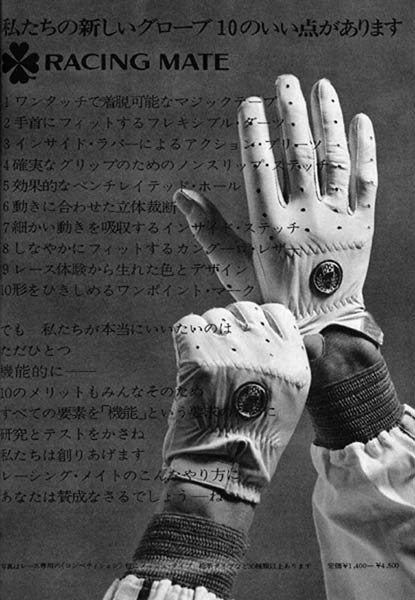
RACING MATE was a driver's accessory company formed in the late 1960's by well-known race driver Mr Shikiba. Shikiba san was famous for his part in Prince's giant-killing attempts in one of the support races of the 1964 Japan Grand Prix at Suzuka. He was driving a Porsche 904 and spent most of the race dicing with a Skyline 2000GT ( S54 ) driven by Tetsu Ikuzawa, which was giving him a fairly hard time. This was one of the drives that started the "sporty" Skyline legend. He still won the race, but Prince and then Nissan have been making mileage out of it ever since. The fact that the Skyline was able to keep up with an exotic German race-bred sports car - and even lead a lap of the race - was great publicity for Prince. RACING MATE started out making stuff like driving gloves and gear shift knobs, then moved into exhausts and other tuning parts. However, their main area of specialisation was in driver's accessories ( race suits, helmets etc. ) - kind of like a Japanese Les Leston. They used to sponsor a lot of race cars, and that's why the four-leaf clover Racing Mate stickers became a popular add-on for sporty-minded drivers of Japanese cars. Shikiba probably nicked the four-leaf clover mark from Alfa Romeo's 1930's racing efforts, but its always been seen as a Good-Luck charm for drivers. Now that the company is defunct, the stickers are most often seen on old Japanese cars as a "period" accessory. Mr Shikiba is alive and well, and sometimes works as a car tester for the Japanese magazine that I too work for - "ENGINE". He's one of those Japanese car-racing legends that are all but unknown outside Japan. Alan T. Edit: PS - Shikiba san got married to 1960's Hong Kong-born Japanese pop star Oyan Fifi, and they are still together I believe. He's also still an extremely cool and stylish bloke!
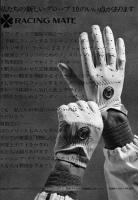
-
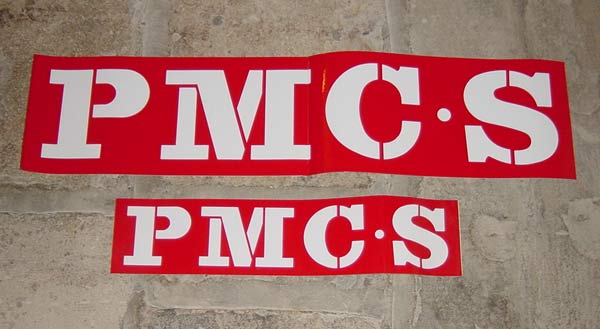
Hi Cuong and Alfadog, PMC.S = "Prince Motor Club. Sports" The Prince Motor Company, like many of the Japanese car manufacturers in the late Sixties, made their race teams like little supporters clubs. PMC.S was formed as the Prince in-house race team, and fans could join the club and get extra benefits at race meetings and regular newsletters etc. When Prince were merged with Nissan, PMC.S became a focus point for sporting Skyline fans in particular. The Skyline factions inside the Nissan organisation kept up the traditions of the club and still used the famous white on red PMC.S stickers on their cars. Even to this day, the GT-R-supporting areas of Nissan Motor Co. are still somewhat autonomous. That's why you still see cars with the PMC.S stickers on them ( especially on the rear quarters of C10 and C110 Skylines ). Alan T.

-
Too much for you and me, even if we club together and share it! The best ones don't even get advertised, but you can find the not so good ones for around 3,500,000 Yen in Japan. I'm waiting for that Lotto win........