HS30-H
Supporting Member
-
Joined
-
Last visited
Everything posted by HS30-H
-
Mr C, Yes, that's the one that ended up with me - but I bought it here in the UK from the people that bought it from EKW all those years ago. See story below. g72s20, I think Ray Broughton's recollections are a good example of why we sometimes need to take a pinch of salt with the stories we get given. They don't entirely match up with the side of the story that I got, and it is fairly clear that he doesn't really understand the model of car that engine originally came from, and that he might be confused about the status of the engine when it arrived in Australia from Japan. I reckon it is fairly clear that it wasn't installed in a car when they got it, and that it had been removed from a car in Japan and sent to Australia as just an engine and trans. The story I got ( and I have little reason to doubt ) was from Paul of Fourways Engineering here in the UK. Paul's mother lives in Australia, and on this particular trip to visit his mother he also planned to buy some used parts from companies such as EKW to ship back to the UK for Fourways' business use ( used Z parts at that time being both cheap and relatively plentiful in Australia, as well as usually in better condition than our rusty English junk.......... ). Paul visited EKW and rounded up a bunch of stuff to ship back. He spotted the S20 engine on a pallet and was told that it had been brought in from Japan with a batch of used engines that were purchased from a dismantler in Japan. Paul called his boss Geoff back at Fourways, and told him about the S20 ( and asked him whether it would be worth purchasing ), the result being that he got the green light and he added the S20 to the other stuff he had bought, and shipped it all to the UK. After it arrived in the UK they never really got around to using it for anything, and it sat dormant literally for years. I spotted it in Fourways' storage barn some years back and asked for first refusal should it ever come up for sale. Eventually I did get that first refusal ( Geoff kept his word ) and I brought it home, but without the transmission - which had disappeared somewhere into the big spares mountains at Fourways. I sourced a proper 'A' type five speed with the correct S20-type bellhousing from Japan ( at no small expense! ) only for the original trans to turn up out of the blue at Fourways when they were having a clear up. Just my luck, but at least I have a spare. The engine and trans had all the hallmarks of being removed from the car in the Japanese dismantlers - most likely from a crashed car judging from the witness marks of impact damage on the offside of the engine. The harness wires, exhaust and fuel lines had been cut through, and all fluids had been drained. A label tucked into the exhaust tube gave a clue to the Japanese dismantler too. Manufacturing date of the engine block ( 2nd November 1969 ) and the engine block number itself gave a clue to the likely manufacturing date of the 432 that it was originally fitted to; clearly a pretty early build - and I find it a fascinating 'what if' to think that the original car might have been possible to repair, but was likely considered uneconomical at their market value in the Eighties. What a shame. I can't imagine that EKW took this engine out of a car themselves ( the evidence I see and hear makes this seem very unlikely ) and indeed they don't appear to really understand what model the engine type was found in. They seem to be thinking of ZGs rather than 432s, and if this engine and trans was actually in a car that they sold separately then why would they have effectively 'chopped' it out so roughly? The story doesn't stack up. Maybe that's just due to the amount of years ago that all this happened? Anyway, after a long process and steep learning curve the engine is almost completely rebuilt now ( just have to reunite the head with the rest of the assembly ). Internally it was in reasonably good order, with no evidence of seizure; the bent distributor shaft was what was stopping it from turning freely, and I reckon this might have been a legacy of the crash that I suspect caused the engine to be taken from the original car. It looks to have been fairly low mileage, but there was a lot of evidence of poor state of tune in the form of severe carbon deposits. All waterways were in excellent condition with no corrosion of the aluminium or iron, but the waterpump body was cracked and the impeller shaft bent ( more crash damage? ). Alternator was smashed ( and early Mitsubishi unit that I wanted to save - but it is sadly fecked ). Crank pulley was also damaged by a big single impact, and needed replacement. I have also replaced the distributor due to its damage. Some parts have been easy to source, and some more difficult - but they have all been too expensive for my liking! I'll take some more photos of it soon to update the rebuild stages in the Gallery. Alan T.
-
If that's the case, I'll have to watch out when I'm ordering a drink or meal at any London bar or restaurant.......... :paranoid: But I'm not guilty on all charges! It wasn't me that got it from EKW, and it was sitting in a very dark shed here in south east England for thousands of years before I rescued it from being a fancy home for mice. At least it went to an honest home, and I must say it is looking fairly spiffy at the moment. Does the idea involve an RB20 head and a large can of Evo-Stik? If so, I might not have one 'available to me' at the moment........
-
Lachlan, Funnily enough, I heard that he was there and was looking for certain things. One of the people he got in touch with is a friend of mine. Small world. He plans an S20 in an S54? Give it a few years and there'll be a thread on here with us all arguing whether this was actually a 'development car' made by Nissan to test the S20 before the PGC10 So is he now 'catching up' with himself re the stories he told three years ago? Or maybe I'm just far too cynical? Yeah, like all those 'Yakuza' who wanted me to chop off my little finger before I was allowed to buy a new distributor cap for my 'Australian' S20 :cheeky: Honestly, some of the stuff that people come up with makes the mind positively boggle, doesn't it?..........
-
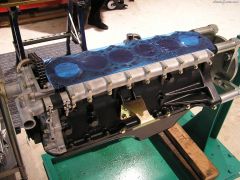 Victor, Rounding it up a little, there would be less than 2,600 engines that were fitted to PGC10, KPGC10, KPGC110, PS30 and PS30-SB sold to the general public. Add a few on for complete crate engines sold as 'spare parts' and then the factory race and development engines, and it looks very unlikely that more than 3,000 were ever made. Hope that helps.
 -
aarc240, I'm not pulling any legs. I don't need to. Who said this car was ever an official Export market model then? Do you know more about it than the rest of us? As far as I am aware, all the 'evidence' presented thus far ( including information and photos sent to me by the previous owner some years ago ) points to its spec as being that of a Japanese market version. The Japanese language servicing / maintenance advice stickers on the car ( which appear to have been there since new ) would appear to confirm that. In which case it would most likely have been registered in Japan before being exported to PNG. The only other scenario I can imagine this car possibly fitting into is that of a 'Diplomatic Sales Office' car, where a car was purchased with certain taxes 'zero rated' via Nissan's DSO office in Ginza, and then exported for foreign use. Even then it would have to be inspected by Japanese Customs officials at the port of export, which would mean that the firewall VIN stamp and engine bay ID tag ( which would also give the engine type ) would be compared to the documentation presented for inspection. Unless of course you think it might have been 'smuggled' out of Japan as contraband goods? You want me to "Get real"? Only a few posts back you wanted us to believe that ".... each ( Nissan ) body was sequentially numbered regardless of the prefix....." I can hear the tune of 'Jingle bells' in the distance, . Talk about teaching your grandmother to suck eggs. Japanese imports and exports ( yes, occasionally including motor vehicles ) are part of my line of work. I can tell you a few interesting stories about Japanese customs inspections and paperwork mountains if you have a couple of weeks to spare. I suggest you concentrate on the car that we are talking about here, and think about it a little bit more about the 'evidence' presented thus far ( weighing up all the possibilities - not ruling out skullduggery ) rather than trying to pick holes in common sense. Alan T.
-
carrott, Do you actually know what you are looking at? At less than 500 made, yes I would call the Fairlady Z432 a "rare, low volume production exotic" actually. It certainly qualifies as such in comparison to most other S30-series Z models.
-
I think the biggest problem with the theory that this VIN stamp could be a simple 'mistake' is that there would have been plenty of opportunities for the mistake to be discovered and action taken. First of these opportunities would have been the big QC check at the factory, and I can't imagine a car with a VIN prefix and spec that didn't match getting through to the stage where it received its first documents and paper 'identity' - let alone being sent out to a dealer and sold to an unsuspecting member of the general public. It would also set off all sorts of alarms as it progressed through the Japanese systems such as first registration ( GT-R was a different taxation category to GT and GT-X, for example ) and local parking permits ( again, GT-R was wider than GT and GT-X - so that would be picked up on ). Servicing at the local Nissan dealer would be another opportunity, and should the car have reached the age where it needed a 'shakken' ( Japanese roadworthiness inspection ) it would surely have been questioned. Lastly, when the car was exported from Japan to PNG the documentation would have been inspected - and a 'KPGC110' VIN prefix with an L20 engine rather than an S20 would have been noted and questioned ( I have personal experience of exporting from Japan, and they are very strict ). Lots of 'ifs' there - but you have to admit the chance of it being a simple 'mistake' that got through all the nets seems remote. The suggestion that Nissan might have 'used up' spare GT-R unibodies on other models also seems to be full of holes: First of all, Nissan didn't have a glut of unsold C110 GT-Rs that caused them to stop making them - they actually made the decision to pull the model because of what you could call 'political' pressure. That is, they didn't want to be seen to be producing such a high performance model during the very sensitive period of what the Japanese call the 'Oil Shock'. This is the same reason that caused Nissan to cancel the projected race programme for the C110 GT-R ( they only produced the two 'Image Cars' - which were standard road cars in drag, and aimed simply at sales hype for the whole C110 range ). So there were not hundreds ( or thousands! ) of 'spare' bodyshells knocking around the factory, and even if there were you would have to imagine that Nissan would re-stamp / alter / rectify the VIN prefixes if they were going to be used on another model. The VIN prefix is a fundamental part of the identity of the car, and without the prefix being appropriate to the spec of the car the body serial number itself is meaningless. We should also bear in mind that a batch of 'KPGC110' VIN-prefixed cars that were not true GT-R models would also indirectly make a nonsense of the 197 real GT-Rs too. So, on balance, I think it looks less likely that it would have been a simple 'mistake', or a case of an 'unused' bodyshell being re-assigned. Which leaves other possibilities......... Well said. I came to the same conclusion without the benefit of being able to see the car in the metal, so I defer to your opinion at the same time as agreeing with you ( if that makes sense! ). The ONLY thing on the car that points to a 'GT-R' identity is the VIN prefix stamped on the firewall ( and not even the body serial number that follows it! ), so in my opinion it is slightly fanciful for some of us to suggest the 'GT-R' connection when all the other evidence against it is so strong. Not wanting to cast aspersions here, but I feel that some of Ray's work on creating this "GT-R clone" is now clouding the issue with regard to its original identity. Things that Ray added or altered are being mistaken for factory spec. Maybe it would be more scholarly of us to think of the car in the spec it was before Ray's ownership when discussing matters of its true identity 'ex-factory'? I remember Ray mentioning that he had an S20 engine that he was rebuilding, and that he was still "looking for some parts" for. I offered to help him with this ( I have a fair few spares knocking around ) but he didn't even tell me what he was looking for. To be brutally honest, I didn't actually believe he had one - but maybe I was just being overly sceptical? I must say, the new owner has ALWAYS been very open, honest, realistic and a stickler for accuracy in his online discussions of these cars. I have every confidence that he will get to the bottom of it, and tell it like it is. He will also most likely turn it into an absolute gem of a car. Good luck to him! :-) Alan T.
-
Mat, I thought I was hallucinating when I first read some of the things written on this thread, so I know how you feel. When I was first asked my opinion on this particular car ( by the previous owner ) I did bring up the possibility that the firewall VIN stamp could have been ( expertly ) "tampered with" by a previous owner some time in the dark and distant past. Not having had the opportunity to look closely at the car in the metal, it is hard to come to an opinion on whether that is the case or not. If I was going to have a close look at it, I'd want to see the reverse side of that firewall panel just as much as the outside face. I believe there is no stamped VIN tag present with the car that would also show engine type, taxation class etc (?). I'm sorry Kent, but you wrote ".....that is what I gather." and you appeared to agree with it. That's the way I read it, anyway. The more people that do that, the more conjecture and inaccurate supposition becomes accepted as - yes - "fact". My intention is not to attack you, just what you are repeating and effectively endorsing. In my opinion, and based on common sense just as much as what we could call 'facts' about the factory KPGC110s, it would be plain daft to believe that Nissan 'used up' spare and unused C110 GT-R bodyshells to make different C110 models, and not change the VIN prefixes on them. Do people honestly believe that thousands of 'KPGC110' VIN-prefixed bodyshells were made? The car in question has a body serial number in the five thousands whilst the known factory C110 GT-Rs sold to the public didn't even make it over three digits - so where are all the others? This car doesn't even appear to have some of the main characteristics of a true C110 GT-R bodyshell - so how can anyone say that it is "....one of the chassis left over from the GT-R production run."???!!! I'm not sure that you understand what I'm getting at? I'm talking about the characteristics of the bodyshell itself, and not the parts that were attached to it. The factory GT-R 'Overfenders' were FRP mouldings that were pop-riveted to the body structure. The rear quarters and inner arch panel pressings of the GT-R were different to all the other models. That's a FUNDAMENTAL difference in the actual sheetmetal of the cars, and the car in question does NOT appear to have the GT-R style pressings and structure ( at least according to the information supplied to me by the former owner ), so how can it have been a GT-R bodyshell? I'm not talking about stuff that was bolted onto the car ( that's a whole other can of worms ), I'm talking about structure. Have you seen a real C110 GT-R with its Overfenders removed? If you have, then you will know what I am talking about. Hold on Brian. I only stated that C110 GT-R production is noted as starting in January 1973. I didn't say that they were all made in January 1973, and I didn't say when production is noted as having finished. I don't see why a true C110 GT-R couldn't have been made in August 1973 or thereabouts - so the build date doesn't really tell us one thing or another, as far as I can see. Alan T.
-
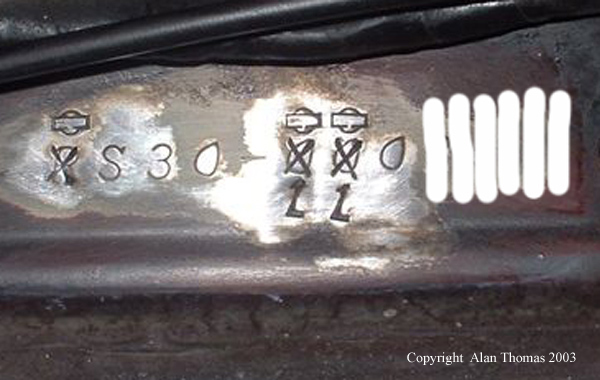
Whoa, whoa, whoa there gentlemen! The facts are getting somewhat forgotten here with some of the excitement. With all due respect to the former owner - and now the new owner - of this car, I'll try to make some objective observations whilst still being polite. Since when did this become a "fact"? Does anybody really believe that Nissan had several thousand C110 GT-R bodies hanging around in a corner of their factory waiting to become something else???!!! Let's get real here, please! The GT-R models ( unlike our beloved S30-series Z range ) were very well documented right from the start of their production run, and the chassis numbers of all the C110 GT-Rs sold to the general public ( and even the ones that were not ) are well known to arch enthusiasts and marque / model experts in Japan. I think you may have been misinformed? The C110 GT-R model had special high-clearanced rear quarter panel pressings that were spotwelded to the inner arch panels, and these are quite clearly visible when the ( FRP ) rear overfenders are removed. I don't believe the car in question left the factory with these rear quarters, and the overfenders seen on the car now are not factory-fitted items. It clearly has a VIN PREFIX of 'KPGC110' - but the body serial number does not conform to the KPGC110 sequence ( it is WAY too high - the C110 GT-R never got past three digits ). The body also seems to lack many of the C110 GT-R-specific details ( especially in the engine bay ) so - let's be clear about this - the VIN prefix on the car doesn't make any sense. I don't know where this guy got his information, but - and I'll try to be polite about this - it is just nonsense. All Nissan VIN prefixes ( certainly in the case of the S30-series Z cars and the C10 and C110 Skylines ) had their own body serial number sequences. Hence we would - theoretically - be able to stand outside the factories concerned and pull out S30-00030, HLS30-00030, PS30-00030 and HS30-00030, as well as GC10-000051, PGC10-000051, KPGC10-000051, GC110-000051 and KPGC110-000051 etc etc. There was no mixing-and-matching of body serial sequences across VIN prefixes - why would there be? How would that make any sense? #005370 is "early" for what VIN prefix series though? I don't get what you are saying here? 'GC110' VIN prefix production started around September 1972, but 'KPGC110' VIN prefix production started around January 1973 according to marque & model expert records ( and Nissan themselves ). Are apples being compared to oranges here? To cut a long story short, all we really have here is an anomalous VIN number and body serial number combination, and a body that was ( reportedly, as it has been greatly modified since then ) factory fitted with running gear and other details that did not fit the VIN prefix. There are a lot of questions about all this, so please let's not kid ourselves that we are looking at a real C110 GT-R here, and let's not take too seriously the idea that somebody could "....resell the car to somebody in Japan for big bucks......". Alan T.
-
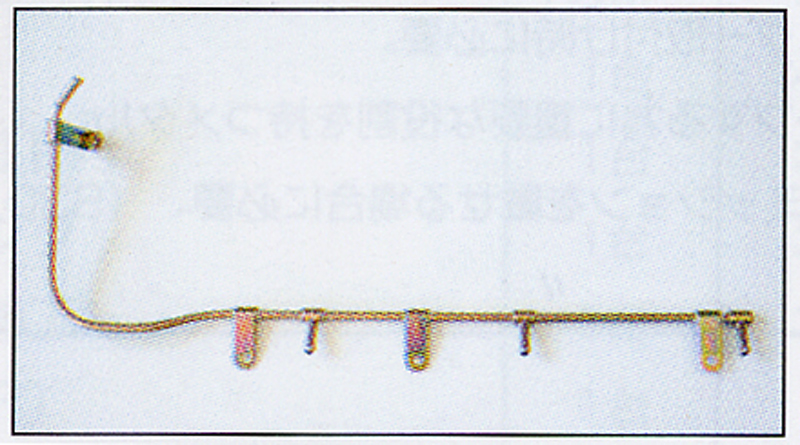
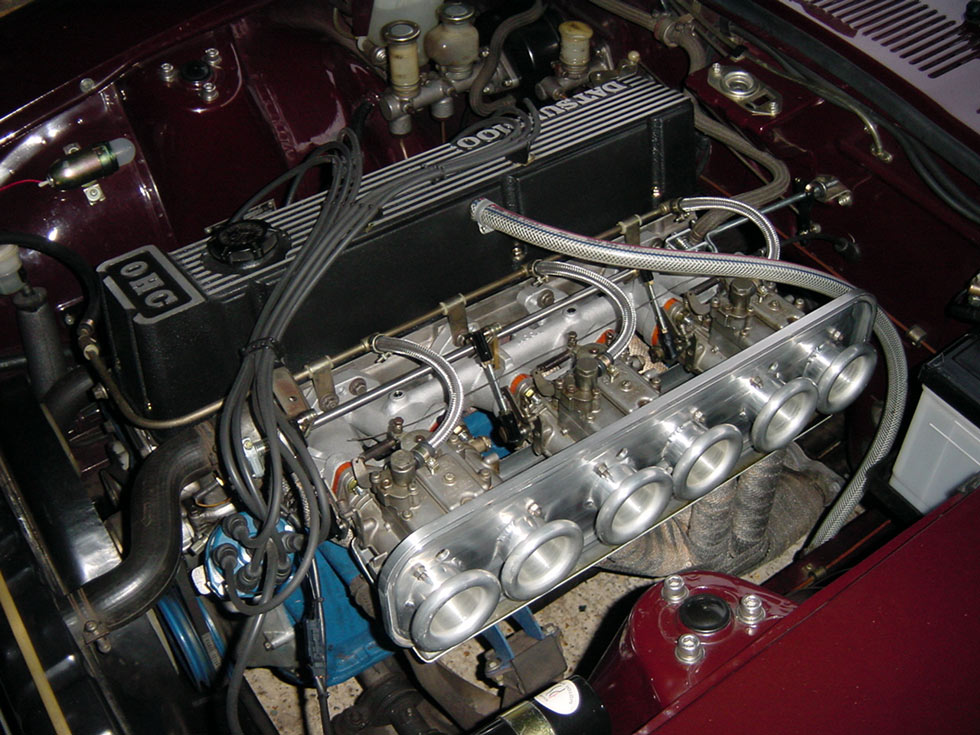
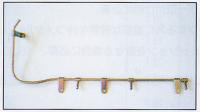
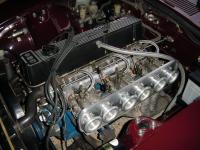
Mike, The original Nissan triple-outlet hard fuel line is still available in Japan - the same one as they used to sell with the triple carb kits. Last time I looked the retail price was around 4,500 JPY or so. I think it is a neat, effective and unobtrusive solution. I use one on one of my cars ( apologies for the crap photo ):
-
Joris, Adrian might not be able to answer you straight away, as I believe he is away racing in South Africa at the moment........... 3023 includes all of the Group 2 & Group 3 stuff as well, and of course some of those parts were shared with Group 4 & even Group 5. As you have found out, the homologation ran out on some parts in period and were therefore no longer allowed. I think I can see the confusion that this might cause, and it might lead you up the wrong path as far as the build and spec of your car. However, I think you might be taking somewhat of a wrong approach to this. In most of the events and series that your car will be eligible to race in, it is more important for the spec of the car to satisfy the scrutineers and organisers of the event than the FIA themselves ( and who would interpret the FIA spec anyway? ). You also have to convince your fellow competitors that your car is not giving you an unfair advantage over them! Most organising bodies will welcome a Group 3, 4 or 5 spec Z with open arms, as it helps to break up the hordes of Porsches and the other 'usual suspects' that make up the majority of the field. They like the variety, so you might find that they are relatively lenient towards you and your car. I think it is the organisers that you need to talk to rather than the FIA, and for most organisers simple proof of 'period use' within the years concerned is enough to keep them happy. I recently assisted in proving period use of 15 inch diameter wheels in FIA-sanctioned events, for example. To be honest it is sometimes better not to go into fine detail on this kind of subject online........... Alan T.
-
Diagnosing carburettor jetting, tuning and setup 'online' is a thankless task! You can't blame people for not wanting to get involved, as there are far too many possible variables that come into play. Having said that, you should be able to get fairly close to optimal jetting on paper if you know the carbs themselves are in good condition and without twisted butterfly spindles etc. First of all, what series of 45DCOE do you have ( series type should be stamped on the top covers ) and do you know their origin? Did they come from another known car / engine ( used ) or are they new out of the box? What size are all your other jets, and the emulsion tubes? Do you happen to know what accelerator pump jet actuating rods are installed ( this should be linked to the series type - that's why I ask )? No disrespect intended, but often these kinds of problems turn out to be due to many things other than the carburettors themselves, or indeed due to inexperienced tinkering............. Final twiddling is always best carried out by an experienced rolling road operator who knows his way around carbs. Unless you are prepared to go through a lot of trial and error it might be best to stump up the cash and take the car to somebody else.
-
 Kats, WOW! - PS30-00088, that's great! And engine number just 7 away from mine. Amazing. The number 8 being 'lucky' in Japan is all to do with Kanji. The best way for me to describe it ( as a layman ) is that the shape of the Kanji for the number 8 is a positive shape, called 'Suehiro-gari' in Japanese. Basically something that is wider at the bottom than at the top has good balance, and signifies that things will get better as they progress. That's my non-Japanese take on it anyway......! Kats, the number 88 always reminds me of Japanese police car numbers. We used to try to avoid them when we went out street racing late at night. It also reminds me of pianos, as full size pianos have 88 keys.........
 -
Kats, Some interesting non-factory variation on this engine (?): S20 factory block paint colour was silver, and engine mounts were painted gloss black with no plating or primer underneath. Three block coolant drain plugs on exhaust side were originally zinc or cadmium plated with gold-passivated finish. Water-pump to head gallery casting hose was typical fabric-covered rubber with wire-type hose clamps.
-
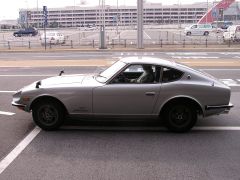 Yoshida san's car is a beautiful example..........
 -
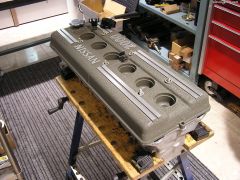
Kats, I think some of the 432 'press' cars were fitted with cam covers that were a different shade to the main production cars - so it is hard to use them as a benchmark...... I always worry about flash photography and early 1970s origination and colour litho printing, not to mention fading inks on 37 year old magazines! PGC10 ( 4 door ) GT-R cam covers were crackle black ( or at least a very very very dark grey ) and Murayama ( works ) competition S20 engines were crackle black. Some KPGC10 ( 2HT ) GT-R valve covers seem to have been a slightly lighter greenish-grey crackle finish, and some KPGC110 can be observed as lighter still. Hard to be definitive on this though. Crackle red was never a factory finish according to my sources of advice ( who should know, given their occupation in the period concerned ) but we see lots of them painted that colour by owners over the years, and by tuning garages such as Ishizaka san's. I think this is 'Testa Rossa' romance! My project S20 engine ( no. S20-000877 ) was originally from a very early 432 ( produced in late 1969 or very early 1970 I'm told ) and lots of the components are dated S44. Valve cover was surely never repainted before I bought it, and it was what I would describe as a 'faded black' crackle finish. I scrubbed and scrubbed, and it still came up blackish dark grey......... but where the paint was covered by brackets and attachments it was pure black crackle underneath. Definitely some variations 'in period' then......
-
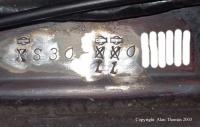
Yesh. Here's one that popped up a few years ago in an unexpected place. Full identity hidden to respect the privacy of the owner:
-
Roger, The only information I have came to me anecdotally, from people employed by Nissan in Japan at the time. One of my friends in Japan says he really wants to get a good UK-market 'RS30' model, to recreate one of Nissan's long lost phantom models: The Nissan 'Fairlady 260Z'. Apparently the problem was most serious on the aircon-equipped cars, and particularly when they were caught up in heavy stop-start traffic during hot weather. Cars were suffering serious fuel vapourisation issues, and dealers could not get a good balance between air-con off and air-con on settings ( the kind of problems that would soon to be eliminated with fuel injection ). They were being forced to make changes that would cause the cars to fail Japan's extremely strict emissions laws ( some of the strictest in the world at that point, I believe ) and a proper cure would have meant a complete re-design of the fuel system and maybe even different carbs. I'm told that Nissan decided to cut their losses, recall the problem cars ( buying them back from customers in some cases ) and fit them with L20A engines instead. The bulkhead VIN stamps were altered to suit, and new metal VIN plates attached to the inner wings ( fenders ). The L20A engine design already had a few years of development and production under its belt ( in a wide variety of models ) and didn't suffer from the same issues as the L26 in the Japanese spec. As I mentioned before, this was not highly publicised by Nissan and the whole issue was somewhat covered up. I still have never seen a Japanese service bulletin or any other Nissan-sourced document that mentions it. I think only a few hundred cars were affected. I think the spec of the domestic L26 concerned would have been different to the export spec L26 ( different carbs and more emissions equipment at least ) so that's why they treated them differently. I don't know the full ins-and-outs of the story, but it is an intriguing story. I would have thought that they would need to change emblems on the cars that were sent back out ( re-badged as 'Fairlady Z' models instead of 'Fairlady 260Z' models ) and this - along with the re-stamping of the firewall VIN and the engine change - might even have made it necessary to repaint the cars. And like most of these kinds of story, it is difficult to pin down the truth, the whole truth, and nothing but the truth. I think Nissan would probably prefer us not to know! Alan T.
-
I'm not sure I quite understand your question. Body serial numbers don't mean anything unless they are linked to a prefix that identifies the model type being counted. Seeing as the '2+2' ( '2/2' in Japan ) is a completely different body type to any of the 2-seater models, it stands to reason that they wouldn't be counted with the same body number sequence. It is the MODEL VARIANT PREFIX that is being counted. So - in your local market case, for example - you could theoretically have had 'RLS30-000260' ( a 2-seater '260Z' model ) and 'GRLS30-000260' a 2+2 '260Z' model ) parked side-by-side in a dealer's showroom. You're missing the point about the full VIN number on your '71 '240Z' model. The body serial number on that particular car is part of the sequence that counts 'HLS30' bodies, and nothing else.
-
And that post is one more reason to think that 'DRBall' is a xenophobic simpleton.
-
You might want to try and replicate the original pieces, which had a lip on them ( for added strength I think ). The outside one had a distinct 'ear' on it to clear the sill seam. Crap photo ( apologies ) attached below to illustrate: If you're coming to UK in June you'll want to see Kevin & Gary's cars I should think? I'll see what I can arrange for you.

-
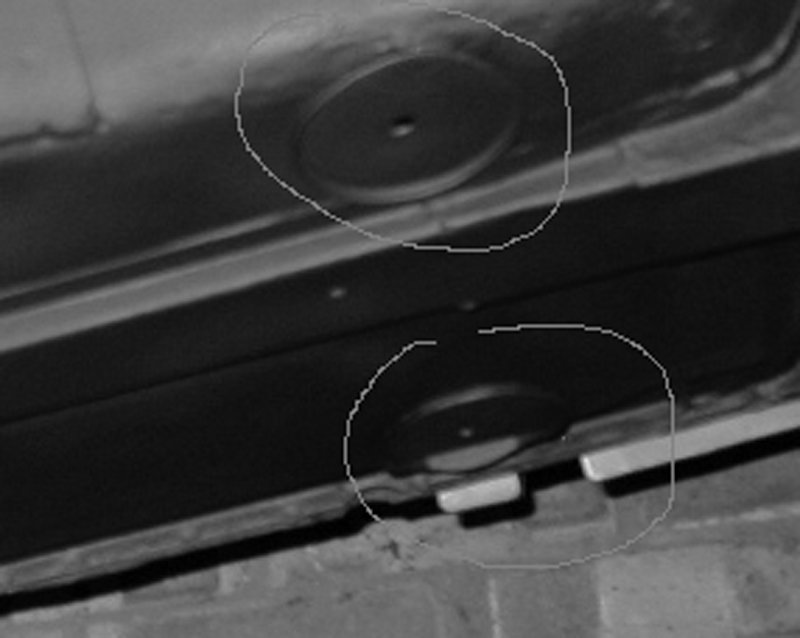
Have you got the attachment point strengtheners that were welded to the floor on cars that were equipped with the passenger footrest from the factory? Those are the most difficult bits to get in my experience ( for obvious reasons ). I've got a spare footrest if you need a better one........?
-
The 432 had a steel bonnet ( hood ). I think you are getting it confused with the 432-R, which had an FRP bonnet. The car you pictured above is a genuine 432-R, and the pictures were taken at a temporary display on the ground floor of Nissan's main showroom in Ginza, Tokyo ( not a museum, unfortunately ). The car on eBay has a slightly confusing description. As it has an 'S30' VIN prefix it obviously started life as either a 'Fairlady Z' ( S30-S model ) or 'Fairlady Z-L' ( S30 model ), and I'd say it was more likely the latter given the evidence of what remains from the original spec. Therefore any mention of '240Z' is inaccurate, as it is clearly neither an Export model 'Datsun 240Z' or one of the domestic market 'Fairlady 240Z' models ( 'HS30-S' / 'HS30' / 'HS30-H' etc ). I'd like to hear the full VIN / body serial number combo to date it properly.
-
No, the F5C71-B transmission was a DIRECT FIFTH gear unit, with a 'Dog Leg First' shift pattern ( nicknamed the "Low Back" in Japan ) as First gear was selected in the same plane as Reverse gear - with Second, Third, Fourth and Fifth in the normal 'H' pattern. This was not an Overdrive transmission. Don't get it mixed up with the FS5C71-B ( note that extra letter S in there ) which was an Overdrive trans, and with a conventional shift pattern. Carl, What look like small numerical differences in overall gearing on your chart actually - in the opinions of many - translate into very noticeable differences in the hands-on driving experience. I don't think legal speed limits have very much to do with it to be honest. If they did, the designers might just as well have given us all two speed trannies........ I've seen you mention before that you think the five-speed transmissions fitted to non-USA market car were to make up for a lack of power, which is curious when you consider that all other market models had a five speed available from the beginning of production and sales. The fact is that the HLS30-U models were given the 4-speed trans as standard equipment because it was part of the cost-cutting effort and effective 'dumbing down' for one market sector, and a perceived image of the potential customer base of that period.
-
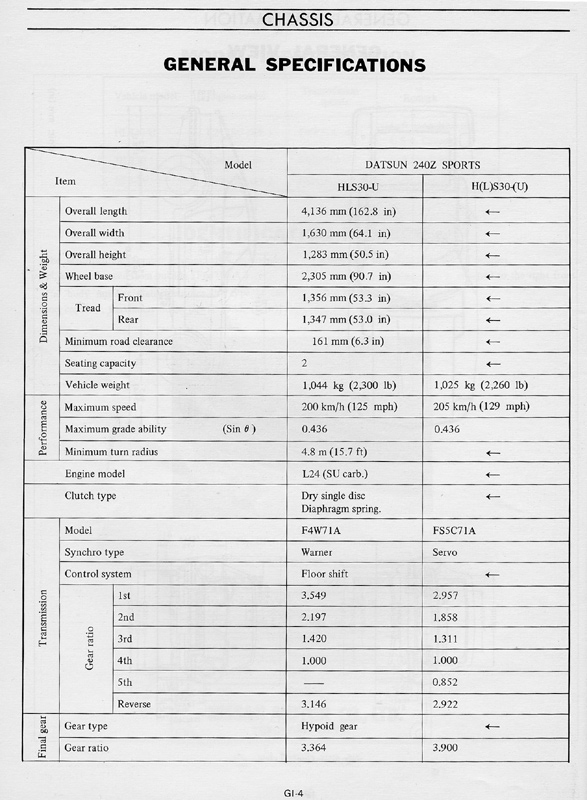
Arne, I believe the R&T magazine data would refer to the HLS30U models when equipped with the FS5C71-A ( as an "option" ), no? I have a 1970 FSM ( this particular edition primarily aimed at the HLS30U models ) and it clearly states the 3.9 diff ratio to be paired with the FS5C71-A. See the attached scan: The 3.9 diff ratio is a nice pairing with the FS5C71-A transmission ratios, and I never understand why some people who purposely select a sports/GT car would seem to be so frightened of using peak revs and staying in the power band for longer. Curious.