


HS30-H
Supporting Member
-
Joined
-
Last visited
Everything posted by HS30-H
-
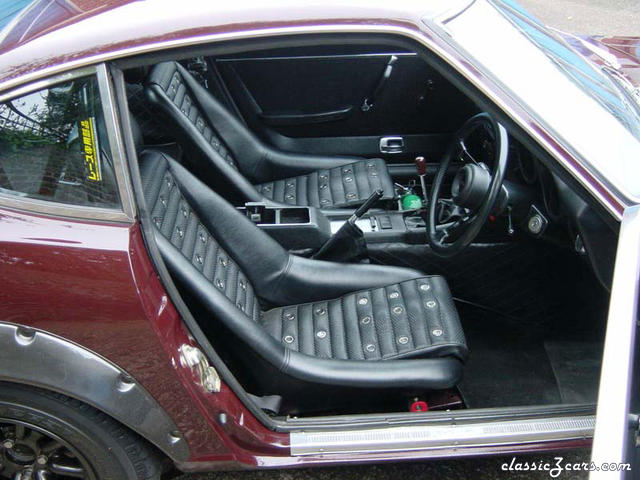
From the album: Fairlady 240ZG ( HS30-H )
1972 Fairlady 240ZG ( HS30-H ). Owner: Alan Thomas, London, UK. Interior - U0175 Datsun Bucket seats, Datsun Competition steering wheel, Rally gear knob, etc. -
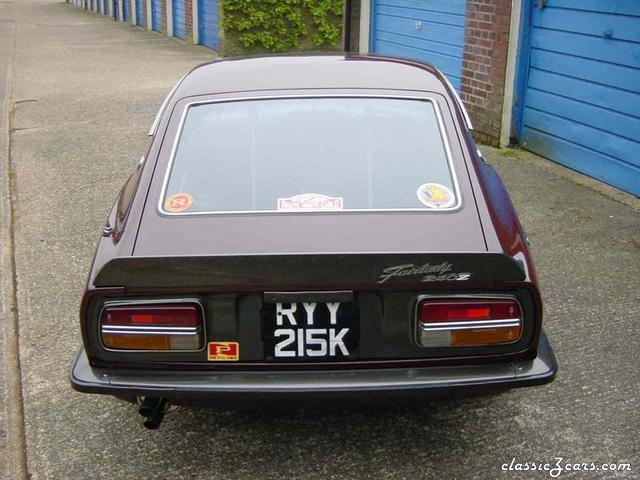
From the album: Fairlady 240ZG ( HS30-H )
Fairlady 240ZG ( HS30-H ), owner: Alan Thomas. London, UK. Rear shot. -
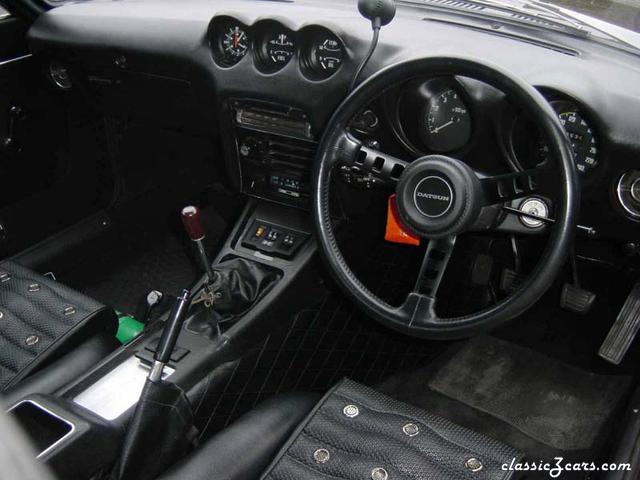
From the album: Fairlady 240ZG ( HS30-H )
Fairlady 240ZG ( HS30-H ), owner, Alan Thomas, London, UK. Interior - "Datsun Competition" steering wheel etc. -
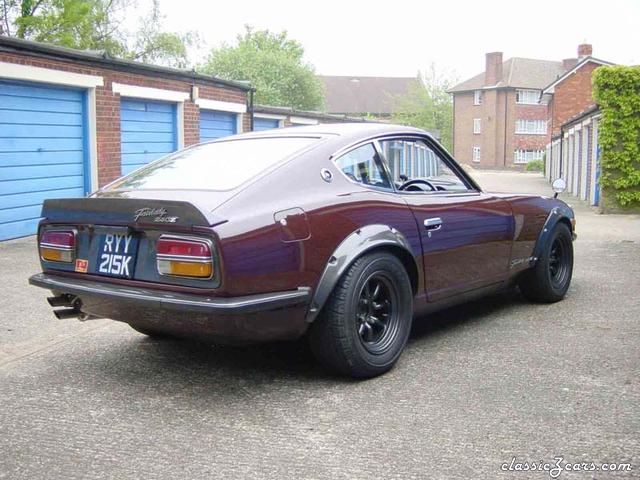
From the album: Fairlady 240ZG ( HS30-H )
Fairlady 240ZG ( HS30-H ), owner: Alan Thomas, London, UK. -
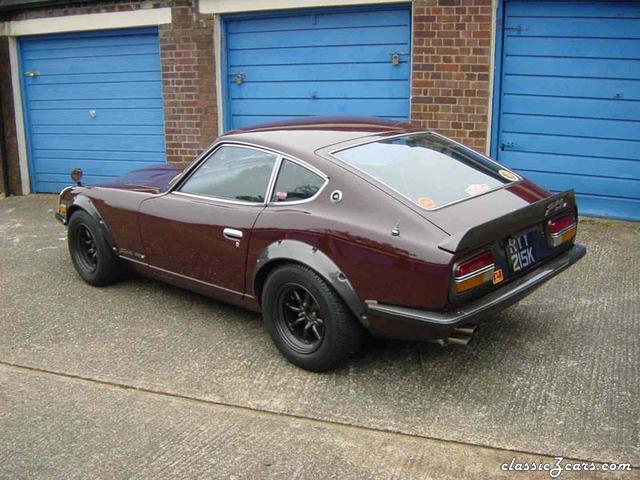
From the album: Fairlady 240ZG ( HS30-H )
1972 Fairlady 240ZG ( HS30-H ), owner: Alan Thomas, London, UK. -
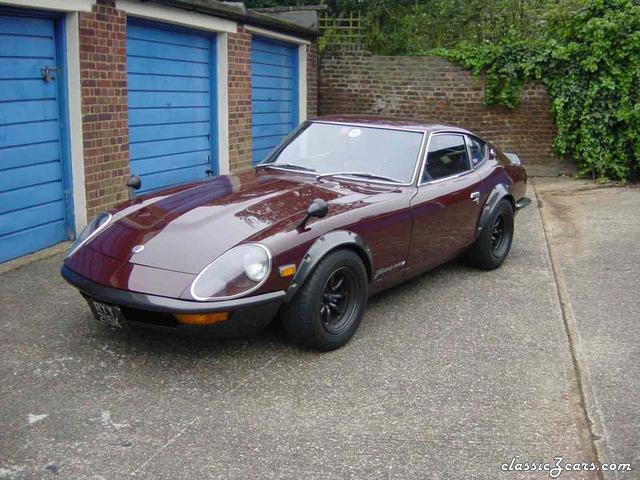
From the album: Fairlady 240ZG ( HS30-H )
1972 Fairlady 240ZG ( HS30-H ), owner: Alan Thomas, London, UK. -
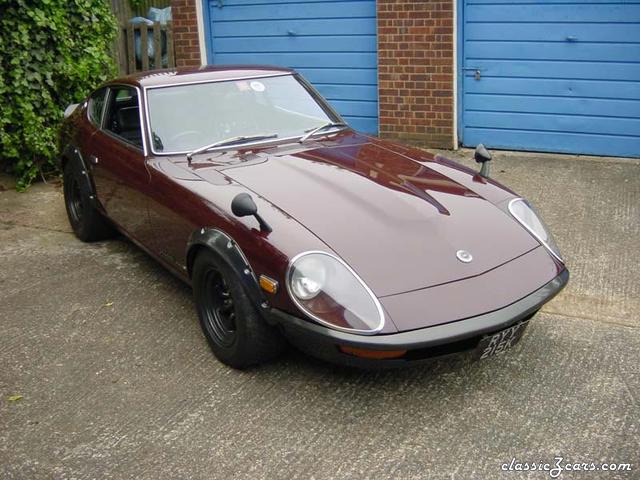
From the album: Fairlady 240ZG ( HS30-H )
1972 Fairlady 240ZG ( HS30-H ) - owner, Alan Thomas. London, UK. -
Oh, and another thing. You might be surprised at the prices that good Z cars change hands for in Japan. There are a real lot of mid-market cars that are good condition ( because of their strict "shakken" test ) and the prices are not too bad. Buying from a dealer is more expensive, and if buying for export you can get a much cheaper deal than you might think. However, it seems that you have quite a low local market value for the Z in Australia ( am I right? ) and it might look expensive in Japan if the exchange rate is not so favourable. However, you are at least closer to Japan that I am here in the UK! If you want a 432, there are still quite a few on the road in Japan. I drove two last year, and they are not all that fast of course. However, with the five-speed that has closer ratios, and the 4.44 LSD, the car is really well balanced and is GREAT fun to drive. The flavour is all there, and having a little six that is happy to spin up to 8000 rpm is really a treat for the senses ( especially aural ). Trouble is that the cheapest 432's change hands around the 4,000,000 Yen mark. Don't know what your $AUS to Yen exchange rate is, but its bound to look expensive to you ( and me.... ). Prices are going UP, not down. Dream on......... eh? Alan T.
-
Hi Alfadog, WHO told you that the Japanese aren't into keeping old cars? I used to live there, and there is a MASSIVE classic car scene there. I think the misconception comes from seeing that the Japanese have very low market values for cars that are three or four years old. At that point, it is simply cheaper to trade in for a new model, and consequently the unwanted but still by our standards good low mileage cars filter down into the used car export market at very low prices. I well remember seeing Russian trawler ships in the northern ports hoisting K-cars onto their decks ( and piling them two or three deep! ) to take home to Russia. The sailors bought them locally for peanuts ( de-registered, and with no papers in some cases ) and would sell them at home at a profit. Most of the more desirable models filter out into the Japanese rural areas, where people are generally less affluent and hoover up the slightly out-of-fashion stuff that is a few years old. Hence after a few more years, when things become "neo-Classic" like the R32 GT-R is now, people go out into the "sticks" to find them. In this way a real lot of old stuff has survived. You would not believe the amount of 60's and 70's cars that are lurking in the countryside - most of them cherished by their owners.......... I would consider writing a book if I thought I could do a good job and it would be popular. However, I probably could not ( too many brackets! ) and it would NOT be popular, as I would tend to veer towards the historical aspect of the domestic Japanese race scene of the late 60's and early 70's. That would be what they call "Vanity Publishing"..................... My cars here in the UK ( London ) are slightly unusual. The main one is a 1972 FAIRLADY ZG ( HS30-H ) that is the only genuine factory-built ZG in Europe. I have owned it for about 5 years now, and it is constantly having parts changed on it; I have a fetish for early 70's Sports Option and race parts, especially factory race parts, and it has quite a few special bits on it now. Most of them are under the skin ( adjustable suspension with rose-jointed compression struts and TCAs, F.I.A four-pot ventilated brakes, LSD with cooler pump, triple Mikunis, Rally cam etc ) and some of them you can actually see ( Option roll bar, Datsun U0175 "Bucket" seats and "Compe" steering wheel ). I even like period stickers, and find that they are the most effective method of making the car go fast.......... The other car is a long-term project ( because money comes in slowly and goes out fast! ) - its an early 1970 Japanese-market S30 model that I am mutating into a Z432-R "Replica", with an S20 engine, Ikeda Bussan factory race seats, Kobe Seiko wheels, 100 litre fuel tank etc etc. The body is now in the paint shop ( 920 Gold - one of the original Z432-R colours, which I love because so many people hate; even in Japan they call that colour "unchi" - which means s**t coloured ). The challenge is to make something that looks and sounds unusual, but is "period correct". There does not seem to be any point in making a 432R replica with an L-series engine. The S20 engine is rather expensive and even more expensive to get big power from, but its all about "flavour". I don't have a website or anything, but I could mail you some photos if you are interested. Australia seems like a bit of a Happy Hunting Ground for cool Z cars and parts. Is that true? I have heard about parts over there that I would be shocked to find over here. My posts always end up so long..................... All the best, Alan T.
-
Hi Alfadog! Sure. I don't mind getting a chance to preach the Bible!...... ALL the "Export" version right hand drive cars from year dot had five speeds - so that's why your official Australian-market car had one from standard. All these cars had the chassis type "HS30" ( the "H" prefix before the base model type "S30" denotes that it had the L24 engine, and the lack of the "L" prefix between that H and the S30 denotes that it was a right hand drive ). These "Export" ( i.e. non-Japanese home market ) HS30's were made from early 1970 ( they only made home-market PS30, PS30-SB, S30 & S30S types in 1969, apart of course from the USA - aimed HLS30 cars ) and that is why some of the RAREST SURVIVOR variants of the S30 Z car are the early 1970 HS30 types. Very few of these were made in the first year of production, and you got the bulk of them down there in Australia ( you lucky dogs! ). So, ignoring all the brackets and other stuff in the above paragraph, all Export-version RHD cars had five-speeds and most of them had the 3.9 diff. ratio. As the game designers are Japanese, they tend to design the games according to what was locally available. However, they are not necessarily up to speed with all the correct info. from 30 years ago - so they can make mistakes. I noticed a "Fairlady Z" crop up in my GT2 game that had a G-nose on it. This would have to be a "Fairlady 240Z" and the H suffix variant at that, if it were a true factory-built ZG. In October 1971 the Japanese "home" market also got the chance to get the L24-engined variant HS30's ( previous to this, only two-litre L-series engined Fairlady Z and Z-L S30 and S30S types, and the S20 twin-cam engined Fairlady Z432 and Z432-R PS30 & PS30-SB were available in the Japanese home market ). The 2-litre cars were still available, but a whole new addition of L24-engined cars ( badged as "FAIRLADY 240Z" ) became available. All of these had five-speeds and a choice of diff. ratio, and included the Fairlady 240ZG ( HS30-H ) which was a limited-production model intended to homologate aerodynamic body parts that the factory wanted to use for racing. From October 1971, the most expensive model in the Japanese home market was the automatic-transmission equipped version of the ZG ( the HS30-HA ) - which incredibly was more expensive than the S20 twin-cam equipped Z432 ( PS30 ) which was still listed up until 1973! For my money, the Japanese home-market cars have always been the most interesting. They had so many more variants, and many of them, especially after late 1971, had better specs than the "Export" versions. They also had an absolutely astounding factory Options and Sports / Competition parts list available to them. Most Z owners outside Japan do not realise how extensive these lists were, and the books on the Z that are written in English very rarely seem to get it right. They almost always dismiss the Japanese home-market cars as some inferior base-model ( mainly because up to Oct.'71 they could only get 2 litres ). At the risk of starting a whole new thread, ( and probably a small nuclear war! ) I will say once again that in my opinion the USA-market export version HLS30 was a mass-produced "basic" model that was specced down for that particular market to keep prices low. Even the European export version HLS30 types had a five-speed transmission. It seems plain that the S30 series Z was DESIGNED as a RHD car, and that the LHD versions were something of a compromise ( check out that handbrake location ). I am now retreating into my nuclear bunker. Yours etc. Alan T. ( HS30-H ) ( "I love brackets" )..............
-
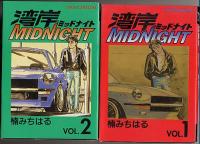
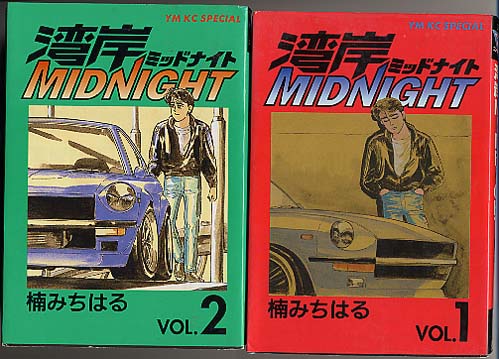
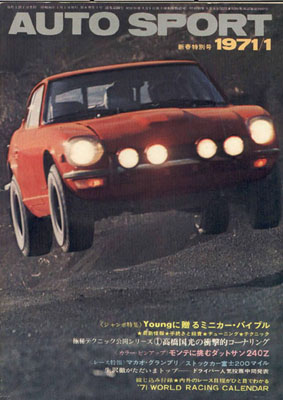
Yes, this is an advertisement for a new game for the PS2. It is based on a "manga" ( Japanese comic ) series from the early 90's called "Wangan Midnight", which was published in a series of small paperback book-style episodes by "Yanmaga" ( Young Magazines ). The "Wangan" is the nickname given to the Tokyo Bayshore Route motorway which curves from Yokohama right round to Chiba, and has always been popular with street racers since it was built. There are very many comics and animated videos that use the street racing theme in Japan, but they are all rather childish and the drawings in the comics themselves are rather basic ( because of the quantity in each episode and the amount of episodes they pump out ). The stories leave rather a lot to be desired too. The animated version is rather better, and the game should be better still - but I doubt if it can play better than the mighty GT3 on PS2.... Here is a scan of a couple of the original books;
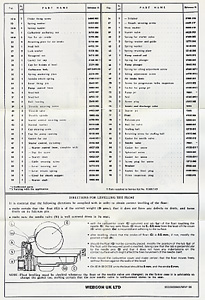
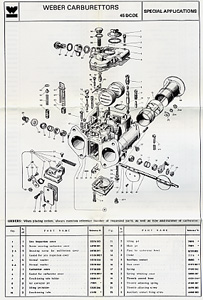
 Hi WESUK, If you live in Swindon I suggest you go around the back of the HONDA factory and have a look at what they have in their dumpsters. You never know, you might find something interesting! Joking aside, tell me what series carburettor you have and I will have a look in my garage at the weekend ( I keep my cars and parts 10 miles from home, not because I want to - but because I have to ). You will find the "series" number written after the type of carburettor, stamped into the casting on the top cover of the body. EG: "40 DCOE - 18" - in this case "18" will be the "series" number of the carburettor, and signifies the internal passageing / circuitry / standard jetting / pump stroke etc etc. Technically, most of the actual top cover castings will interchange on the 40 DCOE ( apart from the later "emissions" type ) - but you will want to have the right one on it if you can. Like ERIC B - let me know what you have got, and I will have a dig in my garage. Good luck, Alan ( HS30-H )Hi Eric, Glad you already had the parts diagram. Just wanted to help you identify the pieces that you have. Here are the jet sizes etc. that I used on my mildly modified L24 with 40 DCOE-18 carbs ( 176 BHP at the wheels - not bad for standard valves and no porting ): *CHOKES = 32mm ( 30mm also OK on such a small engine, as you need to promote good airspeed at low RPM for good off-idle performance and good driveability ) *AUX. VENTURI = 4.5 ( standard on most 40 DCOE carb series ) *MAIN JETS = 115 ( leaner is better - those 130s are too big ) *EMULSION TUBES = F2 *AIR CORRECTOR JETS = 175 *IDLE JETS = 0.50 F9 *ACCEL. PUMP JETS = 0.45 *ACCEL. PUMP INLET / DISCHARGE VALVE = 0.5 *NEEDLE VALVES = 1.75 *ACCEL. PUMP STROKE = 10mm That accelerator pump rod stroke is very important for the "driveability of your car on such a mildly tuned engine. Make sure that it is right and you will certainly find the car easier to use. Looks like some of your data already matches with this - so you are half way there. I would recommend a final "rolling road" dyno session to get the jetting spot on. If you can find out the series number on the carb top, I can have a look in my garage and see if I have a spare top that I can send you to replca that damaged one. Good luck. Alan.And here's the other side;
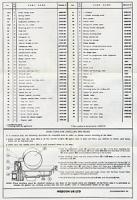 This might be of help to you;
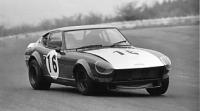
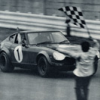
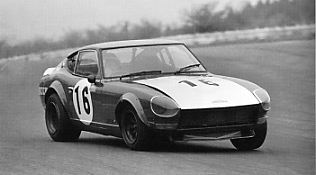
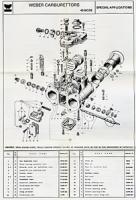 Hi Eric, I can see what you are up against, and I have been there myself! I too bought some carbs on the vendors' description, only to see an archaeological artifact from the Dung dynasty turn up in the post........... That broken part in your picture is rather serious. This is the mounting for the float pivot, and it will be difficult to repair properly. If you get it welded, the welder will need to be very skilfull and you will need to re-drill the hole for the float pivot spindle. Tell me what series the carbs are ( there is a number on the top cover of the carb after the bit that says "40 DCOE" ) and I might have a suitable spare body of the same series that you can swap all your internals on to. It is most important to get the same series, as all the internal drillings etc. are different for the different series. Restoring the carburettors properly is like restoring vintage wristwatches. It is not easy, and you really need to have all the information and tools to hand. At least you CAN get all the parts OK. There are plenty of specialists in the USA - have a look in a magazine like Grassroots Motorsport for a supplier. The round jet covers are not expensive, and a nice new set of three will make the carbs look much better. The "wing-nut" top cover fasteners are made of brass, and are also still available. As to the emulsion tubes and jets - I would not put too much effort into cleaning them until you are sure that you are in the ballpark for your own engine. What were the carbs on before, and what are the currently-fitted emulsion tubes, main jets and air correctors? I can give you some baseline data for a stock-ish L24 with cam and muffler if you think it would help. You might end up needing new jets, in which case there is no point in scrubbing up the old ones. Certainly you should avoid poking any orifices with wire ( or get ready to see a doctor! ) as you will damage them for sure. I would also pay attention to the accelerator pump rod stroke - which is very sensitive on this kind of carburettor and can change the driving characteristics completely. The "series" of the carburettor will tell you what was fitted in them from the factory, but not necessarily what is in them now ( somebody might have changed them ). These are all still available anyway. Tell me what "series" they are and I will have a dig around and see if I have a spare body for you. I know I am a long way from you, but it might be easier in the long run.............. All the best, Alan ( HS30-H ).At the risk of starting a whole new thread, here is a picture of what I am REALLY interested in. This is a picture of Works driver Kenji Tohira at the 1971 Japan Grand Prix in the GT race ( in the GT-2 class ) in a Works ( SCCN ) HS30 "Fairlady Z". Just in case you heard that the Z was not very successful in domestic races.....................
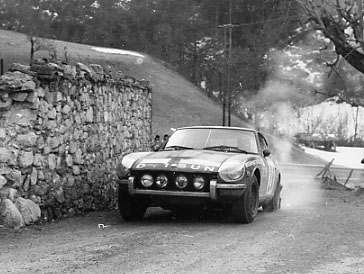
 Hey sennavsprost! your avatar is going to start some new threads if you are not careful! Did you know that the no.15 car still exists? It's part of the Harada Collection at the Kawaguchiko Motor Museum in Japan, and they sometimes bring it out for demonstration runs. That S20 engine just screams............. Here's another little scan on the thread of our Works rally car discussion. This pic. shows a Works car at Nissan's rally test course in Japan. They did a fair bit of simulation out there before they sent the cars out of Japan for the rallies..........
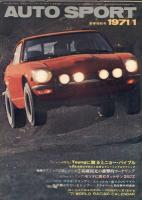 Thanks for the kind words from EricB & sennavsprost - its nice to know that its not just a few demented idiots like me who find this interesting. Doehring, you have collected a fair bit of data about those Works rally cars. However, I keep hearing about more and more little events and testing that we never heard about. Sometimes the Works team would ship cars back to Japan after a few events and refurbish them, after which they would be brought back to Europe, Africa or Australia to act as practice cars / chase cars, or as entries for local drivers. As far as I am aware, Nissan have never released to the general public any information regarding the chassis numbers of the Works rally cars. The local team base organisers ( such as Old Woking Service Station in the UK, and D.T.Dobie in Kenya ) would obviously know which chassis numbers they had at any particular time, but I should think that only Nissan's Competition Department staff themselves would have all the data about which chassis did which event. There is a lot of misleading information in the English-language books that cover the subject of Nissan's competition history. We cannot trust all that we read, as it usually has not come from the horse's mouth. I would have thought that there is an opportunity for the definitive book on the S30 type Z race history to be written, but any volunteer would have to do a hell of a lot of research! By the way Doehring, did I make it seem as though I thought that some of the Works rally cars used the S20 engine in my previous post? Sorry about that if I did - but certainly the Works rally cars only ever used the L-series sixes ( with the later ones using the "LY" Crossflow version ). What I was talking about was the similarity of the Z432-R ( PS30-SB ) bodyshell to the shell construction of the Works rally cars. That is something that few people realise or comment on. Here is an "on-line" present for Guus...........
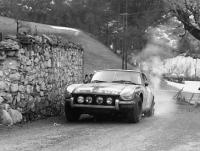 Hello Doehring, We are probably getting nearer the truth now, and it seems that we are uncovering a little bit of creative resourcefulness on the behalf of the '75 Le Mans entrant ( commonly known as "cheating"! ). The car at Le Mans in '75 was wearing a Japanese registration plate with the numbers "6466" which was originally on a LHD 260Z Works Rally car that never competed in the Safari Rally. If the car was in fact an ex-Works Safari Rally 240Z, then the "6466" number must have been a switch....... In my experience, if somebody is talking about cars that have some Works competition rally history then they almost invariably say that it is "ex Safari". If you added up all the cars that were "ex Safari" it would probably come to a couple of hundred! I think that this happens because the Safari Rally was one of the Z car's most successful events. They won outright twice with the Z, and that tends to get remembered better than a third on the Monte Carlo or even a win on the Welsh Rally................ I think it seems to be becoming clear that the Japanese registration plate that the car was wearing at the '75 Le Mans should not have actually been on it. The car that entered Le Mans in '75 may well have been an ex-Works Safari Rally 240Z that Hans Schuller sourced from the Works rally team, but they obviously needed to have some kind of identity switch because of homologation and eligibility rules. I think this must be why they gave it the Japanese registration number ( and presumably some paperwork to back up the identity was shown to the ACO ). If that '75 Le Mans car was indeed an ex-Safari Rally car ( it was certainly not one of the two that won the event, as they are both still extant and belong to Nissan in Japan ) then it would have led a very interesting and varied life! That would be another statistic for the record books; Safari Rally AND Le Mans history! All the best, HS30-Hand here's the other page: HS30-H
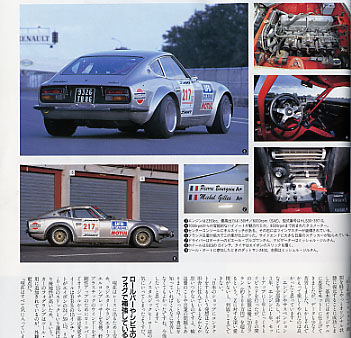
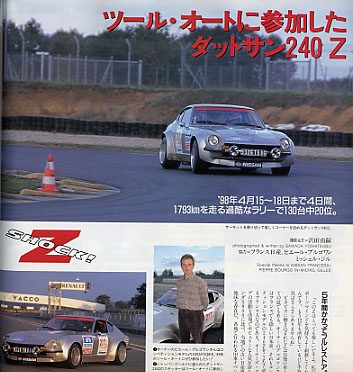
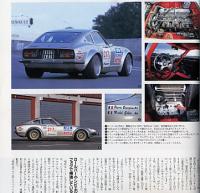 Fred! Don't worry too much about checking out that car at the "Le Mans Revival" event on Saturday. When I saw the photos that you posted ( the silver car ) I realised that I had seen this car before. It was featured in a two page article in the December 1998 issue of NOSTALGIC HERO in Japan. In the article, the owner ( Mr Pierre Bourgoin ) describes it as a genuine "Competition Model" - but he does not say that the car was actually the one ( or ones? ) that ran at Le Mans in '75 and '76. What he says is that the car used to belong to Mr Andre Haller, the entrant and owner of the '75 and '76 Le Mans entries, and was the "sister car" to the one that crashed at Le Mans in '76 - sadly killing Mr Haller. He says that his car ( chassis number HLS30-39710 ) is a 1971 model car - one of two that were imported to Germany in 1972, and then brought to France presumably by Mr Haller. So, in this article he is not claiming that his car actually competed at Le Mans - but he IS saying that it is a "Competition Model". This seems to be a rather fanciful claim, as the only "Competition Model" S30 cars that were brought to Europe in the early 1970s were the factory "Works" Rally cars. These cars were based on special bodyshells that incorporated many design features and details from the PS30-SB ( 432-R ) and were in fact a kind of hybrid 432-R with an L-series engine and the special parts for Rallying. The Works circuit-race Z cars in Japan were initially based on the 432-R ( with the S20 engine ) and within a year they had partially switched to the the L-series engined cars, but still using many details from the PS30-SB bodyshells. These cars were called "240ZR" by the factory, and later developed into the Group 4, 5 & 6 racers with the full aerodynamic kit and the "LY" Crossflow engine on injection. I don't know what Mr Bourgoin thinks makes his car a "Competition Model" - but perhaps he is under the impression that the car is something that it is not. As far as I can see from the article and the photos, the car does not seem to use any parts that would identify themselves as "Works" competition parts - let alone have the special body of an ex-Works Rally car or factory circuit race car. It even seems to have the normal S30-type fuel tank ( and none of the Works competition cars were fitted with those ). It does have Mikuni carburettors - but then so do many cars. These were available from many many sources - and Sanyo even offered a kit to fit them on the car when it was launched in 1969. Perhaps Fred you should ask Mr Bourgoin what the history of his car is, so that you can hear it from him in person. If you have heard that this car is one of the cars that ran at Le Mans, and it is just hearsay, then all well and good. However, if Mr Bourgoin is claiming that his car IS one of those cars - then he needs to prove it. It seems to me that anyone doing this would need to make sure that he knew ALL about the factory race cars and the parts that they used, otherwise he would come unstuck very quickly. Even calling your car a "Competition Model" needs qualification, if the person saying it is inferring that it is some kind of official factory-built or sanctioned model.................. We must all be careful of people who might be interested in talking up the history of their car in order to make it worth more money, or fooling people who don't know any better.We should share information to make us better armed to fight against bogus claims and fancy stories. Here is a scan of the article about the car; All the best, HS30-H
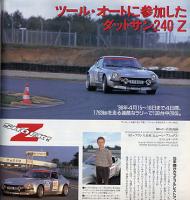 Fred! Don't get stressed out about this, I only wanted you to keep in mind some of the points that might identify the car. However, having seen the pictures from the "Tour Auto" in France I actually recognised the silver car from an article in a Japanese magazine a few years ago.I think it was in Nostalgic Hero or Old Timer, and I seem to remember them pointing out that it had a doubtful history in the article. I think I can say that the silver car is almost certainly NOT the car that competed at Le Mans in 1976. The owner might think that it is, or have been told that it is, but I am sorry to say that it is very unlikely. You will notice that the silver car seems to be LHD ( when the '76 Le Mans car was RHD - I think I am right in saying ). I also think that this silver car is a "240z" base, rather than a "260Z". It seems to have no FRP or GRP "Works" type panels on it ( bonnet / hood / hatch etc ) and the roll cage does not look correct. It also seems to have lost its fuel filler in the rear hatch and the acrylic windows. I have no idea whether it has a "Flat Floor" and a big fuel tank - maybe you will be able to investigate it. I really think that it is not the '76 Le Mans car, but there is the small possibility that it could be the '75 Le Mans car ( if the '75 and '76 cars were not indeed the same car ). It also seems very unlikely to be the remains of "6466" either. I guess we have to reserve ultimate judgement, and there is also the chance that it DOES sport some parts from the Le Mans cars or what was claimed to be "6466" - but it seems so far away from the specification of either of those cars that I have to say it seems very unlikely to be any of those cars. What does the owner claim it to be? Isn't this great??!! ( hey, wake up all you others!.... ) Best regards, HS30-HHi all, This is turning into a really entertaining and informative thread isn't it? Its a bit of archaeology, and much more interesting than all those "How fast will my Z go if.....?" threads isn't it!? Rodd, I like your paint job - and your car looks nice and "simple". Really pure and nicely in period feel. Nice one. Doehring, Sorry to hear that it rained for your holiday. Two weeks ago I was in Italy and it POURED down with rain every day. There were really bad storms over the whole central European area, and I got really wet. Best if you stay at home and stay tuned to this thread - its looking quite good. Fred, sounds like you are on an exciting mission to see what claims to be the '76 Le Mans car this weekend. I think that you might like to get a good look at as many details as possible, but particularly these; CHASSIS NUMBER ( is it an RS30 or an RLS30, or is it an HS30 or HLS30? ). As I mentioned before, "6466" was definitely an RLS30 chassis number - a Left-Hand-Drive European-Spec. "260Z". Strangely, the pictures of the '75 Le Mans car in period show a RHD car with the back end ( tail lamps and back panel / trim ) from a "240Z". This makes me think that it was not the same chassis as the Works Rally car chassis that the number "6466" was originally placed on. Of course, you are going to see what claims to be the '76 Le Mans car - which I guess does not necessarily have to be the same car as the '75 Le Mans car - but in my personal opinion I think they used the '75 car in '76 too. ENGINE - this does not prove anything, but as far as I am aware the original engine on "6466" was an "LY" Crossflow, and possibly on the Nissan "ECGI" injection system. I believe that when the car passed into the hands of privateer rally driver Chris Sclater he used it with both the original engine and then a more normal L-26 bored up to 2.8 or 2.9 and with 50mm Mikuni carbs. It will be interesting to see what engine the car has now. BODY - again, they would have modified the car for Le Mans - so this does not necessarily mean anything, but ALL of the Works Rally Zs had a "Flat Floor" at the rear. The spare-wheel well was removed and a ribbed panel was fitted flush with the surrounding floor. This enabled a much larger fuel tank to be used - initially a 100 Litre tank ( just like the PS30-SB tank ) and then a 110 litre tank. Later still, I believe a 120 Litre tank was also used. These big tanks and their flat floor are one of the things that quickly identifies Works competition Z cars. It would be also interesting to look for evidence of Rally jacking point mountings, Sump Guard mountings, and evidence of the "Works" type roll cage - with two vertical bars from the roof hoop down to the floor. These were bolted, not welded into the car. However, I would have thought that the Le Mans regulations would have forced them to modify this. Look for evidence of the fuel-filler in a cutout on the rear hatch, with a "Monza" style flip-down filler cap in a kind of box. The original fuel filler on "6466" was this type - unlike the earlier Works 240Z Rally cars which used the original location. They also changed the venting for the fuel tank, by putting vents in the acrylic glass of the quarter window. All the plastic windows on the Works cars were stamped with a small "NISSAN" logo on the interior side. Apart from that, check just about EVERYTHING else!!! The current owner might believe it to be the ex-"6466" body, or he might not. The car might have been re-shelled after the accident in '76, and in fact the '75 Le Mans car might not have actually been "6466" at all ( but I believe it WAS an ex-Works Rally 240Z, rather than a 260Z ). This is like a Chinese puzzle, but it is fascinating.................... Sorry for the usual long-winded post. HS30-H.

Important Information
By using this site, you agree to our Privacy Policy and Guidelines. We have placed cookies on your device to help make this website better. You can adjust your cookie settings, otherwise we'll assume you're okay to continue.