HS30-H
Supporting Member
-
Joined
-
Last visited
Everything posted by HS30-H
-
Steve, That one was too easy for them!............. As its equipped with the full aircleaner assembly its NOT a 432R ( PS30-SB ) which came from the factory without. This kind of challenge might be fun. I think I will have a scope and see if I can post up a really hard challenge for identification. HALZ, you are right; the Japanese government was ( and still is ) trying to keep a lid on engine sizing by taxing different capacities different amounts. To go over 2 litres was very costly for the man in the street, so the car manufacturers kept domestic market stuff smaller. Mind you, the Japanese road network in the late Sixties and early Seventies was still very basic - so there were not many places to use anything more powerful......... Ash, the S20 is not a DIRECT ancestor of the SR20 ( although the appellation sounds almost the same ) - but you COULD think of it as part of the family tree. The S20 was ( and still is ) a legend in Japanese motoring history, and won many races in the Skyline. Actually, when Nissan launched the Z432 in October 1969 they described the car as a "Fairlady Z with a Skyline GT-R engine". The GT-R had the engine for more than a year before the Z432. Cuong, strictly speaking the carburettors are actually "MIKUNI" ( who licensed the basic design from SOLEX, but made their own design improvements ). They used both the SOLEX and MIKUNI names together on the carburettor bodies. The S20 was a very complex engine for the late Sixties, and was most certainly NOT based on any other production block ( sometimes people say it was based on the L20 block, which is not so ). It even had cross-bolted mains and a "girdle" that fitted over the crank to strengthen the block. Basically it was a race engine that was detuned and softened for road use. Keep 'em coming Steve! Alan T.
-
Rick, PTSD would have been getting off lightly where S130's are concerned......... Your comment about being shot at by VC ( you must be an old codger!? ) reminded me of something. I went to visit a Z-owning friend of mine in Japan last year, and he lives well out in the "sticks". I was introduced to his 89 year old father, who told me that the last time he was this close to an Englishman he was looking at him through a gunsight............. I didn't ask him the outcome of that one, but I kept an eye out for him during the rest of the evening! Regards, Alan T.
-
I still have not got over it. Its not something that I like to talk about too much. Almost as bad as that time I nearly bought a 280ZX. Very traumatic. Alan T.
-
I'd like to stick up for Rick's last point, as I think its a good one. However, I don't think that anything should be deleted ( unless any information it contains is plain wrong ) - rather that the parties involved in the posts should try to "tie up" the loose ends. I can be very frustrating to see threads that end with a cliffhanger and then go dead. Sometimes these threads would be of great help if only the conclusion could be reached. Sometimes people see these old threads and revive them by posting replies ( I know I've done it myself when not paying attention to the date of the last post ) and this feels something like being attacked by a dead sheep............... So maybe a little guidance on posting etiquette from the powers that be is in order? I don't contribute or participate in any other sites like this one - so I'm sure that I for one could do with a little help on what to do and what not to do. I certainly do try to make sure that any threads or posts that I subscribe to are not left "hanging" wherever possible. Regards, Alan T.
-
Hi Fred! I'd be surprised if it had indeed been done before........ The main reason is because I believe the 8.32 Thema is Front Wheel Drive, and the engine is transverse. It'd be a whole lot of trouble converting it back to North-South, and a proper longitudinal Ferrari V12 with a transmission attached to it could be had from a specialist Ferrari breaker ( and I know there's a few of them out there, as Ferraris do get crashed or beyond economic repair ) for not that much money....... I bet the HybridZ site would show up evidence of the RWD Ferrari V12 engine having been put into a Z ( with a 250 GTO "replica" body on it ). Anythings possible over there in HybridZ land. The 8.32 Thema is a real "sleeper" though, and it boasts massive torque - so don't be fooled by the fairly low numbers of the BHP figure. My daily driver is an Alfa Romeo 156 2.5 V6 24V ( Sport Pack 3 ) and the engine is really pretty. Sounds good too, and has a close-ratio 6 speed transmission. Trouble is it's transverse and front wheel drive! I don't know what you have for breakfast Fred, but I like what it does to you! Keep taking the medicine....... Regards, Alan T.
-
Hi Beandip, I already told both you and the owner of the car what that is, both in replies to your original posts and in PMs and direct e-mails to both of you. What's changed since then? If there is something specific that you want to know about, then let me know and I can maybe help you - but other than that, as I told you before, its nothing "fancy"................ The L20 was offered in countless different versions in many models other than, and as well as, Zs for the Japanese home market. You should not be surprised that it revs so well - it has an extremely short stroke! The Y70 head is nothing special ( as I told you before ) and in fact is not even one of the desirable heads with more performance potential; its a fairly late iteration of L-series head that was low-emissions related, and not a hot tip for tuning work. The earlier L20 with the E30 head has a better combustion chamber shape. I have always been slightly irritated that people tend to dismiss the smaller capacitied Japanese home market Z engines as vastly inferior, even though they usually have never driven one. In fact, many of the higher-spec. Japanese S30-series cars with the L20 engine and five-speed transmission drove better than the USA / North American spec. models ( which lost all their 400cc advantage by mating it with a four-speed and a very low diff. ratio ). As you say, the L20 can be very revvy - and this can be quite a sporting characteristic with a relatively close-ratioed five speed trans. and 3.9 diff. ratio. Don't forget that the Japanese home market also had the choice of the L24 engine from October 1971 onwards. That left them with a relatively wide choice of Z variants from cheapo L20 and four-speed equipped "cooking" models with no carpets or hubcaps, right up to the 240ZG and twin-cam 24 valve S20-equipped Z432. That's quite a different situation to the rest of the world, which tended to get one market-specific model and no choice other than paint and interior colour. The USA / North American market version looks quite a spec. compromise in this light, with its 4-speed and diff. ratio................. ( its hard to resist the temptation to poke a little fun at this version whenever the opportunity arises ). There is a lot of disinformation and ill-informed hearsay out there in cyberspace about the rarer variants of Z engine. I was absolutely amazed to read on the HybridZ site that people were posting nonsense about the S20 and LY Crossflow engines, and the O.S. Giken TC24 twin cam conversions. These ranged from posts saying that the S20 was a twin-cam cylinder head that Nissan put on the L20 block ( totally wrong! ) to comments on the LY Crossflow head being a twin cam ( it was a single cam ). They even get all three mixed up and nobody sorts it out for them. All this must have come about because there is very little literature out there for people to learn from; any Z-related books or magazine articles in the English language are usually poorly researched when it comes to these rarer variants, and these are usually the very writers who dismiss the 2 litre engines as some kind of inferior nails. If the engine ( or whole car? ) came from Japan in anything other than "new" condition, then it may have been improved or rebuilt over there with a compression ratio increase and / or a camshaft change. This is quite often enough to wake one of these engines up and make it seem quite peppy. But if you think its something special, then think again. Sorry to repeat it - but its actually quite "normal" in Japan.......... Regards, Alan T.
-
-
-
Pic. 2:
-
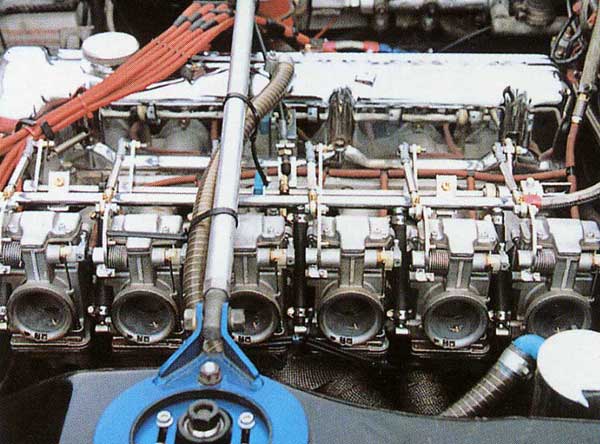
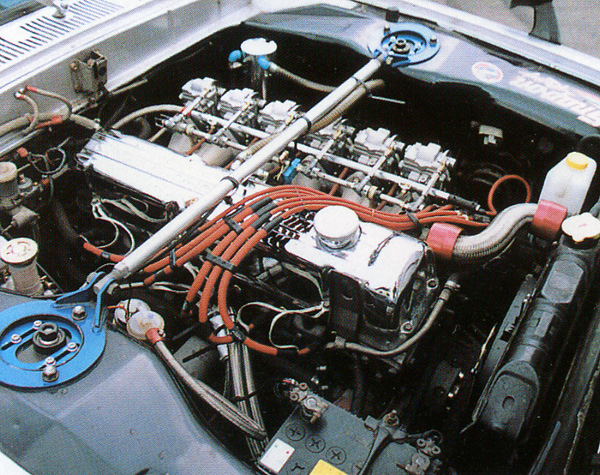
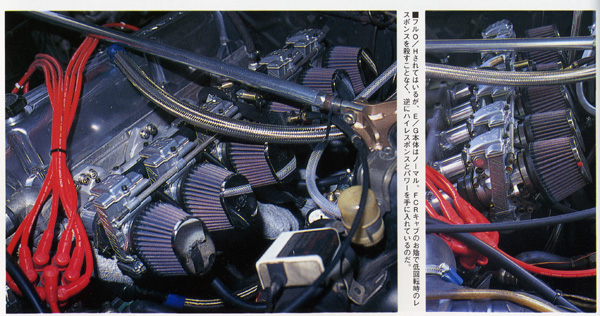
Hi Fred, Guus, 2Many, ozlime, beandip and everyone, Like so many things, its been done in Japan before. You used to be able to buy a kit for quite a lot of Japanese "Classic" cars - although it was pretty expensive. The FCR carbs cured all the tuning problems that Guus mentions, and I believe that they work quite well. The following pictures are of C10 and C110 Skylines with the 6 FCR's on L28 engines. Sorry I could not dig up any S30-series Z pictures with the FCR's. Alan T.
-
Yes Ash, I know where to get them from. Trouble is that they are not that cheap ( especially considering that they are "just" bare FRP mouldings ) and I am not sure that they would line up with the nose that you have already got on your car ( it will depend on how accurate it is and where it came from ). I better take this conversation off the forums and send you another personal e-mail for the fine details. Cheers, Alan T.
-
Hi Biker, I'll send it to your e-mail address, as it is too long ( wide ) to fit on these pages without messing about ( and I'm not computer literate enough to sort it out ). It's not "secret" information; its data that Nissan had available and has been reproduced in a lot of the tuning books and Sports Option parts lists. Anyway, I'll mail it to you. Ash, That deal sounds good to me. A proper race-version of the "B" box with the dogleg shift pattern and direct fifth ( non overdrive ) is a LOT of work to put together. Cutting gears is also not cheap, and there will be a lot of fabrication involved in making the shift forks and rails. If you firm up the spec. with this supplier and you are sure that he can do the job successfully - then I would be interested in a couple of boxes myself. Let me know how it proceeds. This might be a way for you to finance your own project. Regards, Alan T.
-
Alfadog, if its me you are calling then forget it! My interest does not cover late model stuff like the Z31. Even the S130 is late for me. However, the 200ZR is another one of those interesting Home market special editions that they never offered to the rest of us. Its certainly a great organ donor for the Hybrid Z guys. By the way, Alfadog - maybe your family would like my new daily driver; A.R. 156 2.5 V6 24v Sport Pack 3. Silver with red leather, bought to replace my 155 2.0 16v Twin Spark which I plain wore out. Regards, Alan T.
-
Yes Ash - they are all in Japan. Mind you, that's closer to you than it is to me! You can still get replicas of the "Works" Type "A" and "B" aerodynamic body kits in Japan. In the pictures above, Shun Koike's car has a "Type A" kit ( notice the shape of the front spoiler on the G nose ) and the genuine Works ZR ( the appelation that they gave to the race version of the ZG ) is wearing the full "Type B" with the different front spoiler, wider arches and tall three-piece rear spoiler. Both kits are still available as replicas in Japan. Alan T.
-
Hi George, Just like Alfadog says - its probably the synchros in your gearbox that are getting tired. If you don't know what these are - basically they are small toothed rings which ensure that your gears mesh together smoothly as you change gear. They wear out eventually, and the only way to fix it is to replace them - which means a full transmission strip down. Meeting this problem, I have noticed that may people start looking around for a good used transmission to swap in. This will almost certainly have the same problems, or will eventually develop them - so its a false economy. If you replace the synchro rings and freshen up the 'box with a few new bearings and shifter bushes, you will not believe the difference. The transmission is one of the main places that the driver interfaces with the mechanism of the car, and if its working right it is a real joy to use. I've driven quite a few "other people's" Z cars, and it is amazing how many of them are soldiering on with a tired and baulky transmission that makes it pain to drive the car. Mind you, you have not got a synchro on reverse gear - so that will always be a slow shift. If you can't get it to engage reverse smoothly ( without the crunch / graunch ) even after doing it slowly and deliberately, then you may have a clutch or clutch operating system issue after all. Did it start doing this suddenly, or has it gradually got worse? Alan T.
-
Hi Saint, 90mph? Is this part of the break-in procedure for your rebuilt engine? I think you should be taking it a bit easier for the first few hundred miles at least........... Pinning down the whine / vibration will be quite hard on a completely restored car that you never drove before the resto. - you do not know the history of some of the components that have not been replaced. However, the low pitched whine is probably the diff. If it was the transmission you would be able to hear it more beside you rather than behind you - so where is it coming from? Since your car started life as an HLS30 you might very well still have a diff. ratio that does not suit your conversion to a 5-speed box. A 3.9 ratio would probably be better - so this might be a good chance to fit one. This should be easy to find here in the UK - but I have one that is a "known quantity" if you get stumped for one. The vibration could be the propshaft or indeed any other rotating component, but the prop and driveshafts would be the most likely culprits seeing as your wheels and tyres are brand spanking new and have just been balanced.......... These cars are supposed to be smooth as anything when cruising in top gear - so there is definitely an issue with yours. However, after taking it completely apart and putting it back together you will have to expect some niggles like this. Don't get too upset, and it will all be sortable in the end. Good luck, Alan T.
-
Hi Ashley, I'll write out the ratios and e-mail them you direct. That custom-built box with " any ratios you want" sounds a bit too good to be true. Where will he be getting the gears from?! There's a fair bit of mix-and-matching that you can do to come up with something close to a close-ratio overdrive box, but its not unlimited and I think he may be exaggerating somewhat......... Of course, if he really CAN come up with something like the Option direct-top ratios then it will be good. Do remember that the best choice for a circuit car is NOT going to be anything with an overdriven fifth gear, and is going to have that dogleg first pattern that will allow you to use second to fifth gears in a conventional "H" gate ( must faster and less easy to fumble a shift in ). Trouble is, this would demand the different rails and selectors of the dogleg box - which are all but unobtainable................ Alan T.
-
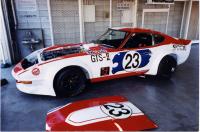
Here's a side-on pic. of the Works 240ZR at the 2001 event, post restoration.
-
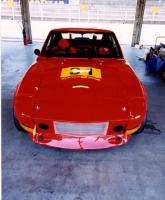
And here it is with the bonnet on ( they don't call them "hoods" in Japan..........
-
Oops, photo dropped off.....

-
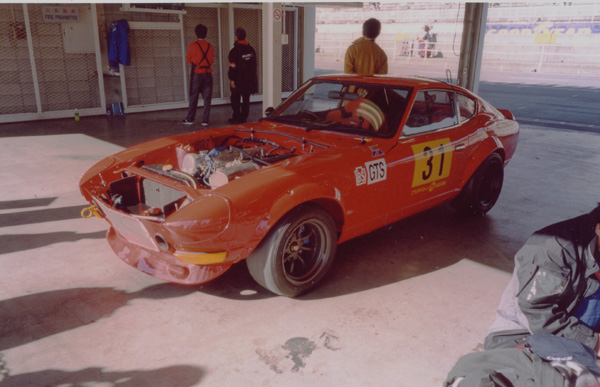
Here's Mr Abe's car from the front three quarter. The sunlight was a bit strong on the day, but the car was part shaded, so it was difficult to get a good shot in the pits. That black line near the cowl is indeed ( as 2Many said ) the rubber sealing strip, and is not any kind of bar or any other device. The airbox on the carbs is a genuine Works type ( supplied by Mr Matsui of NP35 ) and they were made from a pressed fibre-board kind of material. The Works race cars had a couple of channels made from the same kind of material that funnelled cool air towards the inlet. This car is roughly in the mid-1970 season spec. - just before the aerodynamic parts debuted, but already with the "Overfenders" and the rad panel sheetmetal ( of which there were many versions ).
-
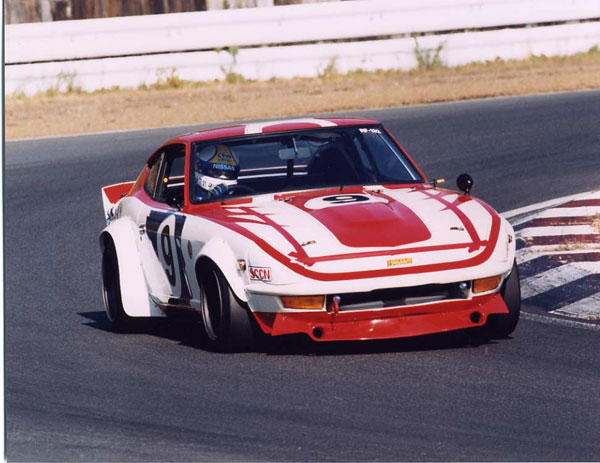
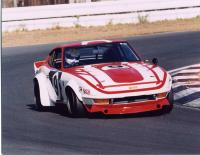
Here's a picture of Shun Koike's car on track at the 2000 event. The driver is Kazuyoshi Hoshino, who drove these cars for the Works team as one of the so-called "Seven Samurai" core of Works Nissan drivers from the early 1970's.
-
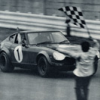
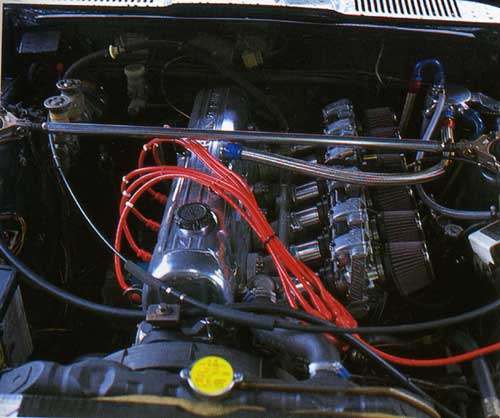
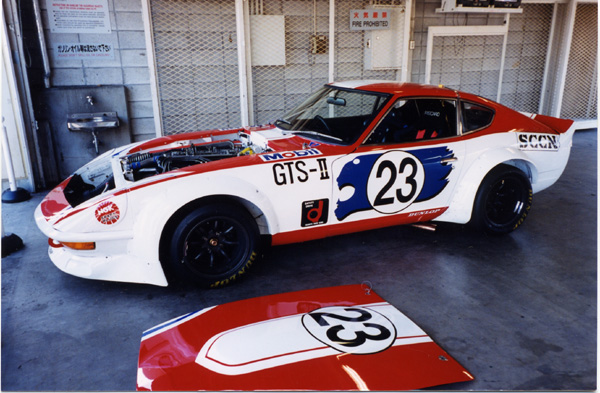
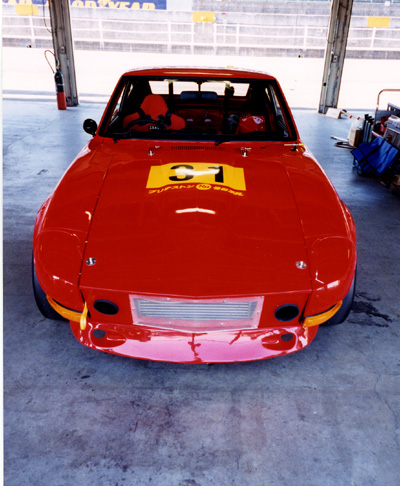
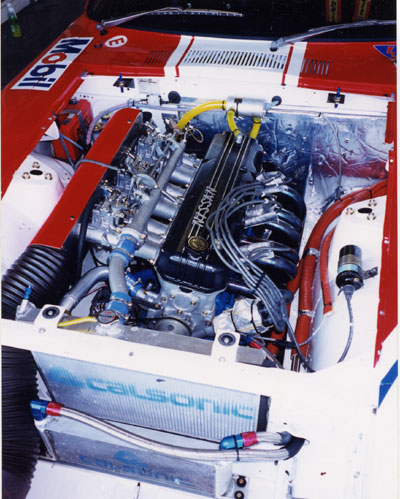
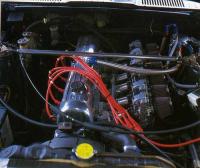
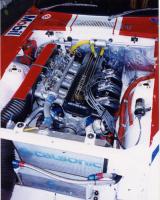
The photos were taken at the NISMO FESTIVAL events at Fuji Speedway - but they are from two different years; the 2000 and 2001 events. The red car ( no.31 ) is a replica of a "Works" 240Z racer, and is owned by Mr Abe. My good friend Mr Matsui of NP35 built the engine for it, and the body was put together by Mr Shun Koike - who I am also proud to call a friend. Shun owns the no.9 car in the photos - which is a replica of another "Works" 240ZR, this time with the full "Type B" Works aerodynamic kit and the hen's-teeth-rare Works 4-spoke magnesium wheels. Mr Matsui also built the engine for that car, and I can tell you that they are both real screamers. Both Shun and Mr Abe are part of a small core of Z enthusiasts in Japan who are after my own heart; they are nuts about the early period race cars ( especially the Works cars ) and they collect the appropriate parts of the period. Sadly, they are forced to use some parts and some specs. on their cars that are not "period" correct - mainly due to safety requirements. If they were not subject to these rules than the cars would be even more accurate replicas of the real thing. The car with the no.23 IS the Real Thing, and the photo was taken at the 2000 event - when Nissan wheeled out the car to show in the pits and not run. It is nothing less than a full Works-spec. 240ZR ( like a lot of these later Works race cars it was based on a later spec. of bodyshell from about 1974, but was still called a "240ZR" ) complete with LY "Crossflow" engine in carburated spec. At the time of the photo, it was in the condition that it had been in for the last 25 years or so; unrestored but with loads of lovely patina and pretty much all of the correct period parts. This car was campaigned in a few races and then became a Test car for the Works "Omori" ( Nissan Competition HQ in Tokyo ) race team, and was also used at the Nissan Racing School, based at FUJI, where they used to coach young Works drivers. For the 2001 event, NISMO decided to "restore" the car - with what I think was too much of a heavy hand. They completely pulled it apart and went through it - chucking away many of the period parts and replacing them with modern equivalents ( especially the rads, seats and fuel tank ). These look jarringly modern and I think they spoil the feel of the car. They even decided not to use the four-spoke Mags and used modern Watanabes instead ( for safety reasons, I guess ).The new paint is pretty much correct for the car when it was in its first season of Works use, though. Here's a picture of the engine bay on the genuine car, which I took in the pits at the 2001 event;
-
Hi Ash, The following information on Nissan's early 1970's "Option" sports / race transmissions might be of interest to you: *32010-N3130 "Close Ratio Overdrive" *32010-N3030 "Wide Ratio Overdrive" *32010-N3220 "Option 1 Race Transmission" *32010-N3221 "Option 2 Race Transmission" *32010-N3222 "Option 3 Race Transmission" *32010-N3201 " Rally Transmission" All the above were based on the FS5C71B / F5C71B "Bent Stick" boxes, and the Options 1,2,3 & Rally type all had "Direct Fifth" 1:1 top gears ( sometimes called the "Direct Top" or "Dogleg" boxes ). These are great for the racer, as you don't spend time going in and out of fifth gear on its dogleg with the danger of wrong-slotting reverse. Once you are out of first gear you have a conventional H pattern gate for second to fifth gears, which is quite handy on the track. The lack of overdrive is not a problem on a proper race car, and can be adjusted-for with a judicious rear-end ratio choice. Most of the Option 1,2 & 3 transmissions ended up in the USA, and are now very hard to find in good used condition ( don't bother trying to find a new one ). These Direct Fifth boxes have quite a few differences internally to the "stock" B type boxes, and the selector forks and rails are now all but unobtainable. I can give you a list of the ratios in all the above boxes, which are quite interesting - but a bit longwinded to post up here. Let me know if you need it. QUAIFE will be a bit of a waste of time for you to call I'm afraid; they used to stock a super-wide straight-cut gear set for the B boxes ( they listed it as a 240RS part ) but they have not made these for a few years now. They don't seem to be very interested in making any more either. You can't bolt in the 240RS box complete as it had a different bellhousing that would leave the trans. about 40 degrees from vertical if you bolted it to an L6. Looking at your car, it seems to me that you might be pretty much unhampered by rules and regs. - in which case you might like to investigate some of the boxes from 2WD Skylines that can be made to fit with a bit of engineering nous. Good luck, Alan T.
-
Hi Z-Voit, That kind of post is pretty much guaranteed to get my attention ( as long as I'm looking in, that is ). As far as I know ( and only the Pope is infallible ) Nissan / Datsun never tried to "soup" any of their race cars in the '60's and '70's. I also don't know of any road cars that they tried to supercharge in the same era, but they might have tried it on some obscure Home-market commercials for all I know. Pretty much most of their induction-side research went on perfecting the fuel injection and engine management systems on the race cars. That's why they were able to jump ahead of their competitors when they applied what they had learned to forced-induction systems. Toyota were always the forced-induction pioneers in Japan ( not forgetting Mazda who were a little behind them ) and Nissan never really got going on turbos until the Eighties. Once they got into them, they really did do it much better than everyone else. However, it was the aftermarket and street-tuning world where most of the really effective research went on.......... I remember HKS used to sell a supercharger kit ( a proper "everything you need" bolt-on job ) for the L28 engine in the early 1980's in Japan. I seem to remember them also offering a bolt-on supercharger kit too around the same period, and I will have to have a dig into my literature collection to see if I can find any photos to scan and post up. That's an interesting challenge for the coming week.......... Why, are you looking for some "free" horsepower?!? Alan T.