HS30-H
Supporting Member
-
Joined
-
Last visited
Everything posted by HS30-H
-
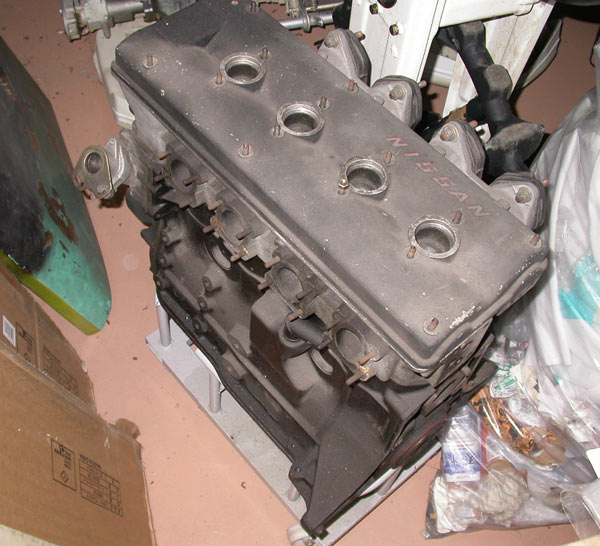
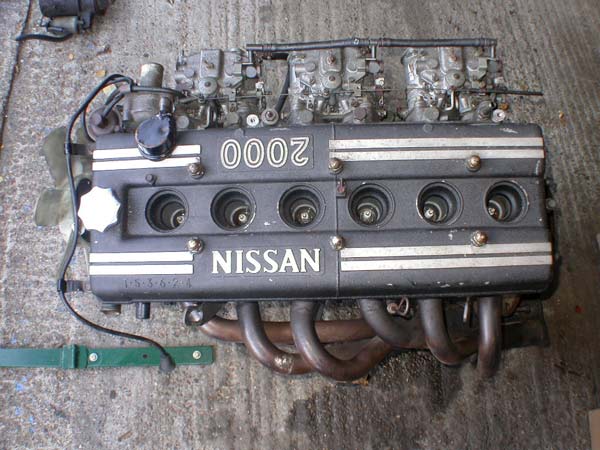
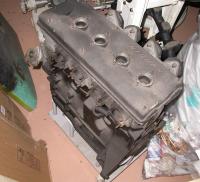
There were a bewildering number of special high-performance twin-cam heads made by Nissan in the Seventies and early Eighties for their four-cylinder engines. Plenty of these were never sold outside Japan, but we did get a sniff of them when Nissan used some of them in their rally cars, and on their occasional forays with Works circuit racers in countries outside Japan. I'd agree about Yamaha up to a point, but don't forget about Honda, Isuzu and Mitsubishi - who were all messing about with twin-cams in the mid-to-late Sixties. However, Prince and Nissan had the upper hand over all of them in Japanese domestic racing - at least until the turbo years. A friend of mine has an interesting Works race engine in his workshop at the moment. Its based on the L18 block, and I snapped it parked up next to his rubbish pile!:
-
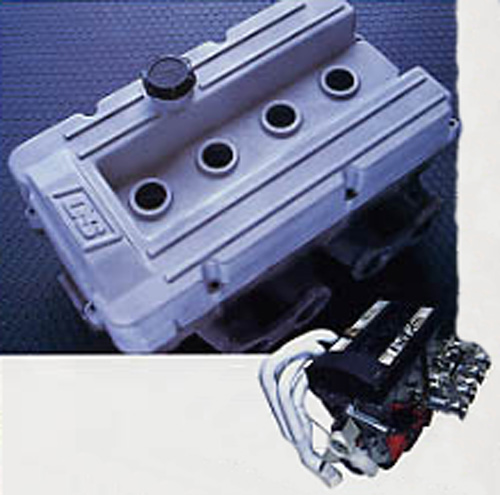
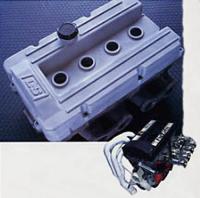
Yes - that was a conversion for the L18 and was called the "MA-II":
-
daddz, I think you are referring to the early Seventies French film called "C'etait un Rendezvous" directed by Claude Lelouch, which consists of a single take ( allegedly ) with a film camera mounted low on the front of a very loud sports car. The take starts with the sound of the driver closing the door of the car and starting the engine. He blasts through the quiet early-morning streets of Paris ( running many red lights and avoiding surprised pedestrians and sleepy taxi drivers ) until he gets to his destination at Montmartre and the 'Rendezvous' of the title. This film was a cult hit amongst car-types, and was sometimes played at car-club film shows as an extra titbit ( its less than 10 minutes long ). I first saw it on cine film in the late Seventies, and there was a lot of mystery surrounding it at that time. There was much discussion about the true identity of the driver ( many people said it was a French Formula One star ) and indeed the type of car that was used ( ranging from Porsche sports-racers to Alpine Renault sports cars ). There was also a legend that the French police arrested the driver after the film was made. Much more about the film has come to be known over the last few years ( although the director likes to keep an air of mystery around it ) and indeed it has recently been released on Video and DVD. With cool-headed analysis its easy to see that the soundtrack does not completely match the film, and that there are a couple of places where this is all too obvious. Its also clear that the low mounting position of the camera makes things look a lot more dramatic than they really were! Maybe we are all a bit more cynical these days............... Its believed that the driver was none other than the director of the film himself, and driving his own Ferrari 275 GTB. The woman at the end of the film is the director's wife. Great fun all the same. Cheers, Alan T.
-
Hi Nick, The Watanabe eight-spoke wheels have been made for many years ( they started making wheels in the mid Sixties ), and the company themselves ceased trading at one point. Then the original management bought back the rights and the name and everything else, and they have been going from strength to strength. This is a very similar situation to the one that MINILITE ( TECH DEL ) experienced here in the UK. As the classic eight-spoke design was never patented or copyrighted back in the Sixties, many companies have made their own versions. This occasionally leads to some confusion as to the actual makers of some wheels. I would think that the wheels you have thataremarked with the Watanabe emblem are definitely made by Watanabe. The ones that do not seem to have any marking could have been made by a number of companies. If they were Enkei eight-spokes ( introduced in 1978, I think ) they would be clearly marked - so you can rule Enkei out. There is a very small chance that they are original Kobe Seiko wheels ( offered in the official Sports Option lists for the 432 / 432R & 240 / 260 ) but these were made from Magnesium and were quite light - so I think you would notice that they were a bit special ( the sizes are also quite distictive ). In many cases, they were not clearly marked with any stamps or casting marks. Without a picture, it would be very hard to identify them. You asked about the Type "A" and "B" Watanabe identifications for their Eight-Spoke wheels. They also make a Type "R" ( we won't go into the F8 and the other more modern types here ) and these letters basically refer to the STANDARD offset for any particular size. For example, they make a 14 x 6.5j wheel in both "A" and "B" types, and these are identical except for their offsets, so the stamping is a way to identify the offset for a particular wheel without needing to actually measure it. Watanabes usually have the size cast into the reverse, and the Type is stamped onto the front of the wheel on the hub casting near the holes. The offset is different for each sizing and application - so there are hundreds of permutations. The Type "R" is usually a wider wheel with more negative offset ( deeper 'dish' ) and they have a subtly different spoke shape in some sizings. The Type "R" was often specified in Magnesium, but they HAVE also been made in Aluminium in the past. Watanabe have also made the Type "A" and "B" in Magnesium as well as the usual Aluminium. They have been making wheels for so long, and for so many applications, that anything might turn up. You have to be quite careful not to end up with something that isn't quite suited to the application. Hope that helps. Alan T.
-
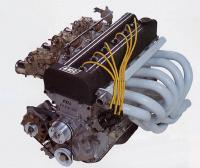
Here's the photograph from the ad - but in colour this time:
-
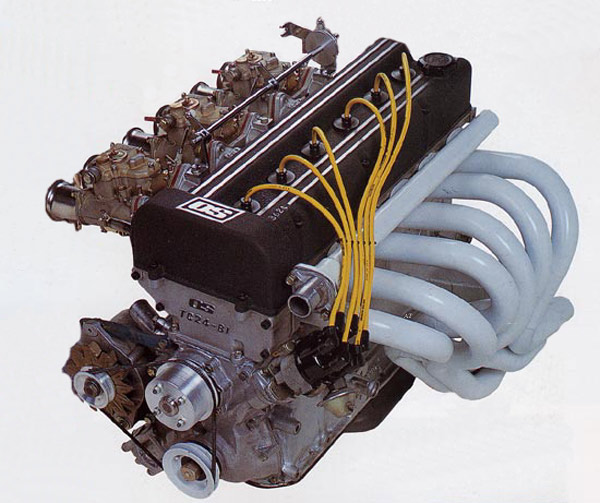
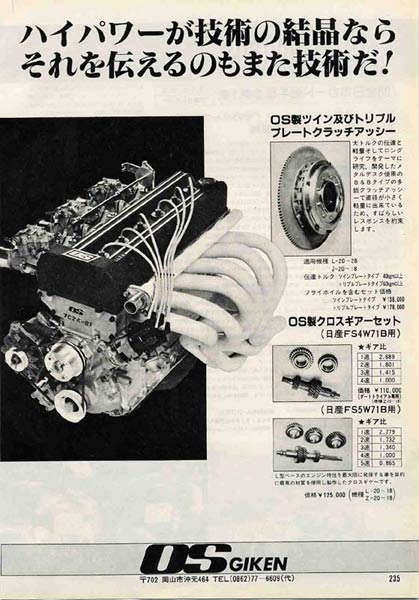
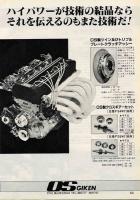
Hi Frank, I think that might be the twin-cam 24-valve crossflow head conversion for the L-series six that was designed and manufactured by a company called "O.S.Giken" in Japan. It was called the "TC24-B1", and as far as I remember they were first offered for sale to the general public in the late 1970's. O.S.Giken are still making high-performance components for street and race cars ( they are famous for their clutch and transmission components in particular ) but they ceased making the TC24-B1 long ago. I spoke to them a few years back about the head ( thought they might have some New Old Stock on a dusty shelf somewhere! ), and they said that they did not have any current plans to re-issue them - even in a limited production run. Their casting patterns are not fit to be re-used, and the tooling costs involved in remaking the patterns would be prohibitive.......... It was a very comprehensive conversion, with many special ancillary parts. It even demanded special pistons and rods. They were pretty expensive when they were current, and they command very high prices when they come up for sale in Japan ( which is not very often ). I have heard many nostalgic stories from Japanese tuners about the heads that they were forced to scrap after big blow-ups. Quite a few of the heads ended up being used with turbo conversions when they first started getting popular amongst the street tuners in Japan. Indeed, I passengered in a twin-turboed TC24 conversion once and it was mighty impressive for the time. I'm not surprised that so few survive. Here's a pic of one of their original magazine ads:
-
Hi symon, Welcome to the site! I'm very pleased to see your car. An original Spanish-market car is a real rarity. Well done. If you need any used parts, then don't hesitate to let me know. I'm based in London, England - so that's actually not too far away either. Best wishes, Alan T.
-
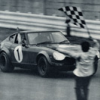
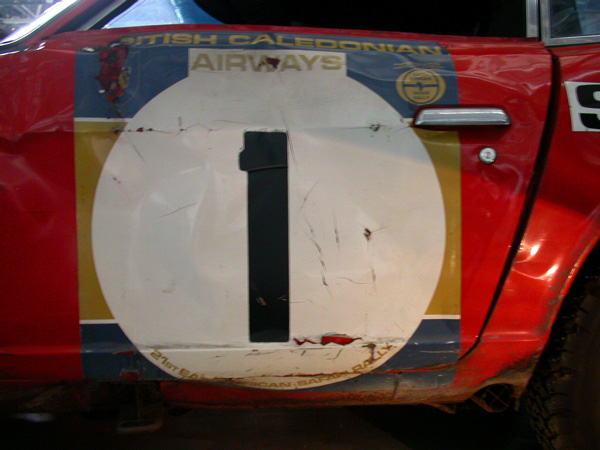
Thanks Guus for following this story right through to the finish, and to victory once again. Isn't it great to see a Z ahead of the 911's and Escorts once more. Here's my little tribute to the winners. A salute from the last Z to win an East African Safari Rally event...........
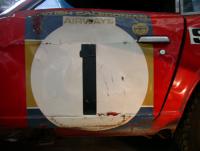
-
Hi Ben, Yes that's correct - the LY was never actually offered already fitted to any prooduction car from the Factory. It was used on some of the 'Works' rally and circuit race cars, and in order to homologate these parts and use them legally they were obliged to offer them to Johji Public through their SPORTS OPTION parts lists in Japan. There are still a few knocking around in Japan, and there are two running LY's here in the UK that I know of.
-
2ManyZs, I wasn't answering your post. I was just pointing out that the first 6cyl DOHC Nissan engine available for sale to the general public was the S20. carguyinok's first post didn't ask specifically about the USA, and as ANYTHING can turn up ANYWHERE these days I thought it worth pointing out that the S20 was produced from 1968 and was even available fitted to a Z. Do you think there actually are any S20 engines in the USA? I've not heard of even ONE outside Japan apart from mine, and you would think that it would be the kind of thing that gets noticed and / or talked about. Has anybody ever seen or heard of one over there or anywhere else? There are lots of apocryphal stories and urban legends out there. I've had quite a few wild goose chases that turned up nothing. Some people over here were even mistaking 4cyl FJ20 engines for the S20 and LY:stupid: carguyinok, do you think the guy was spinning you a yarn about it being his Grandmother's car? It might be that he knew EXACTLY what it was, but was being a bit coy about it. Possibly a case of him playing his cards close to his chest and not letting on about his "Q Car"? :classic:
-
"Bike-pusher's" articles in Classic & Motorcycle Mechanics magazine are very funny too. Ebay needs a bit of this every now and then, I reckon. I've had some bad experiences with it recently. Its not just the bidders though; I've had some run-ins with some pretty stupid vendors too.:tapemouth
-
Discussed in this thread earlier today:ebay poster
-
"Cursive Toshibas" is a nice expression. I've never heard of that. Its a nice font isn't it? The Stanley font was nice too. So you had Koitos as well as Toshibas in USA? Was there any cut-off or delineation between the two brands as to what came on what year / month? As far as I know, the Japanese market cars seemed to be pretty much mixed ( but always in pairs! ). Probably another case of Nissan using different sources for a fairly standard product? The headlamps in the UK-market cars had a bad reputation from the very beginning. Some of the original magazine road tests pointed them out as a little inadequate.
-
Ah, right. Now I see why it looked to me as though you had ignored my comments and were trying to stir it up. One misunderstanding on top of another. As one of the very few English members of this site who contribute fairly regularly, I can tell you that it makes me feel very self-conscious. I do try to take cultural differences into account when I post here. The fact that we have a fairly wide cross-section of nationalities on here - and therefore lots of cultural differences - makes it seem to me that its a good thing to watch what we say and how we say it. I wish I could go back and start this whole bloody thread over again on the right foot. Alan T.
-
Ozlime240z, If you have any problem with me, just PM me. I think I said that I'd been straightened out as to the intention of most of the comments, and I thanked the people that PM'd me to straighten me out. Maybe that did not come across in the above posts ( at least not to you? ). Seems to me that you are just having a bit of a stir ( ? ). Did you actually read the post I made above, or did I not explain myself properly?
-
Thats a ****ing big spoon you've got there boy.
-
There WAS a 24-valve DOHC 6 available in the S30-series bodyshell. It was first fitted to the PGC10 Skyline GT-R in 1968, and was available in the PS30 Fairlady Z 432 from 1969. It was called the "S20".............
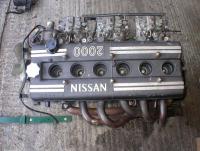
-
-
And here's the pair of pedals photographed together. They are part-stripped of their black Factory paint at the moment. The Brake pedal had been attacked by brake fluid some time in the past, so I'm taking them both back to bare metal and will refinish them. I think you can see that they are indeed stamped out of flat sheet steel, as there seems to be no finishing to the surface at all:
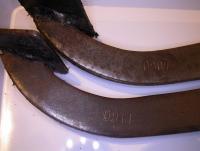
-
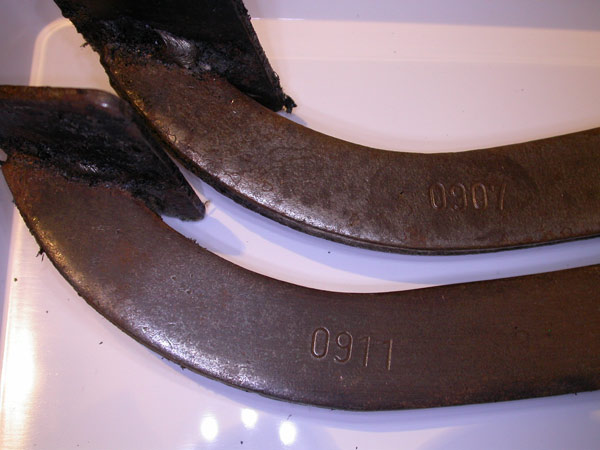
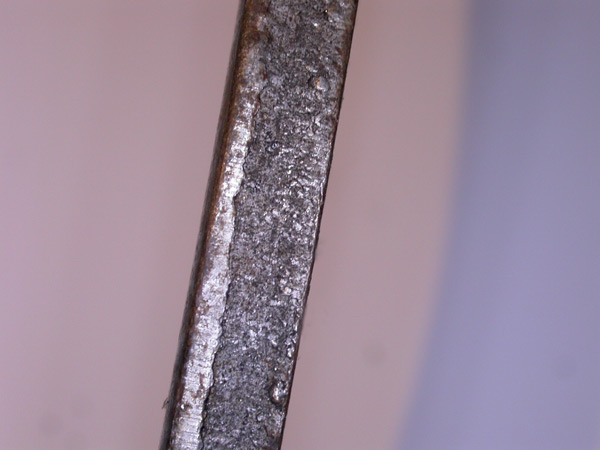
May I take this opportunity to say a big THANK YOU to the kind people who PM'd me about this thread and the way I was feeling about it? I was very dismayed to think that anyone would believe that this was some kind of trick or joke, and for a good while I was quite upset. However, The PM's were very encouraging and I'm very pleased and honoured that people are taking the time to look into this. Some points I should make: *I had no idea that any cars would have NO number on at least one of their pedals. I have never seen a pedal without SOME form of stamping or other identification mark on it. You learn something new about these cars every day............. *I was calling these numbers "dates" for a reason; It has been suggested to me that the four-digit stamps on my pedals indicated the month and the day of manufacture, and that the year was not marked as it was not necessary on a component that would not be hanging around for more than a year. HOWEVER - I did not think that this was completely true, as I have seen some pedals ( admittedly RHD ) that had letters as well as numbers on them. I have also seen numbers higher than 31 in pairs - which would surely nix the theory that it meant either a day or month. *I wanted to try to get to the bottom of it by seeing what other cars had. The "0907" and "0911" numbers I posted photos of are from my project car - which is a Japanese home-market "Fairlady Z-L" ( S30 ) made in 1970. My other car - also Japanese home-market - has some letters as well as numbers on the pedals ( that car has a late 1971 build date ). *I know that RHD and LHD pedal shapes are quite different, but I was expecting ( hoping! ) that a clearer picture might emerge that showed a pattern or method to the numberings. I'm none the wiser! There is of course a greater thickness to the pedal stem on the BRAKE pedals in comparison to the CLUTCH pedals. That's natural when you consider the duty of each pedal. However, I believe that they are both stamped or punched out of steel stock rather than one of them being cast - as somebody suggested. Here's a close-up of my Brake pedal stem in profile. You can see that it has probably been punched out with a die ( ? ):
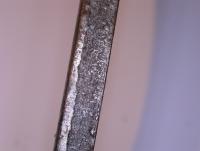
-
ps Did you know that some S30-series cars left the Factory with Toshiba and Stanley brand headlamp units, as well as Koito? Did you only get Koito in the USA? Alan T.
-
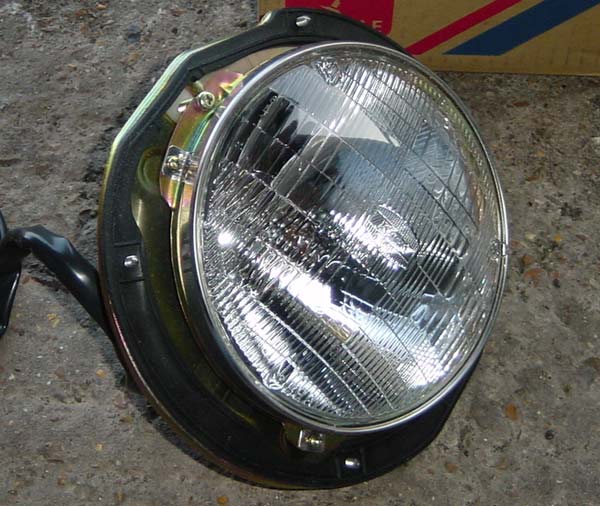
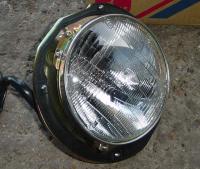
Hi daddz, They are still available in Japan, even in the otherwise-useless "Autobacs" and "Helloes" stores. Just the lamp unit itself that is, not the headlamp bowl / surround. However, I'm fairly sure that the lenses are all configured for RHD. Surely that's no good for you in the USA? The beams will be pointing in the wrong direction................ I'm pretty sure that Kats would have had to install RHD-configured lamp units in his car so that it would pass its 'Shakken', and be used legally in Japan. Alan T. ( Here's one that I bought a while back. Disregard the bowl and surround - which is from Nissan ):
-
Hi Mike, This is very interesting and its very heartening to hear these questions from others who are ( like me ) interested in the little graffitoes and 'ken' marks that can be found on our cars. I can read some Japanese, and this is one of the characters that I have seen before on the underside of the dash. You have got it the correct way up in your photo ( which is not always immediately apparent! ) and I can tell you that the way it is written, this Kanji says "kawa". That's a word that is often interpreted to mean 'skin' or 'hide', and in fact "kawa" is MOST often used in reference to 'leather'. Now, "kawa" can mean several different things depending on its context ( like most of the 5000-odd Japanese Kanji characters ) but I would guess that in THIS contex it might be best to read it NOT in the 'leather' translation - but in the 'skin' or possibly 'covering' sense................. Why would it say this? Well - the messages and graffitoes that you see on some parts of the Z are often little inter-departmental notes, or 'shouts' if you like. They can bring attention to the assembly or sub-assembly workers to watch out for a particular problem or change in spec amongst a batch of cars or parts. I have also seen little messages that can be translated as what you might call Friday-afternoon banter between workers - just meant to raise a smile and while away the hours........... So what does it actually MEAN? Well, again this is a half-educated guess, but I think it might well signify a fault or problem with the covering of the dash pad that was sent to be rectified or redone. That's the only thing that comes to mind, and the main thing that swings it for me is that Nissan often referred to their embossed-texture vinyl interior pieces as "leather" ( even though it was NOT real leather! ). I think its just a colloquialism really. Therefore, I would guess that a fault might have been spotted that needed to be rectified ( presumably it WAS rectified ). Seeing as there was only ONE finish on our dash pads, I would have a hard time imagining it signified a different finish or material for this dash pad. Of course I could well be wrong, so please don't take this as gospel. Just my thoughts on the subject after seeing a fair few similar notes and messages on the cars from many markets. You might like to send a PM to Kats to ask him to look at this thread and give his opinion. Best regards, Alan T.
-
-
Michael - thanks very much indeed for that. Its much appreciated. However, it was not your posts that upset me - it was a few of the others. If they were posted in fun then the sentiment went right over MY head. All I'm getting is bad vibes and I'm not liking it. I'm wondering what people expect to get for nothing....... Alan T.