Phred
Community Member
-
Joined
-
Last visited
Everything posted by Phred
-
Benn9090 Your Comp. & flow #'s are not uncommon for a street engine with some miles on it. On the downward intake piston stroke, with the throttle plate at idle position, a vacume is created. this is what your reading with the flow gauge. If one cyl. is less effecient than another, or a slight vacume leak exsists, these numbers will vary. simply average and balance them as best you can. You can minimize the difference when setting up the carbs on the bench. With each individual carb, back the idle screw out all the way. Hold the throttle plates closed, and look through the carb bores while holding up to a light. You should not be able to see any light sneeking past the throttle plates. If you see light passing by one plate and not the other, loosen the two throttle plate retaining screws, and lightly tap on them with the back of the plastic screwdriver handle untill they both "seat" into the throttle bore. Retighten, and check with the light. Repeat if needed. This easy adjustment will assure you that both throttle plates of the carb are getting the same amount of movement (flow) when the throttle arm is moved. Now, any differential readings on the same carb will indcate an intake leak or the cylinders inability to draw air equally. Phred
-
Eric, I've been rebuilding and tuning Webers for years, And I agree with all that Alan (HS30-H) said. For parts and expert advice in your area. go to: www.piercemanifolds.com (408) 842-6667 Gilroy, Ca. Order: Isolator kit #99005.146 (3ea.) Phred
-
Eric, After cranking, check all spark plugs to see if they are all the same, i.e. gas fouled or dry. Also, with a mirror & light, look down each carb to verify each squirter/accelerator pump is functioning. While peeking down there make sure all throttle plates are opening equally. It won't keep it from starting, but I didn't see any Isolator 'o' ring plates between carbs and manifold. These are part of a mount kit which keeps the carbs isolated from engine vibrations, which keeps the float level from splashing fuel up into the air corrector jets which causes flooding, and poor performance. Let us know what you find. good luck. Phred
-
Go to: www.rebelloracing.com Phred
-
I was just about to order one. Does anyone know if all the dash covers are made by the same parent company, and then simply labled with different retailers names? Or does one brand fit better than another? I'm aware of MSA & VB, but I also picked up a business card at the Portland Roadster Show from a place called - Dash-Caps in Paradise, Ca. (www.dashcaps.com) The sales person said they only offered half caps for the 240's because they had problems getting the full cover to fit properly. But also said if enough interest was shown, they would likly work toward making the full cover again. Preferably one that fits. I would like to ask all who have bought dash covers, to reply with place of purchase and quality of fit. Then we could offer a knowledgeable recomendation to those in need. Thanks. Phred 71' 240 Vintage Racer/restoration in progress
-
Balancing eng. components is part of my job as a racing engine builder and machinist. First, it will not gain you 15, or any horsepower. unless the bal. was so far off that the bal. job allowed the engine rev a bit further than it did prior to the bal job. (highly unlikely) A complete bal. job involves balancing both rotating and reciprocating parts. That means everything that spins around (rot.) and everything that goes up and down. (recip.) The crank, fly, clutch cover, and damper are spun individually, and as an assembly, on an electronic eng. balancer. This machine works somewhat like a spin balancer for tires. An imbalance is detected by a sensor, and with the use of a strobe light, the location is indicated. The required amount of weight is drilled, or ground away, untill no imbalance is indicated. The con rods, pistons, and pins are balanced statically so that all components are equal in weight. A balanced engine may last longer because there is less stress delivered to all areas within the engine. Iv'e had assemblys nearly hop off the machine when a badly out of balance component is bolted to the crank, so you can imagine the hammering the bearings might encounter. Any time an engine is rebuilt with performance in mind, a complete balance job is just as important as the parts you build it with. It is generally not practical to disassemble an engine just to balance it unless a serious internal problem exists. If you are looking for higher revs and higher horsepower, a balance job is worth its weight in gold. Having driven both balanced and unbalanced engines on the street, and the track, I can tell the difference in the smoothness throughout the rev range. And it will theoretically live longer. But, sorry, no horsepower gains by simply balancing an engine. Phred
-
I've been reading/hearing about some confusion many home engine builders are having concerning camshaft timing-duration numbers. Such as,"my 300 degree cam dosn't have as much lift as my buddies 280 degree cam, and his seems to make more power. Whats up?" First, understand there are two different methods cam duration is measured. One is the absolute, or advertised duration. The distance in degrees measured from a point where the lobe physically starts to rise from the base circle, to another point where the lobe blends back into the base circle. The second is a standard "checking height" of .050 lifter rise, or in the case of the L series engines, valve lift. Naturally, if you take a degree reading .050 after the the valve starts to rise, and another .050 before the valve closes, the total duration will be less than the "advertised" duration. So, the first rule in describing a cam is to state, " 300 degrees @ .050" or "300 degrees total advertised duration". Without that distinction for comparison, degree numbers are useless. Lastly, valve lift is a seperate function of cam design. Valve lift is also measured two different ways. Advertised lift, is the total physical size of the lobe, measured in thousandths of an inch. This is somtimes refered to as "gross valve lift". Then there is the actual running valve lift which is known as "net valve lift. This is a lesser number, (which is why they don't advertise it) because of the required subtraction of valve clearance values and the amount lost (or gained) because of the rocker ratio. I hope I didn't confuse the issue any more than it already is. Simply be aware of the many ways of the black art of the bump stick. Phred, the Engine Shaman
-
TWM Induction builds quality parts, but gets quality prices for their stuff. 1999 catalog lists a manifold without linkage for $317.44 !!!!:eek:
-
Hope I didn't mislead you. The R-180 3.9 is NOT an LSD unit. You have to supply that part yourself. In my case, Im going for the Quaife. However it is a complete rear end, ready to run.
-
I bought a R-180 3.9:1 from: garykaz@pacbell.net (Glendale, Ca.) Price $200. plus $50. shipping to Portland, Or. Claims to be able to produce one on request. Give him a try, worked for me.
-
Brandon, I've built a few engines with similar specs, and it seems your results are not uncommon. You are at that point where its hard to have the best of both worlds. Thats a pretty big cam for the street. They will tend to feel boggy till you get in the range where they are ment to run. You are amplifing this condition by Installing larger chokes (venturi). The larger venturi size will slow down the velocity of the incoming air. You need higher velocity. By removing your velocity stacks, ( they named them correctly) you created turbulance at the entrance of the carb, and while it may have seemed better, your horsepower at peak was less. I've seen up to 10 HP lost with stacks removed. So what can you do? Its not practical to shorten an intake manifold. Most all brands are about the same lenght. But you could put on the real short stacks that TWM offers.(find them on the Web) Another trick to try is to advance your cam a couple degrees. This will have the effect of moving the power band down slightly, making a bit more power down low. Making your flat spot a bit less bothersome. Also, Different venturis require different jetting. You might need to get one of those mixture sensors, or an EGT gauge to nail down the proper jetting. Getting the jetting right can make a world of difference, drivabilty wise. Its a tough problem, one which you might not be able to totally cure, but you should be able to make it better. Good luck buddy. Phred
-
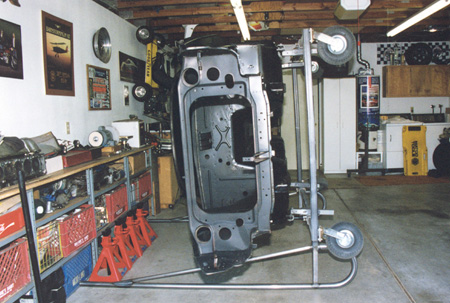
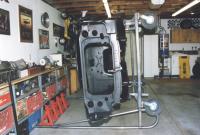
Well. This is no rottisserie, but it serves the same function, and as a shop roll-around when its not up on its side. The "handles" can be slippid in either side of the roll-around, and using over center weight distribution, the handles then become the "feet" for the whole thing. I can give you more details if your interested in building one. Phred
-
I just lightened a stock 1980 ZX flywheel. It started out at just over 24 lbs. I suppose they vary a bit, depending on the casting and how much was factory balanced out of it. So when you talk of a shaved fly at 22 lbs, it probably had the easy weight taken off. There's a lug of material just behind the ring gear thats easy to machine off, and its about two pounds or so. After that, you have to start being more of a machinist. (which I am) I was very conservative, and took out 6lbs. for a total weight of 18lbs. The Centerforce Dual Friction clutch weights 10 lbs. I saw a 12 lb. cast fly, and it scared me. Lite steel is good. lite cast, bad. has to do with metalergy and strength of materials. Just for comparison, a Cosworth BDD Formula Atlantic engine uses a steel fly on the order of 5 to 7 lbs. and they commonly shift at 9,500 to 10,500 RPM. and I havn't seen one fail in Twenty years.
-
Hi Team, I'm building a 71Z as a Vintage SCCA car. I have been reading all the comments on the Quaife/Gleason/Torson units. I have chosen to use the R-180 for the weight savings it offers. I have a 3.9:1, however I need to pull it apart to measure the ring gear, as Quaife offers units in both 110mm, and 115mm ID. Unless I can find a used one for sale, I'll be ordering one in a month or two. I"ll let you know how it goes. Phred