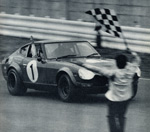
HS30-H
Supporting Member
-
Joined
-
Last visited
Everything posted by HS30-H
-
Hi Chris, Unless you have accidentally hit the jackpot and found a real Fairlady Z432 ( PS30 ), I don't think that the engine in the car will be a DOHC . Its much more likely to be an L20 - essentially the same as the L24 but with a smaller capacity. You didn't mention that the car was RHD, so I would assume that you are talking about a US-market "240Z" that has had an L20 engine transplanted into it. That would not be considered an upgrade by most people. However, if it is in fact an RHD car you may well be looking at a privately-imported Japanese-market car. Many of these were brought home from Japan by American servicemen ( I've got one of these too ). Check out the VIN number to make sure ( best place to look to make 100% sure is on the firewall metal above the brake booster - and you may have to push away some tubes and wires to see it clearly ). We have discussed similar subjects here in the past - so use the SEARCH function ( try words like "Fairlady" or "S30" or "VIN" and you should find some interesting info ). Good luck. Alan T. ( ps - If it says "PS30" on the VIN code then all your Christmases will have come at once ).
-
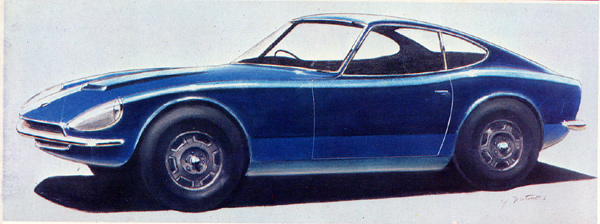
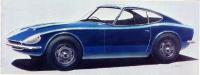
Hi Steve, It DOES look a little like the Opel GT doesn't it? Mr Matsuo's styling sketch is attributed to the late 1965 to early 1966 period in the 1970 Japanese publication that I picked it up from ( a full report on the concept, design and productionising on the S30-series Z ). The Opel GT was put on sale in 1968. I think it probably shows that Stylists and Car Designers were all pretty much thinking along the same lines in that period, rather than anything more sinister! Alan T.
-
You guys are much too clever with Photoshop. I'm too scared to even start that program up............. Fred - I think your dual-brake design needs patenting straight away! Alfadog - I like the handle in the middle of the driver's seat. I can imagine that there are people out there who would like to see me 'sit on it'................. Seriously though, isn't it interesting how its now located on the left side of the tunnel on both LHD and RHD versions? OK - its not quite as far away as on the S30-series, but its still going to be easier to use for one version or the other. Just like on the S30, one of the versions must be 'wrong' ( or at least less 'right' than the other...... ). Alan T.
-
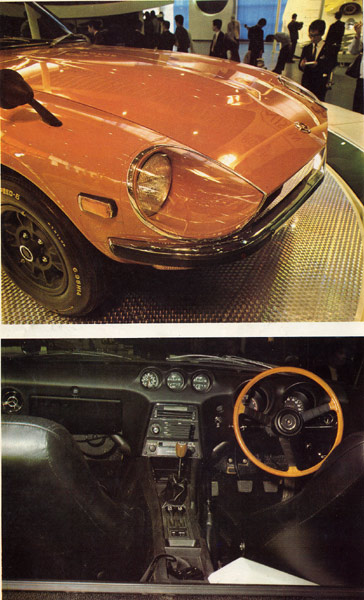
Good point Zedrally, But if you look at the ORIGINAL console ( with Choke and Hand Throttle in the centre behind the gearlever ) it was much more symmetrical than the later ( choke only ) version. Take a look at my earlier-posted picture from the Tokyo Motor Show stand of 1969. You can see that the main difference they would have had to engineer for the console on the earlier cars was just the cut-out or clearancing next to the brake handle itself. I get the feeling that carguyinok is far closer to the truth ( if there is a "truth" to be told ) of the productionising of the Handbrake lever assembly as it relates to the shell than anyone else so far. However, my experience of these bodyshells in stripped-down form ( although perhaps more limited than many of the people that have been posting here ) tells me that the bodyshell could have only got so far down the line as an indeterminate LHD or RHD base. At some point it was allocated either an RHD or LHD identity, and I think that point must have been when the FIREWALL was put into the car. From what I have seen of the LHD to RHD shell conversions in this country ( usually relatively rust-free USA cars that are converted using a rusty UK-market RHD car as a parts and identity donor ) I reckon that to do a "proper" and full job of the switch the WHOLE firewall panel would have to be switched. In reality, this very rarely gets done ( far too complicated ) and a compromise is made. Its relatively simple to do - but you can usually tell that its been done if you look closely. As has been pointed out, some of the panels that made up the bodyshell must have been generically designed ( such as the top of the scuttle, where the wiper arm pivots go, having both LHD and RHD-type cutouts ) so that the pressings could be used for both versions. However, as far as I can see, the main part of the firewall ( not just the pedalbox support panel ) seems to be either LHD or RHD oriented. As carguyinok has pointed out, maybe having a "handed" trans tunnel pressing would have meant that the orientation of the bodyshell would have had to have been determined further back down the line than ideal? That would seem to be logical. Its still interesting that they chose to have the handle on the right side of the tunnel, though......... Anybody find those prototype pics interesting? I thought it was worth noting that they were ( perhaps naturally ) RHD-oriented. Alan T.
-
Hi Tanny, Any advice that you receive will have to be balanced with the fact that you are up there in the stratosphere at 6500ft. That's certainly going to mean that you will have to fine tune for your local barometric conditions, so do remember that the final tuning is up to you or to a local dyno shop that knows Webers. Having said all of the above, and in light of your request for help in my Gallery pictures ( remember - the car that you saw there runs Mikunis ) - here is what I think regarding Webers on your car; The good news is that you have the very model that Weber themselves recommended for the L24 engine ( the 40DCOE-18 ). This means that you should have all of the internal circuits and the Accelerator Pump Rod stroke ( 10mm ) that is suited to your engine. HOWEVER - bear in mind that the life of these carbs did not begin on the day you met them. Never take anything for granted when it comes to old carbs, and particularly on old side-draughts. People just cannot resist messing with them, and the lack of local availability for replacement or more suitable parts usually means that people "make do and mend" or use parts that look similar, but aren't suitable. The previous post from carguyinok is very good advice indeed - its very often possible to find jets that have been redrilled ( an old "racer" trick was to solder and redrill them if smaller sizes were needed ). If in doubt -replace. Do you know the history of the carbs? What were they on before you got them? Were they on a running car? Anyway, you need to check them out THOROUGHLY before you go any further with this. Make sure you know what you have got. Check out your "Choke" sizes ( its a raised number on the casting ) and they simply slip out after you take off the inlet trumpet and then pull out the Auxiliary Venturi. Either 30mm or 32mm chokes should be sufficient for your engine ( the smaller venturi keeps up the inlet air speed, to promote torque ). I used to run both 32mm, and then 34mm chokes in my old 40DCOE-18's. Both are considered fairly small - but perfectly adequate. Here are the numbers "from the book" for the 40DCOE-18 on an L24 in normal conditions: *CHOKE - 30~32mm *AUX. VENTURI - 4.5 *MAIN JETS - 130 ( 1.30 ) *EMULSION TUBES - F2 *AIR CORRECTOR JETS - 175 ( 1.75 ) *IDLE JETS - 0.50 F9 *ACCEL. PUMP JETS - 0.45 *ACCEL. PUMP INLET & DISCHARGE VALVE - 0.55 *NEEDLE VALVE - 1.75 ( 175 ) *ACCEL. PUMP ROD STROKE - 10mm Looking at your numbers, I would say that the first thing I noticed was that your Inlet & Discharge valves ( "Bleed Back Valves" ) are small at 0.35 - and you might want to upgrade them whatever happens ( there's only three of them ). In fact, the size you have quoted is a very rare size and I wonder why they were in the carbs in the first place ( 0.55 is stock for the 18-type ). You do not mention your emulsion tube sizes. F2 should be good for you. You cannot underestimate the importance of setting the FLOAT LEVELS correctly on these carbs. The float level governs many things in the operation of the carbs. Make sure you do not fudge this issue ( been there - done that - wished I hadn't! ). You mentioned my throttle linkage in your post on the Gallery pic. and indeed I would recommend that you have the best manifold and linkage that you can find / afford. Carburettors ( and particularly multiple side-draughts ) are basically just precision measuring devices. The precision has to be matched in the linkage, otherwise its all pretty meaningless. You will mainly just need to make sure that each carburettor has the same datum point as the rest ( do this without the linkage attached, and in the idle position ), and then make sure that each carb is pulled the same amount - and at the same time as - the others. I know its just common sense, but here in the UK I have seen manifolds and linkages on L-series engines that would be more at home on Fred Flintstone's car. I hope that yours is better than that......... And then you have to think about fuel flow and fuel pressure. The Webers like to have about 3 or 4psi AT ALL TIMES ( that means even at full throttle with the engine turning high revs and eating lots of fuel ). Make sure that your pump and lines are able to feed them. I had great success with blocking off the return line to the tank completely, and just running the fuel feed lines into the carbs with no return at all. Some people seem to keep the return lines and still have no problems. Make sure that you have 3 to 4psi at all times and all should be well. You will need to have a proper Fuel Pressure Regulator unit to do this ( very simple ) and I would recommend having it as near to the carbs as possible. I would forget about the Colourtune for now and start learning how to read the plug colours correctly ( you will get very good at this after a short time ). If you don't feel up to the job of tackling this, then I would recommend that you find a friendly specialist with Weber / Dell'orto / Solex-Mikuni knowledge ( and a chassis dyno if possible ) and get him to sort it out for you. Once its been "right" once you can eliminate all sorts of possibilities from the equation if it starts running "wrong" again. At the moment, its difficult to know where to start with advice for you. I'd make sure that the parts are all there and the jet sizes and settings are all near the baseline above, and then start eliminating possibilities. Don't lose heart, as they ought to be great once they are properly dialled-in. The sound alone is worth it. Good luck, Alan T.
-
Good to hear that's what you needed. The very best of luck with trying to get the carbs accepted ( and all the other stuff ). Failing that you could go to Japan and buy a 432 and see if the scrutes will allow you to race that! Now that would be interesting! Good luck, Alan T.
-
afildes, Was that what you needed? Alan T.
-
You said it.......... I've lost all sorts of stuff that way, but I've learned my lesson with them now. They usually blame it on their printers, or say "we sent it back by post - didn't you receive it?". The stuff I did get back was usually dog-eared to hell and had been used as a coaster for their morning coffee. Don't lend stuff to magazines any more......... Alan T.
-
Amen to all that you just said, and very well put too Enrique. It is a mystery as to what happened to the fine old art of Debate Without Confrontation. I remember one of my very first trips to Paris ( years ago - when I still had a hair-style ), when my friend and I were looking for a place to get a late-night drink in one of the dingier parts of St. Germain. We ended up in a very odd little bar, one of those places where the locals look around and go all quiet when you walk in the door. We decided to ask for some advice on what to drink, and the evening just became better and better. We got into all sorts of debates with the locals ( including the old chestnut of Winston Churchill vs. Charles De Gaulle ) and things got discussed quite passionately, not always eloquently, but the opinions of others were patiently listened to. In the end the whole lot of us were turfed out into the street at 5am by the owner - all on first-name terms, temporarily friends for life and with a new insight into eachother's thinking. If we had tried that in our own home town, I think we would have been in a fight before Midnight! It is indeed Nissan's fault that there are not any accurate production records for the S30-series Z ( and many other of their models ). Local market importers sometimes seem to have a better idea and more information on what they received than Nissan do of what they sent there. Australia seems to be a particularly good example of this. A good example of just how stupid Nissan were ( if a giant corporation can be called "stupid" ) is the way that they allowed the myth about Goertz to become bigger and bigger until its now almost irrefutable fact. Poor old Mr Matsuo was left out in the cold for so long, and now if you tell people he headed the design team of the Z they will not believe you. How dumb of Nissan to let that happen. I have a feeling that the "Task of a Lifetime" is a bit of an understatement when it comes to the History of this car. I myself have been gathering information on the area that I am particularly interested in ( especially the Factory race and rally cars ) but feel a very very long way from knowing even half the story. If I felt I had enough accurate information on that area I might even try to make an attempt at putting together a little book or booklet on the subject. Suffice to say that I still feel a very long way away from that day. I think the fact that the story of the car holds so much mystery and intrigue must be one of the reasons that I like it so much. Cheers! Alan T.
-
Enrique, you are quoting zhome. zhome in turn is quoting a famously wizz-poor book that was written by somebody in the corporation that had limited access to the facts, and was primarily engaged in making advertising bumph for the 280ZX. I don't blame zhome for quoting the figures ( there's not a lot else to go on and it all seems nice and tidy ) - but the figures are WRONG. That book is a perfect example of the lovely word "revisionism" that you dropped into one of your previous posts. Isn't it quite clear to all by now that Nissan Japan were completely disorganised in their record-keeping system around the late Sixties and early Seventies period? This might seem most un-Japanese to many people, but its famously true and rather well-known amongst Japanese Z-enthusiasts that I have spoken to. If the figures in that list were true, then all the RHD cars that I have seen in 1969 publications such as Car Graphic, Playdrive, Auto Sport and Auto Technic ( and including the cars on the show stand at the Tokyo Motor Show of 1969 that I posted a photo of above ) must be either fakes or figments of somebody's imagination. Suffice to say that the figures in the "280ZX" book are just plain inaccurate............. In fact, some of those "in the know" have hinted to me that Nissan did indeed know pretty much what they produced, but have only ever published what they wanted to be known. I'm not hinting at an Enron-sized scandal, but ask any accountant if the figures he writes in a ledger are 100% true. For my part, I believe in ****-ups rather than conspiracies. Chaos theory is usually king in this kind of situation. Just to put it straight once again in case anyone misunderstands that "first 500 VINs went to America" type of quote - the "HLS30" had its OWN numbering sequence. The S30-series Z range was like a pack of playing cards. Just because there's a Jack of Diamonds it doesn't mean that there are not Jacks of other suits. As I have written on this site many times before, theoretically there would have been individual cars in existence with the numbers S30-00240, PS30-00240, HLS30-00240 and HS30-00240. From physical evidence provided by cars that are still in existence, its possible to deduct that HS30-00240 was made AFTER the other three - but most definitely NOT that HLS30-00240 preceded the other two. Here's something that I don't think I've ever written here before. As far as Nissan Japan were concerned in 1969, the "star of the show" in their range was the 432. They had no idea that the HLS30 "240Z" was going to be such a runaway success ( although you can bet that they were HOPING it would be just as successful as Katayama was telling them it would be ) - and the main focus of the Japanese press coverage and public interest at the launch of the range was the most glamorous and exotic of them all - the 432. Of course, if you want to JUST look at sales figures as a mark of success or failure, then the 432 would be classed as the latter ( McDonalds syndrome ). By arguing the case for the RHD cars so strongly, it might be misconstrued that I am trying to prove that the RHD cars were in some way superior to the LHD cars. I'd rather let their specifications speak for themselves and let people decide what they prefer to believe in that respect ( both variants have advantages and disadvantages ). What I think is wrong, and what I am trying to even up the score on, is the unfair emphasis in the written history of the S30-series Z on just one local market variant ( yes - the market that was bigger than all the others combined ). That's why all the preceding talk of quantity and numbers is missing the point. That part of the story is a 'no contest' - in the same way that McDonald's would win a Michelin star if the quantity of hamburgers sold was part of the judging process. Yours etc, Alan T.
-
Hi Rolf, Yes, almost all markets except the USA / North American got the close-ratio FS5C71-A transmission and a suitable diff ratio right from the beginning of sales. This is not news to those of us in the UK, Australia and NZ ( and yourself in Germany ) - but it does seem to surprise a few American owners, a lot of whom seem to be searching for 5-speeds and 3.9 diff. ratios if posts on this site and others are anything to go by. When the "B" type ( 'bent stick' ) transmissions were introduced, the USA / North American market was STILL stuck with a 4-speed - while the rest of the Z world got the close-ratio "FS5C71-B", again with quite nicely-spaced close ratios. It seems that the "FS5W71-B" 'wide' ratio 5-speed was the first 5-speed to be offered in a car ( as opposed to the Datsun Competition lists ) in the USA / North American market. Is that correct? Interesting that your German-market GRLS30 had the passenger footrest fitted to it. By that time lots of funny things were happening at the factory. We have seen hybrid 240Z / 260Z cars here in the UK that shared parts of both models. All very strange, and it makes a nonsense of any factory data that you try to refer to when you need parts for these hybrid models. Cheers! Alan T.
-
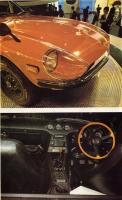
I'm going to post a photo of one of the cars on Nissan's show stand at the 16th Tokyo Motor Show, which ran from 24th October to 6th November 1969. There were quite a few cars on the stand, and a lot of them were S30-series Z cars. They even showed an "Export" version ( as our colleague Kats recently pointed out ) and both a 432 ( "PS30" ) and 432-R ( "PS30-SB" ). I just wanted to post this picture to illustrate the 1969 show and its date:
-
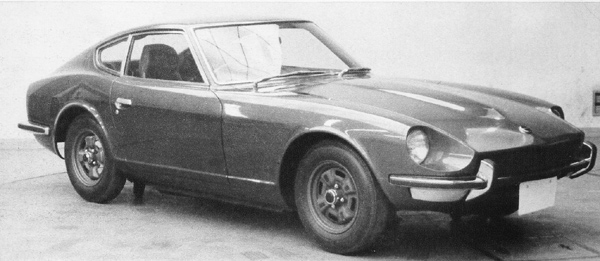
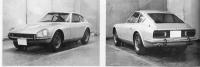
....and here's the third photo. Its one of the prototypes from around mid 1968, and you can see that its getting really close to the final design. Notice that it too is RHD:

-
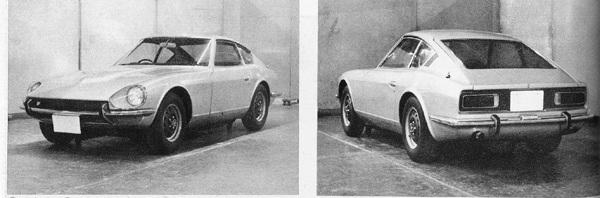
....and here's the second photo. Its a prototype from around early 1966. This was before the design was made wider, and a few detail changes were made. It is also RHD:
-
The first 500 S30-series Z cars EXPORTED were sent to the USA / North American market. These were not the first 500 S30-series Z's MADE. Even the LOWEST "HLS30" VIN number ( lets say for the sake of argument that "HLS30-00001" actually got sold to the public ) will not actually prove that the car was made before "S30-00001" or "PS30-00001", or even "HS30-00001". That's the whole point of the gripe about Z history being written around the Export cars - and the HLS30 in particular. English-language history writes the HLS30 "240Z" as the first of the breed or some kind of Darwinian ancestor to ALL the S30-series variants. Thats just not true. The S30 series Z was designed in Japan. It was made in Japan. It was put on show to the general public for the first time in Japan. RHD S30-series Z cars were sold to the general public first in Japan, and therefore RHD S30-series Z cars ( both Fairlady Z and Z-L, and 432 and 432R ) were being made on the production line either before or at the same time as the HLS30 "240Z" model. I have been assured by an original Z production line worker in Japan that the Export RHD version of the "240Z" ( the "HS30" ) was 'productionised" - or finalised for the assembly line - at the same time as the other models, but the first production of cars for sale to the general public was delayed. Apparently, this was due to production line space and the fact that the HS30 had to conform to Type Approval laws for both the Australian / NZ and UK markets ( causing spec. changes in lighting ). Many people seem to believe that the S30-series Z car was designed AS an LHD car, rather than either being designed for both LHD and RHD use, or designed initially as an RHD and productionised with an LHD version. For those people I would like to post the following photos. I have more - but space here is slightly restrictive and I think that these three might help to illustrate my points. Here's the first: its a styling sketch from the late 1965 / early 1966 period by Yoshihiko Matsuo. Notice that he has drawn an RHD car:
-
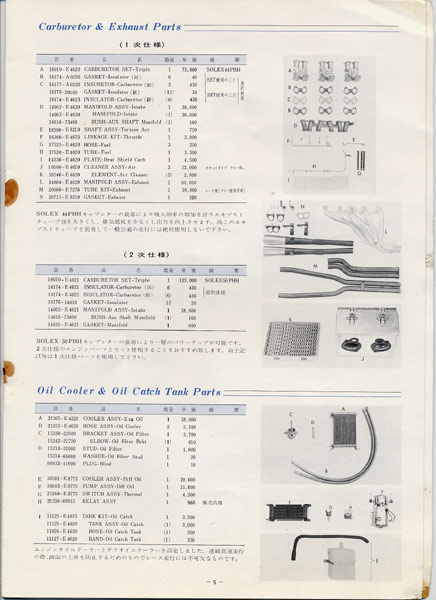
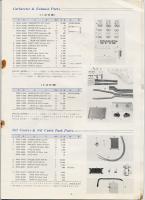
- and here's a copy of Page 5 with the carbs and manifolds on it. The total document is 12 pages long and its pretty comprehensive. Size restrictions will limit me to posting just a reduced copy here - but I can e-mail you some big files if you have the space and no restrictions on your e-mail. Let me know. All the best, Alan T.
-
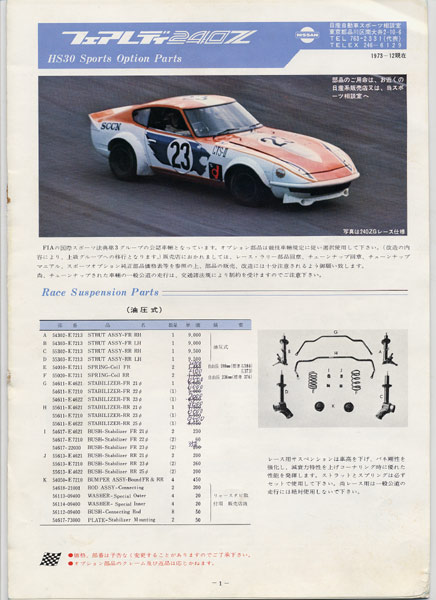
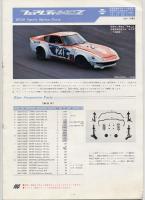
Hi Alan, I have the December 1973 version for the S30 / HS30. I used to have an earlier one for them too - but made the mistake of lending it to a classic car magazine here in the UK. Never got it back - they "lost" it. Great. I also have the 432 / 432R one, but that will not help you as the scrutes will look at the VIN code on your car and conclude that its not a "PS30". Good luck with trying to persuade them to let you use the carbs ( and all the rest of the Sports Option stuff ) - the Historic circuit racing guys here in the UK have tried to get this stuff allowed before now, but the cloth-cap brigade won't let 'em ( even though they allow all sorts for the British and Italian cars ). The poor Z cars have to run virtually stock - not even LSD! The Historic Rally guys have it quite a lot better, as its run under FIA rules - so all the FIA homologated stuff ( up to around 1978 ) can get in OK. Will your local scrutes not allow stuff under FIA homologation? Anyway, here's a copy of the title page:
-
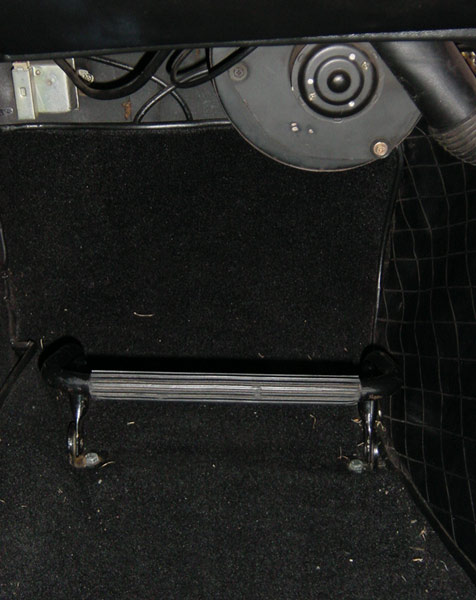
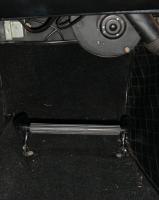
Just in case anyone's not seen what the Japanese-market Footrest looks like:
-
Zedrally - I think the Choke ( and Hand Throttle ) positioning on the RHD cars is just fine. Don't you? All things considered, their position is a default if the Handbrake lever is on the right of the tunnel. Sean, in answer to your query about the Passenger Foot Rest ( entertainingly called the "Navigator's Foot Rest" in the Japanese sales catalogues ) - this was an Option part in Japan. It could be specified on any of the early Japanese-market cars for a small extra cost. Most of the Japanese-market bodyshells that I have seen had the strengthened mounting bosses on the passenger footwell ( they were spotwelded on and sealed with rubber bungs if not used ). This made the footrest a bolt-on accessory. To my knowledge, no export model cars had these bosses spotwelded to the floor from the Factory ( but I have seen a couple of export-model cars that seem to have had them added later ). Japanese-market cars also had the extra front seat-rail mount brackets ( allowing the seats to have two different bolt-down positions for the runners ). Notice that the REAR brackets always have two sets of holes - more Z hermaphrodity. Did anybody ever wonder about them? Many people who have had a ride in the passenger seat of my ZG comment that the footrest is a handy thing to be able to use. You can hook your toes underneath it or put them on top to brace yourself when you are convinced that the driver is going to have another off track excursion. Not all of these people were shorties either. One genius even noted that it allowed him to keep his feet away from the exhaust heat on that side of the tunnel. Any of you left hooker owners ever feel slightly overwarm in the throttle-foot department? Time for a Gipsy's kiss and a cup of Rosy Lee I think, Alan T.
-
Thanks for the Internet history lesson Enrique. I do appreciate that the country where a website is based is going to influence its bias, but we ARE talking about the history of a Japanese car. I can't believe that anybody would be so taken in by its local distributor's advertising copy and marketing hype that they truly believed stuff like the "full size American space" quote. But then again, it was the end of the Sixties and perhaps we were all quite a lot more gullible then. I wonder if American buyers of British "Sports" cars of the same period had the same kind of advertising fired at them? One of the reasons that these British makes started to die out was that customers came to realise that they were having a re-heated version of last-week's leftovers put in front of them. Whatever, yesterday's advertising copy should not be allowed to become today's gospel. Ah yes, about my Horn Pad........ Chief Inspector Scanlon certainly spotted that my horn buttons are in rotation ( nothing gets past you does it?! ). I use either a "Datsun" logoed horn button, or the Japanese-market "Z" logo button depending on whom I'm trying to impress. The "Datsun Compe." Sports Option-list steering wheel was ( somewhat ironically in view of the above discussions ) branded with the "Datsun" logo in Japan. Many Japanese Z enthusiasts find the "Datsun" logo something of a rarity / novelty. There are others who prefer not to have the "Datsun" brand on the car. I swing both ways ( but don't tell anyone - OK? )........ This does not seem to apply in the USA, but over here in the land of cloth capped, tweed-jacketed and pipe-smoking "Sports" car enthusiasts, the "Datsun" brand is something of a joke. This makes it rather amusing to turn up in the paddock of a VSCC or HSCC race meeting in something that most of these dinosaurs do not recognise. Its nice to see their expressions change when they see the word "Datsun" on the car. Most of them would recognise the shape of a "normal" bodied S30-series Z, but 99% of them have no idea what a Fairlady 240ZG is. Of course the next question is "why" I riveted on those tacky flares and the 250GTO bodykit. Almost nobody believes it left the factory like that. This is why I am trying to put together a Fairlady Z432-R replica. I can't afford to buy a real 432 and then turn it into an "R" replica, but its possible to make a pretty good job from an early Japanese bodyshell and put some REAL parts on it. I REALLY want other people to hear, smell and see an early Z with an S20 engine in it. I'd love for everybody on this site to experience it too, and when its finished I am giving an open invitation for anybody who is interested to come and have a drive. Although they are not ultimately all that powerful, its the balance of the 160-odd BHP in a light shell driving through a close-ratio 5-speed to an LSD-equipped 4.44 geared diff and on skinny tyres, that is so good. Add that extra ingredient of a little mystery and rarity, and you have what amounts to the perfect Z Martini........... Cheers! Alan T.
-
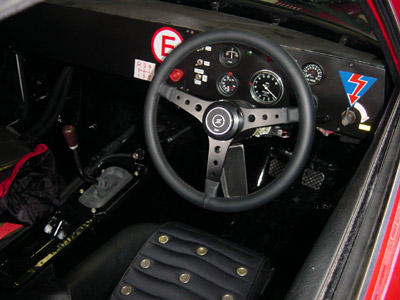 This is a race-only dash, custom-built by the Factory race team. The earlier Factory race cars used a chopped-about version of the stock dash. This car is later, and dispensed with the stock dash completely.
 -
Ouch! You just hurt my car's feelings! Seems not everybody likes the Japanese home-market mirrors, but "abominations" is a perhaps a bit strong!........... Still - at least you'll be able to turn them into money. What's the plan for filling in the massive holes they will leave in your front guards though? The spring-back mount for the JDM mirrors is enormous. They are a little like icebergs; what you can see sticking out is only half the story................ Alan T.
-
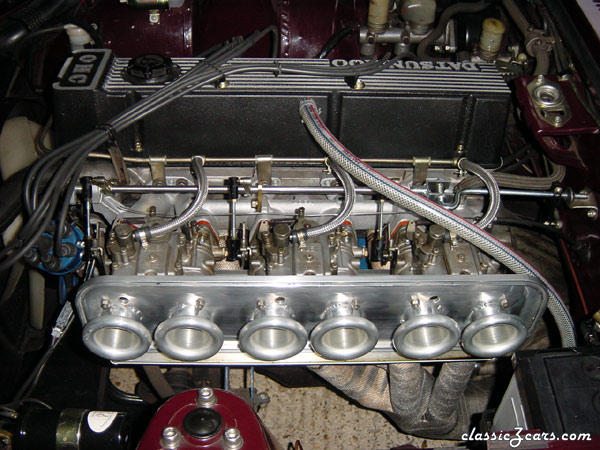 Yes, its a big help actually. It reduces heat-sink into the carbs and engine bay, but its expensive and quite difficult to make a neat job of installing it. Definitely recommended.
 -
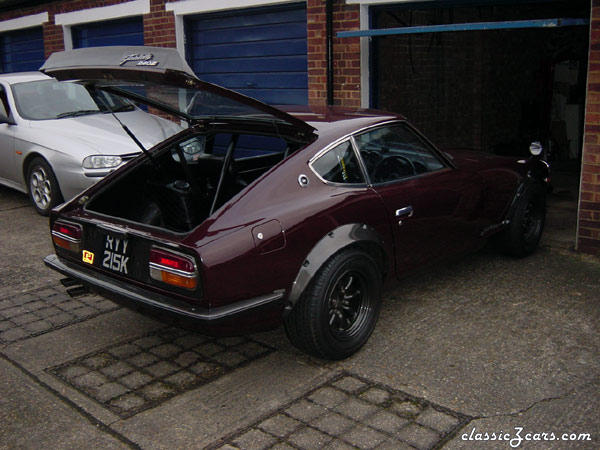 Hi Gav, the 432R replica is currently living in the paint and body shop. Its been there a long time already, as its having work done on it when there is space ( to get a cheaper rate ). I'm busy gathering other parts for it - so it suits me fine. Its re-assembly home will be in another of these lock-up garages as in the pic. above. Good point about the heating in the 432R ( you are right - the "R" model had no heater at all ). I think I will have to compromise, as no heat / demisting is a real problem here in the UK. I will probably just block off the eyeball and centre dash vents. Some street-used R's had heaters retro-fitted by their owners - so I have a precedent there.
 -
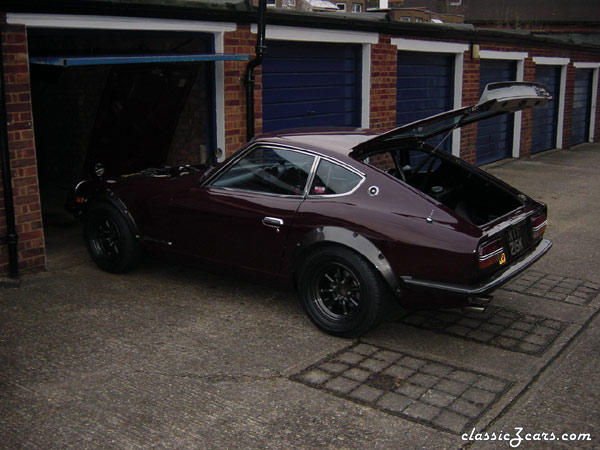 If that row of garages was all mine I'd be able to live off the proceeds of renting them out! Here in London, there's a real shortage of covered parking. I rent three of these and they are a good 30 minute drive across town, but still expensive.