mdbrandy
Community Member
-
Joined
-
Last visited
Everything posted by mdbrandy
-
I had a short e-mail conversation with the winner. He has a restored '72, so at least it is going to a good home .
-
Well, that's pretty standard e-bay disclaimer stuff. I wasn't really worried about it.
-
Actually, there's no telling how much I really missed it by. I bid with 17 seconds to go, and was high bidder at $80. The other guy then sniped in with 3 seconds left, and put in a bid that was something higher than mine. There is no way to tell what his maximum bid was - e-bay just bids slightly higher than the next highest bid for you. So he could have bid $150 for all I know. Let's think that :cross-eye . That way I won't worry about the fact that he might have only bid $105, and if-only....!!!!:tapemouth That's one reason I snipe. Gives me no time to lose control and get into a bidding war.
-
Rats! That one got too expensive. $104!!
-
Only available in black unless you're lucky. Every once in a while other colors show up on e-bay, and Chloe has taken to coloring black ones with custom colors, although I don't know how many different colors.
-
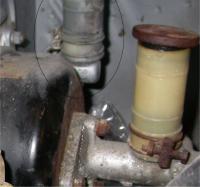
You appear to be correct. The pic attached shows the MC (circled in the background) on my '70 240Z. Reservoir at the very end of the cylinder. I just went out to my 280 and looked at what I bought from Nissan a few months ago, and it has the reservoir about halfway down the cylinder. Learned something new today! Thanks.
-
So, this is a part that I haven't researched differences in. Are the MCs different between the 240 and 280Zs? I didn't think they were. Last winter I bought a new MC for the 280 from my local Nissan dealer. Pricy, but I needed it fast.
-
That has nothing to do with oil pressure. That is a separate sending unit on the right side of the block down by the oil filter.
-
Doesn't sound normal. In my '78, when the car is cold, the oil pressure guage is maybe 1/4 of the way up at idle, and 2/3 of the way up when I am driving. Once the car warms up, the idle pressure is a little above the bottom mark, and the running pressure is something around half way. Which part can't you find? The sending unit, or the guage? The problem is more likely the sending unit. I know Chloe (MidwestZ) can get those - the NOS Nissan ones are over $50, but there are aftermarket ones too that are cheaper. I have no experience lately buying and installing one, however.
-
I think Carl's point is that while you may be seeing flow, it may be only half the flow that is supposed to be there due to plugging of the radiator tubes. No way you can tell by just looking. Heat transfer in an air-to-water heat exchanger like the radiator is highly dependent on heat transfer area (as well as velocity, surface conditions, and other things), so half the flow would be at most only half the heat transfer. Maybe at idle that half flow is fine, but at speed, the engine's heat output outstrips the radiator's (degraded) flow ability. Bottom line is don't discount the possibility of degraded radiator flow due to plugged tubes. Wish I could help you on the sender. Don't know that one.
-
I just got over my overheating problem on my '78 by replacing the fan clutch. However, my problem was opposite from yours - I could not idle for any length of time after the engine was up to temp without the temperature quickly rising. Getting the car moving (with air moving through the radiator) brought the temp back down. New fan clutch was the ticket. For your problem, I don't know. My fan clutch was freewheeling, and thus not cooling enough. If yours is locked up instead, could it be fine at low speed, and putting extra stress on the motor/water pump at higher RPM, causing higher temps? Seems like a SWAG, but.... Since your problem is occurring at higher speeds, seems like it should not be a problem with moving air through the radiator (is the radiator clean outside?), so it has to be with moving hot coolant through the radiator. Thus, thermostat, blocked radiator, bad water pump, etc. are reasonable things to look at. My guage is now pretty much rock solid right in the center.
-
If those are for me, after I answered the first time, I refreshed the home page, and this question showed up under the latest news items. It is gone now, so Mike must have moved it to the right place.
-
BTW, this doesn't belong on the front page news...
-
Depends on what STUFF you mean :classic: . Engine, yes. Transmission, yes. Other parts of the drivetrain, many/most. Gas tank, I don't think so. Interior, lots of things no, some yes. So, what do you mean?
-
Ok, so now it all works. Kind of have to read around MSA's directions, and understand the hub geometry very well versus the original wheel. I had pounded the roll pins in too far, because I was baseing their height off where they entered the hub. Well, that's wrong. The height of the pins on the original wheel must be equal to the height ABOVE THE BASE OF THE HUB on the new hub, and not height above the surface where the pins enter the hub, like on the original wheel. Also, I hadn't been able to figure out which holes to put the pins in, because I had followed their directions and put the hole in the hub marked "Up", at the top of the wheel. Wrong again. If I rotated the hub about 120 degrees, then the holes line up for the wheel, and the correct holes are available for the pins. Lastly, you have to bend the HECK out of the horn contact on the steering column. I had to raise it probably almost a full inch to get it to contact the copper contact ring. But it works now, and I don't think it will hurt anything.
-
Ok, I did as we had discussed above; ran up to temp, disconnected coil, FI relay, and removed all spark plugs. Screwed compression guage into cylinder 1 and pushed button on remote starter. Well, the starter turned, but after 2 or three revolutions, it disengaged and spun. So I tried it again; same result. I took off the remote starter switch and used the ignition key instead. Same result. Starter will turn engine 1 to 3 revolutions, and then disengage and just spin. It's like that without the sparkplugs it can spin the engine too fast, and doesn't like that, so it disengages. I have the gear reduction starter on the car (that's apparently what it came with). Anyone had similar issues? Note that I have now installed the plugs, rehooked-up the coil and FI relay, and the car starts like a top. No problems.
-
I'll post how things work out. Did your adapter actually have pin holes where they should be? On my original wheel, the roll pins are directly on either side of the center shaft hole. On the adapter, one was beside the hole, and one a little lower. Couldnt find a geometry where two pin holes were directly across from each other like on the original wheel. Also, the roll pins would not insert into the adapter so that they only stuck out as far as the originals. They stick out farther, but still do not engage the turn signal mechanism. Fun.... Mine came with that little spring and contact you're talking about, but it was marked for 'Nissan, 1980 and up'. Since mine's a '78, that shouldn't matter either...
-
I can't actually vouch for the information, since I didn't actually use it yet, but this writeup seems reasonable: http://www.jrdemers.com/280ZX/tankvents/tankvents.html
-
So, I installed a new steering wheel today. Got it from MSA, and it came with their "Billet Hub". Looks nice. However, I can't for the life of me get the horn to work, or the turn signals to turn off. It looks like there is no way that the horn contactor that slides around on the copper ring is going to touch. One of the roll pins could not be installed in the same position as on the orignal wheel, although it was close. But it appears as though neither of them do anything. AND, they are both actually sticking out too far, although it's fairly obvious that they are not rubbing on anything. So it isn't that I inserted them too far. Anyway, I'm going to pull it again tomorrow, measure the distance between the roll pins on the new and old wheel, etc, and then I'll call MSA on Tuesday, but if any of you that have installed an MSA-supplied adapter on a 280Z have an hints, I'd appreciate hearing them. Thanks.
-
Yes, I tossed $25 at it to see where the other guy's head was. He had already bid higher. I'm sure it will go for more. We'll see where time takes the bidding...
-
Thanks Stephen, I did forget to mention the coil wire. Question, however - if I've removed all the spark plugs, and thus disconnected all the spark plug wires from them, what difference does removing the coil wire make? I can see it to keep any of the hanging plug wires from arcing to something that they shouldn't, but otherwise...
-
Thanks, Carl. Sounds like the quickest thing for me would be to warm up, disconnect the FI relay, pull the plugs, and go to it.
-
Would disconnecting the FI relay disable injector pulsing but allow the engine to crank? That'd be good. Probably just take a minute to disconnect the relay. ricksaia: Need to keep from pumping fuel during the compression test. Lots of raw fuel through the exhaust will supposedly screw up the cat converter. 78 280zcar: That'd work too, but would probably take as long as removing the injector connectors. One question that no one has answered is how important is it to have the engine up to operating temp? Obviously the clearences are more correct at temperature, but how different would the readings be with a cold engine? Or with an engine that has cooled down for 15 minutes? I read about many people measuring their compression - do you make sure the engine is hot? Thanks.
-
Interesting thought. Not sure whether there's one fuse or multiple, or whether I'd have to pull a fusible link. Also, the EFI is so integrated with the starting/ignition system, that I'll have to see if it will turn over if I do that. But it's a good idea. We shall see!
-
Ok, time to tune up the 280Z, and I wanted to test compression while I have the plugs out. Haven't run a compression check on any car for probably 20 years, so I opened up the factory manual to read what it wants me to do. I assumed I had to keep fuel from being injected through the EFI system. Factory manual wants me to disconnect all the injector connectors and the cold start injector connector. AFTER running the engine up to temp. However, those connectors are pretty brittle by now, and I'll have to be very careful with them. It's likely to take 15 minutes or more to carefully disconnect all the connectors and remove the plugs. By then, the engine will still be warm, but by no means at operating temp. So how important is having the engine up to operating temperature in testing compression? Any other tips or tricks for measureing compression on an EFI engine?