emptech
Community Member
-
Joined
-
Last visited
Everything posted by emptech
-
A friend of mine has a smoke machine, good for finding air and vacuum leaks, if my intake gasket is not leaking, I'm not going to touch it. Jim
-
I was considering a master vac leak, pumped on brakes, pedal went to floor, resivor for rear brakes was dry, filled up, fluid going somewhere. Rebuilt cylinder, now other issues. Should put that on hold and get back to vac leak problem.
-
I can't remember on the gasket, swapped carbs years ago. Going down another rabbit hole now with brake problems. Can we still get the gasket?
-
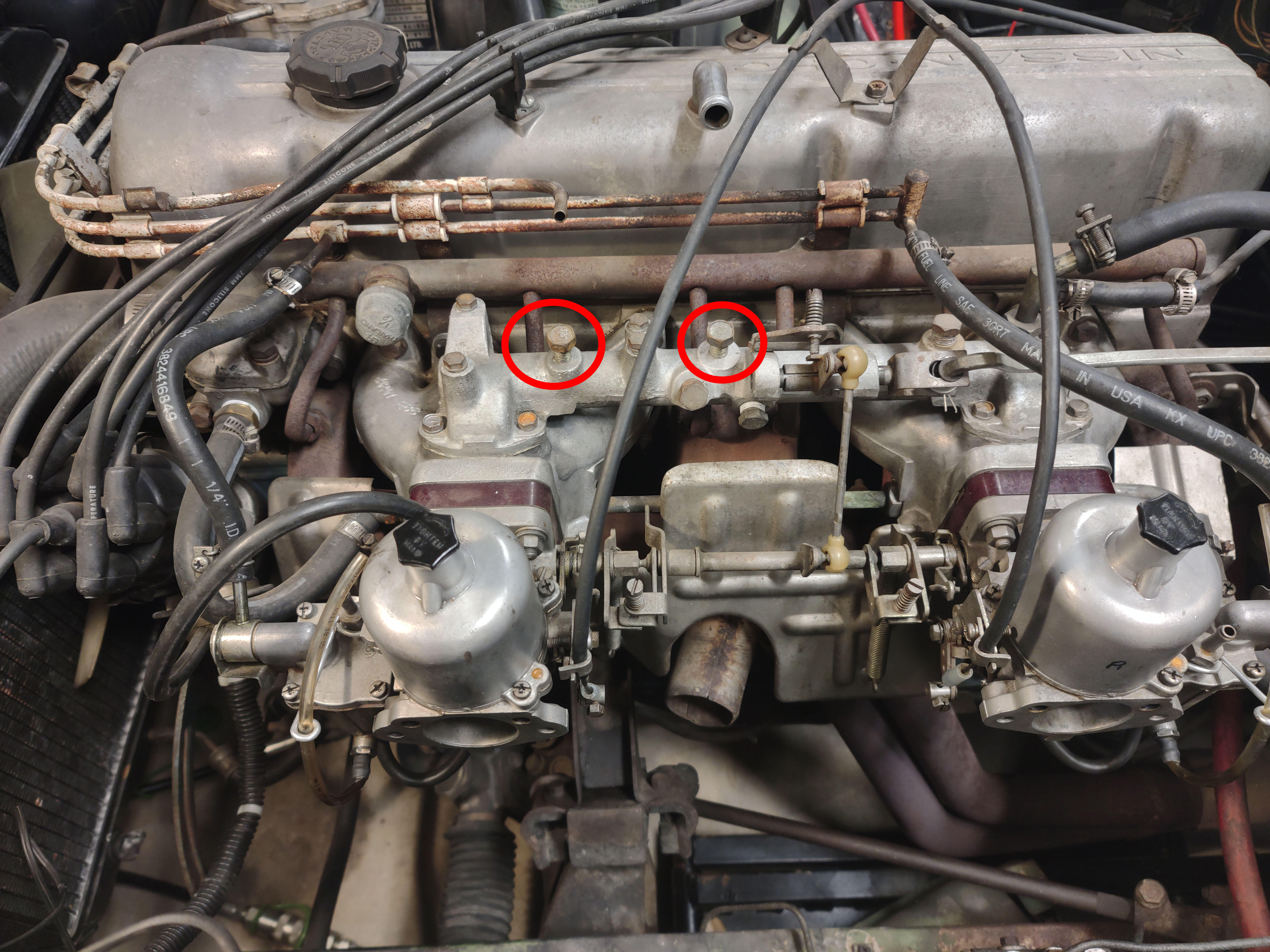
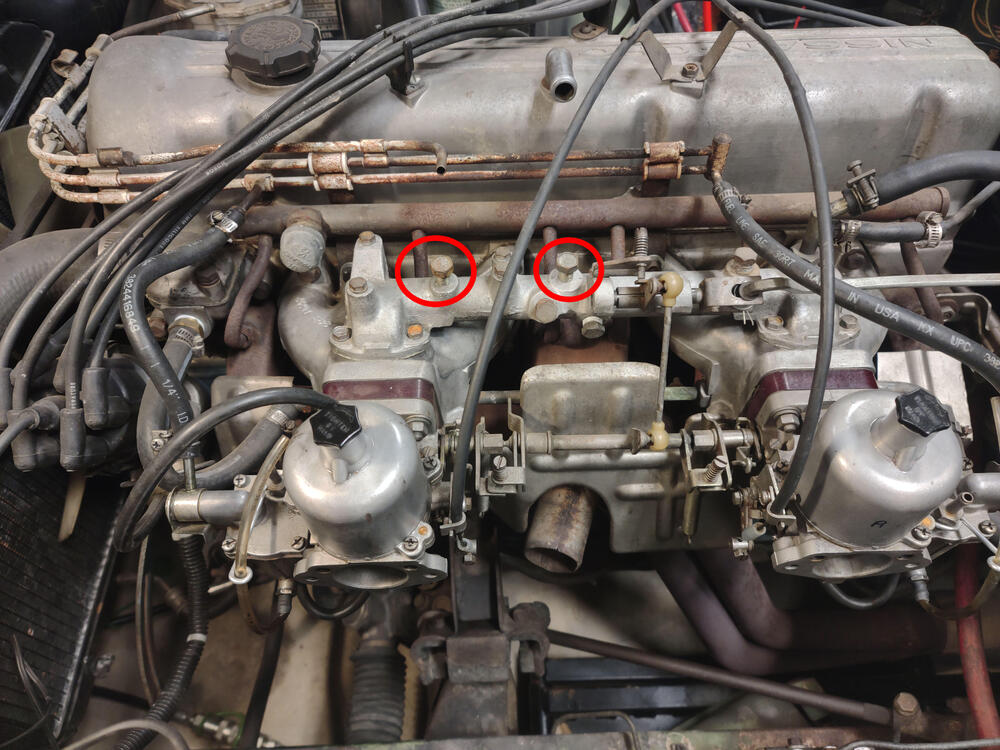
As I'm working on a 260z engine, I found somebody decided to plug some holes in the balance tube by using two 10mm straight thread cap screws (bolts). The original holes were tapered but they forced metric cap screws into the holes, ruining the threads. Notice they were only able to get the screws in part way. I've attach a photo, I circled the two locations. Without drilling the holes out I was able to thread the holes with a 1/8-27 tapered pipe tap, thus allowing me to use 1/8" plugs. All other plugs I've found seem to be the proper threads. Jim
-
CO, I have to apologize on what I said about the barb fitting taken off the 260z balance tube. I went back and looked at the balance tube, the fitting I have with 27 tpi did not come from the balance tube, it was in the box of parts and I assumed that's where it came from. You are right, you know your stuff. As soon as I get the brake problem solved I'll get back to my mixture adjustment and vacuum leak. Jim
-
I mentioned that somebody plugged holes in the 240z balance tube. I was able to run a 1/8-27 pipe tap into the holes, there was enough metal there to get some good threads. I then sealed the holes with 1/8" brass pipe plugs (which I made) and a turn of teflon tape. What's interesting is that I took off a fitting from a 160z flat top balance tube, a barb to male taper fitting. The threads on my 27tpi pipe tap were exactly the same pitch as the fitting from the 260z balance tube. So perhaps Nissan used different thread standards? On to the next problem, vacuum leak. Jim
-
Yes, take it a lock smith. If the core can be removed from the cylinder it isn't that difficult to make a key. Key blanks are common. I can't recall if the core is wafers or pins. Come to think of it, it's a double cut key, so it would be a wafer lock. To remove the core from the cylinder without a key, not a big deal to pick the lock. I have no idea what a lock smith would charge, but it's not a big deal. When I closed my business I kept all the key blanks, I probably have what you need. Jim
-
I salvaged a fitting, barb to male taper thread. A 1/8" NPT 27 threads tap lines up perfectly with the fitting I just pulled. That's what I'm going to chase the threads with, using lots of teflon tape, and install 1/8 pipe plugs. I have lots of brass hex stock available, I'll probably just make my own plugs.
-
Just to let you know, what appear to be bolts plugging the holes in the balance tube are actually tapered pipe plugs. They have a different pitch than most metric bolts and if you force a metric bolt into the hole, you will ruin the threads. I know, I'm working on a 240z that somebody plugged the holes with ordinary bolts, now I have to correct their damage.
-
Some of the holes had real taper plugs, pipe threads. Two of the taper holes were about 10mm and somebody had forced straight thread bolts into the taper holes, ruined the threads. I might be able to chase them and put in 1/8" taper pipe plugs. I don't know that the bolts made a good seal. I"ve verified that some of the threaded holes are 1/8" NPT 27, I'll chase the threads and with teflon tape will repair the holes. I have a 1/8" to barb adapter I can connect my vacuum gage, haven't used it in years. Jim
-
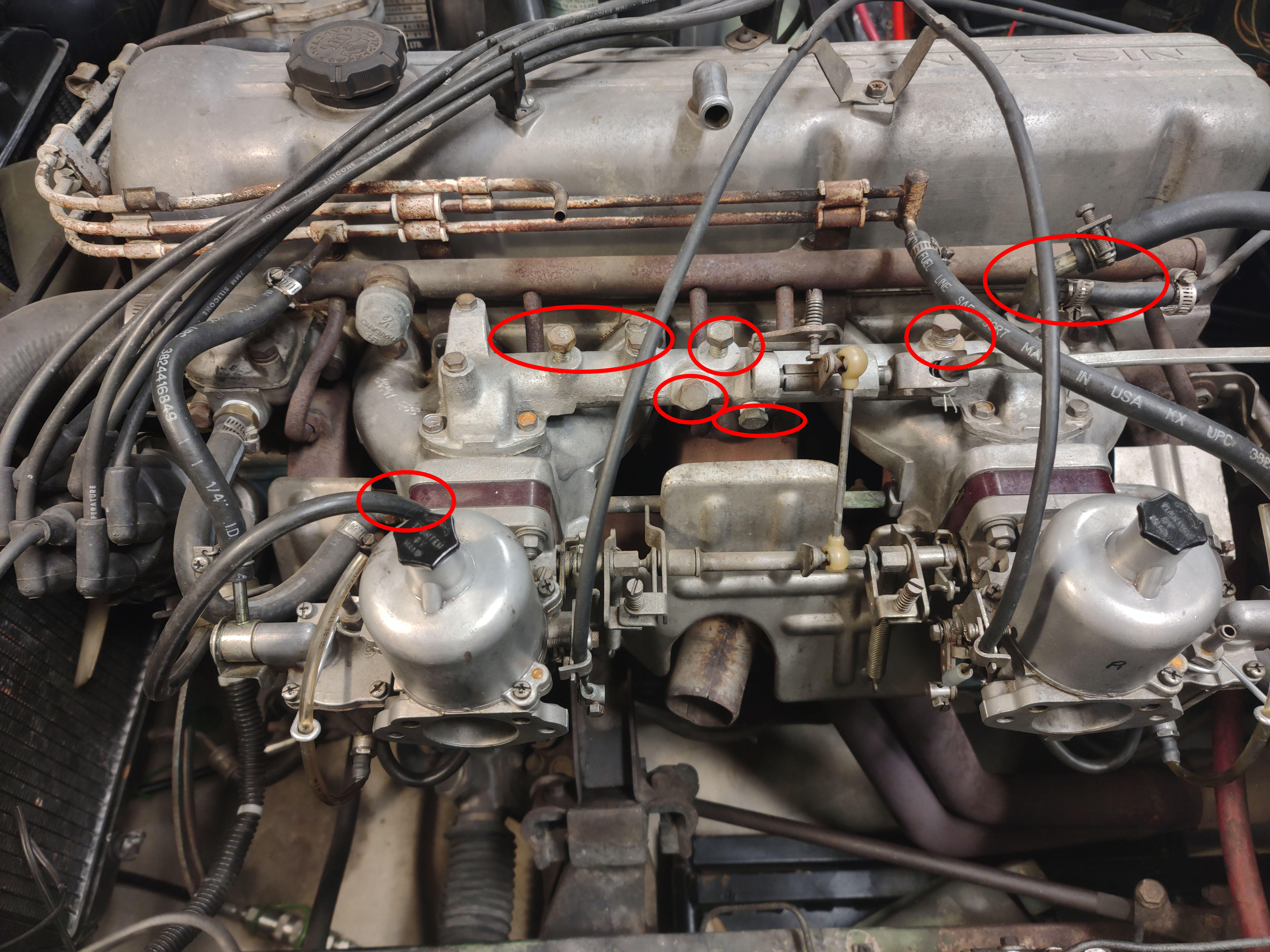
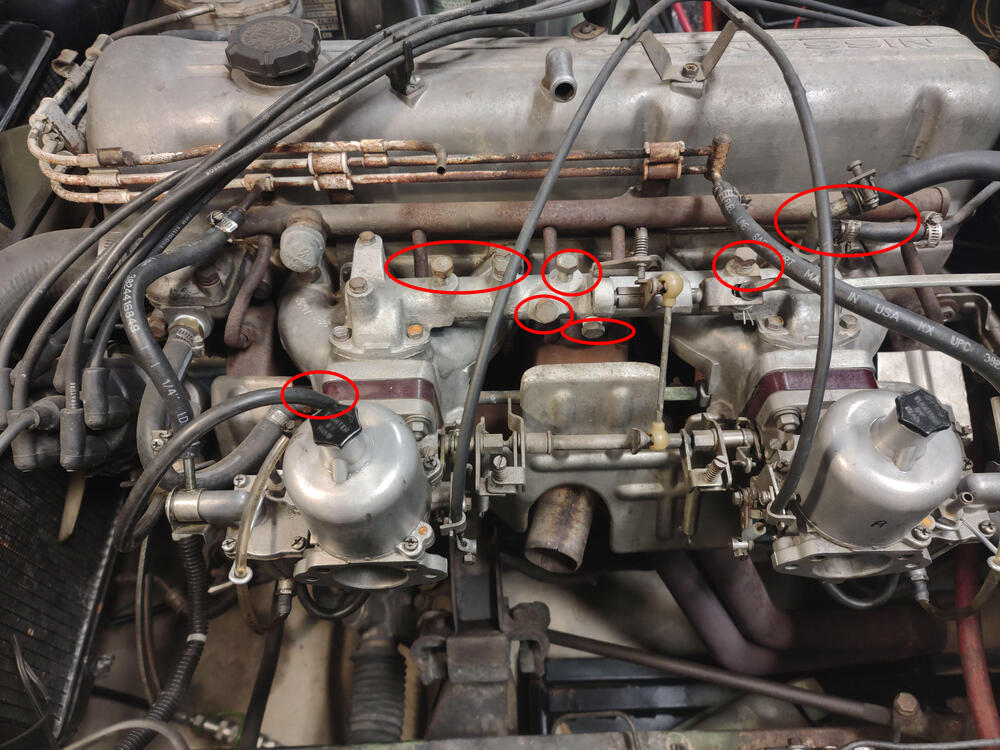
I included a photo. I circled all of the ports in the vacuum manifold, I think they call it something else. I bought the 240z assembly used on ebay, so somebody had messed with everything, I mean everything. They plugged many of the threaded ports where things, mostly emission items attached. They did not use Teflon tape, and I don't even know if the threads matched. I'm thinking about removing all the plugs, which in some cases are just bolts. If the threads are not right, correct them and use teflon tape to seal the threads. It would be easy to seal off the vacuum lines going to the master vac and transmission.
-
I pulled the hose going to the master vac, sucking on it or blowing into it no obvious leak there. I did not try compressed air. This is a 260z with an automatic transmission. I see vacuum lines going to the master vac and down to the automatic transmission. There is another vac line from the front carb to the vac advance on the distributor. There are two fuel rails, one from the fuel filter/fuel pump that feeds the two carbs, another one that feeds excess fuel back to the gas tank. The top hard line has nothing connected on either end, I think it was part of the smog system. I did find a hard line going somewhere, think it was a vent line to the gas tank, probably went on the charcoal filter cannister. The only thing that makes sense to me to have to turn the nuts so far down is a vac leak, but where? Would there be any point in connecting a vac gage to the intake manifold? I'm puzzled. I haven't tried using a propane blow torch to leak propane around suspected leaks but it's not like this car has vacuum lines going all over the place, it doesn't. I'd attach photos but don't know what would help at this moment.
-
CO: I feel pretty confident that the float levels are now correct. I have not checked for vacuum leaks, if the rubber diaphragm in the master vac was ruptured, that could be giving me a lean mixture and turning the nuts six turns down would compensate. Somehow I need to cut off the vacuum line to the mastervac. The engine used to have a carbon canister which I removed. I wonder if it had a vacuum line going to it, if so I wonder what I did about it. I agree, years ago when the car was driven, had to pull the choke back to get it to start, then would back it off a bit to raise the idle speed until it warmed up, not the case right now.
-
I discovered something I was doing wrong. On the bottom of each carb is a small button, the service manual calls it a "lifter." By pressing it with one's finger, can raise the piston slightly, I think the purpose is to make sure the piston isn't stuck. By pressing on the lifter, the piston goes up along with the needle. Logic says that would make the mixture more rich, so I thought and I would use that method to determine if my mixture was rich or lean, bad idea. The manual says to turn the nuts 1/8 turn at a time to find the max rpms. I think I'm in the ball park, I need to find where I get the highest rpms by adjusting the nut on each carb. Once I get the mixture proper, I can return to setting the idle speed and the balance. CO was very helpful in getting the floats adjusted, I ended up per his idea of adding weights to each float. If I'm on the wrong track, please let me know, I'm open to suggestions. Jim
-
The needles are adjust correctly, one takes a straight edge along the piston to make sure the shoulder on the needles are correct. There is a lot of history here, had a very difficult time getting the needles and floats adjusted right in the bloat bowls, that took an enormous amount of time. I have a tach on the coil, next is to turn the nuts to go on the rich side, then rock back and forth to lean, looking for max rpms, at least thats what I understand. I've been running fuel out of a 5 gallon gas can, the excess goes back into the main tank, ran my gas can out of fuel. The fuel tank is somewhat rusty, need to find if it is usable or now.
-
Engine was running super lean, have the nuts turned down six turns to far. I think it's a bit too lean yet but it runs, had to adjust the idle screws, rpms was too high. I'll install a small tach and play with mixtures next. If I remember there is an idle screw on each carburetor. Then there is a screw that adjusts just one for the purpose of synchronizing them. The brakes have an issue, one of the brake reservoirs goes empty when I pump the brakes, got a leak somewhere, didn't see anything dripping on the floor. One problem at a time, engine first. Are master cylinder rebuild kits still available? Jim
-
Installed new fuel hoses from ZTheraphy, they are more flexible than my other hoses from the hobby shop. Fuel may have been OK, but running new fuel anyway. With choke all the way on, nuts about 2.5 turns down, starts with ether. Then RPMs picked up and engine ran for the first time. As I reduce the choke to the point where the choke is off, the nozzles all to the top, engine coughs and dies. With the chokes on again, engine runs, very clearly the carbs have been set too lean. I'm thinking about setting the nuts about five turns down, that should richen it. Then run it with the chokes on and gradually back them off. I think if I keep trying that and can get it to run with no choke, I'm in the right direction. If I get that far, I can start adjusting the mixture, one carb at a time to where the idle RPMs peak. I would then go back and forth between carbs for peak RPMs, once I get it stable, then synch the carbs with the unisyn and set the idle RPMs. BTW, have not done any actual testing for vacuum leaks. If there is a leak that happened by itself, I might check the vac assisted brakes, it has a large rubber diaphragm that could be rotten. I'm 77, and have forgotten a lot about this stuff but it's coming back. I think I'm in the right direction, appreciate comments. Jim
-
Still waiting for the silicon rubber fuel lines, but in the meantime disconnected the fuel filter and took a container with new fuel, connected to the fuel rail. I made sure to purge the questionable fuel. Cranked the engine, coughed and sputtered and the engine actually started. It was running extremely rough, couldn't even tell if it was all cylinders. Once I cleaned up some spilled fuel on the ground, I'll try again. The fuel level is set to 10 turns (10mm) below the bridge. I then set the nuts on the nozzles to 2.5 turns out from the bridge. I should pull the plugs just to see what they look like, hasn't been running in probably 5-10 years. As the engine ran, I could even hear the electric fuel pump running, thus fuel on the ground. I'm going to connect the fuel system back to kind of normal, where it will suck clean fuel from a gas can, as the tank is dirty. I also need to put some 20 weight or atf in the carbs, think I've used too heavy oil. I didn't have the engine running long enough to experiment with mixtures yet. I'll keep you posted, not out of the woods yet. Jim
-
I just ordered a pair from Z, I've used silicon rubber hoses before for other gas-related things, they would eventually get soft, but I'm told their's is made for gasoline. I'll do a visual again, looking for vacuum leaks can be difficult, if the engine was running one can use propane that gets sucked up from the leaks and you can hear it in the engine, but this guy won't start yet, oh forgot, need to use new fuel to be supplied directly to the fuel bowls. I'll keep you posted, hopefully getting close. Jim
-
I'm the original owner of a 72 240z, it's on blocks now, I want to get the 260 out of my hair so I can get back to restoring the 240. I'm all ears, been working on cars for a long time but I've forgotten a lot of stuff, I listen to everyone's suggestions. I've known for a long time the hoses can't be too stiff and normal fuel line is too stiff, that's why I used the special plastic tubing made for model air planes, but as it got older, it got more stuff. I have some chores today, when I get back I'll look into the choke linkage and hoses. BTW, the choke lever broke many years ago and was replaced then, it is a weak point, ever since then I would never pull the lever by the end, always at the base of the lever, couldn't believe how much those levers are selling for. I need to step back and look over the mechanism. Keep up the suggestions - Jim
-
The fuel lines to the nozzles are kind of stiff. They are a plastic material I bought from a hobby shop, made for model airplane fuel. I bought some su rebuild kits, came with new rubber tube's, did not install them. I made the assumption the fuel rails were the same from flat tops to round tops. I'm wondering if I should pinch off the line returning gas to the tank. The electric fuel pump doesn't get electricity until the engine runs, until the engine runs, residual fuel in the bowls is used to start the car, it works that way on my 72 240z. I believe I swapped out the entire intake manifold, not just the carbs. So the linkages were from a 240z, but we know what assume does. I th8nk the choke linkage may be stiff too.
-
There are still three fuel rails, one from the filter to the carb bowls. The second one sends excess fuel back to the tank. Nothing to and from the third hard line. I installed a push button switch so I can force the electric fuel pump on. The mechanical pump has been removed and bypassed. While setting float levels I would hold the button down for about 10 seconds while the bows fill, I could also hear gas trickle back into the tank. I have z therapy site glasses on the carbs and when I try to start the engine, the fuel levels in the bowls does not go down, or it doesn't look like it. Is it possible too much fuel is being sent back to the tank?
-
Now that I have confidence in the float levels, I'm still having a problem getting the engine started. Next step is brand new fuel. A reminder, I removed the 260z flat tops and replaced them with 249z carbs. I read the thread about the nail in the carb, I need to takea step back to see what I missed. Hate to say, the car ran fine with the flat tops, I have to remember, if it's not broke, don't fix it. When I run the engine with a puff of ether, it caughs and sputters, not getting fuel, sounds too lean. I was hoping the bowl level would have fixed it. Somebody had messed with the carbs before I got them. Ideas?
-
I'm curious as to what the culprit is. Was it the distributor, ignition module? Was it even an electrical problem? I had a problem once with my 72 240z that would stall when going down the freeway. I would start it, it would run again. I ended up putting a Tee fitting in the fuel line from the fuel pump and ran a pressure gage inside the car through the window. Turned out when the engine would quit, there was no fuel pressure. The steel fuel line from the engine to the tank had rust in it. I actually got it cleared by running a wire through the fuel line. So, what happened? Jim
-
I finally got the fuel level with the jet while turned 10 turns down, I then returned to what people recommend as a starting point, 2.5 turns from the top. With the choke on, will only run on starting fluid. The only thing I haven't tried is fresh fuel, Ive been using fuel I keep for my lawn mower, haven't tried new gas. Ideas? Jim