chaseincats
Community Member
-
Joined
-
Last visited
Everything posted by chaseincats
-
Hi all, I am replacing all of the grommets in my firewall since they are 50 years old. I noticed the AC and heater core hoses use a single oval-shaped firewall grommet instead of individual ones for each hole. Is there a reason I shouldn't use standard circular grommets for the hoses instead of buying the bespoke oval ones for $46 from thezstore (this one)? I found this picture of the firewall with the single oval grommet removed and it looks like 2 standard-fitting grommet holes. Any idea why they went with that ovular one? They must have used it for a reason I'd have thought, but I can't come up with a reason why using 2 circular grommets wouldn't work, no?.

-
Resurrecting this thread like pick-your-favorite Bela Lugosi movie. After giving up on this for years, I was on the highway last night with the driver-side window open (passenger side window closed) and it was REALLY making a lot of noise. I discovered when I shut the driver-side window, the sound goes away immediately, but re-opening it starts the sound again. This only happens at over a certain speed. It sounds like a huge hornet buzzing around in there. I'm assuming there is somehow air getting into the roofliner or side pillars causing something to flap around fast enough to make noise but I am not seeing any opening. Has anyone experienced this?
-
in what sense?
-
Dude just take it back to the mechanic who installed it and have him undo the new coil/MSD box as a test. There’s no reason to play guesswork if it worked before. I’m unsubscribing from this thread as this is the last bit of advice I’m providing because you're not listening to us.
-
Talk to the mechanic who broke your car. I have nothing else to add.
-
In that case, put those parts back on and see if it fixes the problem
-
Glad to hear its not leaking anymore and the gauge works. The car dying issue is too broad for us to help. I'd suggest taking it to a local mechanic.
-
he has a very hard time following directions - please don't throw any additional options his way
-
Use the thread sealant you found that @Patcon agreed you use. No more questions - you have the information you need. Do the thread sealant.
-
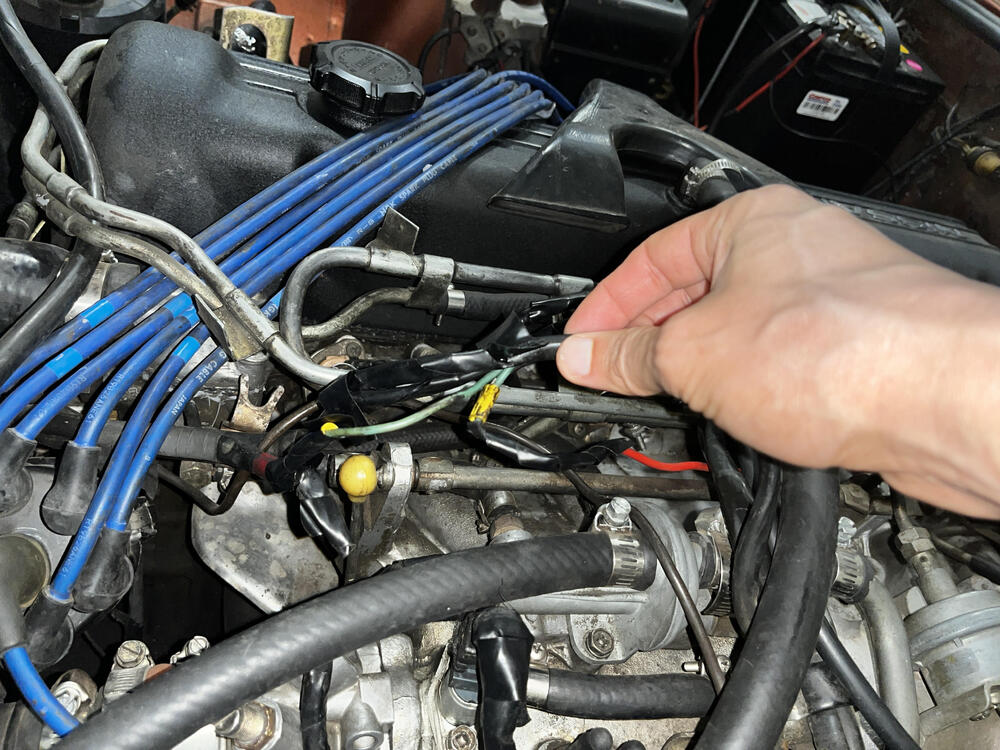
Update: I was able to confirm I do have the heat shield that sits between the headers and intake manifold as well as the one that shields the brake/clutch cylinders from the heat of the headers. I loosely zip tied the wires to the throttle rod like in the image so we should be good to go. My guess was the wires were too high and getting blasted with the radiator fan's air instead of hiding lower and being shielded by the dizzy and intake manifold angle. Thanks everyone for your ideas as always
-
Gotcha, I do have both of those - I didn't realize the vertical one you were talking about was the one that protects the master cylinder @Zed Head No, the prior owner added that a decade ago, not sure why.
-
can you elaborate a bit on this?
-
Would I need to remove any exhaust manifold bolts to add it? I'm concerned one or more would break.
-
Cool, it looks like it is ziptied to the fuel rail
-
That’s a good question - I know for sure the horizontal one is there but him not sure about the vertical since I do have headers. I’ll check
-
This is a great idea - I’m surprised Datsun didn’t do this out of the gate. Do you use this?
-
Can you post a picture when you get a chance?
-
Post driving update: The car drives great - if I had to guess, the bit of dirt/corrosion on the coolant temp wires had the car run in 'fully warmed-up max lean mode' with a car that doesn't get up to 180...but who knows. My question for you folks is where are you all putting the temp/thermotime bullet connector wires? I popped the hood after driving and these just get cooked in there to the level that the electrical tape glue starts to melt...then will harden again tonight. Granted this is what has been the case forever I guess, but with the new tape/connectors on there, I just noticed it. Is there a place you route them so they get less heat soak or do they just drape over the intake manifold as-is? I used to have them ziptied to the fuel rail but I'm sure that cooked them even more, no?
-
These are the two shakeables in the car that I’ve found so far that cause it to die: The first is the ecu temp harness connector which somehow even after the car is warmed up leans the engine out further: youtube video here The second is the main ECU power relay. If you knock on the relay bracket, the engine would die. I took that relay out, cleaned its contacts, tightened the internal screw it has to hold it to its metal cap, then to the relay bracket, now you REALLY have to bang on that bracket to get it to die. youtube video here This week I learned 'if your engine doesn't run right, jiggle and bang on things'
-
I replaced the connectors on the thermotime switch's sub-harness/its oem harness side years ago but left the temp gauge ones as-is and sanded them a bit because they weren't as bad. I'll change the connectors tonight for the temp gauge side regardless, but I don't understand why a higher resistance level/bad connection (which is supposed to richen the engine) caused it to lean out. Basically I'm looking for a definitive thing to point at and say, to quote Al Pacino, "that's the bad guy." Jiggling that wire fixed it, but I don't understand why.
-
UPDATE: After driving it yesterday and it running lean per usual, I got out and while the engine was running, jiggled wiring and when I got to the connection between the ecu coolant temp sensor and main harness, the car stumbled. After that, it returned to the proper mixture (14.2 idle instead of 14.7) and it drove great/richer throughout the rev-range unlike before. I got home and with a multimeter, noticed that if I jiggle that connection just right, that connection loses continuity. I read that over 176 degrees, the ecu fully leans out the car (the car was fully warmed up to around 170 degrees at that time (I have a 170 degree thermostat instead of 180)). That said, the ECU leans out the car by the temp sensor providing less resistance rather than more to the ecu (my connectors were slightly dirty/loose which would provide more resistance which should have riched it I'd think). I'm trying to figure out why jiggling that connection riched it instead of leaned out the car further. Any ideas?
-
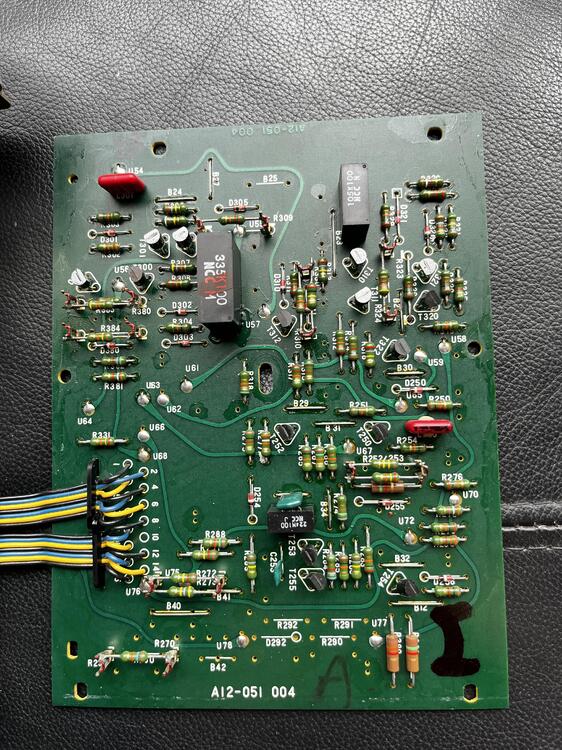
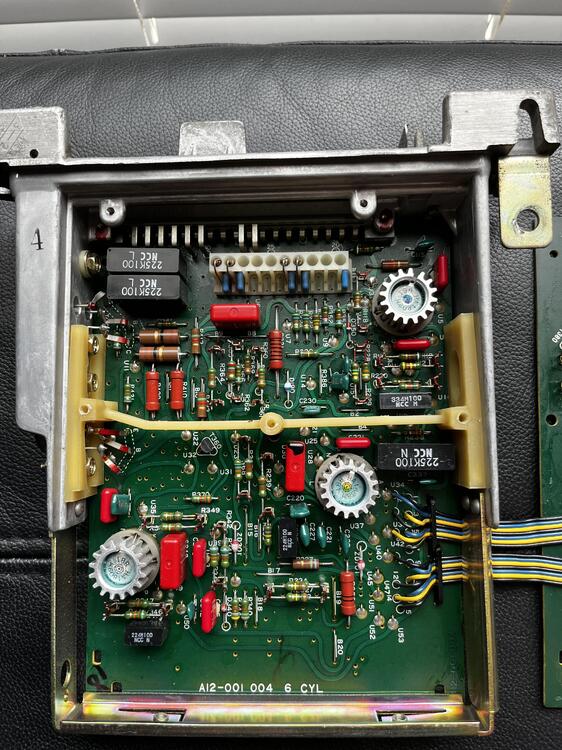
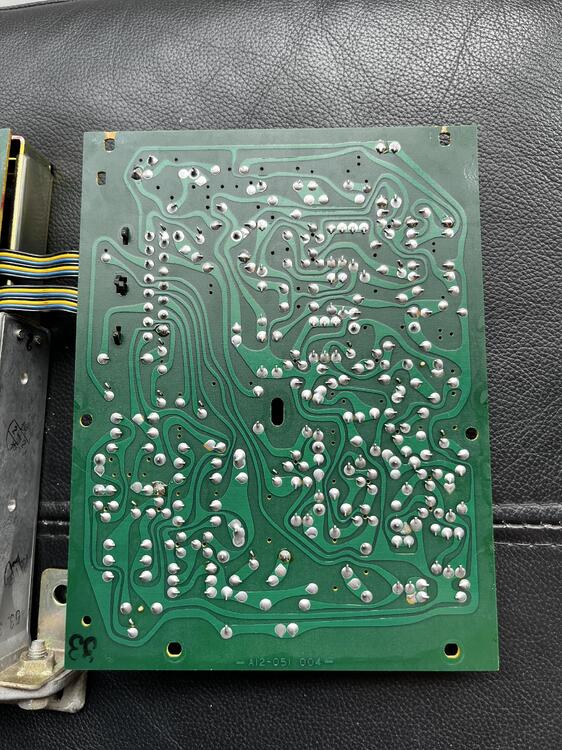
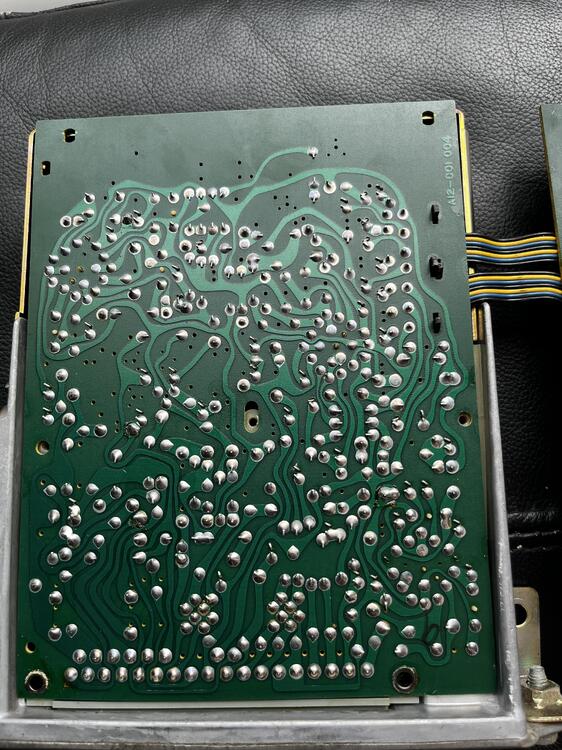
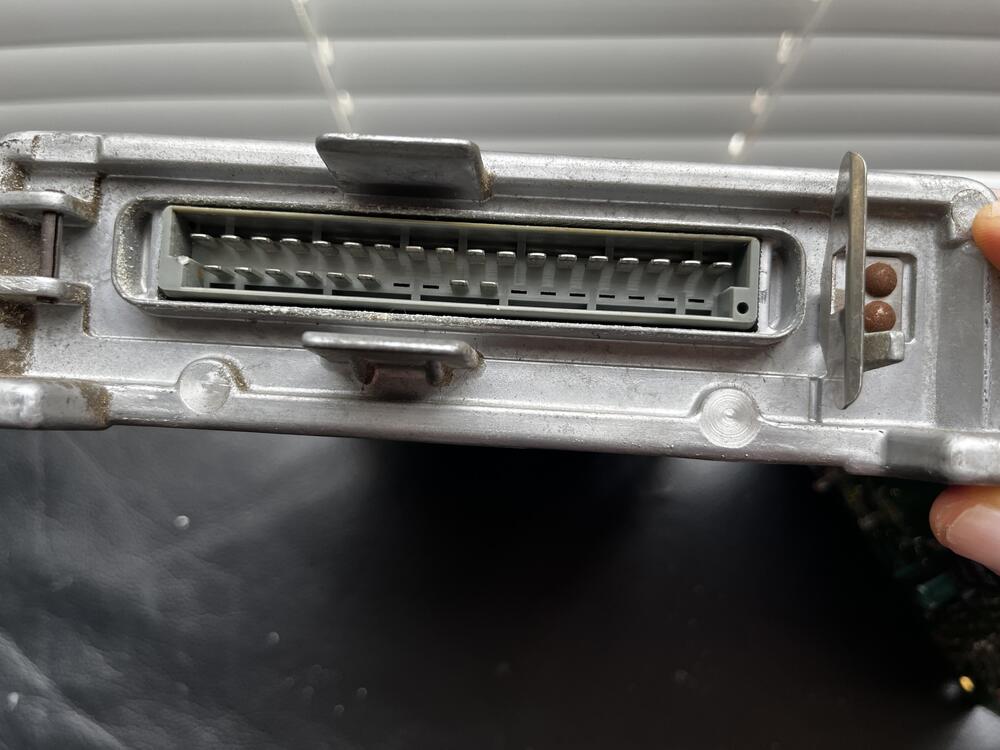
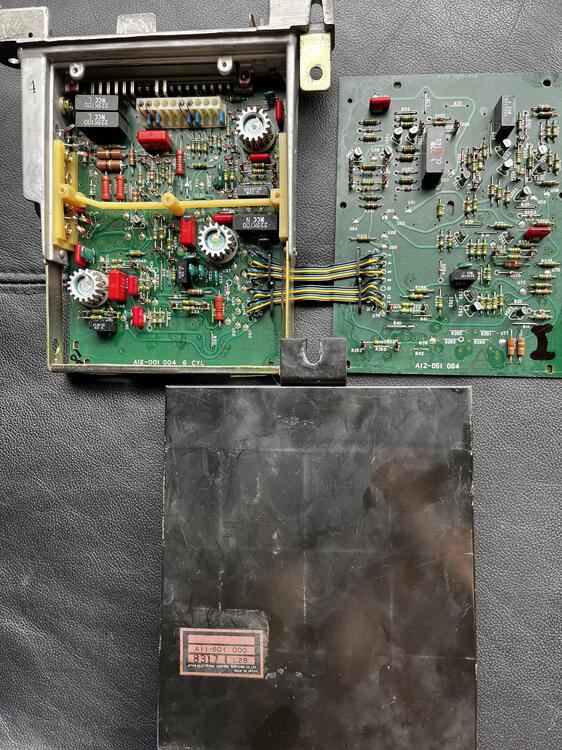
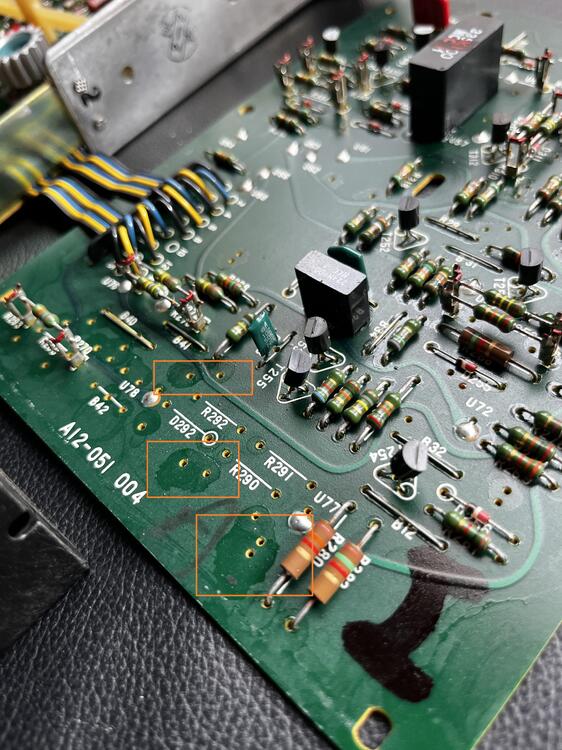
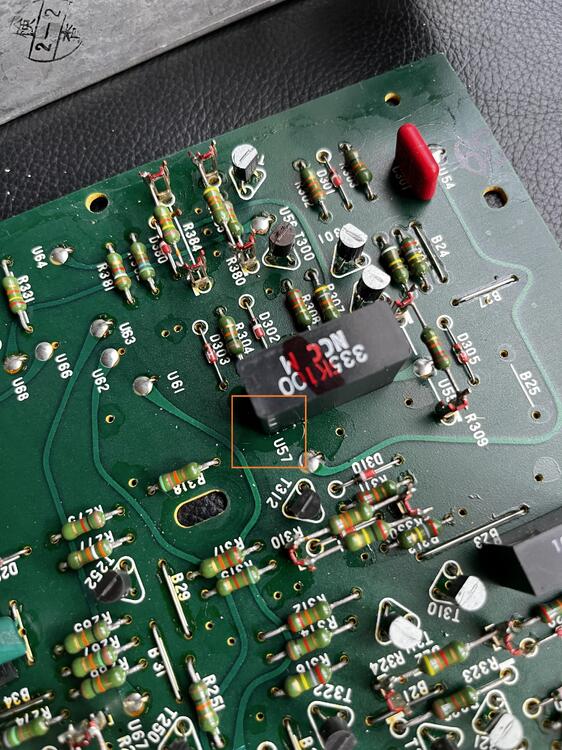
Hi gang, So I took the car out last night and noticed it's no longer idling at 14.2 but way up at 14.6 - 14.7 and is also weaker once it's in 'cruise mode' (tab not touching the idle enrichment or full-throttle pin in the TPS) than before the shut-off incident even though I hadn't changed anything. In the past, moving the AFM's black gear 1-tooth to the lean side of the original factory position gets the idle to 13.8, turning another tooth (now 2-teeth past original position) gets you a 14.2 idle, and 3-teeth gets you a 14.7 idle. Interestingly, while I moved the black gear back to 1-tooth past original positioning, I get 13.8, but 2-teeth now goes to 14.7 at idle (instead of 14.2 how it behaved in the past when running properly). I popped open the current ECU and nothing crazy jumps out at me (see below pics) damage-wise. That said, I did notice there is some clear stuff (looks like transparent glue) coming from one of the chips and each of the holes that don't have chips soldered through them have some sort of shiny polish to them (boxed in orange on the final two below pics). None of those things I noticed look fresh at all however (something that happened within the past week when the shut-off occurred). EDIT: I remember last night noticing the dip stick wasn't fully in - when I popped it fully in, the car went down and idled at 14.2 for maybe 20 seconds but went back to 14.7 after that. I plugged the hole with my finger just to be sure it wasn't the dipstick's seal or it popping out, but noting changed and sat at 14.7 again so that must have been a fluke. Any ideas?
-
Good suggestion - I just checked and they're tight and free of corrosion since the last time I sanded them.
-
Arg, that's not what I wanted to hear haha
-
Interesting. I wonder if auto used additional sensors like for the full-throttle kickdown function.