chaseincats
Community Member
-
Joined
-
Last visited
Everything posted by chaseincats
-
Vacuum theory question for you. I was looking at the atlanticz vacuum measurement page and gave their test a shot. At idle with 10 degrees btcc timing per the FSM I'm sitting at around 16.25 lb of vacuum. The only way to get it into the 17-22 range (in this case to 17) is to advance the timing to 15 degrees at idle while configured to run at 800 rpm at idle. My question is, is vacuum lbs something to pursue or is it just a measurement. Basically asking should I leave my idle timing at 15 degrees so I can have 17 lbs of vacuum or put it back to 10 because vacuum is just a measurement for engine health and not a tuneup configuration point in the FSM like timing, valve lash, etc?
-
Good catch on the pitting but luckily that's just oil that had a couple of small bubbles in it from when I took the cap off (but you definitely did make me look twice haha). Since the car got a well needed oil change tonight, and in the interest of keeping as much of that oil in the engine as possible, I came up with an interim solution which I think should work: I grabbed some thick gasket paper and made a ring seal, placing it basically on top of the old rock hard one and being sandwiched between the oil cap and valve cover until I can find a replacement.
-
Arg I wonder if I am able to get the old one out, if I can just take it to home depot and says 'what fits in here'? haha
-
thezstore has replacement seals, you're just paying 20 bucks shipping for a 2 dollar piece of rubber
-
Yea the whole thing is powder coated minus the lettering of course. You might be right about that but what's done is done I guess.
-
Wow really? I'll get a flat head and hammer and try to bash it out or something tonight then. Could I just go to home depot and grab a thick oring if they have it in its stead? I really don't want to spend $20 to ship a 2 dollar part from thezstore haha
-
Both of my AFMs have been 5-pin so that makes sense as to why both have screws then
-
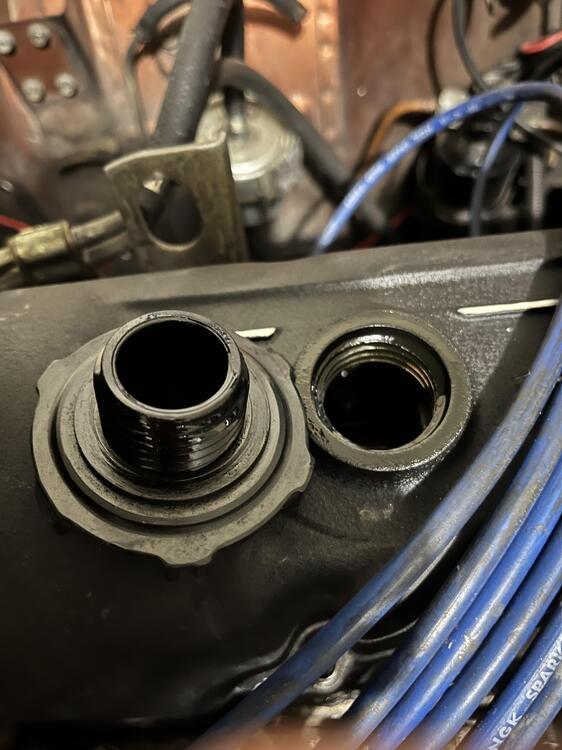
Just pulled the oil cap and it seems like there's neither an indentation on the valve cover nor in the oil cap. What looks like a seal is molded plastic and you can see on the lip where oils been sneaking out. I pulled my PCV valve and it's good - also the valve cover breathing hose is hooked up to the AFM boot so there shouldn't be any pressure building up in the valve cover to the point it would be blowing out of the cap which is what's really confusing...
-
I'm assuming all of ours have just hardened over the years and are no longer sealing
-
I'll give it a look tonight then and report back
-
I do but I closed it up. I can crack it open tonight and grab some pics.
-
Unless I never noticed because it's rock hard rubber. I'll check tonight and report back.
-
The PCV valve is only a couple years old but I can check tonight. My cap absolutely does not have an O ring...I'll go to oreillys tonight.
-
wtf mine didn't give access like that...maybe they're different per year?
-
Unfortunately that's correct
-
Hi gang, Got a weird one for you today. It seems oil is somehow sneaking out of my valve cover's oil cap even though it is VERY tightened down. There is definitely a thin oil trail coming out of it and running further back on the top of the valve cover. The outlet for the valve cover breather hose also seems to be moist around the base of that L-fitting. Any idea how this is even possible? My oil pressure gauge is showing maybe 2/3s of the way up while driving and sits at around 1/4 at a traffic light so the pressure in there isn't anything out of the ordinary. I didn't think the oil caps had gaskets on the top, did they?
-
I actually did on the one with the wobbly arm just for the hell of it since it was useless in its current state. Taking the back plate off surprisingly does nothing except give you access to the idle air mixture bypass passage to clean it if memory serves. I remember opening it and being really confused how the sweeper arm is actually removed since I was sure that's how the rebuilders do it but no dice.
-
Anyone? Maybe I'm not understanding this
-
To tune the car with the air fuel gauge I leaned the car out 3 teeth on the black gear. Adding the potentiometer, being a resistor, would only serve the purpose of richening the car, right? So in theory, to modify the curve with the potentiometer, I’d need to first lean the car out a few more teeth on the AFM before I could successfully get some wiggle room to richen it, right? As I understand it, plugging the potentiometer in and turning the dial to the smallest level of resistance would essentially be as lean as I could make the car without messing with the AFM, correct?
-
I messed with mine when tuning it with an air fuel gauge but marked all the original positions so I could reset it when I try this...
-
Why is this better than messing with the afm out of curiosity?
-
This can only be used to richen the mixture not lean it out though since it’s adding resistance to the temp sensor, correct?
-
Could you take a couple pictures of the installation instructions?
-
UPDATE: for all those having issues, give this test a shot: jack up a wheel and spin it - you may also have my issue which is the lugs not in the right way/wrong lugs/bad lug holes/out of round tires/etc because you can see in the below the video the tire not spinning uniformly. I did this for all 4 tires and swapped the best up front which helped my wobble by 80%. Going to try new lugs in a few weeks after travel though too video: https://youtube.com/shorts/OwrFAXh1hfY
-
UPDATE: I may be onto something here. I pulled one lug with the car on the ground (flat with washer style) and noticed even though the zx wheels are not acorn style, they were NOT keeping the hub stud centered in the wheel so even though the wheels/tires are balanced, they are not centered on the hub overall probably causing the shake. Thinking back, I tried my friends new wheels and tires with his acorn nuts years ago with no shake but tried my other friend's wheels a few weeks ago with my lugs and got a shake. I will get acorn style nuts within the next few weeks and see what happens, but I think we may be onto something here.