benn9090
Community Member
-
Joined
-
Last visited
-
IMPORTANT: When removing the brake booster, or installing a used one, it is critical that you do not pull out the engine-bay side pushrod of the brake booster. The so-called "reaction disc", which is a solid rubber disc about the diameter of a quarter, can fall off inside the booster. The result will very poor brake feel - you will have a deep spongy pedal and then all of the sudden you will get full braking and the car will stand on its nose. If this has happened to you: Pry the retainer ring out of the engine-bay-side of the booster, and pull the pushrod out. Turn the booster upside down and shake it until teh reaction disc falls out. Use some tacky grease on the pushrod to get the reaction disc back into its socket. All will be well again. Learned all this the very very hard way, Mark
-
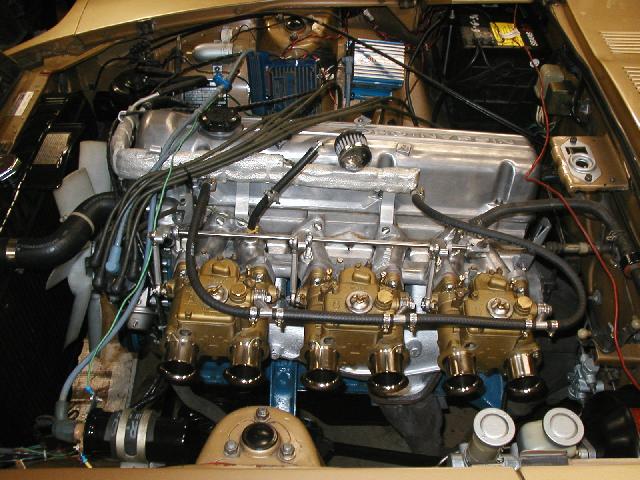
Rolf, thanks for the pointer to the "get rid of the jerk" link on ZHOME.COM. I need to accomplish something similar, although I may do it by cobbling the Weber linkage itslef as opposed to the Datsun linkage itself. BTW, here is a fantastic website regarding O2 sensors and using them for jetting purposes. www.wps.com/LPG/o2sensor.html Eric, I'm afraid I have a similar situation - though I ported the head, purchased a 274 cam, and installed the Webers and the N42 echaist manifold (as opposed to my crappy 260 manifold with smog ports), I have what amounts to a 5% power increase over my old DGV setup. Here's to hoping things improve if I dial things in a bit more precisely .... -Mark
-
New annoyance: Although I am using the longer carburetor throttle levers and the shorter holes on the main linkage shaft, I have still had to shorten my pedal stroke by 1.5" by lengthening the throttle stop under the pedal. The result is a very "hair-trigger" throttle. Is this simply the way things are, or is it possible my '74 has a different linkage ratio than the earlier Zs this kit was p;ossibly originally designed for? -MB
-
The new main jets made a big difference to the positive! I also connected the exhaust, although in a very ugly manner, and I also took an old used 02 sensor from my '85 Supra and temporarily installed it in the front pipe and strung a voltmeter into the cockpit. Eric, you might consider doing a similar trick. With all that done, the car runs pretty decent - only a slight stumble on progression, which according to the 02 sensor is lean - and I guess my experiience with this car and my intution say it is lean as well. Assuming I have the 02 sensor specs correct, steady-state cruise is close to stoichiometric, just a bit to the rich side, and WOT in 3rd and 4th gear is on the rich side. I guess I could try 50 pump jets in place of my 45s to try to cure the progression stumble - any comments? Eric- My fuel dribbling ended when I completed the exhaust connections! My theory is that reversion pulses from the crappy exhaust scavenging of an open header causes fuel to be spit back in the venturi and it creeps out between the air horn and the body. I have been told that poor synchronization will cause the same. By the way, there is a Synchrometer on EBAY for bidding for $36 (new would be about $70) ....http://cgi.ebay.com/ebaymotors/ws/eBayISAPI.dll?ViewItem&item=1841962591... .... and here is a good website about DCOEs http://www.cruzers.com/~twakeman/TR/WeberDCOEinfo.htm Alan - GOOD POINT about the mechanical pump requiring a lot of time to replenish the bowls. I agree Eric should remove the mechanical pump. Other questions: 1.) Is anyone running vac advance? 2.) PCV solutions - currently I have a breather filter on the intake (valve cover) and a long rubber pipe on the outlet (crankcase) that vents low in the engine bay back by the firewall (under the brake booster). Any other ideas? Regards, and sorry for the long posts .... Mark
-
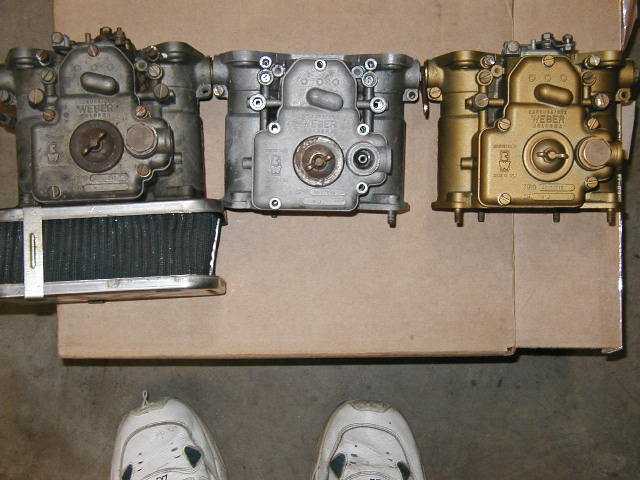
Eric- Your '73, like my '74, came from the factory with BOTH mechanical (mounted on the head) and electric fuel pumps (mounted back at the tank). The factory manual claims the electric pump's purpose is to defeat vapor lock. The manual also claims that the electric pump only operates at startup and below 750 rpm. The pressure of the two pumps is not additive. In any case, as long as the fuel pressure is reasonable (~3 psi), this should have nothing to do with your inability to start the car. In my case I have the factory electric pump still at the tank, and a "Purolator"-style electric mounted on the right front strut tower along with the regulator. I cannot yet say whether I will ultimately have fuel starvation problems or not. Dave - My carbs are finished with Eastwood Carb Renew "Bronze", and I simply buffed the brass bits. Carb Renew is an aerosol fuel-resistant paint, essentially. You strip the carbs to bare bodies, soak in cleaner, wipe dry, plug the holes with rubber stoppers and simply spray away. One can of Carb Renew will barely do three DCOEs. You can use the leftover to touch up brake line brackets, hood prop rods, etc. -Mark Bennett
-
I think I found something. It looks like my main jets have been soldered and redrilled --
-
Alan- Just measured my accelerator pump strokes at ~9.5 mm, close to the 10 mm specified for the DCOE18s. Byunique- I *think* I read somewhere out on the Web (Redline? Carbs Unlimited?) that ~1-1/2 turns out is indeed correct for some series of Weber 40s - bit I fouhnd a spec for my 40DCOE 18s suggesting 1/2-3/4 turns as a starting point, and that is about where they idle best. My popping is out of the exhaust and happens on overrun - but again, I have just a sawed off head pipe at this time. I have never gotten a backfire out of the carb - well, at least not since I fixed that huge dizzy advance vacuum leak! Thanks guys - I appreciate you hanging in there with me. We'll get EricB running right too. -MB
-
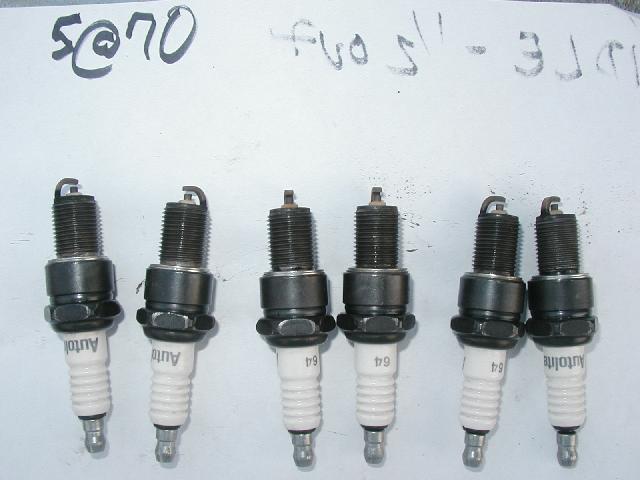
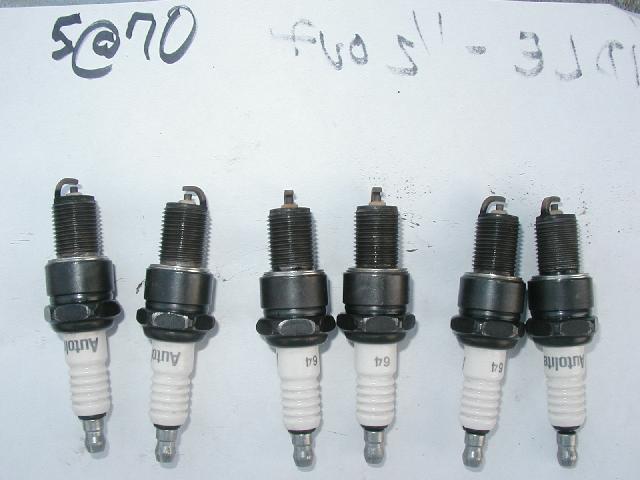
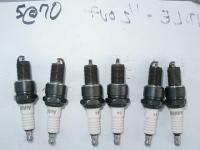
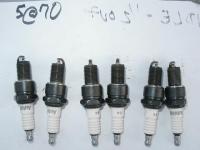
5 mins running at 70 mph/3200 rpm - plugs oriented such that darkest color faces camera. I also took pictures from 4th gear part-throttle acceleration, which burbles and barely accelerates ... they didn't come out, but they looked exactly like Haynes manuals tell you a healthy spark plug should look - though I feel it must have been rich as hell! -MB
-
5 mins running at 70 mph/3200 rpm - plugs oriented such that darkest color faces camera. I also took pictures from 4th gear part-throttle acceleration, which burbles and barely accelerates ... they didn't come out, but they looked exactly like Haynes manuals tell you a healthy spark plug should look - though I feel it must have been rich as hell! -MB
-
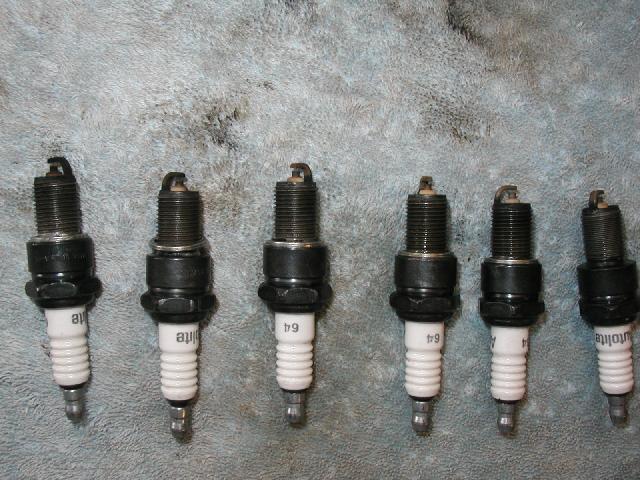
An example of my plugs after idling for 5 minutes. Idle mixtures at 3/4 out. Resultant action taken was 1/4 turn in on #6 (left most) and 1/8 turn on #5 (second from left).

-
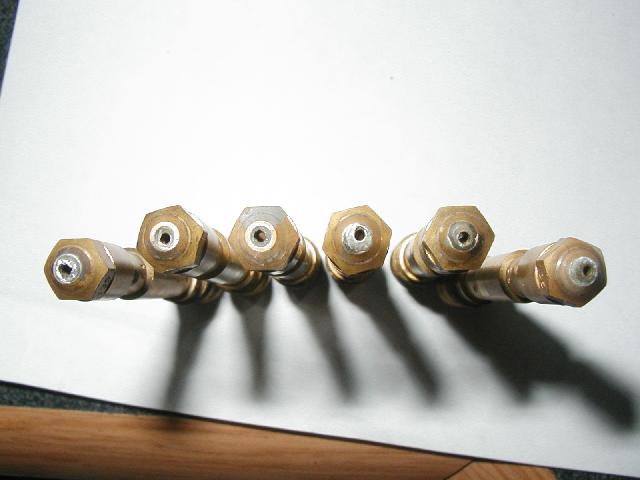
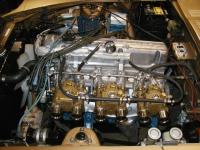
No, its true I don't have the full exhaust hooked up. I was a little afriad to turn over my 6-barrel flamethrower to the exhaust shop with no brakes. I have unspeakable brake problems, but as a brake engineer I'm hoping I can fix them without requiring assistance from Europe . I would be happy to take my car to a dyno and have an expert such as the one you describe work on my car - unfortunately, I don't believe such a Weber expert exists for more than 1000 miles. I did some road testing at fixed RPMs, but the results were inconclusive. I'm afraid the ultra-hot Jacobs ignition is burning the plugs clean even though I feel am richer than hell. I should say, my needle valves could very well be what you describe (1.75 v. 2.00) - to clarify, those parts that are MARKED I checked with the manual and found them to be the same as those (hence alleviating me from having to write them down somewhere). EricB is probably eating and socializing with family for the July 4 celeb!!! Some pics to follow. -Mark
-
Thanks Phred - I reseated the throttle valves and that helped the Syncing a little. I don't think I had a vac leak at the o-ring gaskets (I sprayed ether at the joint and the engine didn't do anything). Jetting advice anyone??? -Sync'd with Synchrometer -Idle mixture at 3/4 turn out Jets are "stock", as listed in Haynes manual Chokes 30mm Aux venturi 4.5 Main 1.30 Emul tube F2 Air corrector 1.75 Idle jet 0.50F9 Accel pump jet 0.45 Accel pump inlet valve with exhaust orifice 0.55 Needle valve 2.00 Starts fine. Must progress with throttle VERY SLOWLY to keep from dousing the spark. If you push the gas down a little too fast it bogs and burbles. If you push faster it actually stops running for a second (but doesn't backfire). This is my first DCOEs, but it sounds like pump jets. Plugs looked reasonable - but they have seen perhaps 45 minutes cumulative of idling, 15 minutes of cruising, and only 10-20 shifts and transitions where it burbles and bogs. Thanks for any help, Mark
-
Alan, Phred, others that may know what the @#$%@ they are doing- Many questions, perhaps when Eric and I both have our cars running nicely we can compile this mess into a nice FAQ: 1.) Got my Synchrometer today! - With flow differences from one carb barrel to the next (within a given carb body), is the wise choice to average the two readings in order to match with the other 2 carbs? 2.) Is it typical to have barrel-to-barrel differences? I can imagine such differences being due to valve timing differences, compression differences, and/or a twisted throttle shaft. My data: Cyl# 1 2 3 4 5 6 compression psig 145, 145, 139, 150, 142, 150. flow (kg/m^3) 5.2 4.8 6.5 4.8 5.5 5 As you can see, my biggest compression difference is between #3 and #4, which is also the carburetor with the largest flow difference. I read somewhere it is typical to sync off the front barrel only. Any advice or comments???? -Mark Bennett Cleveland, OH (<-- nobody knows what a Weber is around here)
-
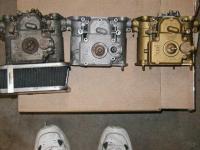
Got around to reading your questions more carefully - as for setting the float level, I try not to bend the float arms themselves much at all, but only the tabs. I take the float off and bend the short arm (for the level) and the long arm (for the droop) toward each other just a little too far, then I put the float back on the lid and flex things around until it matches the specs. I used drill rod of 5/16 (level) and 9/16 (droop) because I don't have metric drills. With these I iterated back and forth to set the levels. I takes perhaps 5 minutes per carb if you remove the lids and work on a nice bench. My carbs are brass-float 40DCOE18s on a Cannon manifold. All the jets and other calibrated parts match what the Haynes Weber book lists as the parts included with the stock Weber conversion kit. Engine is L26, mild port/polish on E88 head, mild Schneider 274 cam, N42 280Z exhaust manifold and head pipe only (like you, I do not have the exhauist fabbed yet). I have the stock 260Z fuel rail (2 outlets) and I have the return line hooked up. Alan seems to think this is not optimal, but I am telling you this only because my car starts and so I don't think it is your main problem. I have the stock electric pump and a Purolator style electric pump in the engine bay, the mechanical pump removed, and the regulator set to 3 psi. Not optimal, but again my car starts OK. My floats levels are set, but the car started even when they were WAY off. My idle screws are 3/4 turns out. The car starts no problem without the starter valves, much like Alan described - 2 pumps and 30 seconds of nannying the throttle. My timing is 10 deg BTDC with vacuum advance disabled. I have done no synchronizing, jetting or mixture adjustements yet. Things that made the car NOT START until I fixed them: -Weak stock ignition coil -Vacuum leak through the distributor advance dashpot. I would block off both brake booster and dizzy vacuum just to make sure. I have the unpreferred o-ring style gaskets, but I got new O-rings and used elastic stopnuts ordered from www.McMaster-Carr.com. At all times the car at least popped and fired, however. -Mark
-
E- Skimmed your message very very quickly, but in regard to your fuel dribbling, I suspect your fuel pump may be overpowering the Weber's float valve with too much pressure. I believe the books will recommended you use 2.5-3.5 psi, and the typical way to do this is with a fuel pressure regulator. The regulator is a chrome dial affair, adjustable from 1-5 in .5 psi increments - should cost about $28, brand names are Purolator or Fuel-Pro. I am a few steps ahead of you in the same process - my Webers are installed and running, but I have to get the @!#$% brakes working before I can do any serious road testing and jetting. FYI, if you decide to tear down and rebuild, I found that Pierce Manifolds had the best prices on rebuild kits. Regards, Mark Bennett '74 260Z '85 Supra '93 Supra TT